
Opening your dashboard
Class 8 Biology Chapter 4 Ecosystems: Competency-Based Questions (CBQ)
40 questions on Chapter 4, each worked through on its own page with the AI tutor. Class 8 Biology, ICSE 2026-27.
40 questions
1–5 marks · Mixed difficulty
- 11 mark
Question 1
Cognitive domain: Application
The students of an Eco Club put fruit and vegetable peels from the school kitchen into a pit in the garden and covered them with a layer of moist soil. After some weeks the peels could no longer be seen. In their place was a dark, crumbly material, and the plants growing near the pit looked greener than the others. Which organisms mainly brought about this change, and what was their role ?
- 21 mark
Question 2
Cognitive domain: Analysis
The figure shows the pyramid of numbers for a forest in which the only food chain studied was grass deer tiger. The three bars are marked P, Q and R.
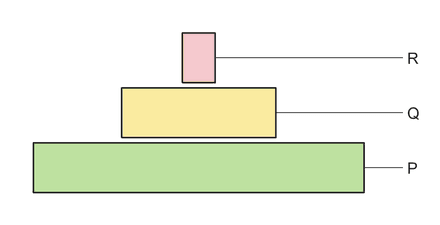
Which bar stands for the deer, and why is bar R the narrowest ?
- 31 mark
Question 3
Cognitive domain: Application
A bulbul feeds on the juicy berries of a tree in a forest. The seeds pass out unharmed in the bird's droppings, far away from the tree, and new seedlings come up there. Which relationship between the bulbul and the tree does this show ?
- 41 mark
Question 4
Cognitive domain: Analysis
A wildlife photographer made notes in three forests of India but forgot to write the type of each forest.
Forest Plants noted Animals noted X fir and pine trees very few animals; squirrel, robin, sparrow Y teak, sal and sandalwood trees deer, wolves, foxes, moths, beetles Z evergreen trees, bamboos, ferns monkeys, flying squirrels, leopards, snails, many insects Which option names the three forests correctly ?
- 51 mark
Question 5
Cognitive domain: Understanding
Assertion (A): An owl that can feed on rats, rabbits and beetles is more likely to survive a bad year than an animal that can feed on only one kind of prey.
Reason (R): A food web permits alternative foods, so an organism can still get food when one of its food sources becomes scarce.
- 61 mark
Question 6
Cognitive domain: Analysis
Assertion (A): Earthworms and millipedes are decomposers.
Reason (R): Decomposers such as bacteria and fungi cannot ingest dead matter directly; they absorb the nutrients that result from its breakdown.
- 71 mark
Question 7
Cognitive domain: Application
Mr Khan had rice and dal for lunch. For dinner he had mutton curry made from the meat of a goat that had been fed on maize.
Complete the sentence :
In the food chain of his lunch Mr Khan was a ______ consumer, but in the food chain of his dinner he was a ______ consumer.
- 81 mark
Question 8
Cognitive domain: Understanding
After a landslide, a steep slope high up in the Himalayas was left as bare soil. No stream flows over it and no animals were seen visiting it. Yet, two years later, young pine seedlings were growing on it. The nearest pine trees stand on the next hill.
Complete the sentence :
The seeds most probably reached the slope with the help of ______, which is an ______ component of the ecosystem.
- 91 mark
Question 9
Cognitive domain: Application
A forest reserve has 30 tigers. Suppose that each tiger eats about 50 deer in one year and that the tigers eat nothing else.
Complete the sentence :
The tigers of this reserve eat about ______ deer in a year, so in the pyramid of numbers the bar for deer has to be much ______ than the bar for tigers.
- 102 marks
Question 10
Cognitive domain: Evaluation
A new officer wants to keep a forest "neat and clean". He orders his staff to collect and take away all the fallen leaves, dead branches and the bodies of dead animals every week. He also has the vultures and crows chased away.
Is this a good decision for the forest ecosystem ? Justify your answer with two reasons.
- 112 marks
Question 11
Cognitive domain: Application
In a small town, many people used to fall ill with malaria every year. The health workers started a programme to control mosquitoes in the town. Within two years, the number of malaria cases fell sharply, even though nothing was done to kill the malarial parasite itself.
(a) Name the malarial parasite. What kind of relationship does it have with a human being ?
(b) Explain why controlling mosquitoes brought down the number of malaria cases.
- 122 marks
Question 12
Cognitive domain: Understanding
The students of a school near the Jaldapara Sanctuary are making a poster with the title "Save the Rhinoceros". Their teacher says, "You cannot save the rhinoceros alone. You have to save its whole forest — the trees, the grasses, the river and the other animals."
Explain why the teacher is right. Give two points.
- 135 marks
Question 13
Cognitive domain: Analysis
Case: Students studied the feeding relationships of eight kinds of organisms living at the edge of a forest and drew the food web shown below. An arrow points from the organism that is eaten to the organism that eats it.
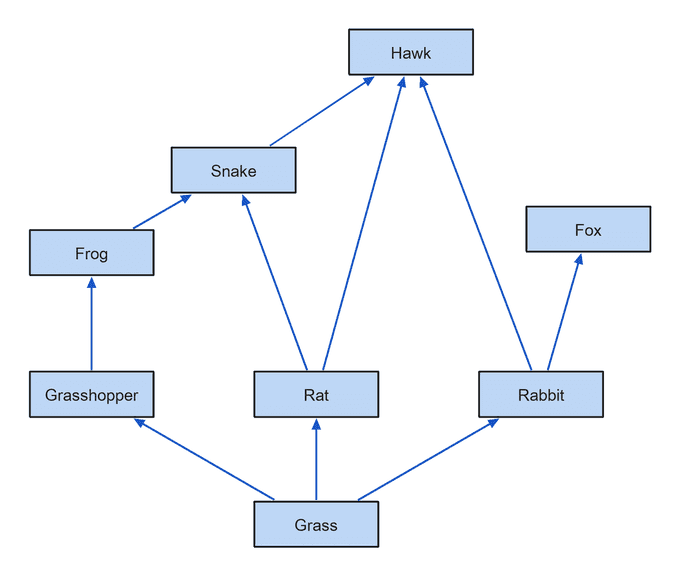
(a) Write the longest food chain in this food web. Name the trophic level of the hawk in this chain.
(b) The snake does not stay at one trophic level. Write two food chains from the web that show this, and state the snake's trophic level in each.
(c) A disease kills all the frogs. Predict the effect on the number of grasshoppers. Will the snakes die out ? Give a reason for each answer.
(d) If, instead, all the grass dries up in a long drought, what will finally happen to the hawks ? Explain.
- 145 marks
Question 14
Cognitive domain: Evaluation
Case: In a forest reserve, tigers were being killed illegally by hunters. The forest department counted the tigers and the deer every five years. It also measured how much of the ground was covered with grass.
Year Tigers Deer Ground covered with grass 2005 20 900 80 % 2010 8 1900 55 % 2015 3 2600 25 % 2020 2 1100 10 % In 2015 a villager said, "Fewer tigers is good news. There are more deer now, so the forest is getting richer."
(a) By how much did the number of deer rise from 2005 to 2015 ? Explain this rise.
(b) Explain why the grass cover kept on falling. By how much did the number of deer fall from 2015 to 2020, and why ?
(c) Judge the villager's statement, using the figures for 2020.
(d) Suggest one step that should be taken to restore this ecosystem, and justify it.
- 154 marks
Question 15
Cognitive domain: Creativity
Case: Behind the school building there is a quiet corner of the garden with a few old trees, grass, fallen leaves and a small puddle. The Eco Club wants to study this corner as a small ecosystem. The members have notebooks, a thermometer, a hand lens and a measuring tape. They have agreed only to watch the animals and not to catch or disturb them.
(a) Plan the study. List three abiotic and three kinds of biotic things the members should look for, and say how they will record each.
(b) Draw a record sheet (table) that the members can fill in during their visit.
(c) Suppose they find grass, grasshoppers, a garden lizard, crows, earthworms and mushrooms. Make one food chain of four organisms from this list, with the trophic level of each. State the role of the two organisms you did not use.
- 161 mark
Question 16
Cognitive domain: Analysis
Four groups of students made a display for the school science fair. Which display shows an ecosystem ?
- 171 mark
Question 17
Cognitive domain: Analysis
The figure shows the food web of a paddy field. An arrow points from the organism that is eaten to the organism that eats it.

How many different food chains in this web end with the eagle ?
- 181 mark
Question 18
Cognitive domain: Analysis
The figure shows the mass of all the living matter at each level of the food chain grass deer tiger in a forest patch. (Hypothetical data.)
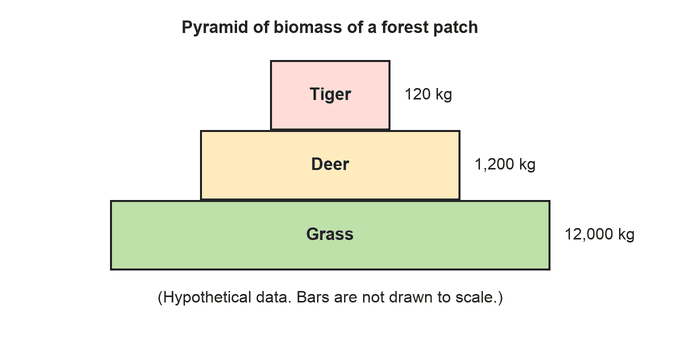
Which conclusion about this pyramid of biomass is correct ?
- 191 mark
Question 19
Cognitive domain: Understanding
A student digs a small pit in a forest floor. In the soil she finds tree roots, an earthworm swallowing mud, the burrow of a rat, white threads of a fungus and a little water with dissolved minerals. Which statement about soil as a component of the ecosystem is correct ?
- 201 mark
Question 20
Cognitive domain: Understanding
Assertion (A): A house sparrow that eats a seed of grass is as much a predator as a tiger that eats a deer.
Reason (R): A predator is an organism that catches and kills other organisms for food, and eating a seed kills the living young plant inside it.
- 211 mark
Question 21
Cognitive domain: Analysis
Assertion (A): Water is an abiotic component that is needed only by animals.
Reason (R): Plants take up the water that rain adds to the soil.
- 221 mark
Question 22
Cognitive domain: Application
A farmer's sunflower plants grew tall and flowered well, but the crop of seeds was very poor. In the same season the beehives that used to stand at the edge of the field had been moved far away. Which statement best explains the poor crop ?
- 231 mark
Question 23
Cognitive domain: Recall
Which of the following describes the Jaldapara Sanctuary correctly ?
- 241 mark
Question 24
Cognitive domain: Application
The Eco Club of a school on the plains wants to plant fir and pine saplings brought from a hill nursery on the school playground. What is the most likely result ?
- 251 mark
Question 25
Cognitive domain: Evaluation
At a meeting a council member says, "Our town's growth is worth any damage to the nearby forest and river, because nature will put itself right again." Which reply is best supported by the chapter ?
- 262 marks
Question 26
Cognitive domain: Application
Meena covers a small patch of grass in the school garden with a large black plastic sheet. She leaves a patch next to it uncovered. After ten days she lifts the sheet.
Predict what she will see on the covered patch, and explain it.
- 272 marks
Question 27
Cognitive domain: Analysis
A student noted what four animals were seen eating in a field.
Animal What it was seen eating Crow grains of rice, small insects and the body of a dead rat Rabbit grass and carrot leaves Fox rabbits and field mice Pigeon grains of wheat (a) Classify each animal as a herbivore, a carnivore or an omnivore.
(b) Which animal also acts as a scavenger ? Give the reason.
- 282 marks
Question 28
Cognitive domain: Evaluation
A student writes, "In a forest only the big trees are producers. The grasses and the small bushes are too small to make food, so they are not producers."
Is the student right ? Give two reasons for your answer.
- 292 marks
Question 29
Cognitive domain: Application
The human liver fluke lives in the human liver and feeds there. Its eggs pass out of the body and develop first inside a pond snail. The young stage that leaves the snail then enters a fish, and a person gets the fluke by eating raw or undercooked infected fish.
(a) Why is the liver fluke called a parasite ?
(b) A village pond has no snails at all. Could fish that grow only in this pond pass the fluke on to people ? Explain.
- 302 marks
Question 30
Cognitive domain: Understanding
The book says that predation is nature's way of transferring energy.
Explain this statement with the help of the food chain grass deer tiger.
- 312 marks
Question 31
Cognitive domain: Evaluation
An officer says, "Both the Gir Forests and the Jaldapara Sanctuary are forests of India, so we can simply release rhinoceroses from Jaldapara into the Gir Forests."
Evaluate the officer's plan with the help of the chapter.
- 323 marks
Question 32
Cognitive domain: Analysis
Case: A student buried g of dried fallen leaves in each of three pits of the same size. After four weeks the leaf pieces left in each pit were dug out, dried and weighed. (Hypothetical data.)
Pit Soil used Leaf left after 4 weeks A Moist garden soil g B Dry garden soil g C Moist garden soil that had been boiled and cooled g (a) Find the percentage of the leaves that was lost in pit A and in pit B.
(b) What does the result in pit C show about the way in which the leaves disappear in pit A ?
(c) Write one conclusion from the three results about the conditions needed for the leaves to disappear.
- 333 marks
Question 33
Cognitive domain: Understanding
The soil of a forest contains mineral nutrients such as potassium and calcium. A tiger of the forest also needs them.
(a) The tiger does not eat soil or plants. Explain how the plants still make these nutrients available to it.
(b) Write the food chain through which the nutrients reach the tiger.
(c) Predict what would happen to the deer and to the tiger if the plants of the forest stopped taking nutrients from the soil.
- 343 marks
Question 34
Cognitive domain: Analysis
Case: A farmer divided young goats of the same age into two groups of . Each goat of group A was given a medicine against intestinal worms (parasites). The goats of group B were given no medicine. Both groups were fed in the same way. The average mass of a goat in each group was noted. (Hypothetical data.)
Group Average mass at the start Average mass after 8 weeks A (medicine) kg kg B (no medicine) kg kg (a) Find the average gain in mass in each group and the difference between them.
(b) Explain the difference with the help of the relationship between a parasite and its host.
(c) Why did the farmer need group B, which was given no medicine ?
- 353 marks
Question 35
Cognitive domain: Analysis
Case: A student kept chilli seeds on moist cotton in four boxes at different temperatures. The number of days that the seeds took to sprout is given below. (Hypothetical data.)
Temperature Days taken to sprout No sprouting in days (a) How many days sooner did the seeds sprout at than at ?
(b) Which temperature is the best of the four ? Can the student say that it is the best temperature for chilli seeds ? Explain.
(c) Which abiotic component of the ecosystem does this experiment study, and what does it show about it ?
- 363 marks
Question 36
Cognitive domain: Creativity
For World Environment Day, Ravi will give a two-minute talk at the school assembly about the river that flows past the school.
Plan his talk:
(i) a title of not more than eight words;
(ii) two points from this chapter that explain why the river must be protected;
(iii) one thing that the students themselves can do.
- 374 marks
Question 37
Cognitive domain: Application
Case: In a mango orchard, small insects called mango hoppers suck the sap from the young leaves and flower stalks of the mango trees. Garden lizards on the tree trunks feed on the hoppers, and a shikra (a small hawk) sometimes catches a garden lizard. A worker of the orchard once fell ill with malaria after being bitten by an infected mosquito.
(a) Write a food chain of four organisms from the passage. Give the trophic level of each organism.
(b) Name the relationship between (i) the shikra and the garden lizard, and (ii) the malarial parasite and the worker. In each case say who gains and who loses.
(c) The tall trees near the orchard, where the shikras used to perch, are cut down, and the shikras stop coming. Predict what will happen, one step after another, to the number of garden lizards, the number of hoppers and the mango trees.
- 384 marks
Question 38
Cognitive domain: Evaluation
Case: A worn-out grassland patch near a village was fenced off, so that cattle and woodcutters could not enter. Every year the volunteers recorded what they saw. (Hypothetical data.)
Year after fencing Ground covered by grass Kinds of insects seen Kinds of birds seen Deer seen (a) By how many percentage points did the grass cover rise from year to year ? How many times as many kinds of insects were seen in year as in year ?
(b) Explain, with the help of a food chain, why the kinds of insects and birds increased as the grass came back, and why deer were seen only from year .
(c) A villager says, "Fencing was a waste of time. We should have planted a few trees and left the rest." Evaluate this statement, using the table and the chapter.
- 395 marks
Question 39
Cognitive domain: Analysis
Case: Students studied one large peepal tree in the school garden. They counted the leaf-eating caterpillars on it and the insect-eating birds (bulbuls and mynas) that fed on these caterpillars. They used average masses from their teacher. (Hypothetical data.)
Organism Number counted Average mass of one Peepal tree kg of living matter Caterpillars g Insect-eating birds g (a) Write the food chain shown by the table, and give the trophic level of each organism.
(b) Describe the shape of the pyramid of numbers for this chain. Explain why it does not have the usual broad base.
(c) Find the total mass of the caterpillars and of the birds in kilograms. Using these and the mass of the tree, say whether the pyramid of biomass has a broad base, and give the reason.
- 405 marks
Question 40
Cognitive domain: Analysis
Case: A lichen is made of a fungus and a photosynthetic alga living together. The alga makes food by photosynthesis, and the fungus forms the body that holds the alga and keeps it moist. A student set up three patches on a bare rock exposed to sunlight and rain for one year. (Hypothetical data.)
Patch Organisms placed on the rock Result after one year 1 Lichen (the fungus and the alga together) Spread by mm and stayed green-grey 2 The alga alone Dried up and died in the dry days 3 The fungus alone Stopped growing and died (a) Name the type of relationship between the fungus and the alga in a lichen. How is it different from parasitism ?
(b) Which partner is the producer ? Explain why the fungus alone died on the bare rock.
(c) Explain the result of patch 2, and say what the three patches together show about the lichen.