
Question 473 marksMedium
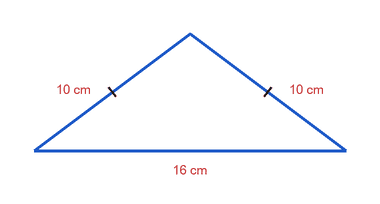
Find the area of an isosceles triangle whose base is 16 cm and length of each of the equal sides is 10 cm.
Confirming your payment
Sign up now and get 250 free tokens.
Mensuration · Question 47 of 83
Find the area of an isosceles triangle whose base is 16 cm and length of each of the equal sides is 10 cm.
Solution:
Concept: The area of a triangle is × base × height, where the height is the perpendicular from the opposite vertex to the base. In a right-angled triangle the two legs (the sides that form the right angle) are a base and its height. In an isosceles triangle, the perpendicular from the vertex between the equal sides bisects the base.
Step 1 — Draw the height.
In an isosceles triangle, the perpendicular from the top vertex to the base cuts the base into two equal halves of 8 cm each. Each half forms a right-angled triangle with hypotenuse 10 cm.
Step 2 — Find the height.
By Pythagoras theorem, height² = 10² − 8².
Step 3 — Find the area.
Now we use half base × height with base 16 cm.
Watch out: Use HALF the base (8 cm) in Pythagoras theorem, but the WHOLE base (16 cm) in the area formula.
Check: Heron's formula, with semi-perimeter 18 cm, gives . That is , or 48 cm², the same answer.
Therefore, the area of the isosceles triangle is 48 cm².