
Opening your dashboard
Class 7 Maths Chapter 23: Mensuration Solutions
83 textbook questions with step-by-step answers, free to read, for ICSE 2026-27.
Get talked through Ch 23, not just shown the answer
Reading a finished solution is not the same as being able to do it. The AI tutor takes one question at a time and works it with you, in your own words, until you can.
- Ask it out loud, in your own words
- It gives you the next step, not the answer
- Stuck on part (ii)? Start there
83 questions with solutions
1–3 marks · Mixed difficulty
The first 26 solutions are on this page. This chapter is a long one, so the rest open on their own page to keep this one quick to load.
- 13 marks
Question 1
The length and the breadth of a rectangular plot are 135 m and 65 m. Find, its perimeter and the cost of fencing it at the rate of ₹ 60 per m.
Solve with AIWritten solution
Solution:
Concept: The perimeter of a plane figure is the total length of its boundary. A rectangle has two equal lengths and two equal breadths, so its perimeter is , where is the length and is the breadth. A fence goes once round the boundary, so the length of fencing needed is the perimeter. The total cost is (length of fencing) × (rate per metre); read backwards, the length of fencing is (total cost) ÷ (rate per metre).
Step 1 — Find the perimeter.
The plot is a rectangle with m and m, so we use .
Step 2 — Find the cost of fencing.
The fence goes once round the plot, so 400 m of fencing is needed. Each metre costs ₹ 60, so we multiply 400 by 60.
So the fencing costs ₹ 24,000.
Watch out: Add the length and the breadth before doubling; (335 m) forgets the second breadth.
Therefore, the perimeter of the plot is 400 m and the cost of fencing it is ₹ 24,000.
- 23 marks
Question 2
The length and breadth of a rectangular field are in the ratio 7 : 4. If its perimeter is 440 m, find its length and breadth.
Also, find the cost of fencing it at ₹ 150 per m.
Solve with AIWritten solution
Solution:
Concept: A ratio compares two quantities by division, and it does not change when both terms are multiplied or divided by the same non-zero number. If two quantities are in the ratio , we may write them as and for some positive number . The perimeter of a plane figure is the total length of its boundary. A rectangle has two equal lengths and two equal breadths, so its perimeter is , where is the length and is the breadth. A fence goes once round the boundary, so the length of fencing needed is the perimeter. The total cost is (length of fencing) × (rate per metre); read backwards, the length of fencing is (total cost) ÷ (rate per metre).
Step 1 — Write the sides using the ratio.
Length : breadth is 7 : 4, so we take the length as m and the breadth as m. The perimeter is 440 m, which gives an equation in .
Step 2 — Find the length and the breadth.
Now we put into and .
Step 3 — Find the cost of fencing.
The fence runs along the whole perimeter of 440 m, at ₹ 150 per metre.
So the fencing costs ₹ 66,000.
Watch out: 7 and 4 are not the sides themselves; they only give the ratio. Check: is 440 m, as given.
Therefore, the length is 140 m, the breadth is 80 m and the cost of fencing is ₹ 66,000.
- 33 marks
Question 3
The length of a rectangular field is 30 m and its diagonal is 34 m.
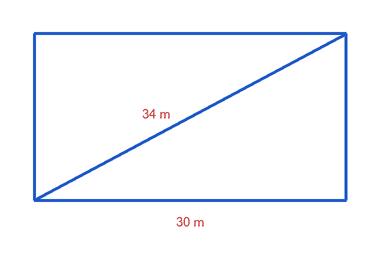
Find the breadth of the field and its perimeter.
Solve with AIWritten solution
Solution:
Concept: A diagonal divides a rectangle into two right-angled triangles. In each one the diagonal is the hypotenuse, so by Pythagoras theorem, (diagonal)² = (length)² + (breadth)². The perimeter of a plane figure is the total length of its boundary. A rectangle has two equal lengths and two equal breadths, so its perimeter is , where is the length and is the breadth.
Step 1 — Find the breadth.
The diagonal (34 m) is the hypotenuse of the right-angled triangle formed with the length (30 m) and the breadth, so breadth² = diagonal² − length².
Step 2 — Find the perimeter.
Now m and m, so we use .
Watch out: Subtract the squares, then take the square root; m is not the breadth.
Therefore, the breadth of the field is 16 m and its perimeter is 92 m.
- 43 marks
Question 4
The diagonal of a square is cm.
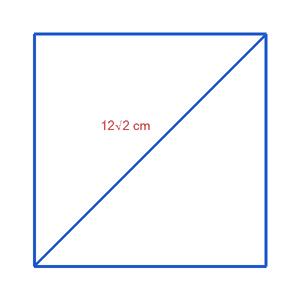
Find its perimeter.
Solve with AIWritten solution
Solution:
Concept: A square has four equal sides, so a square of side has perimeter . Read backwards, the side of a square is its perimeter divided by 4. By Pythagoras theorem, the diagonal of a square of side is .
Step 1 — Find the side.
A diagonal of a square of side is . Here it is cm, so we compare the two.
Step 2 — Find the perimeter.
A square has four equal sides, so its perimeter is 4 times the side.
Watch out: The diagonal is not a side; cm would be four diagonals, not the perimeter.
Therefore, the perimeter of the square is 48 cm.
- 53 marks
Question 5
Find the perimeter of a rectangle whose length = 22.5 m and breadth = 16 dm.
Solve with AIWritten solution
Solution:
Concept: The perimeter of a plane figure is the total length of its boundary. A rectangle has two equal lengths and two equal breadths, so its perimeter is , where is the length and is the breadth. Both sides must be in the same unit before we add them.
Step 1 — Bring both sides to metres.
The length is in metres and the breadth in decimetres, so we change the breadth to metres first. Since 10 dm make 1 m, 16 dm is 16 ÷ 10 = 1.6 m.
Step 2 — Find the perimeter.
Now m and m, so we use .
Watch out: Never add 22.5 and 16 directly; mixes metres with decimetres and means nothing.
Therefore, the perimeter of the rectangle is 48.2 m.
- 63 marks
Question 6
Find the perimeter of a rectangle with length = 24 cm and diagonal = 25 cm
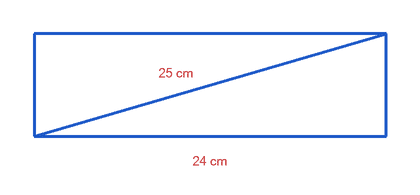 Solve with AI
Written solution
Solution:
Concept: A diagonal divides a rectangle into two right-angled triangles. In each one the diagonal is the hypotenuse, so by Pythagoras theorem, (diagonal)² = (length)² + (breadth)². The perimeter of a plane figure is the total length of its boundary. A rectangle has two equal lengths and two equal breadths, so its perimeter is , where is the length and is the breadth.
Step 1 — Find the breadth.
The diagonal (25 cm) is the hypotenuse of the right-angled triangle with the length (24 cm) and the breadth, so breadth² = diagonal² − length².
Step 2 — Find the perimeter.
Now cm and cm, so we use .
Watch out: The diagonal is not a side of the rectangle; use it only to find the breadth.
Therefore, the perimeter of the rectangle is 62 cm.
- 73 marks
Question 7
The length and breadth of a rectangular piece of land are in the ratio of 5 : 3. If the total cost of fencing it at the rate of ₹ 48 per metre is ₹ 19,200, find its length and breadth.
Solve with AIWritten solution
Solution:
Concept: A fence goes once round the boundary, so the length of fencing needed is the perimeter. The total cost is (length of fencing) × (rate per metre); read backwards, the length of fencing is (total cost) ÷ (rate per metre). A ratio compares two quantities by division, and it does not change when both terms are multiplied or divided by the same non-zero number. If two quantities are in the ratio , we may write them as and for some positive number .
Step 1 — Find the perimeter.
The fence runs along the whole boundary, so the length of fencing (the perimeter) is the total cost ₹ 19,200 divided by the rate ₹ 48 per metre.
Step 2 — Write the sides using the ratio.
Length : breadth is 5 : 3, so we take the length as m and the breadth as m, and put them into .
Step 3 — Find the length and the breadth.
Now we put into and .
Watch out: The 400 m is the whole perimeter , not the sum .
Therefore, the length of the land is 125 m and its breadth is 75 m.
- 83 marks
Question 8
A wire is in the shape of a square of side 20 cm. If the wire is bent into a rectangle of length 24 cm, find its breadth.
Solve with AIWritten solution
Solution:
Concept: When a wire is bent into a new shape, its length does not change. So the perimeter (or circumference) of the new shape equals the perimeter of the old one. A square has four equal sides, so a square of side has perimeter . Read backwards, the side of a square is its perimeter divided by 4. The perimeter of a plane figure is the total length of its boundary. A rectangle has two equal lengths and two equal breadths, so its perimeter is , where is the length and is the breadth.
Step 1 — Find the length of the wire.
The wire first makes a square of side 20 cm, so its length is the perimeter of that square.
Step 2 — Find the breadth of the rectangle.
The same 80 cm of wire makes the rectangle, whose length is 24 cm. So must be 80, and we solve for the breadth .
Watch out: Halve 80 first: is 40 cm, so , not .
Therefore, the breadth of the rectangle is 16 cm.
- 93 marks
Question 9
If P = perimeter of a rectangle, l = its length and b = its breadth; find :
(i) P, if l = 38 cm and b = 27 cm
(ii) b, if P = 88 cm and l = 24 cm
(iii) l, if P = 96 m and b = 28 m
Solve with AIWritten solution
Solution:
Concept: The perimeter of a plane figure is the total length of its boundary. A rectangle has two equal lengths and two equal breadths, so its perimeter is , where is the length and is the breadth.
Step 1 — Part (i): find P.
We put length 38 cm and breadth 27 cm into .
Step 2 — Part (ii): find b.
Halving shows that is half the perimeter. So the breadth is half the perimeter minus the length; here the perimeter is 88 cm and the length is 24 cm.
Step 3 — Part (iii): find l.
In the same way, the length is half the perimeter (96 m) minus the breadth (28 m).
Watch out: In parts (ii) and (iii) halve the perimeter before subtracting the known side.
Therefore, (i) P = 130 cm; (ii) b = 20 cm; (iii) l = 20 m.
- 103 marks
Question 10
The cost of fencing a square field at the rate of ₹ 75 per meter is ₹ 67,500. Find the perimeter and the side of the square field.
Solve with AIWritten solution
Solution:
Concept: A fence goes once round the boundary, so the length of fencing needed is the perimeter. The total cost is (length of fencing) × (rate per metre); read backwards, the length of fencing is (total cost) ÷ (rate per metre). A square has four equal sides, so a square of side has perimeter . Read backwards, the side of a square is its perimeter divided by 4.
Step 1 — Find the perimeter.
The length of fencing is the perimeter, which is the total cost divided by the rate per metre.
Step 2 — Find the side.
A square has four equal sides, so the side is the perimeter divided by 4.
Watch out: 900 m is the distance all the way round; divide it by 4 to get one side.
Therefore, the perimeter of the field is 900 m and each side is 225 m.
- 113 marks
Question 11
The length and the breadth of a rectangle are 36 cm and 28 cm. If its perimeter is equal to the perimeter of a square, find the side of the square.
Solve with AIWritten solution
Solution:
Concept: The perimeter of a plane figure is the total length of its boundary. A rectangle has two equal lengths and two equal breadths, so its perimeter is , where is the length and is the breadth. A square has four equal sides, so a square of side has perimeter . Read backwards, the side of a square is its perimeter divided by 4.
Step 1 — Find the perimeter of the rectangle.
We use with length 36 cm and breadth 28 cm.
Step 2 — Find the side of the square.
The square has the same perimeter, 128 cm, and its four sides are equal, so we divide by 4.
Therefore, the side of the square is 32 cm.
- 123 marks
Question 12
The radius of a circle is 21 cm. Find its circumference (Take ).
Solve with AIWritten solution
Solution:
Concept: The circumference of a circle is its perimeter, the length of its boundary. For a circle of radius it is , which is also , because the diameter is . In this exercise unless another value is given.
Step 1 — Write π as a fraction.
The mixed number is .
Step 2 — Find the circumference.
We put the radius 21 cm into . Since 21 is , the 7 cancels.
Watch out: Use the radius in ; (66 cm) is only half the circle.
Therefore, the circumference of the circle is 132 cm.
- 133 marks
Question 13
The circumference of a circle is 440 cm. Find its radius and diameter. (Take )
Solve with AIWritten solution
Solution:
Concept: The circumference of a circle is its perimeter, the length of its boundary. For a circle of radius it is , which is also , because the diameter is . In this exercise unless another value is given. When is known, we put it into and solve for .
Step 1 — Find the radius.
We put the circumference 440 cm into and solve for . Since makes , we multiply 440 by .
Step 2 — Find the diameter.
The diameter is twice the radius.
Watch out: Divide by the whole of , that is by ; dividing only by gives the diameter, not the radius.
Therefore, the radius is 70 cm and the diameter is 140 cm.
- 143 marks
Question 14
The diameter of a circular field is 56 m. Find its circumference and cost of fencing it at the rate of ₹ 80 per m. (Take ).
Solve with AIWritten solution
Solution:
Concept: The circumference of a circle is its perimeter, the length of its boundary. For a circle of radius it is , which is also , because the diameter is . In this exercise unless another value is given. A fence goes once round the boundary, so the length of fencing needed is the perimeter. The total cost is (length of fencing) × (rate per metre); read backwards, the length of fencing is (total cost) ÷ (rate per metre).
Step 1 — Find the circumference.
The diameter is 56 m, so we use (the same as with radius 28 m).
Step 2 — Find the cost of fencing.
The fence goes once round the field, so 176 m of fencing is needed at ₹ 80 per metre.
So the fencing costs ₹ 14,080.
Watch out: 56 m is the diameter; (352 m) would use it as the radius.
Therefore, the circumference is 176 m and the cost of fencing is ₹ 14,080.
- 153 marks
Question 15
The radii of two circles are 20 cm and 13 cm. Find the difference between their circumferences. (Take ).
Solve with AIWritten solution
Solution:
Concept: The circumference of a circle is its perimeter, the length of its boundary. For a circle of radius it is , which is also , because the diameter is . In this exercise unless another value is given. The distributive law lets us write as .
Step 1 — Write the difference.
The circumferences are and . Taking the common factor out, the difference is .
Step 2 — Work it out.
We use ; the 7 in the bracket cancels the 7 below.
Watch out: You may also find both circumferences ( cm and cm) and subtract; the answer is the same.
Therefore, the difference between the circumferences is 44 cm.
- 163 marks
Question 16
The diameter of a circle is 42 cm, find its perimeter. If the perimeter of the circle is doubled, what will be the radius of the new circle ? (Take ).
Solve with AIWritten solution
Solution:
Concept: The circumference of a circle is its perimeter, the length of its boundary. For a circle of radius it is , which is also , because the diameter is . In this exercise unless another value is given. When is known, we put it into and solve for .
Step 1 — Find the perimeter.
The diameter is 42 cm, so the radius is 21 cm. We use .
Step 2 — Find the new perimeter.
The perimeter is doubled.
Step 3 — Find the new radius.
Let be the new radius. We put the new circumference 264 cm into .
This is twice the old radius, as expected: when doubles, doubles too.
Watch out: Doubling the perimeter doubles the radius (21 cm to 42 cm); it does not double the diameter's 42 cm to 84 cm.
Therefore, the perimeter of the circle is 132 cm and the radius of the new circle is 42 cm.
- 173 marks
Question 17
The perimeter of a square and the circumference of a circle are equal. If the length of each side of the square is 22 cm, find :
(i) perimeter of the square.
(ii) circumference of the circle.
(iii) radius of the circle.
Solve with AIWritten solution
Solution:
Concept: A square has four equal sides, so a square of side has perimeter . Read backwards, the side of a square is its perimeter divided by 4. The circumference of a circle is its perimeter, the length of its boundary. For a circle of radius it is , which is also , because the diameter is . In this exercise unless another value is given. When is known, we put it into and solve for .
Step 1 — Part (i): perimeter of the square.
A square has four equal sides of 22 cm.
Step 2 — Part (ii): circumference of the circle.
The question says the circumference equals the perimeter of the square, so it is also 88 cm.
Step 3 — Part (iii): radius of the circle.
We put the circumference 88 cm into .
Therefore, (i) the perimeter of the square is 88 cm; (ii) the circumference of the circle is 88 cm; (iii) the radius of the circle is 14 cm.
- 183 marks
Question 18
Find the radius of the circle whose circumference is equal to the sum of the circumferences of the circles having radii 15 cm and 8 cm.
Solve with AIWritten solution
Solution:
Concept: The circumference of a circle is its perimeter, the length of its boundary. For a circle of radius it is , which is also , because the diameter is . In this exercise unless another value is given.
Step 1 — Write the equation.
Let the radius of the required circle be cm. Its circumference equals the sum of the other two circumferences, so .
Step 2 — Solve for R.
Every term has the factor , so we divide the whole equation by .
Watch out: No value of π is needed here, because 2π cancels from every term.
Therefore, the radius of the circle is 23 cm.
- 193 marks
Question 19
Find the diameter of a circle whose circumference is equal to the sum of circumferences of circles with radii 10 cm, 12 cm and 18 cm.
Solve with AIWritten solution
Solution:
Concept: The circumference of a circle is its perimeter, the length of its boundary. For a circle of radius it is , which is also , because the diameter is . In this exercise unless another value is given.
Step 1 — Find the radius.
Let the radius be cm. Then , and dividing every term by gives .
Step 2 — Find the diameter.
The diameter is twice the radius.
Watch out: The question asks for the diameter, so double the radius 40 cm.
Therefore, the diameter of the circle is 80 cm.
- 203 marks
Question 20
The circumference of a circle is eight times the circumference of the circle with radius 12 cm. Find its diameter.
Solve with AIWritten solution
Solution:
Concept: The circumference of a circle is its perimeter, the length of its boundary. For a circle of radius it is , which is also , because the diameter is . In this exercise unless another value is given.
Step 1 — Find the radius.
Let the radius be cm. Then , and dividing both sides by gives .
Step 2 — Find the diameter.
The diameter is twice the radius.
Watch out: Eight times the circumference means eight times the radius, and so eight times the diameter (8 × 24 cm) too.
Therefore, the diameter of the circle is 192 cm.
- 213 marks
Question 21
The radii of two circles are in the ratio 3 : 5, find the ratio between their circumferences.
Solve with AIWritten solution
Solution:
Concept: For two circles of radii and , the circumferences are and . Their ratio is , and cancels, so the circumferences are in the same ratio as the radii.
Step 1 — Write the radii.
Since the radii are in the ratio 3 : 5, we take them as and .
Step 2 — Divide the circumferences.
The circumferences are and ; and cancel.
Watch out: The ratio of circumferences is NOT squared; only areas go as the squares of the radii.
Therefore, the ratio between the circumferences is 3 : 5.
- 223 marks
Question 22
The circumferences of two circles are in the ratio 5 :7, find the ratio between their radii.
Solve with AIWritten solution
Solution:
Concept: For two circles of radii and , the circumferences are and . Their ratio is , and cancels, so the circumferences are in the same ratio as the radii.
Step 1 — Write the ratio of circumferences.
Let the radii be and . The ratio of the circumferences, , is given as .
Step 2 — Cancel 2π.
The common factor cancels from the top and the bottom, so .
Therefore, the ratio between the radii is 5 : 7.
- 233 marks
Question 23
The perimeters of two squares are in the ratio 8 : 15, find the ratio between the lengths of their sides.
Solve with AIWritten solution
Solution:
Concept: For two squares of sides and , the perimeters are and . Their ratio is , and the 4 cancels, so the perimeters are in the same ratio as the sides.
Step 1 — Write the perimeters.
Let the sides be and . The perimeters are and , and their ratio is .
Step 2 — Cancel the 4.
The 4 cancels from the top and the bottom, so .
Therefore, the ratio between the lengths of the sides is 8 : 15.
- 243 marks
Question 24
The lengths of the sides of two squares are in the ratio 8 :15, find the ratio between their perimeters.
Solve with AIWritten solution
Solution:
Concept: For two squares of sides and , the perimeters are and . Their ratio is , and the 4 cancels, so the perimeters are in the same ratio as the sides.
Step 1 — Write the sides.
Since the sides are in the ratio 8 : 15, we take them as and .
Step 2 — Divide the perimeters.
The perimeters are and . We divide and cancel the common factor .
Therefore, the ratio between the perimeters is 8 : 15.
- 253 marks
Question 25
Each side of a square is 44 cm. Find its perimeter. If this perimeter is equal to the circumference of a circle, find the radius of the circle.
Solve with AIWritten solution
Solution:
Concept: A square has four equal sides, so a square of side has perimeter . Read backwards, the side of a square is its perimeter divided by 4. The circumference of a circle is its perimeter, the length of its boundary. For a circle of radius it is , which is also , because the diameter is . In this exercise unless another value is given. When is known, we put it into and solve for .
Step 1 — Find the perimeter of the square.
A square has four equal sides of 44 cm.
Step 2 — Find the radius of the circle.
The circumference is also 176 cm, so we solve .
Therefore, the perimeter of the square is 176 cm and the radius of the circle is 28 cm.
- 263 marks
Question 26
Find the area of a rectangle whose length and breadth are 25 cm and 16 cm.
Solve with AIWritten solution
Solution:
Concept: The area of a plane figure is the amount of surface it covers, measured in square units such as cm² or m². A rectangle of length and breadth has area , and a square of side has area .
Step 1 — Note the sides.
The rectangle has length 25 cm and breadth 16 cm, and its area is length × breadth.
Step 2 — Multiply.
We multiply the two sides; the unit becomes cm × cm, that is, cm².
Therefore, the area of the rectangle is 400 cm².
- 273 marks
Question 27
The diagonal of a rectangular board is 1 m and its length is 96 cm.

Find the area of the board.
- 283 marks
Question 28
The sides of a rectangular park are in the ratio 4 : 3. If its area is 1728 m², find :
(i) its perimeter
(ii) cost of fencing it at the rate of ₹ 40 per metre.
- 293 marks
Question 29
A floor is 40 m long and 15 m broad. It is covered with tiles, each measuring 60 cm by 50 cm .Find the number of tiles required to cover the floor.
- 303 marks
Question 30
The length and breadth of a rectangular piece of land are in the ratio 5 : 3. If the total cost of fencing it at the rate of ₹ 24 per metre is ₹ 9600, find its :
(i) length and breadth
(ii) area
(iii) cost of levelling at the rate of ₹ 60 per m².
- 313 marks
Question 31
Find the area of the square whose perimeter is 56 cm.
- 323 marks
Question 32
A square lawn is surrounded by a path 2.5 m wide.

If the area of the path is 165 m², find the area of the lawn.
- 333 marks
Question 33
For each figure ,given below ,find the area of shaded region:
(All measurements are in cm )
(i)
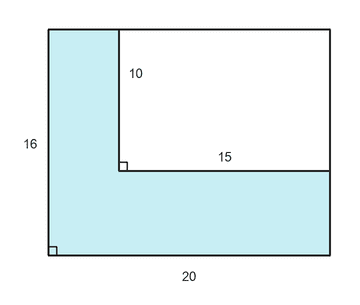
(ii)
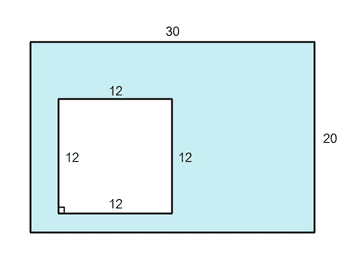
(iii)
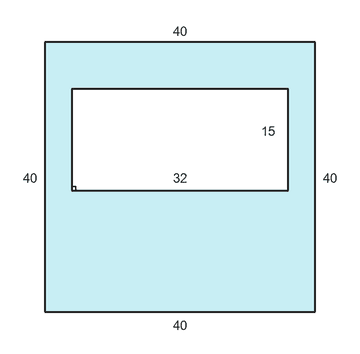
(iv)
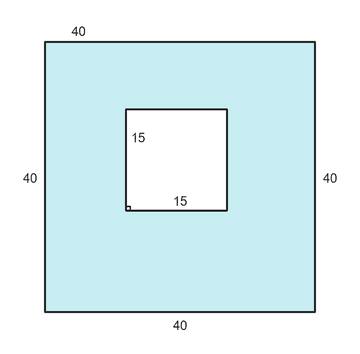
(v)
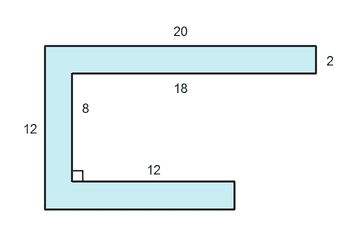
- 343 marks
Question 34
One side of a parallelogram is 20 cm and its distance from the opposite side is 16 cm. Find the area of the parallelogram.
- 353 marks
Question 35
The base of a parallelogram is thrice its height. If its area is 768 cm², find the base and the height of the parallelogram.
- 363 marks
Question 36
Find the area of the rhombus, if its diagonals are 30 cm and 24 cm.
- 373 marks
Question 37
If the area of a rhombus is 112 cm² and one of its diagonals is 14 cm , find its other diagonal.
- 383 marks
Question 38
One side of a parallelogram is 18 cm and its area is 153 cm². Find the distance of the given side from its opposite side.
- 393 marks
Question 39
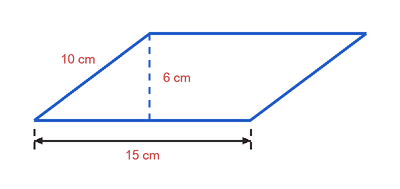
The adjacent sides of a parallelogram are 15 cm and 10 cm. If the distance between the longer sides is 6 cm, find the distance between the shorter sides.
- 403 marks
Question 40
The area of a rhombus is 84 cm² and its perimeter is 56 cm. Find its height.
- 413 marks
Question 41
Find the area of a triangle whose base is 30 cm and height is 18 cm.
- 423 marks
Question 42
Find the height of a triangle whose base is 18 cm and area is 270 cm².
- 433 marks
Question 43
The area of a right-angled triangle is 160 cm². If its one leg is 16 cm long, find the length of the other leg.
- 443 marks
Question 44
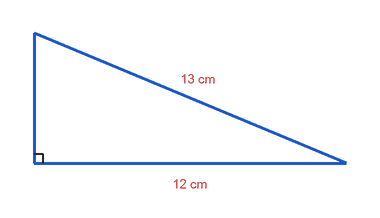
Find the area of a right-angled triangle whose hypotenuse is 13 cm long and one of its legs is 12 cm long.
- 453 marks
Question 45
Find the area of an equilateral triangle whose each side is 16 cm (take =1·73).
- 463 marks
Question 46
The sides of a triangle are 21 cm, 17 cm and 10 cm. Find its area.
- 473 marks
Question 47
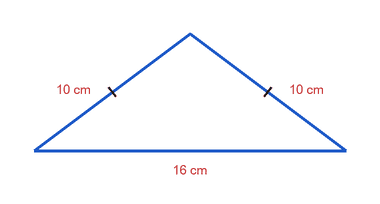
Find the area of an isosceles triangle whose base is 16 cm and length of each of the equal sides is 10 cm.
- 483 marks
Question 48
Find the base of a triangle whose area is 360 cm² and height is 24 cm.
- 493 marks
Question 49
The legs of a right-angled triangle are in the ratio 4 : 3 and its area is 4056 cm². Find the lengths of its legs.
- 503 marks
Question 50
The area of an equilateral triangle is cm². Find the length of each side of the triangle.
- 513 marks
Question 51
The sides of a triangle are in the ratio 15 : 13 : 14 and its perimeter is 168 cm. Find the area of the triangle.
- 523 marks
Question 52
The diameter of a circle is 20 cm. Taking π = 3.14, find its circumference and its area.
- 533 marks
Question 53
The circumference of a circle exceeds its diameter by 18 cm. Find the radius of the circle.
- 543 marks
Question 54
The ratio between the radii of two circles is 5 : 7. Find the ratio between their:
(i) circumferences
(ii) areas
- 553 marks
Question 55
The ratio between the areas of two circles is 16 : 9. Find the ratio between their:
(i) radii
(ii) diameters
(iii) circumferences
- 563 marks
Question 56
A circular racing track has inner circumference 528 m and outer circumference 616 m.

Find the width of the track.
- 573 marks
Question 57
The inner circumference of a circular track is 264 m and the width of the track is 7 m.
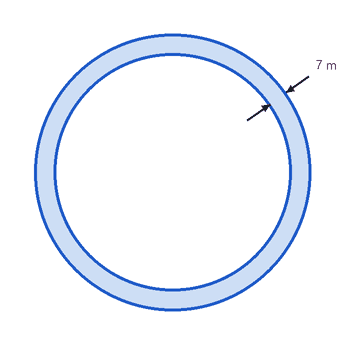
Find :
(i) the radius of the inner track.
(ii) the radius of the outer circumference.
(iii) the length of the outer circumference.
(iv) the cost of fencing the outer circumference at the rate of ₹ 50 per m.
- 583 marks
Question 58
The diameter of the wheel of a car is 63 cm. How much distance will the car move during 2000 revolutions of its wheel (in kilometres) ?
- 593 marks
Question 59
The diameter of the wheel of a car is 70 cm. How many revolutions will it make to travel one kilometre ?
- 603 marks
Question 60
A metal wire, when bent in the form of a square of the largest area, encloses an area of 484 cm². Find the length of the wire.
If the same wire is bent in the form of the largest possible circle, find :
(i) radius of the circle formed.
(ii) area of the circle.
- 613 marks
Question 61
A wire is wound along the boundary of a circle with radius 28 cm. If the same wire is bent in the form of a square, find the area of the square formed.
- 623 marks
Question 62
The length and the breadth of a rectangular paper are 35 cm and 22 cm .Find the area of the largest circle which can be cut out of this paper.
- 633 marks
Question 63
From each corner of a rectangular paper (30 cm x 20 cm) a quadrant of a circle of radius 7 cm is cut. Find the area of the remaining paper i.e., the shaded portion.
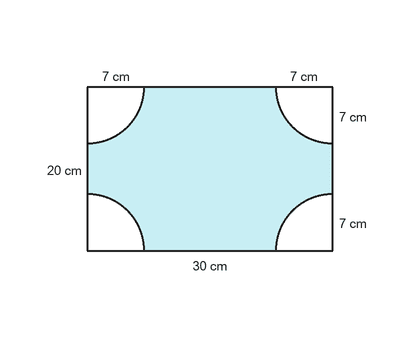
- 641 mark
Question 64
The perimeter of a square is 32 cm, its area is :
- 651 mark
Question 65
A wire is in the shape of a square of side 20 cm. If the same wire is bent in the form of a rectangle of length 25 cm; then the breadth of the rectangle is :
- 661 mark
Question 66
Area of ΔABC is 18 cm². If the height AD is 3 cm, then the length of the side BC is :
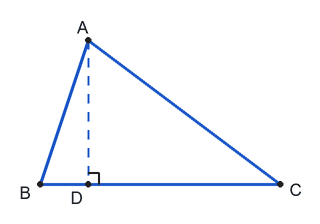
- 671 mark
Question 67
The area of the given triangle is :

- 681 mark
Question 68
In the given triangle ABC, AB = 8 cm, BC = 12 cm, AC = 10 cm and altitude AD = 6 cm; the length of altitude CE is :
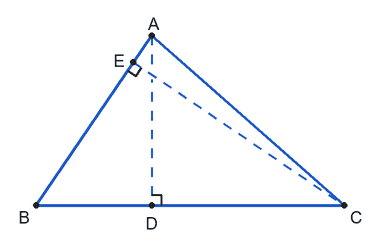
- 691 mark
Question 69
The area and the perimeter of a square are numerically equal. Side of the square is :
- 701 mark
Question 70
The radii of given two concentric circles are 2 cm and 1 cm. The area of the shaded portion is :
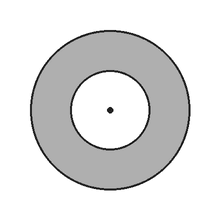
- 711 mark
Question 71
If the base of a triangle is doubled and its height is halved, the area of the triangle is :
- 721 mark
Question 72
Ratio between the radii of two circles with their circumferences 7 cm and 10 cm is :
- 731 mark
Question 73
The length and the breadth of a room are 3 m and 2 m respectively. The floor of this room is to be tiled with square of side 20 cm. The number of tiles required is :
- 741 mark
Question 74
If the area of a circle is numerically equal to its circumference; its radius is :
- 751 mark
Question 75
The perimeter of a semicircle (including its diameter) of radius 7 cm is :
- 761 mark
Question 76
The ratio between the areas of two circles is 16 : 25, the ratio between their circumferences is :
- 771 mark
Question 77
Area of the shaded region is :
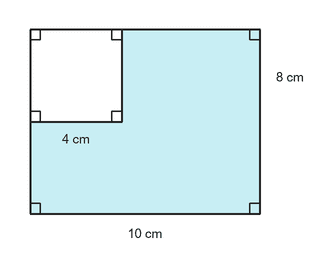
- 781 mark
Question 78
If BD = 20 cm, AP = 8 cm and CQ = 12 cm; the area of quadrilateral ABCD is :
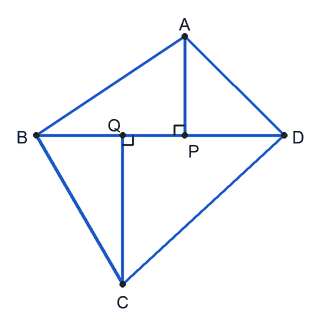
- 791 mark
Question 79
Statement 1 : The area of an equilateral triangle whose height is cm is 16·24 cm²
Statement 2 : Area of equilateral triangle = × (height)² square unit.
Which of the following options is correct?
- 801 mark
Question 80
Statement 1 : The distance around the edge of a circle is 2πr units.
Statement 2 : The ratio of areas of two circles is 64 : 169. The ratio of their circumference is 8 : 13.
Which of the following options is correct?
- 811 mark
Question 81
The following questions are Assertion-Reason based questions. Choose your answer based on the codes given below :
(1) A is true, R is false.
(2) A is false, R is true.
(3) Both A and R are true.
(4) Both A and R are false.
Assertion (A) : The perimeter of a square whose area is 2·56 m² is 6·4 cm.
Reason (R) : Perimeter of square = (4 × side) unit
- 821 mark
Question 82
The following questions are Assertion-Reason based questions. Choose your answer based on the codes given below :
(1) A is true, R is false.
(2) A is false, R is true.
(3) Both A and R are true.
(4) Both A and R are false.
Assertion (A) : The altitude of a triangle whose base is 15 cm and area is 0.9 m² is 12 m.
Reason (R) : Area of triangle = unit²
- 831 mark
Question 83
The following questions are Assertion-Reason based questions. Choose your answer based on the codes given below :
(1) A is true, R is false.
(2) A is false, R is true.
(3) Both A and R are true.
(4) Both A and R are false.
Assertion (A) : A parallelogram has sides 8 cm and 12 cm. The ratio of the distance between its shorter side to the distance between longer side is 2 : 3
Reason (R) : Area of parallelogram = ( Base× corresponding height) unit²
What Class 7 Maths Ch 23 covers
The sections of the chapter, in the order the book takes them. Every question above comes from one of these.
- 01Relation Between the Unit of Length and Unit of Area
- 02Perimeter of Some Plane Figures
- 03Circumference (Perimeter) of a Circle
- 04Area of Some Plane Figures
More ways to study this chapter
The same chapter asked three other ways. Practise it, revise it, and see what the board has set on Ch 23 before.
Class 7 Maths Ch 23 questions students ask
How many questions are there in Class 7 Maths Ch 23?
83 questions. Every one is solved step by step on this page.
Are these Class 7 Maths solutions free?
Yes. Every question and its full working is free to read, with no account needed.
Can I download the Class 7 Maths Ch 23 solutions as a PDF?
There is no PDF to download. Every solution is on this page instead, which means it is searchable, always the current syllabus, and readable on a phone. Use your browser's print option if you want it on paper.