
Question 313 marksMedium
In the given figures, the directed lines are parallel to each other. Find the unknown angles.
(i)
(ii)
(iii)

(iv)
(v)
(vi)
(vii)
(viii)
(ix)

(x)
(xi)

(xii)

Confirming your payment
Sign up now and get 250 free tokens.
Lines and Angles · Question 31 of 48
In the given figures, the directed lines are parallel to each other. Find the unknown angles.
(i)
(ii)
(iii)
(iv)
(v)
(vi)
(vii)
(viii)
(ix)
(x)
(xi)
(xii)
Solution:
Concept: When a transversal cuts two parallel lines, corresponding angles are equal, alternate angles (interior or exterior) are equal, and co-interior (allied) angles add up to 180°. When two straight lines cross, the vertically opposite angles (the angles facing each other) are equal. Angles on one side of a straight line, at a point on it, add up to 180°. Two adjacent angles whose outer arms form a straight line are called a linear pair, so they add up to 180°. When a bend lies between two parallel lines, we draw a third line through the bend, parallel to them. The angle at the bend then splits into two parts, and each part is found from the parallel lines.
Step 1 — Figure (i).
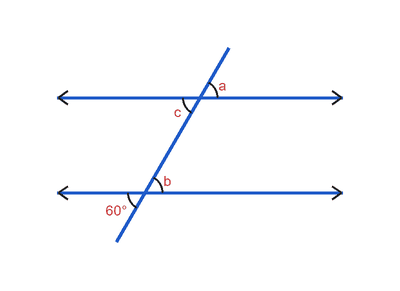
The angle b faces the 60° angle at the lower point, so b is 60° (vertically opposite angles). The angle a sits in the same position at the upper point as b at the lower point, so a is also 60° (corresponding angles). The angle c lies between the parallel lines on the other side of the transversal from b, so c is 60° as well (alternate angles).
Step 2 — Figure (ii).
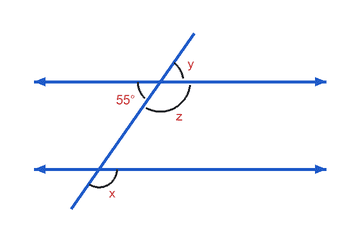
The angle y faces the 55° angle, so y = 55° (vertically opposite angles). z forms a linear pair with 55°. x sits in the same position at the lower point as z at the upper point, so x = z (corresponding angles).
Step 3 — Figure (iii).
The angle c sits in the same position on the right-hand line as the 120° angle on the left-hand line, so c = 120° (corresponding angles). a forms a linear pair with c, and b faces a, so b = a (vertically opposite angles).
Step 4 — Figure (iv).
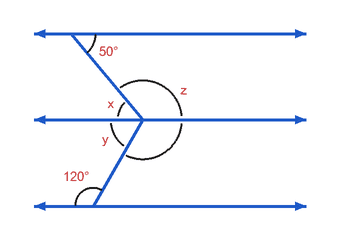
The angle x and the 50° angle are alternate angles between the top and middle parallel lines, so x = 50°. y and the 120° angle are co-interior angles between the middle and bottom parallel lines, so they add up to 180°. z is the rest of the full turn round the bend.
Step 5 — Figure (v).
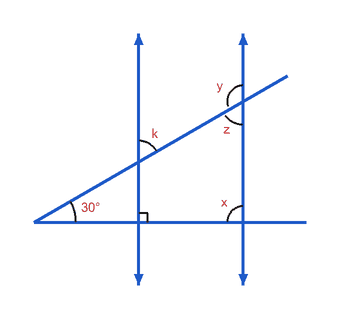
The left vertical line meets the horizontal line at 90°, and the two vertical lines are parallel, so x and that 90° are co-interior angles.
In the triangle formed by the horizontal line, the slant line and the left vertical line, the third angle is found from the angle sum, and k is vertically opposite to it.
So k is 60°. The angles z and k lie between the vertical lines on opposite sides of the slant line, so z is also 60° (alternate angles), and y forms a linear pair with z.
Step 6 — Figure (vi).
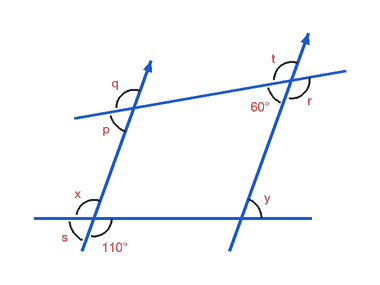
At the lower left point, x faces 110°, so x = 110°, and s forms a linear pair with 110°. y sits in the same position as the 70° angle next to 110° at the left line, so y = 70° (corresponding angles).
Step 7 — Figure (vi): the upper line.
The angle p sits in the same position on the left line as the 60° angle on the right line, so p = 60° (corresponding angles). q forms a linear pair with p, t corresponds to q, and r faces t.
Step 8 — Figure (vii).
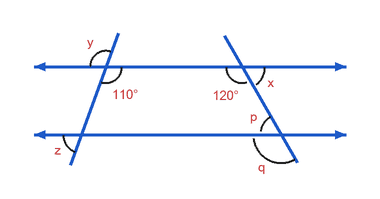
The angle y faces the 110° angle, so y = 110°. z sits in the same position at the lower line as the 70° angle next to 110° at the top line, so z = 70° (corresponding angles). On the right-hand transversal, x forms a linear pair with 120°; p and x are alternate angles; q forms a linear pair with p.
Step 9 — Figure (viii).
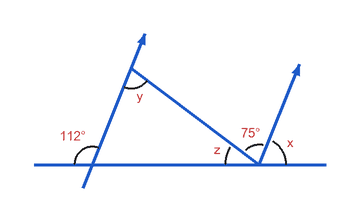
The inside angle at the left line forms a linear pair with 112°, and x corresponds to it on the parallel right-hand line. y and the 75° angle are alternate angles on the slanting segment. At the right-hand point, z, 75° and x lie on the straight base line.
Step 10 — Figure (ix).
The inside angles at the bottom form linear pairs with 115° and 120°. a and c are alternate angles to them (the top and bottom lines are parallel), and a, b, c lie on the straight top line.
Step 11 — Figure (x).
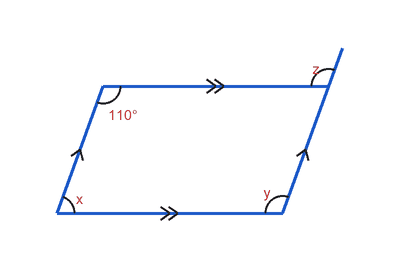
Both pairs of opposite sides are parallel. x and 110° are co-interior angles on the left side, y and x are co-interior angles on the bottom side, and z and 110° are alternate angles on the top line (the right side is produced).
Step 12 — Figure (xi).
We draw a line through the bend parallel to the two directed lines. It splits x into two parts; each part is co-interior with one of the given angles. y is the rest of the full turn round the bend.
Step 13 — Figure (xii).
We draw a line through the bend parallel to the two directed lines. It splits b into two parts, which are alternate angles to 50° and 40°. a is the rest of the full turn round the bend.
Watch out: An angle marked all the way round the outside of a bend is a reflex angle (more than 180°); find it from 360°.
Therefore, (i) a, b and c are each 60°; (ii) x is 125°, y is 55°, z is 125°; (iii) a is 60°, b is 60°, c is 120°; (iv) x is 50°, y is 60°, z is 250°; (v) k is 60°, x is 90°, y is 120°, z is 60°; (vi) x is 110°, s is 70°, y is 70°, p is 60°, and q, r and t are each 120°; (vii) y is 110°, z is 70°, x and p are each 60°, q is 120°; (viii) x is 68°, y is 75°, z is 37°; (ix) a is 65°, b is 55°, c is 60°; (x) x is 70°, y is 110°, z is 110°; (xi) x is 70°, y is 290°; (xii) a is 270°, b is 90°.