
Question 303 marksMedium
Which pair of the dotted line segments, in the following figures, are parallel. Give reason :
(i)
(ii)

(iii)
(iv)
(v)
(vi)
Confirming your payment
Sign up now and get 250 free tokens.
Lines and Angles · Question 30 of 48
Which pair of the dotted line segments, in the following figures, are parallel. Give reason :
(i)
(ii)
(iii)
(iv)
(v)
(vi)
Solution:
Concept: Two lines cut by a transversal are parallel when a pair of corresponding angles is equal, or a pair of alternate angles is equal, or a pair of co-interior angles adds up to 180°. If the test fails, the lines are not parallel.
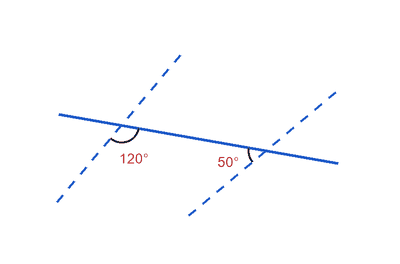
Step 1 — Figure (i).
The 120° and 50° angles lie between the dotted segments, on the same side of the solid line, so they are co-interior angles.
The sum is not 180°, so the dotted segments are not parallel.
Step 2 — Figure (ii).
The angle vertically opposite to 45° is also 45°. It lies between the dotted lines on the same side of the transversal as the 135° angle, so they are co-interior angles.
The sum is 180°, so the dotted segments are parallel.
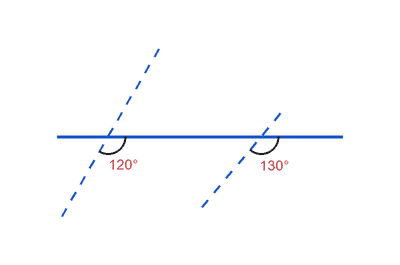
Step 3 — Figure (iii).
The 120° and 130° angles sit in the same position at the two points, so they are corresponding angles. 120° is not equal to 130°, so the dotted segments are not parallel.
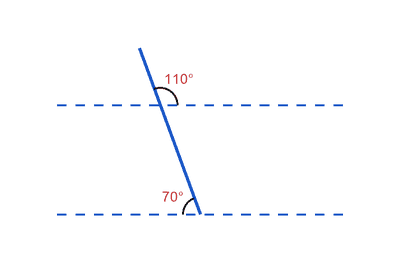
Step 4 — Figure (iv).
The angle vertically opposite to 110° is 110°, and it is co-interior with the 70° angle.
The sum is 180°, so the dotted segments are parallel.
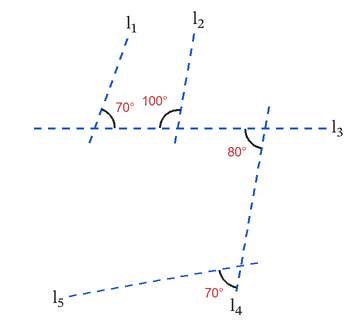
Step 5 — Figure (v).
With as the transversal, the 70° at and the 100° at are co-interior angles, and 70° + 100° = 170°, so is not parallel to . At , the angle above on the left is 180° − 80° = 100° (linear pair); it corresponds to the 100° at , so . With as the transversal, the 80° (at ) and the 70° (at ) are corresponding angles; they are not equal, so is not parallel to .
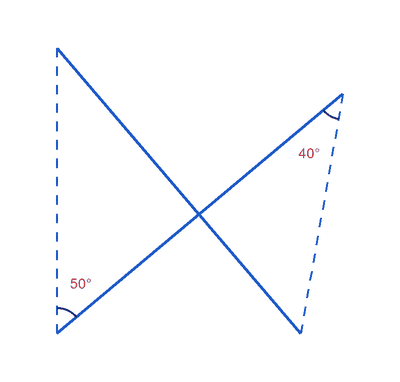
Step 6 — Figure (vi).
The slanting solid line is the transversal; the 50° and 40° angles lie between the dotted segments on opposite sides of it, so they are alternate angles. 50° is not equal to 40°, so the dotted segments are not parallel.
Watch out: Co-interior angles must ADD to 180°; corresponding and alternate angles must be EQUAL.
Therefore, the dotted segments are parallel in (ii) and (iv), and in (v) only ; in (i), (iii) and (vi) they are not parallel.