Answer: (C) Statement 1 is true, and statement 2 is false.
Concept: We judge each statement separately, true or false, and then choose the option that matches both verdicts. Two angles are adjacent when they have a common vertex and a common arm, and their other two arms lie on opposite sides of the common arm, so the angles do not overlap.
Step 1 — Judge statement 1.
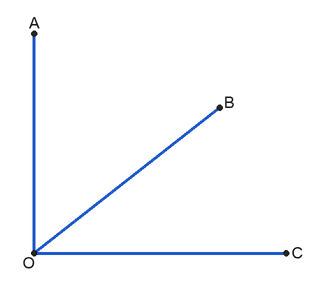
The angles ∠AOB and ∠BOC have the common vertex O and the common arm OB, and OA and OC lie on opposite sides of OB. So they are adjacent, and statement 1 is true.
Step 2 — Judge statement 2.
Part (c) allows the other two arms to lie on the same side of the common arm. Then one angle lies inside the other and they overlap, so they are not adjacent. Statement 2 is false.
Watch out: For adjacent angles the outer arms must be on opposite sides.
Why the other options are wrong:
- (A): Statement 2 is false because of its part (c).
- (B): Statement 1 is true: the angles share O and OB and do not overlap.
- (D): It has the verdicts the wrong way round.
Therefore, statement 1 is true and statement 2 is false, option (C).