Answer: (D) Statement 1 is false, and statement 2 is true.
Concept: We judge each statement separately, true or false, and then choose the option that matches both verdicts. Points are collinear when they all lie on one straight line.
Step 1 — Judge statement 1.
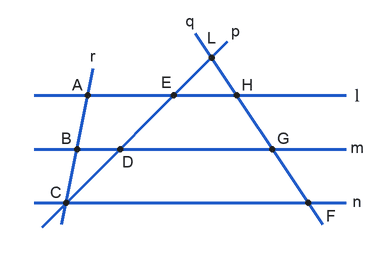
Line q passes through L, H, G and F, and line p passes through L, E, D and C. Each of these lines has four points on it, so four collinear points do exist. Statement 1 is false.
Step 2 — Judge statement 2.
Points that lie on one straight line are called collinear points. This is the definition, so statement 2 is true.
Watch out: Count the points on every line, including the slanting lines p and q.
Why the other options are wrong:
- (A): Statement 1 is false: lines p and q each carry four points.
- (B): Statement 2 is true: it is the definition of collinear points.
- (C): It has the verdicts the wrong way round.
Therefore, statement 1 is false and statement 2 is true, option (D).