
Opening your dashboard
Class 7 Chemistry Chapter 7: Air and Atmosphere Solutions
36 textbook questions with step-by-step answers, free to read, for ICSE 2026-27.
Get talked through Ch 7, not just shown the answer
Reading a finished solution is not the same as being able to do it. The AI tutor takes one question at a time and works it with you, in your own words, until you can.
- Ask it out loud, in your own words
- It gives you the next step, not the answer
- Stuck on part (ii)? Start there
36 questions with solutions
1–5 marks · Mixed difficulty
- 11 mark
Question 1
The most abundant gas present in air is:
Solve with AIAnswer
- Correct
(A) Nitrogen
(B) Oxygen
(C) Carbon dioxide
(D) Water vapour
Answer: (A) Nitrogen
Concept: Air is a mixture of gases. By volume, dry air is about 78 % nitrogen, 21 % oxygen, about 0.9 % argon and only tiny amounts of carbon dioxide and other gases; water vapour varies from place to place.
Step 1 — Recall the share of each gas.
The table gives the main gases of dry air by volume.
Gas Share of dry air by volume Nitrogen 78.08 % Oxygen 20.95 % Argon 0.93 % Carbon dioxide about 0.04 % Step 2 — Pick the largest share.
Nitrogen makes up more than three-quarters of the air, far more than any other gas, so it is the most abundant gas in air.
Watch out: Oxygen is the gas we need most, but it is not the gas present in the largest amount.
Note: Carbon dioxide in air is now about 0.04 % (about 420 parts per million); older books give 0.03 %, the value of several decades ago.
Why the other options are wrong:
- (B) Oxygen: This is the second most abundant gas, about 21 % of air, far less than nitrogen's 78 %.
- (C) Carbon dioxide: This is only a trace gas, about 0.04 % of air.
- (D) Water vapour: This is present in a small amount that changes with the weather, usually a few per cent at most.
Therefore, the most abundant gas in air is nitrogen, option (A).
- 21 mark
Question 2
The gas used to prepare baking soda is :
Solve with AIAnswer
(A) Nitrogen oxide
- Correct
(B) Carbon dioxide
(C) Sulphur dioxide
(D) Nitrogen dioxide
Answer: (B) Carbon dioxide
Concept: Carbon dioxide has many uses in industry. One of them is making baking soda (sodium hydrogen carbonate, ), a substance that contains carbon and oxygen taken from carbon dioxide.
Step 1 — Look at what baking soda is made of.
Baking soda is sodium hydrogen carbonate, . It contains sodium, hydrogen, carbon and oxygen, but no nitrogen and no sulphur.
Step 2 — Match with the gas used.
The carbon in baking soda comes from carbon dioxide, which is passed into a solution during its manufacture. So carbon dioxide is the gas used to prepare baking soda.
Watch out: Baking soda gives off carbon dioxide when it is heated or meets an acid; it is also made from carbon dioxide.
Why the other options are wrong:
- (A) Nitrogen oxide: This is wrong because baking soda contains no nitrogen; oxides of nitrogen are air pollutants.
- (C) Sulphur dioxide: This is wrong because baking soda contains no sulphur; sulphur dioxide is a poisonous gas that causes acid rain.
- (D) Nitrogen dioxide: This is wrong because baking soda contains no nitrogen; nitrogen dioxide is a poisonous pollutant gas.
Therefore, the gas used to prepare baking soda is carbon dioxide, option (B).
- 31 mark
Question 3
Which of the following is the main constituent of proteins ?
Solve with AIAnswer
(A) Methane
(B) Sulphur dioxide
- Correct
(C) Nitrogen
(D) Oxygen
Answer: (C) Nitrogen
Concept: Proteins are the body-building substances of all living things. Every protein contains carbon, hydrogen, oxygen and nitrogen; nitrogen is the element that marks out proteins from carbohydrates and fats.
Step 1 — Recall the elements in food substances.
Carbohydrates and fats are made of carbon, hydrogen and oxygen only. Proteins contain these too, and in addition always contain nitrogen.
Step 2 — Pick the constituent that proteins depend on.
Plants take in nitrogen from the soil (as nitrates) and build it into proteins; animals get their proteins by eating plants. So nitrogen is the main constituent linked with proteins.
Watch out: Proteins do contain oxygen, but so does almost every food substance; the constituent special to proteins is nitrogen.
Why the other options are wrong:
- (A) Methane: This is a gaseous fuel (the main part of natural gas), not a constituent of proteins.
- (B) Sulphur dioxide: This is a poisonous pollutant gas, not a part of proteins.
- (D) Oxygen: This is partly true, since proteins do contain oxygen, but carbohydrates and fats contain it too; nitrogen is the constituent that proteins need and other foods lack.
Therefore, nitrogen is the main constituent of proteins, option (C).
- 41 mark
Question 4
The presence of which substance in air causes pollution ?
Solve with AIAnswer
(A) Smoke
(B) Oxides of sulphur
(C) Chloroflurocarbons
- Correct
(D) All of the above
Answer: (D) All of the above
Concept: An air pollutant is any substance in the air that harms living things or materials. Smoke, oxides of sulphur and chlorofluorocarbons (CFCs) are all air pollutants.
Step 1 — Check each substance.
Smoke carries fine particles that harm the lungs. Oxides of sulphur are poisonous and cause acid rain. Chlorofluorocarbons damage the ozone layer and are also greenhouse gases.
Step 2 — Choose the complete answer.
Since every listed substance pollutes the air, the complete answer is "All of the above".
Watch out: When each option is true on its own, an "All of the above" option is the complete answer.
Why the other options are wrong:
- (A) Smoke: This is a pollutant, but choosing it alone leaves out the other two pollutants listed.
- (B) Oxides of sulphur: This is a pollutant, but choosing it alone leaves out smoke and CFCs.
- (C) Chloroflurocarbons: This is a pollutant (it depletes the ozone layer), but choosing it alone is incomplete.
Therefore, smoke, oxides of sulphur and chlorofluorocarbons all pollute the air, option (D).
- 51 mark
Question 5
The gas which protects the earth from ultraviolet rays is :
Solve with AIAnswer
(A) oxygen
(B) carbon dioxide
(C) inert gases
- Correct
(D) ozone
Answer: (D) ozone
Concept: High in the atmosphere (the stratosphere) there is a layer of ozone, , a form of oxygen whose molecules have three atoms. It absorbs most of the sun's harmful ultraviolet (UV) rays.
Step 1 — Recall what blocks UV rays.
Ultraviolet rays can cause sunburn, skin cancer and eye damage. The ozone layer absorbs most of them before they reach the ground.
Step 2 — Match with the options.
So the gas that protects the earth from ultraviolet rays is ozone.
Watch out: Ozone and oxygen are both made of oxygen atoms, but only ozone forms the UV shield.
Why the other options are wrong:
- (A) oxygen: This is ordinary oxygen, ; it is not the gas of the protective layer.
- (B) carbon dioxide: This is a greenhouse gas that traps heat; it does not shield the earth from UV rays.
- (C) inert gases: These gases are present only in tiny amounts and do not absorb the sun's UV rays.
Therefore, ozone protects the earth from ultraviolet rays, option (D).
- 65 marks
Question 6
Name the following :
(a) The process by which atmospheric nitrogen is converted into nitrate and nitrite salts and gets fixed in the soil ________
(b) Substances which burn in air to produce a large amount of heat and light energy ________
(c) The amount of moisture present in the air ________
(d) Tiny droplets of water which remain suspended in air ________
(e) Harmful substances present in air which cuase pollution ________
Solve with AIWritten solution
Solution:
Concept: Each blank is a term from the chapter on air: how nitrogen enters the soil, what fuels are, and the words for moisture, water droplets and harmful substances in the air.
Step 1 — (a) Nitrogen entering the soil.
Atmospheric nitrogen is changed into nitrates and nitrites in the soil by lightning and by bacteria. This process is called nitrogen fixation.
Step 2 — (b) Substances that burn to give heat and light.
Substances such as coal, wood, LPG and CNG burn in air and give a large amount of heat and light. They are called fuels.
Step 3 — (c) Moisture in the air.
The amount of water vapour (moisture) present in the air is called humidity.
Step 4 — (d) Tiny suspended water droplets.
When water vapour near the ground cools, it forms tiny droplets that stay suspended in the air. This is called fog (thin fog is called mist; such droplets high in the sky form clouds).
Step 5 — (e) Harmful substances in the air.
Harmful substances in the air that cause pollution are called air pollutants.
Watch out: Humidity is the amount of moisture in the air; it is not the water droplets themselves (that is fog or mist).
Therefore, (a) nitrogen fixation, (b) fuels, (c) humidity, (d) fog, (e) air pollutants.
- 75 marks
Question 7
Define the following terms :
(a) Pollutants
(b) Acid rain
(c) Global warming
(d) Smog
Solve with AIWritten solution
Solution:
Concept: A definition says in one sentence what a term means, and an example makes it clear. These four terms all come from the section on air pollution.
Step 1 — (a) Pollutants.
Harmful substances that get into the air (or water or soil) and make it unfit for living things are called pollutants. Examples are smoke, carbon monoxide and sulphur dioxide.
Step 2 — (b) Acid rain.
Rain that is acidic is called acid rain. It forms when gases such as sulphur dioxide and nitrogen dioxide from burning fuels dissolve in the water in the air and form acids that come down with the rain.
Step 3 — (c) Global warming.
The gradual rise in the average temperature of the earth is called global warming. It is caused mainly by the increase in heat-trapping (greenhouse) gases, such as carbon dioxide, methane, nitrous oxide and chlorofluorocarbons, in the air.
Step 4 — (d) Smog.
Smog is a mixture of smoke and fog that hangs over cities. A second kind, photochemical smog, forms when oxides of nitrogen and unburnt fuel from vehicles react in sunlight. Smog irritates the eyes and makes breathing difficult.
Watch out: Acid rain is not rain mixed with ready-made acid; the acids form in the air from gases such as sulphur dioxide and nitrogen dioxide.
Therefore, pollutants are harmful substances in the air, acid rain is acidic rain, global warming is the rise in the earth's average temperature, and smog is smoke mixed with fog.
- 85 marks
Question 8
Give one use for each of the following inert gases:
(a) Argon
(b) Helium
(c) Neon
(d) Radon
(e) Krypton
(f) Xenon
Solve with AIWritten solution
Solution:
Concept: The inert (noble) gases are argon, helium, neon, krypton, xenon and radon. Together they make up just under 1 % of air (almost all of it argon). They hardly react with other substances, and each has its own uses.
Step 1 — (a) Argon.
Argon is filled in electric (filament) bulbs, because it does not react with the hot tungsten filament and so the filament lasts longer.
Step 2 — (b) Helium.
Helium is filled in weather observation balloons, because it is very light and does not burn.
Step 3 — (c) Neon.
Neon is used in advertising signboards, because it glows bright orange-red when electricity passes through it.
Step 4 — (d) Radon.
Radon is radioactive, so it was used in the treatment of cancer (radiotherapy); today safer radioactive sources have largely replaced it.
Step 5 — (e) Krypton.
Krypton is used in flash lamps for photography and in some fluorescent lamps.
Step 6 — (f) Xenon.
Xenon is used in photographic flash lamps, because it gives a very bright white flash.
Watch out: Neon gives the red glow of advertising signs; ordinary household tube lights contain argon and mercury vapour, not neon.
Therefore, argon fills electric bulbs, helium fills weather balloons, neon lights advertising signs, radon was used to treat cancer, and krypton and xenon are used in photographic flash lamps.
- 95 marks
Question 9
Answer the questions put against each of the following constituents of air :
(a) Nitrogen : Explain its significance for plants and animals.
(b) Oxygen : What is the percentage proportion of oxygen in air ? Why is oxygen called active air ?
(c) Carbon dioxide : "Although carbon dioxide plays no role in respiration, all life would come to an end if there is no carbon dioxide in air." Support this statement with relevant facts.
(d) Water vapour : Explain its role in modifying the earth's climate.
Solve with AIWritten solution
Solution:
Concept: Each main part of air has its own job: nitrogen builds proteins, oxygen supports life and burning, carbon dioxide is the raw material of food made by plants, and water vapour controls the weather.
Step 1 — (a) Nitrogen is needed for proteins.
Nitrogen is an important part of proteins, which all plants, animals and human beings need for growth.
- Plants cannot use free nitrogen from the air. It is first fixed in the soil as nitrates (by lightning and by bacteria, such as those in the root nodules of leguminous plants); plants absorb these nitrates and build plant proteins.
- Animals and human beings cannot use atmospheric nitrogen at all; they get proteins by eating plants (or other animals).
- Nitrogen also dilutes the oxygen of air, so burning stays under control instead of becoming violent.
Step 2 — (b) Oxygen is the active part of air.
Air contains about 21 % oxygen by volume (about one-fifth). Oxygen is called active air because it is the part of air that supports burning and respiration. When Lavoisier heated mercury in a closed volume of air, only about one-fifth of the air was used up; the remaining four-fifths, mostly nitrogen, did not react.
Step 3 — (c) Life depends on carbon dioxide.
Green plants use carbon dioxide and water, in sunlight and with chlorophyll, to make glucose by photosynthesis:
- All animals and human beings depend on plants for food, directly or through other animals. Without carbon dioxide there would be no photosynthesis and so no food.
- Photosynthesis also puts back the oxygen used up in respiration and burning.
- Carbon dioxide also traps some of the earth's heat (the greenhouse effect), which keeps the earth warm enough for life.
Step 4 — (d) Water vapour shapes the climate.
Water vapour controls the weather and climate in several ways.
- It causes rain; when it cools it also forms clouds, fog, mist, dew, frost, snow and hail.
- The amount of moisture in the air (humidity) controls how fast water evaporates from the bodies of plants and animals.
- It traps heat like a greenhouse gas, so humid nights stay warmer than dry ones.
- Through the water cycle it keeps moving water between the land, the sea and the air.
Watch out: Carbon dioxide is given out in respiration, so the statement in (c) means only that it is not taken in during respiration; life still depends on it through photosynthesis.
Therefore, nitrogen builds proteins, oxygen (about 21 %) is the active air that supports burning and respiration, carbon dioxide feeds photosynthesis on which all food depends, and water vapour brings rain and controls the climate.
- 103 marks
Question 10
"Air is a mixture." Support this statement citing at least three evidences.
Solve with AIWritten solution
Solution:
Concept: A mixture has no fixed composition, its parts keep their own properties and can be separated by physical methods. A compound has a fixed composition and a formula. Air behaves like a mixture in every way.
Step 1 — The composition of air is not fixed.
The amounts of water vapour, carbon dioxide and dust in air change from place to place and from time to time. A compound always has the same composition.
Step 2 — Each part keeps its own properties.
Oxygen in air still supports burning, and carbon dioxide in air still turns lime water milky. In a compound the parts lose their own properties.
Step 3 — The parts can be separated by physical methods.
Air can be liquefied and then separated into nitrogen, oxygen and argon by fractional distillation, because they boil at different temperatures.
Step 4 — Further evidence.
Liquid air has no fixed boiling point, there is no energy change when its gases are mixed, and air cannot be written with one chemical formula.
Watch out: Do not give "air is colourless" as evidence; a colourless gas could be a compound too.
Therefore, air is a mixture, because its composition varies, its parts keep their own properties and they can be separated by physical methods.
- 113 marks
Question 11
What is air pollution ? Give one harmful effect each of sulphur dioxide, nitrogen dioxide and hydrogen sulphide present in the air ?
Solve with AIWritten solution
Solution:
Concept: Air pollution is the presence in air of harmful substances (pollutants) that damage the health of living things or harm materials. Each pollutant gas has its own harmful effects.
Step 1 — Define air pollution.
When harmful substances such as smoke, dust and poisonous gases get into the air and make it harmful for plants, animals and human beings, the air is said to be polluted. This is called air pollution.
Step 2 — Give the effect of each gas.
Each gas named in the question harms living things in its own way.
- Sulphur dioxide: it irritates the lungs and causes breathing problems; it also dissolves in rain water to cause acid rain.
- Nitrogen dioxide: it irritates the eyes, nose and throat and lungs; it also helps form smog and acid rain.
- Hydrogen sulphide: it has a foul smell of rotten eggs, causes headache and nausea, and is poisonous even in small amounts.
Watch out: Hydrogen sulphide is not just smelly; at higher levels it dulls the sense of smell, so the danger is not noticed.
Therefore, air pollution is the presence of harmful substances in air; sulphur dioxide causes breathing problems and acid rain, nitrogen dioxide irritates the eyes, nose and throat, and hydrogen sulphide causes headache and nausea.
- 125 marks
Question 12
(a) What are the causes of air pollution ?
(b) Suggest five measures to prevent air pollution.
Solve with AIWritten solution
Solution:
Concept: Air is polluted by a few natural events but mostly by human activities, so changing those activities is the main way to prevent it.
Step 1 — (a) List the causes of air pollution.
Natural events such as volcanic eruptions, forest fires, dust storms and pollen add some pollutants, but most come from human activities:
- burning of fuels such as coal, wood, petrol and diesel;
- smoke and gases from vehicles;
- smoke and gases from factories and power plants;
- cutting of forests, which leaves fewer trees to absorb carbon dioxide;
- use of insecticides and pesticides sprayed in fields;
- burning of garbage and dry leaves, and explosions in wars and mines.
Step 2 — (b) Suggest five measures.
Each measure below removes a cause listed in part (a).
- Grow more trees. They absorb carbon dioxide and give out oxygen.
- Fit filters and tall chimneys in factories, so smoke particles are trapped and the remaining gases are released high above people.
- Fit catalytic converters and keep engines tuned in vehicles, so less carbon monoxide and fewer oxides of nitrogen come out of the exhaust.
- Do not burn garbage and dry leaves; compost them instead.
- Use cleaner fuels and transport such as CNG, LPG, electric vehicles and public transport, and use solar and wind energy where possible.
Watch out: Chimney filters trap smoke particles; they do not remove carbon dioxide.
Therefore, air is polluted mainly by burning fuels, vehicles, factories and cutting forests, and it can be reduced by planting trees, filtering factory smoke, fitting catalytic converters, not burning garbage and using cleaner fuels and transport.
- 131 mark
Question 13
A fuel that releases the least amount of pollutants in the air is :
Solve with AIAnswer
(A) sulphur dioxide
(B) chlorofluorocarbons
(C) smoke
- Correct
(D) CNG
Answer: (D) CNG
Concept: A fuel is a substance that burns to give heat. A clean fuel burns completely and gives off very few pollutants. CNG (compressed natural gas, mostly methane) is such a fuel.
Step 1 — See what burning CNG gives.
Methane, the main part of CNG, burns completely in enough air to give carbon dioxide and water:
It gives no smoke, no ash and almost no sulphur dioxide.
Step 2 — Check which options are fuels.
Sulphur dioxide, chlorofluorocarbons and smoke are not fuels at all; they are themselves pollutants. CNG is the only fuel in the list, and it is a clean one.
Watch out: CNG still gives carbon dioxide, a greenhouse gas; it is cleaner, not pollution-free.
Why the other options are wrong:
- (A) sulphur dioxide: This is not a fuel; it is a poisonous pollutant gas that causes acid rain.
- (B) chlorofluorocarbons: These are not fuels; they were used in refrigerators and sprays, and they damage the ozone layer.
- (C) smoke: This is not a fuel; it is a pollutant formed when fuels burn incompletely.
Therefore, CNG releases the least pollutants into the air, option (D).
- 141 mark
Question 14
The natural way of adding oxygen to air which involves green plants is called :
Solve with AIAnswer
- Correct
(A) photosynthesis
(B) respiration
(C) burning
(D) dissolution
Answer: (A) photosynthesis
Concept: Photosynthesis is the process by which green plants use carbon dioxide and water, in sunlight and with chlorophyll, to make glucose; oxygen is given out.
Step 1 — Write the change.
The overall equation for photosynthesis is:
Step 2 — See which process adds oxygen.
Oxygen is a product of photosynthesis, so this natural process involving green plants adds oxygen to the air.
Watch out: Plants also respire day and night, but in daylight they give out much more oxygen by photosynthesis than they use.
Why the other options are wrong:
- (B) respiration: This uses up oxygen from the air and gives out carbon dioxide.
- (C) burning: This also uses up oxygen from the air.
- (D) dissolution: This means dissolving a substance in a liquid; it does not add oxygen to the air.
Therefore, the natural way green plants add oxygen to the air is photosynthesis, option (A).
- 151 mark
Question 15
Which one of the following is most likely to be corroded ?
Solve with AIAnswer
(A) a stainless steel cupboard
(B) a galvanised iron bucket
- Correct
(C) an iron hammer
(D) a tin-plated iron box
Answer: (C) an iron hammer
Concept: Rusting is the slow oxidation of iron in the presence of air (oxygen) and moisture, forming hydrated iron(III) oxide. Iron is protected when its surface is covered or when it is made into a rust-resistant alloy.
Step 1 — Check each object for protection.
Stainless steel is an alloy of iron with chromium and nickel that resists rusting. A galvanised bucket is coated with zinc, and a tin-plated box is coated with tin. The iron hammer has no protection.
Step 2 — Pick the unprotected iron.
Bare iron is exposed to air and moisture, so the iron hammer is the most likely to corrode.
Watch out: A scratch in a tin coating makes the iron below rust quickly, but an unscratched tin-plated box is still protected.
Why the other options are wrong:
- (A) a stainless steel cupboard: This is wrong because stainless steel is an alloy designed to resist rusting.
- (B) a galvanised iron bucket: This is wrong because the zinc coating protects the iron, even where the coating is scratched.
- (D) a tin-plated iron box: This is wrong because the tin coating keeps air and moisture away from the iron.
Therefore, the iron hammer is the most likely to be corroded, option (C).
- 161 mark
Question 16
The substance which produces oxygen gas when heated is :
Solve with AIAnswer
(A) Potassium chloride
- Correct
(B) Potassium chlorate
(C) Potassium hydroxide
(D) Potassium carbonate
Answer: (B) Potassium chlorate
Concept: Some compounds that contain oxygen give it off when heated. Potassium chlorate () decomposes on heating, faster with manganese dioxide as a catalyst.
Step 1 — Write the decomposition.
On heating, potassium chlorate breaks down into potassium chloride and oxygen:
Step 2 — Check the other compounds.
Potassium chloride contains no oxygen. Potassium hydroxide and potassium carbonate contain oxygen but only melt on ordinary heating; they do not give off oxygen. So potassium chlorate is the answer.
Watch out: Potassium chloride is the product left behind in the reaction above, not the substance heated.
Why the other options are wrong:
- (A) Potassium chloride: This contains no oxygen at all, so it cannot give oxygen; it is left behind when potassium chlorate is heated.
- (C) Potassium hydroxide: This melts on heating but does not give off oxygen.
- (D) Potassium carbonate: This is stable to ordinary heating and does not give off oxygen.
Therefore, potassium chlorate gives oxygen gas when heated, option (B).
- 171 mark
Question 17
The process by which oxidation of food takes place in our body is called :
Solve with AIAnswer
(A) Combustion
- Correct
(B) Respiration
(C) Photosynthesis
(D) Excretion
Answer: (B) Respiration
Concept: Respiration is the process in which living cells use oxygen to oxidise food (glucose) and release energy, with carbon dioxide and water as products.
Step 1 — Write the change.
In our cells glucose combines with oxygen:
Step 2 — Name the process.
This slow oxidation of food in the body, which releases energy, is called respiration.
Watch out: Breathing (taking air in and out) is only part of it; respiration is the oxidation of food inside the cells.
Why the other options are wrong:
- (A) Combustion: This is fast burning with heat and light; food is not burnt with a flame in the body.
- (C) Photosynthesis: This is how green plants make food; it does not oxidise food.
- (D) Excretion: This is the removal of waste products from the body, not the oxidation of food.
Therefore, the oxidation of food in our body is called respiration, option (B).
- 181 mark
Question 18
A catalyst used in the preparation of oxygen is :
Solve with AIAnswer
(A) Manganese oxide
(B) Potassium permanganate
- Correct
(C) Manganese dioxide
(D) Manganese (II) chloride
Answer: (C) Manganese dioxide
Concept: A catalyst changes the rate of a reaction and is left chemically unchanged at the end. In the preparation of oxygen, black manganese dioxide, , speeds up the decomposition of hydrogen peroxide (or of potassium chlorate).
Step 1 — Write the reaction with the catalyst.
Hydrogen peroxide decomposes quickly when manganese dioxide is added:
Step 2 — Name the catalyst precisely.
Manganese dioxide is not used up; it can be filtered off and used again. So the catalyst is manganese dioxide.
Watch out: The name "manganese oxide" does not name one compound, because manganese forms several oxides; the precise name of the catalyst is manganese dioxide.
Why the other options are wrong:
- (A) Manganese oxide: This is too vague: manganese forms several oxides, and only manganese dioxide is named as the catalyst.
- (B) Potassium permanganate: This does give oxygen when heated, but it is used up in the reaction, so it is a reactant, not a catalyst.
- (D) Manganese (II) chloride: This is not used in the preparation of oxygen.
Therefore, manganese dioxide is the catalyst used in the preparation of oxygen, option (C).
- 191 mark
Question 19
Assertion (A): Air is invisible and transparent. Reason (R): Air is a mixture of colourless gases.
Solve with AIAnswer
- Correct
(A) Both A and R are true and R is the correct explanation of A.
(B) Both A and R are true but R is not the correct explanation of A.
(C) A is true but R is false.
(D) A is false but R is true.
Answer: (A) Both A and R are true and R is the correct explanation of A.
Concept: A gas that has no colour cannot be seen and lets light pass through. Judge the Assertion (A) first, then the Reason (R), and only then decide whether R explains A.
Step 1 — Judge the Assertion.
We cannot see air, and light passes through it, so air is invisible and transparent. A is true.
Step 2 — Judge the Reason.
Air is a mixture of nitrogen, oxygen, argon, carbon dioxide and other gases, all of which are colourless. R is true.
Step 3 — Decide whether R explains A.
A mixture of colourless gases has no colour, so we cannot see it and light passes through it. R is the correct explanation of A.
Watch out: Dust and smoke can make polluted air hazy, but the gases of air themselves are colourless.
Why the other options are wrong:
- (B): This is wrong because R is exactly the reason why air is invisible and transparent.
- (C): This is wrong because R is true: all the gases of air are colourless.
- (D): This is wrong because A is true: air is invisible and transparent.
Therefore, both A and R are true and R is the correct explanation of A, option (A).
- 201 mark
Question 20
Assertion (A): During the process of photosynthesis, plants take in carbon dioxide and give out oxygen. Reason (R): Carbon dioxide dissolved in water adds taste to water.
Solve with AIAnswer
(A) Both A and R are true and R is the correct explanation of A.
- Correct
(B) Both A and R are true but R is not the correct explanation of A.
(C) A is true but R is false.
(D) A is false but R is true.
Answer: (B) Both A and R are true but R is not the correct explanation of A.
Concept: Photosynthesis takes in carbon dioxide and gives out oxygen. Separately, carbon dioxide dissolved in water gives it a slightly sharp taste, as in soda water. Judge the Assertion (A) first, then the Reason (R), and only then decide whether R explains A.
Step 1 — Judge the Assertion.
In photosynthesis plants take in carbon dioxide (and water) and give out oxygen. A is true.
Step 2 — Judge the Reason.
Carbon dioxide dissolved in water forms a weak acid that gives water a slightly sharp, pleasant taste; this is why soda water tastes different. R is true.
Step 3 — Decide whether R explains A.
The taste of water has nothing to do with why plants take in carbon dioxide and give out oxygen. So R does not explain A.
Watch out: Two true statements about the same gas need not be linked; always ask whether R gives the cause of A.
Why the other options are wrong:
- (A): This is wrong because R, about the taste of water, does not explain photosynthesis.
- (C): This is wrong because R is true: dissolved carbon dioxide does give water a taste.
- (D): This is wrong because A is true: plants take in carbon dioxide and give out oxygen in photosynthesis.
Therefore, both A and R are true but R is not the correct explanation of A, option (B).
- 211 mark
Question 21
Assertion (A): The component of air which is required by living organisms is only oxygen. Reason (R): Oxygen is essential for respiration and combustion.
Solve with AIAnswer
(A) Both A and R are true and R is the correct explanation of A.
(B) Both A and R are true but R is not the correct explanation of A.
(C) A is true but R is false.
- Correct
(D) A is false but R is true.
Answer: (D) A is false but R is true.
Concept: Living things need several components of air, not just one. Judge the Assertion (A) first, then the Reason (R), and only then decide whether R explains A.
Step 1 — Judge the Assertion.
A says living organisms need only oxygen. This is false: plants need carbon dioxide for photosynthesis, which makes all food, and all living things need nitrogen (fixed into the soil) to make proteins.
Step 2 — Judge the Reason.
Oxygen is needed for respiration in living things and for the burning of fuels. R is true.
Step 3 — Decide the option.
A is false and R is true, so the question of R explaining A does not arise.
Watch out: The word "only" makes A false, even though oxygen is very important.
Why the other options are wrong:
- (A): This is wrong because A is false: living things need nitrogen and carbon dioxide as well.
- (B): This is wrong because A is false, so A and R cannot both be true.
- (C): This is wrong because A is false and R is true, not the other way round.
Therefore, A is false but R is true, option (D).
- 221 mark
Question 22
Assertion (A): Nitrogen is an important constituent of proteins which is necessary for growth in humans, plants and animals. Reason (R): Nitrogen supports combustion.
Solve with AIAnswer
(A) Both A and R are true and R is the correct explanation of A.
(B) Both A and R are true but R is not the correct explanation of A.
- Correct
(C) A is true but R is false.
(D) A is false but R is true.
Answer: (C) A is true but R is false.
Concept: Nitrogen is the inactive part of air: it is a constituent of proteins but does not support ordinary burning. Judge the Assertion (A) first, then the Reason (R), and only then decide whether R explains A.
Step 1 — Judge the Assertion.
Nitrogen is an important part of proteins, which humans, plants and animals need for growth. A is true.
Step 2 — Judge the Reason.
Nitrogen does not burn and does not support the burning of ordinary fuels such as wood, paper and candles; it actually dilutes oxygen and slows burning. R is false.
Step 3 — Decide the option.
A is true and R is false.
Watch out: It is oxygen, not nitrogen, that supports combustion.
Why the other options are wrong:
- (A): This is wrong because R is false: nitrogen does not support combustion.
- (B): This is wrong because R is false, so A and R cannot both be true.
- (D): This is wrong because A is true: nitrogen is an important constituent of proteins.
Therefore, A is true but R is false, option (C).
- 235 marks
Question 23
Fill in the blanks :
(a) ________ is the most abundant inert gas present in air.
(b) Oxides of sulphur and nitrogen combine with rain water to form ________ and ________ which cause ________
(c) ________ and ________ are the most common air pollutants.
(d) ________ discovered the oxygen gas.
(e) Oxygen occupies about ________ of air by volume.
Solve with AIWritten solution
Solution:
Concept: The blanks test the composition of air, how acid rain forms, the common air pollutants and the discovery of oxygen.
Step 1 — (a) The most abundant inert gas.
Argon makes up about 0.93 % of air, far more than all the other inert gases together, so the blank is argon.
Step 2 — (b) Acids in acid rain.
Oxides of sulphur dissolve in rain water to form sulphuric acid (and sulphurous acid), and oxides of nitrogen form nitric acid. These acids cause acid rain.
Step 3 — (c) The most common air pollutants.
Burning fuels in vehicles and factories release large amounts of carbon monoxide and sulphur dioxide, the most common pollutant gases (smoke, dust and oxides of nitrogen are also common).
Step 4 — (d) The discoverer of oxygen.
Joseph Priestley discovered oxygen in 1774 by heating mercuric oxide.
Step 5 — (e) The share of oxygen in air.
Oxygen is about 21 %, that is about one-fifth, of air by volume.
Watch out: Nitrogen is not an inert gas, even though it is the most abundant gas in air; the most abundant inert gas is argon.
Note: Carl Scheele also prepared oxygen independently, a little before Priestley, but published his work later, in 1777; Lavoisier gave the gas its name.
Therefore, (a) argon, (b) sulphuric acid and nitric acid, which cause acid rain, (c) carbon monoxide and sulphur dioxide, (d) Joseph Priestley, (e) one-fifth (about 21 %).
- 245 marks
Question 24
Write 'true' or 'false' for the following statements :
(a) When magnesium is burnt, it gains weight.
(b) Oxygen reacts with metals to produce an acidic oxide.
(c) Chlorofluorocarbons cause ozone depletion.
(d) Oxygen changes moist red litmus paper to blue.
(e) Symbiotic bacteria living in the root nodules of leguminous plants absorb nitrogen directly from the air.
Solve with AIWritten solution
Solution:
Concept: Check each statement against the properties of oxygen and the facts about air; correct each false statement.
Step 1 — (a) Burning magnesium.
Magnesium combines with oxygen from the air to form magnesium oxide, so the product weighs more than the magnesium alone:
The statement is true.
Step 2 — (b) Oxides of metals.
Metals combine with oxygen to form basic oxides, such as magnesium oxide and calcium oxide, which turn red litmus blue. The statement is false.
Step 3 — (c) Chlorofluorocarbons.
Chlorofluorocarbons rise into the upper atmosphere, where the chlorine they release breaks down ozone. The statement is true.
Step 4 — (d) Oxygen and litmus.
Oxygen is neutral; it does not change the colour of red or blue litmus. The statement is false.
Step 5 — (e) Bacteria in root nodules.
Bacteria (Rhizobium) in the root nodules of leguminous plants take nitrogen gas from the air in the soil and fix it into compounds the plant can use. The statement is true.
Watch out: In (a), mass is still conserved: the extra mass is the oxygen taken from the air.
Therefore, (a) true, (b) false, (c) true, (d) false, (e) true.
- 255 marks
Question 25
Match the following :
The items of the two columns are given below.
Column A Column B (a) Global warming (i) Hydrated ferric oxide (b) Acid rain (ii) Manganese dioxide (c) Rust (iii) Carbon dioxide (d) Catalyst (iv) Methane (e) Photosynthesis (v) Nitrogen dioxide Solve with AIWritten solution
Solution:
Concept: Link each process or term in Column A with the substance in Column B that causes it, forms it or acts in it. Each item in Column B is used once.
Step 1 — (a) Global warming.
Methane is a strong greenhouse gas that traps heat, so global warming matches (iv), methane. (Carbon dioxide is also a greenhouse gas, but it is needed for part (e).)
Step 2 — (b) Acid rain.
Nitrogen dioxide dissolves in rain water to form nitric acid, so acid rain matches (v), nitrogen dioxide.
Step 3 — (c) Rust.
Rust is hydrated iron(III) oxide, so rust matches (i), hydrated ferric oxide.
Step 4 — (d) Catalyst.
Manganese dioxide speeds up the decomposition of hydrogen peroxide without being used up, so catalyst matches (ii), manganese dioxide.
Step 5 — (e) Photosynthesis.
Green plants take in carbon dioxide to make food, so photosynthesis matches (iii), carbon dioxide.
Watch out: Match one item at a time and use each item of Column B only once; carbon dioxide fits both (a) and (e), but (e) can only be carbon dioxide.
Therefore, (a) matches (iv), (b) matches (v), (c) matches (i), (d) matches (ii) and (e) matches (iii).
- 265 marks
Question 26
Name :
(a) The most abundant element in the earth's crust.
(b) A chemical called oxygenated water.
(c) A metal highly resistant to rusting.
(d) A mixture of oxygen and carbon dioxide used for artificial respiration.
(e) Two substances from which oxygen can be obtained on a large scale.
(f) An oxide and a carbonate containing oxygen.
(g) Two substances which undergo rapid oxidation.
(h) A gas used in fire extinguishers.
Solve with AIWritten solution
Solution:
Concept: Each answer comes from the occurrence, preparation, properties and uses of oxygen.
Step 1 — (a) Most abundant element in the crust.
Oxygen makes up nearly half (about 46 %) of the earth's crust by mass, mostly combined in rocks and minerals.
Step 2 — (b) Oxygenated water.
Hydrogen peroxide, , is called oxygenated water because it gives off oxygen easily.
Step 3 — (c) A metal that resists rusting.
Gold (or platinum) does not react with oxygen and moisture, so it does not rust or tarnish.
Step 4 — (d) Oxygen and carbon dioxide mixture.
Carbogen, a mixture of about 95 % oxygen and 5 % carbon dioxide, was used for artificial respiration.
Step 5 — (e) Large-scale sources of oxygen.
Air (by liquefaction and fractional distillation) and water (by electrolysis) give oxygen on a large scale.
Step 6 — (f) An oxide and a carbonate.
An oxide: silica (sand), . A carbonate: limestone (calcium carbonate), . Both contain combined oxygen.
Step 7 — (g) Substances that oxidise rapidly.
Magnesium and phosphorus combine with oxygen very quickly, burning with a bright flame and giving heat and light.
Step 8 — (h) Gas in fire extinguishers.
Carbon dioxide neither burns nor supports burning, so it is used in fire extinguishers.
Watch out: In (c), rusting strictly means the corrosion of iron; gold and platinum do not corrode at all.
Note: Carbogen is no longer used for first aid or resuscitation; today oxygen alone is given, by trained people.
Therefore, (a) oxygen, (b) hydrogen peroxide, (c) gold, (d) carbogen, (e) air and water, (f) silica and limestone, (g) magnesium and phosphorus, (h) carbon dioxide.
- 275 marks
Question 27
Give two examples of the following :
(a) Greenhouse gases.
(b) Substances which cause air pollution.
(c) Gases responsible for acid rain.
(d) Gases which increase the process of rusting.
(e) Fuels which produce energy without leaving any residue.
Solve with AIWritten solution
Solution:
Concept: Pick the examples from the sections on pollution and on the properties of oxygen.
Step 1 — (a) Greenhouse gases.
Carbon dioxide and methane trap the heat given off by the earth.
Step 2 — (b) Substances that pollute air.
Sulphur dioxide and carbon monoxide (smoke and dust are others).
Step 3 — (c) Gases that cause acid rain.
Sulphur dioxide and nitrogen dioxide dissolve in rain water to form acids.
Step 4 — (d) Gases that speed up rusting.
Carbon dioxide and sulphur dioxide dissolve in the moisture on iron and make it acidic, which speeds up rusting.
Step 5 — (e) Fuels that leave no residue.
LPG and CNG are gaseous fuels that burn completely and leave no ash.
Watch out: In (d), oxygen and water are what rusting needs; the acidic gases only make it faster.
Therefore, (a) carbon dioxide and methane, (b) sulphur dioxide and carbon monoxide, (c) sulphur dioxide and nitrogen dioxide, (d) carbon dioxide and sulphur dioxide, (e) LPG and CNG.
- 285 marks
Question 28
Define :
(a) Oxidation
(b) Catalyst
(c) Respiration
(d) Ignition temperature
Solve with AIWritten solution
Solution:
Concept: Each definition comes from the chemical properties and uses of oxygen; an example makes it clear.
Step 1 — (a) Oxidation.
The chemical combination of a substance (a metal, a non-metal or a compound) with oxygen is called oxidation. For example, carbon is oxidised when it burns:
Step 2 — (b) Catalyst.
A catalyst is a substance that changes the rate of a chemical reaction (usually speeds it up) but itself remains chemically unchanged at the end. Example: manganese dioxide in the preparation of oxygen.
Step 3 — (c) Respiration.
Respiration is the process in which living cells use oxygen to oxidise food (glucose) and release energy, giving carbon dioxide and water.
Step 4 — (d) Ignition temperature.
The lowest temperature to which a substance must be heated before it catches fire is called its ignition temperature.
Watch out: A catalyst takes part in the reaction but is left unchanged in amount and composition at the end.
Therefore, oxidation is combination with oxygen, a catalyst changes the rate of a reaction without being changed itself, respiration is the oxidation of food in cells to release energy, and ignition temperature is the lowest temperature at which a substance catches fire.
- 295 marks
Question 29
What do you observe when the following substances are heated and then tested with moist blue and red litmus paper ?
(a) Sulphur
(b) Phosphorus
(c) Calcium
(d) Magnesium
Solve with AIWritten solution
Solution:
Concept: Each substance burns in oxygen to form its oxide. The oxide is then tested with moist litmus. Oxides of non-metals are acidic (moist blue litmus turns red); oxides of metals are basic (moist red litmus turns blue).
Step 1 — (a) Sulphur.
Sulphur burns with a blue flame, giving sulphur dioxide with a choking smell:
Sulphur dioxide dissolves in the water on the paper to form sulphurous acid, so moist blue litmus turns red; red litmus does not change:
Step 2 — (b) Phosphorus.
Phosphorus burns with a dazzling flame, giving dense white fumes of phosphorus pentoxide:
The oxide dissolves in water to form phosphoric acid, so moist blue litmus turns red; red litmus does not change:
Step 3 — (c) Calcium.
Calcium burns with a brick-red flame, forming a white solid, calcium oxide:
Calcium oxide reacts with water to form calcium hydroxide, an alkali, so moist red litmus turns blue; blue litmus does not change:
Step 4 — (d) Magnesium.
Magnesium burns with a dazzling white light, forming a white powder, magnesium oxide:
Magnesium oxide forms a little magnesium hydroxide with water, so moist red litmus turns blue; blue litmus does not change:
Watch out: Do not look straight at burning magnesium; its light is very bright.
Therefore, sulphur and phosphorus give acidic oxides that turn moist blue litmus red, while calcium and magnesium give basic oxides that turn moist red litmus blue.
- 302 marks
Question 30
What are the two types of oxidation processes? Among these, which one produces a large amount of heat and light energy ? Which type of oxidation are respiration and rusting reactions ?
Solve with AIWritten solution
Solution:
Concept: Oxidation is combination with oxygen. It can be fast or slow, depending on how quickly the substance combines with oxygen.
Step 1 — Name the two types.
The two types are fast oxidation (burning or combustion) and slow oxidation.
Step 2 — Find the one that gives heat and light.
In fast oxidation the substance combines with oxygen very quickly, so a large amount of heat and light is given out, as when coal or LPG burns.
Step 3 — Classify respiration and rusting.
Respiration and rusting take place slowly and give out only a little heat and no light, so they are slow oxidation processes.
Watch out: Slow oxidation still releases energy; it is released so gradually that no flame or light is seen.
Therefore, the two types are fast and slow oxidation; fast oxidation (burning) gives a large amount of heat and light, and respiration and rusting are slow oxidation.
- 313 marks
Question 31
What are oxides ? Give two examples of metallic and non-metallic oxides each.
Solve with AIWritten solution
Solution:
Concept: An oxide is a compound of oxygen with one other element, formed when a metal or a non-metal combines with oxygen.
Step 1 — Define oxides.
Compounds formed by the chemical combination of an element (a metal or a non-metal) with oxygen are called oxides. For example, magnesium burns to form magnesium oxide:
Step 2 — Give two metallic oxides.
Sodium oxide, , and magnesium oxide, . Metallic oxides are usually basic.
Step 3 — Give two non-metallic oxides.
Carbon dioxide, , and sulphur dioxide, . These non-metallic oxides are acidic.
Watch out: Not every non-metallic oxide is acidic; carbon monoxide and water are neutral, so they are poor examples here.
Therefore, oxides are compounds of an element with oxygen; sodium oxide and magnesium oxide are metallic oxides, and carbon dioxide and sulphur dioxide are non-metallic oxides.
- 325 marks
Question 32
State two differences between :
(a) Rusting and burning.
(b) Respiration and burning.
Solve with AIWritten solution
Solution:
Concept: Rusting, respiration and burning are all oxidation processes. Burning is fast oxidation; rusting and respiration are slow oxidation.
Step 1 — (a) Compare rusting and burning.
The table sets the two processes side by side.
Rusting Burning It is a slow oxidation. It is a fast oxidation. A little heat is released, and no light. A large amount of heat is released, with light. It needs both air and moisture. It needs air (oxygen) but no moisture. It starts on its own at ordinary temperature. It starts only when the fuel is heated to its ignition temperature. Step 2 — (b) Compare respiration and burning.
The table sets these two processes side by side.
Respiration Burning It is a slow oxidation. It is a fast oxidation. It takes place inside living cells, at body temperature. It takes place outside living things, at a high temperature. Energy is released gradually, without light. Energy is released quickly, as heat and light. It is controlled by enzymes in the cells. It needs a flame or spark to start it. Watch out: Any two correct differences in each part are enough; each difference must compare the same feature of both processes.
Therefore, rusting is slow oxidation needing moisture and giving no light, while burning is fast oxidation giving heat and light; respiration is slow oxidation in living cells at body temperature, while burning is fast and needs a high temperature.
- 335 marks
Question 33
(a) Taking hydrogen peroxide, how would you prepare oxygen in the laboratory ?
(b) What is the role of manganese dioxide in the preparation of oxygen ?
(c) Write the word equation for the above chemical reaction.
(d) Why is hydrogen peroxide preferred in the preparation of oxygen gas ?
(e) Why is oxygen collected by downward displacement of water ?
(f) What happens when a glowing splinter is introduced in a jar containing oxygen ?
(g) What happens when oxygen gas is passed through alkaline pyrogallol solution ?
Solve with AIWritten solution
Solution:
Concept: Hydrogen peroxide decomposes into water and oxygen when manganese dioxide is added as a catalyst. The oxygen is collected over water.
Step 1 — (a) Prepare oxygen from hydrogen peroxide.
Set up the apparatus shown and follow these steps.
Chemicals: dilute hydrogen peroxide solution and manganese dioxide powder.
- Put a little manganese dioxide (a black powder) in a flat-bottomed flask.
- Fit a two-bored cork with a thistle funnel, whose stem reaches below the liquid, and a delivery tube that ends just below the cork.
- Lead the delivery tube into a trough of water, under a beehive shelf, and stand an inverted gas jar full of water on the shelf.
- Add hydrogen peroxide slowly through the thistle funnel; slow addition controls the rate of the reaction.
- Let the first few bubbles (air from the flask) escape, then collect the oxygen in the jar by downward displacement of water; cover the full jar under water and remove it.

Step 2 — (b) Role of manganese dioxide.
Manganese dioxide is a catalyst. It speeds up the decomposition of hydrogen peroxide, so oxygen comes off quickly, but it is left chemically unchanged at the end and can be used again.
Step 3 — (c) Word equation.
The word equation names the reactant, the catalyst over the arrow, and the products:
Step 4 — (d) Why hydrogen peroxide is preferred.
Hydrogen peroxide is the better starting material for three reasons.
- No heating is needed, so the glass apparatus is not at risk of cracking.
- The rate of giving off oxygen can be controlled by adding the liquid slowly.
- Dilute hydrogen peroxide is safer than strongly heating potassium chlorate, which can explode if it contains impurities.
Step 5 — (e) Why oxygen is collected over water.
Oxygen is only slightly soluble in water (only about 3 cm³ of oxygen dissolves in 100 cm³ of water at room temperature), so very little is lost. It is only slightly heavier than air (about 1.1 times), so it would mix with air and could not be collected pure by displacing air.
Step 6 — (f) Glowing splinter in oxygen.
The glowing splinter bursts into flame, but the gas itself does not burn. This shows that oxygen supports burning; it is the test for oxygen.
Step 7 — (g) Oxygen through alkaline pyrogallol.
Alkaline pyrogallol solution absorbs the oxygen and turns dark brown. It is used to remove oxygen from a gas mixture and to show that a gas is oxygen.
Watch out: The thistle-funnel stem must dip below the liquid, or the oxygen escapes through the funnel; the delivery tube must end above the liquid.
Therefore, oxygen is made by adding hydrogen peroxide to manganese dioxide (the catalyst) and collected over water because it is only slightly soluble; it rekindles a glowing splinter and is absorbed by alkaline pyrogallol, which turns dark brown.
- 345 marks
Question 34
Give reasons :
(a) Why is potassium chlorate not preferred laboratory prepration of oxygen gas ?
(b) Carbon dioxide gas is used in fire extinguisher.
Solve with AIWritten solution
Solution:
Concept: Safety decides which chemical is used to make oxygen; the properties of carbon dioxide decide its use against fire.
Step 1 — (a) Why potassium chlorate is not preferred.
Potassium chlorate gives oxygen only when it is heated strongly:
Strong heating may crack the glass apparatus, and potassium chlorate mixed with impurities such as carbon or paper can explode. So hydrogen peroxide, which needs no heating, is preferred.
Step 2 — (b) Why carbon dioxide is used in fire extinguishers.
Carbon dioxide does not burn and does not support burning. It is also heavier than air, so it settles over the fire like a blanket and cuts off the supply of oxygen. Gas coming out of the extinguisher is also very cold, which cools the burning material. Without oxygen the fire goes out.
Watch out: A carbon dioxide extinguisher should not be used in a small closed room, because the gas pushes out the oxygen people need to breathe.
Therefore, potassium chlorate is avoided because it needs strong heating and can cause accidents, and carbon dioxide puts out fires because it does not support burning and, being heavier than air, cuts off the oxygen.
- 355 marks
Question 35
(a) Give four uses of oxygen.
(b) How is oxygen naturally renewed in air ?
(c) Write the missing part/word in the following figure representing the oxygen cycle.
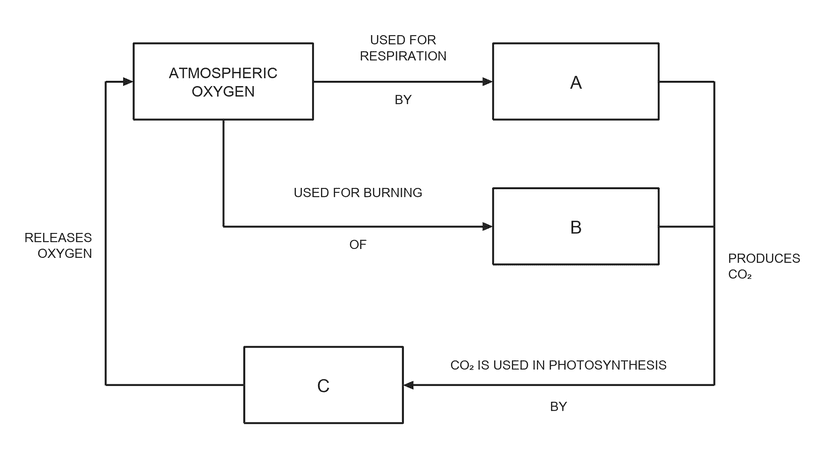 Solve with AI
Written solution
Solution:
Concept: Oxygen is used up in respiration and burning, and green plants put it back into the air by photosynthesis. This circulation is the oxygen cycle.
Step 1 — (a) Give four uses of oxygen.
Oxygen has many uses because it supports life and burning.
- Respiration: all living things need it; oxygen cylinders help patients with breathing problems and mountaineers at great heights.
- Burning of fuels: fuels burn in oxygen to give heat and light.
- Welding and cutting metals: the oxy-acetylene flame is hot enough to melt steel.
- Rockets: liquid oxygen is carried to burn the rocket fuel, since there is no air in space.
Step 2 — (b) Explain how oxygen is renewed.
Oxygen is used up all the time, yet its share of air stays almost constant. This is because green plants give out oxygen in photosynthesis, using carbon dioxide and water in sunlight:
Step 3 — (c) Fill in the oxygen cycle.
Read the arrows of the figure: atmospheric oxygen goes to A for respiration and to B for burning; both produce carbon dioxide, which C uses in photosynthesis before releasing oxygen.
- A: plants and animals (living things), which use oxygen for respiration;
- B: fuels, which use oxygen for burning;
- C: green plants, which use carbon dioxide in photosynthesis and release oxygen.
Watch out: Plants respire too, but in daylight they give out far more oxygen by photosynthesis than they use.
Therefore, oxygen is used for respiration, burning, welding and rockets; it is renewed by photosynthesis in green plants; and in the cycle A is plants and animals, B is fuels and C is green plants.
- 365 marks
Question 36
Sophia along with her classmates and teacher went on a school trip to Agra. She got an opportunity to visit Taj Mahal, the famous monument, made up of white marble. Sophia had heard a lot about its beauty but she was surprised to see the dull and pale yellow appearance of Taj Mahal.
Her teacher explained that it is due to the various factories in Agra, which emit harmful gases of sulphur and nitrogen in the atmosphere. These gases produce acid rain which has adverse effects on human health, animals, crops, buildings, etc.
(a) Name the gases which form the acid rain.
(b) What are the acids formed in the acid rain ?
(c) Give two balanced chemical equations to show the formation of acid rain.
(d) Why is Taj Mahal slowly turning yellow from white ?
(e) How can renewable sources of energy prevent air pollution ?
Solve with AIWritten solution
Solution:
Concept: Oxides of sulphur and nitrogen dissolve in rain water to form acids. Acid rain reacts with marble (calcium carbonate) and slowly damages it.
Step 1 — (a) Name the gases.
The gases that form acid rain are sulphur dioxide (and sulphur trioxide) and nitrogen dioxide.
Step 2 — (b) Name the acids.
These gases form sulphurous acid and sulphuric acid (from the oxides of sulphur) and nitrous acid and nitric acid (from nitrogen dioxide).
Step 3 — (c) Write two balanced equations.
Sulphur dioxide dissolves in rain water to form sulphurous acid:
Nitrogen dioxide dissolves in rain water to form nitrous acid and nitric acid:
Step 4 — (d) Explain the yellowing of the Taj Mahal.
The Taj Mahal is made of marble, which is calcium carbonate. The acids in acid rain react with the marble and turn its smooth surface into a rough, powdery layer, for example:
This slow damage, called marble cancer, makes the white surface dull and pale yellow.
Step 5 — (e) How renewable energy helps.
Solar, wind and water (hydro) energy produce electricity without burning fuels. So they release no smoke, sulphur dioxide, nitrogen dioxide or carbon monoxide, and using them in place of coal and petrol reduces air pollution and acid rain.
Watch out: The acids are not present in the factory smoke; they form when the oxides meet water in the air.
Note: Studies of the Taj Mahal have found that much of its yellow-brown tint also comes from fine soot and dust particles that settle on the marble; acid gases add to the damage by corroding the surface.
Therefore, sulphur dioxide and nitrogen dioxide form sulphuric, sulphurous, nitric and nitrous acids, the acids attack the marble of the Taj Mahal, and renewable energy cuts the burning of fuels that releases these gases.
What Class 7 Chemistry Ch 7 covers
The sections of the chapter, in the order the book takes them. Every question above comes from one of these.
- 01Constituents of Air
- 02The Importance of the Various Components of Air
- 03Air Quality
- 04Types of Pollutants in Air and Their Harmful Effects
- 05How to Prevent Air Pollution
- 06Oxygen
More ways to study this chapter
The same chapter asked three other ways. Practise it, revise it, and see what the board has set on Ch 7 before.
Class 7 Chemistry Ch 7 questions students ask
How many questions are there in Class 7 Chemistry Ch 7?
36 questions. Every one is solved step by step on this page.
Are these Class 7 Chemistry solutions free?
Yes. Every question and its full working is free to read, with no account needed.
Can I download the Class 7 Chemistry Ch 7 solutions as a PDF?
There is no PDF to download. Every solution is on this page instead, which means it is searchable, always the current syllabus, and readable on a phone. Use your browser's print option if you want it on paper.