
Opening your dashboard
Class 7 Chemistry Chapter 7 Air and Atmosphere: Competency-Based Questions (CBQ)
40 questions on Chapter 7, each worked through on its own page with the AI tutor. Class 7 Chemistry, ICSE 2026-27.
40 questions
1–5 marks · Mixed difficulty
- 11 mark
Question 1
Cognitive domain: Application
Zoya opens a packet of potato chips. The packet was puffed up like a pillow, and the chips are still crisp and fresh two months after they were packed. At the factory, the air inside each packet is pushed out by another gas just before the packet is sealed.
Which gas is used, and why?
- 21 mark
Question 2
Cognitive domain: Analysis
A teacher gives Arnav three gas jars X, Y and Z. One jar has oxygen, one has nitrogen and one has carbon dioxide, but the labels have fallen off. Arnav does three tests on each jar.
Jar A glowing splinter is put in A burning candle is put in Fresh lime water is shaken in the jar X Bursts into flame Burns more brightly Stays clear Y Goes out Goes out Turns milky Z Goes out Goes out Stays clear Which set of labels is correct?
- 31 mark
Question 3
Cognitive domain: Application
Farhan's teacher prepares oxygen in the laboratory. She puts exactly 2 g of black manganese dioxide powder in a flask and adds hydrogen peroxide solution drop by drop. Oxygen bubbles out quickly. When the bubbling stops, Farhan filters out the black powder, dries it well and weighs it.
What will Farhan most likely find?
- 41 mark
Question 4
Cognitive domain: Understanding
On a cold December morning in a big city, the air looks grey and thick. Drivers cannot see far ahead, and many people say that their eyes are burning. There was fog during the night. There was also a lot of smoke in the air from vehicles and from heaps of burning waste.
Which statement best explains what has happened?
- 51 mark
Question 5
Cognitive domain: Understanding
Assertion (A): In the laboratory, oxygen is collected by the downward displacement of water.
Reason (R): Oxygen is lighter than air and dissolves very easily in water.
- 61 mark
Question 6
Cognitive domain: Analysis
Assertion (A): Sand, limestone and water all contain oxygen, but none of them can relight a glowing splinter.
Reason (R): In these substances oxygen is present in the combined state, chemically joined to other elements.
- 71 mark
Question 7
Cognitive domain: Understanding
Gurpreet grows wheat on his farm every winter. This year an agriculture officer tells him to grow moong, a pulse crop, on the same land in summer. "It will make your soil richer in nitrogen without any fertiliser," she says.
Complete the sentences to explain how.
The roots of pulse (leguminous) plants have small swellings called root ________. Bacteria called ________ live in them. These bacteria change nitrogen of the air into ________, which the plant then uses to make proteins.
- 81 mark
Question 8
Cognitive domain: Understanding
Every spring, the trees and crops around Simran's village are in flower. Many villagers start sneezing and get itchy, watery eyes. There is no factory or heavy traffic near the village. A fine yellow powder from the flowers can be seen floating in the air.
Name this natural pollutant of the air.
- 91 mark
Question 9
Cognitive domain: Application
Meena pours freshly prepared lime water into two test tubes. With a small pump, she bubbles air from the room through tube 1 for one minute. The lime water still looks clear. Then she gently blows the air she breathes out through a straw into tube 2 for one minute.
Predict what Meena will see in tube 2. Name the gas that causes this change.
- 102 marks
Question 10
Cognitive domain: Application
At a science fair, Dev holds an empty paper cup over a candle flame. It catches fire at once. Then he fills another paper cup with water and holds it over the same flame. The water becomes hot, but this cup does not catch fire.
(a) Why does the empty paper cup catch fire?
(b) Why does the paper cup with water in it not catch fire, although it is held in the same flame?
- 112 marks
Question 11
Cognitive domain: Evaluation
A brick factory near Lata's village burns coal. Thick black smoke used to settle on the nearby houses and fields. The owner now builds a very tall chimney with filters inside it. He tells the villagers, "My factory does not pollute the air any more."
Is the owner's claim fully correct? Give one way in which the new chimney helps, and one reason why the claim is not completely true.
- 122 marks
Question 12
Cognitive domain: Evaluation
Kiran learns that green plants give out oxygen. She says, "Tonight I will keep ten potted plants in my bedroom and shut the door and all the windows. The plants will give me extra oxygen while I sleep."
Is Kiran's plan a good one? Give two reasons for your answer.
- 134 marks
Question 13
Cognitive domain: Analysis
The eco-club of a school measured the air at three places in its town for one week. The members used a small air monitor lent by a science centre. The table shows the average amount of three pollutants found in the air at each place. All amounts are in micrograms in one cubic metre of air. A bigger number means that more of the pollutant is present. The club also noted that most of the buses and trucks at the bus stand were old and gave out black smoke.
Place Dust and smoke particles Sulphur dioxide Nitrogen dioxide P – gate of a factory that burns coal 180 90 40 Q – crossing at the bus stand 240 20 85 R – town park 60 8 15 (a) Which place has the cleanest air? Use the table to support your answer.
(b) Sulphur dioxide is highest at P, and nitrogen dioxide is highest at Q. Suggest a reason for each of these two results.
(c) How many times as much dust and smoke is there in the air at Q as at R? Name two diseases that people who work at Q all day may get. Suggest two steps, for the buses and trucks, that would make the air at Q cleaner.
- 144 marks
Question 14
Cognitive domain: Application
A factory makes all its products from ordinary air. First, the dust, water vapour and carbon dioxide are removed. The clean air is then cooled and squeezed under high pressure until it turns into a pale blue liquid at about −200°C. This liquid air is allowed to warm up slowly. The gases boil off one after another and are collected in separate tanks. The factory sells them to a hospital ward, a blood bank, a factory that makes electric bulbs and a welding workshop.
Gas Boiling point Nitrogen −196°C Argon −186°C Oxygen −183°C (a) As the liquid air warms up, which gas boils off first and which boils off last? Give a reason.
(b) The gases of the air are separated here without any chemical reaction. What does this tell you about air? Give one more piece of evidence for this from the table.
(c) Which gas should the factory send to each of its four buyers? State what each buyer uses the gas for.
- 155 marks
Question 15
Cognitive domain: Creativity
The iron gates and window grills of Aditi's school rust badly every monsoon. Her teacher says, "Iron rusts only when both air and moisture are present." Aditi wants to test this statement herself.
She has: four new iron nails of the same kind, four test tubes with corks, tap water, water that has been boiled and cooled (boiling drives out the air dissolved in water), cooking oil, and some anhydrous calcium chloride (a white solid that soaks up moisture from the air).
(a) Design the experiment. Describe what Aditi should put in each of three test tubes, so that one nail gets both air and moisture, one nail gets air but no moisture, and one nail gets water but no air.
(b) Predict what Aditi will see in each test tube after one week. What do the results show?
(c) State two things that Aditi must keep the same for all the test tubes so that the test is fair.
(d) One nail and one test tube are left. Suggest how Aditi can use them to find out whether painting protects iron from rusting. Explain why paint should work.
- 161 mark
Question 16
Cognitive domain: Analysis
In a science class, Ms Mehta draws 100 equal squares to stand for 100 volumes of clean, dry air. She colours the squares for three groups of gases X, Y and Z, as shown. Z stands for all the remaining gases of the air taken together.
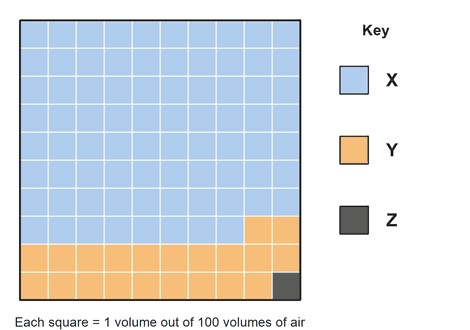
Which statement is correct?
- 171 mark
Question 17
Cognitive domain: Application
A sweet shop sends ice cream to a wedding in an insulated box packed with blocks of dry ice. The box is opened in a well-aired place. After a few hours the blocks of dry ice have become much smaller, but the inside of the box is completely dry. There is no puddle of water, as there would have been with blocks of ordinary ice.
Which statement explains this?
- 181 mark
Question 18
Cognitive domain: Analysis
Rahul's notes say, "Non-metals form acidic oxides, and metals form basic oxides." He knows that hydrogen is a non-metal and that it burns in oxygen to form water, so water is an oxide of hydrogen. He dips a moist blue litmus paper and a moist red litmus paper into pure distilled water. Neither paper changes colour.
Which conclusion is correct?
- 191 mark
Question 19
Cognitive domain: Understanding
Assertion (A): After a thunderstorm, the soil receives some nitrogen compounds that plants can use.
Reason (R): Lightning provides the very high temperature at which the nitrogen and oxygen of the air combine to form oxides of nitrogen, which rain carries to the soil as acids.
- 201 mark
Question 20
Cognitive domain: Analysis
Aman prepares oxygen from 50 cm³ of the same hydrogen peroxide solution in two separate trials, and collects all the oxygen over water. In trial 1 he adds 0.5 g of manganese dioxide powder. In trial 2 he adds 1.0 g of the same powder. The graph shows the volume of oxygen collected against time.

Which conclusion is supported by the graph?
- 211 mark
Question 21
Cognitive domain: Analysis
The diagram shows how nitrogen moves between the air, the soil, plants and animals. Four arrows are marked P, Q, R and S.
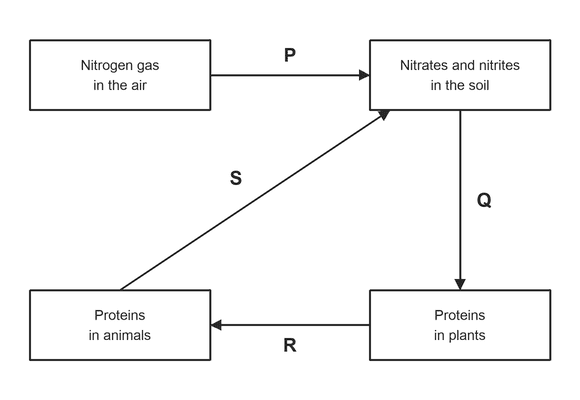
Which row correctly describes the four arrows?
- 221 mark
Question 22
Cognitive domain: Application
Two identical new iron railings were fixed in the same year. One is in a hill village far from industry. The other is at a crossing beside a factory that burns coal. Both places get the same amount of rain. After one rainy season, the second railing is much more rusted than the first.
Which statement best explains this?
- 231 mark
Question 23
Cognitive domain: Application
Aarav's mass is 40 kg. His teacher tells him that about 65% of the mass of the human body is oxygen. Aarav wonders whether he is carrying a heavy load of the gas that he breathes.
Which statement is correct?
- 241 mark
Question 24
Cognitive domain: Understanding
Water vapour enters the air through many natural processes and human activities, and some processes take it out of the air.
Which of the following does not add water vapour to the air?
- 251 mark
Question 25
Cognitive domain: Analysis
Assertion (A): Argon is filled in electric bulbs because it reacts with the hot filament and makes it glow brighter.
Reason (R): Argon is an inert gas.
- 262 marks
Question 26
Cognitive domain: Evaluation
Before Diwali, the residents' association of a colony in Delhi must choose one of two plans for the festival night. Plan 1 is a large display of firecrackers in the colony park. Plan 2 is a laser light show with music in the same park, in which nothing is burnt. It is late autumn, and the nights are already foggy.
Which plan is better for the air of the colony? Give two reasons from the chapter.
- 272 marks
Question 27
Cognitive domain: Application
A rocket that travels into space carries a large tank of liquid oxygen along with its fuel. An aeroplane that flies within the lower atmosphere carries only its fuel and no oxygen tank.
(a) Why must the rocket carry its own oxygen, while the aeroplane does not need to?
(b) Why is the oxygen carried as a liquid and not as a gas?
- 282 marks
Question 28
Cognitive domain: Analysis
Pooja studies three processes in which a substance combines with oxygen. She writes down what she notes about each.
Process Where and when it happens Heat and light Other notes P In the cells of her body, all the time A little heat, no light Glucose is used up; carbon dioxide and water vapour are formed Q On an iron gate outside, over several months Very little heat, no light A brownish red, flaky coating forms; moisture is needed R In the kitchen, when LPG is lit with a match A large amount of heat and light Burns only after it has been lit (a) Name the processes P, Q and R.
(b) Pooja's friend says, "Q cannot be an oxidation, because it gives no flame and no light." Use the table to show that he is wrong.
- 292 marks
Question 29
Cognitive domain: Application
Tara prepares oxygen in the school laboratory from hydrogen peroxide and manganese dioxide, and collects it in gas jars over water. Before she starts, the flask and the delivery tube are full of air. She fills jar 1 first, and a glowing splinter does not catch fire in it. She then fills jar 2, and the glowing splinter relights at once.
(a) Why does the glowing splinter fail to relight in jar 1?
(b) How will Tara know when jar 2 is completely full of oxygen?
- 302 marks
Question 30
Cognitive domain: Evaluation
Riya's mother asks her to switch off the fan and the lights in the empty hall. Her brother says, "That has nothing to do with air pollution. Electricity comes through wires, and nothing is burnt in our house." Their town gets its electricity from a power station that burns coal.
Is her brother right? Explain, and give one other thing the family can do to keep the air clean.
- 312 marks
Question 31
Cognitive domain: Analysis
After a thunderstorm in an industrial town, Imran collects some rain water in a clean glass bowl. A moist blue litmus paper dipped in it turns red. Two sources of the gases are suspected: the coal-burning factory nearby, which gives sulphur dioxide, and the lightning during the storm.
(a) Write the equation for the acid formed from sulphur dioxide and rain water.
(b) Name a gas that is present even in clean air and also makes rain water slightly acidic, and write the equation for the acid it forms. Why can the litmus test alone not tell Imran which source made this rain water acidic?
- 323 marks
Question 32
Cognitive domain: Application
A scientist keeps a sample of oxygen at normal atmospheric pressure and slowly changes its temperature. At this pressure, oxygen boils at −183 °C and freezes at −218.4 °C.
State the physical state of oxygen at each of these temperatures, with a reason:
(a) −150 °C
(b) −200 °C
(c) −220 °C
- 333 marks
Question 33
Cognitive domain: Understanding
The label on a bottle of cooking oil says that it contains an antioxidant. Priya says, "That is a waste. Air is full of oxygen, and oxygen is good for us."
(a) What may happen to the oil if it reacts slowly with the oxygen of the air?
(b) How does an antioxidant help?
(c) Name two common kitchen foods that are good sources of antioxidants.
- 343 marks
Question 34
Cognitive domain: Application
The first-aid room of a hospital keeps a cylinder labelled carbogen. The label says that the gas contains 95% oxygen and 5% carbon dioxide by volume, and the cylinder holds 20 litres of the gas.
(a) Find the volume of oxygen and the volume of carbon dioxide in the cylinder.
(b) Write the ratio of the volume of oxygen to the volume of carbon dioxide in the simplest form.
(c) For what purpose is carbogen given to patients?
- 353 marks
Question 35
Cognitive domain: Evaluation
A workshop must cut a thick steel plate. Steel must be heated to about 1500 °C before it melts. The owner can choose any one of three flames.
Flame Temperature Oxygen with hydrogen (oxy-hydrogen) about 2800 °C Oxygen with acetylene (oxy-acetylene) about 3300 °C A burner using air instead of pure oxygen (Hypothetical data.) about 1400 °C (a) Which of the flames can melt the steel plate?
(b) Which flame is the best choice for the thick plate? Give a reason.
(c) Why is a flame with pure oxygen hotter than a flame with air?
- 363 marks
Question 36
Cognitive domain: Analysis
The equations below show respiration of glucose in living cells and photosynthesis in green plants. Energy is released in respiration, and sunlight is needed for photosynthesis.
(a) When 5 molecules of glucose respire, how many molecules of oxygen are used and how many molecules of carbon dioxide are formed?
(b) Suppose that in one hour of sunlight a tiny part of a leaf makes 5 molecules of glucose by photosynthesis, and in the same hour its own respiration uses up 2 molecules of glucose. (Hypothetical data.) How many molecules of oxygen does this part of the leaf give out to the air in that hour?
(c) How many molecules of carbon dioxide does it remove from the air in that hour? What does this show about the part that green plants play in the oxygen cycle?
- 374 marks
Question 37
Cognitive domain: Analysis
The eco-club of a school studied how the students who live about 1 km from the school can reach it. Walking and cycling do not burn any fuel, but every motor vehicle burns fuel and gives out carbon dioxide, along with smaller amounts of harmful gases such as carbon monoxide. The club wants to advise the students on the cleanest way to travel. Its teacher reminds the members that a fair comparison needs the gases per student, not only the total for a vehicle. The club estimated the mass of exhaust gases released in one trip of 1 km. (Hypothetical data.)
Way of reaching school Students carried Exhaust gases released in the trip Walking or cycling 1 0 g School bus 40 1000 g Car with one student 1 150 g Car-pool (one car) 4 150 g (a) Which way of reaching school causes no air pollution by burning fuel? Find the mass of exhaust gases per student for the school bus.
(b) How many times is the mass of exhaust gases per student for a car with one student as great as for the car-pool?
(c) Name one harmful gas given out by motor vehicles and one health problem it causes. Which way of reaching school should the club recommend for students living 1 km away? Give a reason.
- 384 marks
Question 38
Cognitive domain: Analysis
To understand global warming, Neha parks a car in an open place on a sunny day in May. She keeps all the windows shut and places one thermometer inside the car and one outside in the shade. Her teacher says that the shut car acts like a small model of the earth's atmosphere. Neha reads both thermometers every hour from 10 a.m. to 4 p.m. and draws a graph, because a graph shows the changes through the day at a glance. (Hypothetical data.)

(a) Read the graph. What are the temperatures inside and outside the car at 2 p.m., and what is the difference?
(b) At what time of the day was the difference between the two temperatures the greatest, and at what time was it the least?
(c) Why is the air inside the car so much hotter? Explain how this is like global warming, and suggest one way to reduce the temperature inside a parked car.
- 395 marks
Question 39
Cognitive domain: Evaluation
A farmer has three equal plots of land with the same soil. Before the season, each plot has 20 mg of nitrates for every kilogram of soil. In plot A he grows wheat with no fertiliser. In plot B he grows peas, a plant with root nodules, with no fertiliser. In plot C he grows wheat and adds a nitrogen fertiliser. After the season, he measures the nitrates again. (Hypothetical data.)
Plot Crop Nitrates after the season (mg per kg of soil) A Wheat, no fertiliser 12 B Peas, no fertiliser 26 C Wheat with fertiliser 40 (a) Find the change in the nitrates in each plot. In which plot, without any added fertiliser, did the nitrates increase?
(b) Explain the result in plot B and the result in plot A.
(c) The farmer says, "Plot C has the most nitrates, so fertiliser is always better than growing peas." Evaluate his statement.
- 404 marks
Question 40
Cognitive domain: Creativity
Asha wants to compare how much dust is present in the air at four places in her school: the playground, the classroom corridor, the road gate and the garden. She has four identical clean glass slides, some petroleum jelly (a sticky jelly), a magnifying lens and a marker. Her teacher says that dust does not settle equally everywhere. Asha thinks that the road gate is the dustiest place, but she wants to test her idea with an experiment instead of guessing.
(a) Describe how Asha can use these items to compare the dust at the four places.
After seven days, she counts the dust specks in a 1 cm square of each slide. (Hypothetical data.)
Place Playground Corridor Road gate Garden Dust specks 120 40 300 60 (b) Which place has the most dust? How many times as many specks are there at this place as in the garden?
(c) State two things Asha must keep the same so that the test is fair. Suggest two steps to reduce the dust at the road gate.