
Opening your dashboard
Class 7 Chemistry Chapter 3: Elements, Compounds and Mixtures Solutions
41 textbook questions with step-by-step answers, free to read, for ICSE 2026-27.
Get talked through Ch 3, not just shown the answer
Reading a finished solution is not the same as being able to do it. The AI tutor takes one question at a time and works it with you, in your own words, until you can.
- Ask it out loud, in your own words
- It gives you the next step, not the answer
- Stuck on part (ii)? Start there
41 questions with solutions
1–5 marks · Easy difficulty
- 11 mark
Question 1
Atoms of different kinds combine to form molecules of :
Solve with AIAnswer
(A) an element
- Correct
(B) a compound
(C) a mixture
(D) none of the above
Answer: (B) a compound
Concept: An element is a pure substance made up of only one kind of atoms. A compound is a pure substance formed when two or more elements combine chemically in a fixed ratio by mass. A mixture contains two or more substances that are not combined chemically.
Step 1 — Read what the molecule contains.
The question says the molecule is built from atoms of different kinds, joined chemically.
Step 2 — Match it with the right type of substance.
A substance whose molecules contain chemically combined atoms of two or more elements is a compound. For example, one water molecule () has two hydrogen atoms joined to one oxygen atom.
Watch out: An element can also have molecules (such as ), but all the atoms in them are of the same kind.
Why the other options are wrong:
- (A) an element: An element is made up of only one kind of atoms, so its molecules (such as or ) never contain different kinds of atoms.
- (C) a mixture: In a mixture the substances are only mixed, not chemically combined, so a mixture is not made of one kind of molecule built from different atoms.
- (D) none of the above: This is wrong because option (B) fits the description exactly.
Therefore, atoms of different kinds combine to form molecules of a compound, option (B).
- 21 mark
Question 2
Which of the following is an inert gas ?
Solve with AIAnswer
(A)
(B)
- Correct
(C) He
(D) S
Answer: (C) He
Concept: Inert (noble) gases hardly react with other elements. They are helium, neon, argon, krypton, xenon and radon. Helium, neon and argon form no compounds under ordinary conditions.
Step 1 — Look for a noble gas among the options.
Of the four symbols, only He stands for one of the noble gases.
Step 2 — Check that it is a gas that hardly reacts.
Helium is a gas that forms no compounds under ordinary conditions, so it is an inert gas.
Watch out: Hydrogen and chlorine are gases too, but they react readily, so being a gas is not enough.
Why the other options are wrong:
- (A): Hydrogen is a reactive non-metal gas; it burns in air to form water.
- (B): Chlorine is a very reactive non-metal gas; it combines with most metals.
- (D) S: Sulphur is a non-metal, but it is a yellow solid at room temperature, not a gas, and it burns in air.
Therefore, the inert gas among the options is helium, He, option (C).
- 31 mark
Question 3
The molecular formula of common salt is :
Solve with AIAnswer
(A) MgO
- Correct
(B) NaCl
(C)
(D)
Answer: (B) NaCl
Concept: The chemical name of common salt is sodium chloride. It is made of the elements sodium (Na) and chlorine (Cl) in the ratio 1 : 1.
Step 1 — Name the compound.
Common salt is sodium chloride, so its formula must contain only Na and Cl.
Step 2 — Write the formula.
One sodium combines with one chlorine, so the formula is NaCl.
Watch out: Common salt is made of ions, so NaCl is strictly its formula unit; this chapter calls it the molecular formula.
Why the other options are wrong:
- (A) MgO: MgO is magnesium oxide, made of magnesium and oxygen.
- (C): is carbon dioxide, a gas made of carbon and oxygen.
- (D): is sodium sulphate; it contains sulphur and oxygen as well as sodium.
Therefore, the formula of common salt is NaCl, option (B).
- 41 mark
Question 4
Which of the following is a metalloid ?
Solve with AIAnswer
(A) Argon
- Correct
(B) Silicon
(C) Berrylium
(D) Phosphorus
Answer: (B) Silicon
Concept: Metalloids are elements that show some properties of metals and some of non-metals. Common examples are boron, silicon, germanium, arsenic, antimony and tellurium.
Step 1 — Sort the four elements.
Argon is a noble gas, beryllium is a metal, phosphorus is a non-metal and silicon is a metalloid.
Step 2 — Pick the metalloid.
Silicon is shiny like a metal but brittle like a non-metal, and it conducts electricity only a little. So silicon is the metalloid.
Why the other options are wrong:
- (A) Argon: Argon is an inert (noble) gas, not a metalloid.
- (C) Berrylium: Beryllium (spelt 'Berrylium' in the option) is a metal in group IIA.
- (D) Phosphorus: Phosphorus is a non-metal; it does not conduct electricity.
Therefore, silicon is a metalloid, option (B).
- 51 mark
Question 5
Quicklime is a compound of :
Solve with AIAnswer
- Correct
(A) Calcium and oxygen
(B) Magnesium and oxygen
(C) Calcium and chlorine
(D) Magnesium and sulphur
Answer: (A) Calcium and oxygen
Concept: Quicklime is calcium oxide, CaO. It is made by strongly heating limestone (calcium carbonate).
Step 1 — Write the formula of quicklime.
The chemical name of quicklime is calcium oxide, and its formula is CaO.
Step 2 — Read the elements from the formula.
The symbols Ca and O show that quicklime is a compound of calcium and oxygen.
Watch out: Do not confuse quicklime (CaO) with slaked lime, , which also contains hydrogen.
Why the other options are wrong:
- (B) Magnesium and oxygen: Magnesium and oxygen form magnesium oxide, MgO, not quicklime.
- (C) Calcium and chlorine: Calcium and chlorine form calcium chloride, .
- (D) Magnesium and sulphur: Magnesium and sulphur form magnesium sulphide, MgS.
Therefore, quicklime is a compound of calcium and oxygen, option (A).
- 65 marks
Question 6
Select elements and compounds from the following list :
Iron, plaster of paris, chalk, common salt, copper, aluminium, calcium oxide, cane sugar, carbon, silica, sodium sulphate, uranium, potassium carbonate, silver, carbon dioxide.
Solve with AIWritten solution
Solution:
Concept: An element is a pure substance made up of only one kind of atoms. A compound is a pure substance formed when two or more elements combine chemically in a fixed ratio by mass. A mixture contains two or more substances that are not combined chemically.
Step 1 — Decide the test for each item.
Ask whether the substance has only one kind of atom (an element) or is made of two or more elements combined chemically (a compound). Writing its formula helps.
Step 2 — Pick out the elements.
Iron (Fe), copper (Cu), aluminium (Al), carbon (C), uranium (U) and silver (Ag) each have a single symbol, so each is made of one kind of atom. These six are elements.
Step 3 — Pick out the compounds.
Each of the other nine substances contains two or more elements combined chemically:
Compound Elements present Plaster of Paris (hydrated calcium sulphate) calcium, sulphur, oxygen, hydrogen Chalk (calcium carbonate, ) calcium, carbon, oxygen Common salt (sodium chloride, NaCl) sodium, chlorine Calcium oxide (CaO) calcium, oxygen Cane sugar () carbon, hydrogen, oxygen Silica () silicon, oxygen Sodium sulphate () sodium, sulphur, oxygen Potassium carbonate () potassium, carbon, oxygen Carbon dioxide () carbon, oxygen Watch out: Carbon is an element, but carbon dioxide and potassium carbonate are compounds because carbon is combined with other elements in them.
Therefore, the elements are iron, copper, aluminium, carbon, uranium and silver; the compounds are plaster of Paris, chalk, common salt, calcium oxide, cane sugar, silica, sodium sulphate, potassium carbonate and carbon dioxide.
- 75 marks
Question 7
Write the symbols of : Helium, Silver, Krypton, Antimony, Barium.
Solve with AIWritten solution
Solution:
Concept: A symbol is a short way of writing an element. It is the first letter of the English or Latin name written as a capital, followed where needed by one more letter of the name written small.
Step 1 — Symbols from the English names.
Helium is He, krypton is Kr and barium is Ba; each uses the first letter and one more letter of the English name.
Step 2 — Symbols from the Latin names.
Silver is Ag, from its Latin name Argentum, and antimony is Sb, from its Latin name Stibium.
Watch out: The second letter is always written small: Kr, not KR.
Therefore, helium He, silver Ag, krypton Kr, antimony Sb and barium Ba.
- 85 marks
Question 8
Write the names of the following elements : Na, C, Kr, U, Ra, Fe, Co.
Solve with AIWritten solution
Solution:
Concept: Each symbol stands for one element. Most come from the English name; a few come from the Latin name.
Step 1 — Symbols from English names.
C is carbon, Kr is krypton, U is uranium, Ra is radium and Co is cobalt.
Step 2 — Symbols from Latin names.
Na is sodium (Latin Natrium) and Fe is iron (Latin Ferrum).
Watch out: Co (cobalt, an element) is different from CO (carbon monoxide, a compound); the small o matters.
Therefore, Na sodium, C carbon, Kr krypton, U uranium, Ra radium, Fe iron and Co cobalt.
- 95 marks
Question 9
Name the main metal present in the following:
(a) Haemoglobin
(b) Chalk
(c) Chlorophyll
(d) Chocolate wrapper
Solve with AIWritten solution
Solution:
Concept: Many everyday substances contain a metal as an important part, joined chemically with other elements.
Step 1 — (a) Haemoglobin.
Haemoglobin, the red pigment in red blood cells that carries oxygen, contains iron.
Step 2 — (b) Chalk.
Chalk is calcium carbonate, so its metal is calcium.
Step 3 — (c) Chlorophyll.
Chlorophyll, the green pigment of leaves, has magnesium at the centre of each molecule.
Step 4 — (d) Chocolate wrapper.
The shiny foil used to wrap chocolate is a thin sheet of aluminium.
Watch out: Haemoglobin contains iron, but chlorophyll contains magnesium; the two pigments are easy to mix up.
Therefore, (a) iron, (b) calcium, (c) magnesium, (d) aluminium.
- 104 marks
Question 10
Name the particles of which :
(a) an element is made up of
(b) a compound is made up of
Solve with AIWritten solution
Solution:
Concept: The smallest particle of an element is an atom. The smallest particle of a compound that can exist on its own is a molecule.
Step 1 — (a) Particles of an element.
An element is made up of atoms of only one kind. (In many elements, such as oxygen, , these atoms join in pairs to form molecules of the element.)
Step 2 — (b) Particles of a compound.
A compound is made up of molecules, and each molecule contains atoms of two or more different elements combined chemically, for example .
Therefore, (a) an element is made up of atoms of one kind, and (b) a compound is made up of molecules.
- 114 marks
Question 11
Define :
(a) Elements
(b) Compounds
Solve with AIWritten solution
Solution:
Concept: Elements and compounds are both pure substances. They differ in whether they can be split into simpler substances by chemical means.
Step 1 — (a) Define an element.
An element is a pure substance made up of only one kind of atoms, which cannot be broken down into anything simpler by chemical methods. Examples: iron, oxygen.
Step 2 — (b) Define a compound.
A compound is a pure substance formed by the chemical combination of two or more elements in a fixed ratio by mass. It can be broken down into its elements only by chemical methods. Examples: water, common salt.
Watch out: A compound has a fixed ratio of its elements (water always has hydrogen and oxygen in the ratio 1 : 8 by mass); a mixture does not.
Therefore, an element is a pure substance of one kind of atoms, and a compound is a pure substance of two or more elements chemically combined in a fixed ratio by mass.
- 125 marks
Question 12
What do you understand by :
(a) Metalloids
(b) Noble gases
Give two examples of each.
Solve with AIWritten solution
Solution:
Concept: Besides metals and non-metals, elements are also grouped as metalloids and noble (inert) gases.
Step 1 — (a) Explain metalloids.
Metalloids are elements that show some properties of metals and some properties of non-metals. For example, silicon is shiny like a metal but brittle like a non-metal. All of them are solids at room temperature.
Step 2 — Give two metalloids.
Boron and silicon are metalloids (germanium, arsenic and antimony are others).
Step 3 — (b) Explain noble gases.
Noble gases are elements that hardly react with other elements, so they are also called inert gases. There are six of them in nature, and all except radon are present in air in small amounts.
Step 4 — Give two noble gases.
Helium and neon are noble gases (argon, krypton, xenon and radon are the others).
Watch out: The noble gases are not completely unreactive: krypton and xenon form a few compounds, so the safe word is “hardly react”.
Therefore, metalloids (e.g. boron, silicon) have properties of both metals and non-metals, and noble gases (e.g. helium, neon) hardly react with other elements.
- 133 marks
Question 13
Give four examples of non-metallic elements.
Solve with AIWritten solution
Solution:
Concept: Non-metals are elements that are usually dull, brittle when solid, and poor conductors of heat and electricity. Leaving out the noble gases, only about a dozen are known.
Step 1 — List four non-metals.
Hydrogen, oxygen, nitrogen and sulphur are non-metals.
Step 2 — Check each one.
Hydrogen, oxygen and nitrogen are gases, and sulphur is a brittle yellow solid; none of them conducts electricity. Carbon, chlorine, phosphorus and iodine are other examples.
Watch out: Graphite, a form of carbon, conducts electricity, yet carbon is still a non-metal.
Therefore, four non-metallic elements are hydrogen, oxygen, nitrogen and sulphur.
- 141 mark
Question 14
A pure liquid is obtained from a solution by :
Solve with AIAnswer
(A) evaporation
- Correct
(B) distillation
(C) filteration
(D) sublimation
Answer: (B) distillation
Concept: Distillation gets a pure liquid from a solution: the solution is boiled, and the vapour is cooled in a condenser so that it turns back into liquid (the distillate).
Step 1 — Note what is wanted.
The question asks for the liquid part of a solution, in pure form, so the liquid must be collected.
Step 2 — Choose the method that collects the liquid.
In distillation the vapour is condensed and collected, while the dissolved solid stays in the flask. So a pure liquid is obtained by distillation.
Watch out: Evaporation and distillation both turn the liquid into vapour, but only distillation condenses and keeps it.
Why the other options are wrong:
- (A) evaporation: Evaporation leaves the dissolved solid behind, but the liquid escapes into the air as vapour and is lost.
- (C) filteration: Filtration removes only insoluble solid particles; dissolved substances pass through the filter paper with the liquid.
- (D) sublimation: Sublimation separates a solid that changes directly into vapour; it does not give a liquid.
Therefore, a pure liquid is obtained from a solution by distillation, option (B).
- 151 mark
Question 15
The components of crude petroleum can be separated by :
Solve with AIAnswer
(A) distillation
(B) evaporation
(C) filtration
- Correct
(D) fractional distillation
Answer: (D) fractional distillation
Concept: Crude petroleum is a mixture of many miscible liquids whose boiling points are close together. Such liquids are separated by fractional distillation, which uses a fractionating column.
Step 1 — Note the kind of mixture.
The parts of crude petroleum (petrol, kerosene, diesel and others) are liquids that mix completely and boil at different but nearby temperatures.
Step 2 — Pick the method for such liquids.
In a fractionating column each part condenses at its own height, so the parts are collected one by one. This is fractional distillation.
Why the other options are wrong:
- (A) distillation: Simple distillation works for a solid dissolved in a liquid, or for liquids whose boiling points are far apart; the parts of crude oil boil close together, so they would distil over mixed.
- (B) evaporation: Evaporation only lets the liquids escape as vapour; it does not separate them from one another.
- (C) filtration: Filtration separates an insoluble solid from a liquid, not one liquid from another.
Therefore, the components of crude petroleum are separated by fractional distillation, option (D).
- 161 mark
Question 16
An example of a homogeneous mixture is:
Solve with AIAnswer
- Correct
(A) tap water
(B) distilled water
(C) sand and water
(D) water and oil
Answer: (A) tap water
Concept: In a homogeneous mixture the components are spread evenly throughout, and they cannot be seen separately. In a heterogeneous mixture they are not spread evenly.
Step 1 — Check each option is a mixture.
Distilled water is pure water, a compound, so it is not a mixture at all. The other three are mixtures.
Step 2 — Pick the one that is uniform.
Tap water has small amounts of salts and air dissolved evenly in it, and no separate parts can be seen. So tap water is a homogeneous mixture.
Why the other options are wrong:
- (B) distilled water: Distilled water is a pure substance (a compound), not a mixture.
- (C) sand and water: Sand and water form a heterogeneous mixture; the sand settles at the bottom.
- (D) water and oil: Water and oil form a heterogeneous mixture; they separate into two layers.
Therefore, tap water is a homogeneous mixture, option (A).
- 171 mark
Question 17
In chromatography, the filter paper is :
Solve with AIAnswer
- Correct
(A) stationary phase
(B) mobile phase
(C) mixture
(D) none of the above
Answer: (A) stationary phase
Concept: In paper chromatography a drop of the mixture is put on a strip of filter paper, and a solvent rises up the paper. The part that stays still is the stationary phase; the moving solvent is the mobile phase.
Step 1 — Decide whether the paper moves.
The filter paper is fixed in place; only the solvent moves up through it.
Step 2 — Name its role.
The paper holds back the components to different extents while the solvent carries them, so the filter paper is the stationary phase.
Why the other options are wrong:
- (B) mobile phase: The mobile phase is the solvent (such as water or alcohol) that moves up the paper.
- (C) mixture: The mixture is the spot of substance (for example ink) put on the paper, not the paper itself.
- (D) none of the above: This is wrong because option (A) is correct.
Therefore, in chromatography the filter paper is the stationary phase, option (A).
- 181 mark
Question 18
A set of mixtures is :
Solve with AIAnswer
- Correct
(A) ink, honey, ice cream, milk
(B) tap water, gold, common salt, alloy
(C) milk, brass, silver, honey
(D) butter, petroleum, tap water, iron
Answer: (A) ink, honey, ice cream, milk
Concept: A mixture contains two or more substances that are not combined chemically. For a set to be a set of mixtures, every item in it must be a mixture.
Step 1 — Test each item of set (A).
Ink is a dye dissolved in a liquid, honey is sugars in water, ice cream is milk, sugar, fat and air, and milk is fat and proteins in water. All four are mixtures.
Step 2 — Check the other sets for a pure substance.
Each of the other sets contains at least one element or compound, so only set (A) is a set of mixtures.
Watch out: One pure substance in a set is enough to rule that set out.
Why the other options are wrong:
- (B) tap water, gold, common salt, alloy: Gold is an element and common salt is a compound, so this set is not all mixtures.
- (C) milk, brass, silver, honey: Silver is an element, so this set is not all mixtures.
- (D) butter, petroleum, tap water, iron: Iron is an element, so this set is not all mixtures.
Therefore, ink, honey, ice cream and milk form a set of mixtures, option (A).
- 191 mark
Question 19
The substance which can be separated by sublimation from a mixture is :
Solve with AIAnswer
(A) salt
- Correct
(B) camphor
(C) petrol
(D) sand
Answer: (B) camphor
Concept: Sublimation separates a solid that changes directly into vapour on heating (and back into a solid on cooling) from substances that do not.
Step 1 — Find the substance that sublimes.
Camphor turns directly into vapour on warming, without melting, and the vapour turns back into solid camphor on a cool surface.
Step 2 — Conclude.
So camphor can be separated from a mixture by sublimation.
Why the other options are wrong:
- (A) salt: Common salt does not sublime; it is recovered from water by evaporation.
- (C) petrol: Petrol is a liquid, so sublimation, a change of a solid, does not apply to it.
- (D) sand: Sand does not sublime; in a sand and camphor mixture, sand is the part left behind.
Therefore, camphor can be separated from a mixture by sublimation, option (B).
- 201 mark
Question 20
A solid-solid mixture is :
Solve with AIAnswer
(A) Salt and water
(B) Mustard oil and water
(C) Honey
- Correct
(D) Alloys
Answer: (D) Alloys
Concept: Mixtures are named by the states of their parts. An alloy is a mixture of a metal with other metals or with a non-metal, and at room temperature it is a solid in which every part is a solid.
Step 1 — Name the states in each option.
Salt and water is solid in liquid, mustard oil and water is liquid in liquid, and honey is sugars dissolved in water, a liquid mixture.
Step 2 — Pick the solid-solid mixture.
An alloy such as brass (copper and zinc) has only solid parts, so alloys are solid-solid mixtures.
Why the other options are wrong:
- (A) Salt and water: Salt and water is a solid-liquid mixture.
- (B) Mustard oil and water: Mustard oil and water is a liquid-liquid mixture.
- (C) Honey: Honey is a thick liquid mixture of sugars in water, not a solid-solid mixture.
Therefore, alloys are solid-solid mixtures, option (D).
- 211 mark
Question 21
Assertion (A) : The molecules of elements and compounds are represented by formulae, formed using atomic symbols.
Reason (R) : Mixtures are impure substances.
Solve with AIAnswer
(A) Both A and R are true and R is the correct explanation of A.
- Correct
(B) Both A and R are true but R is not the correct explanation of A.
(C) A is true but R is false.
(D) A is false but R is true.
Answer: (B) Both A and R are true but R is not the correct explanation of A.
Concept: Judge the Assertion (A) on its own, then the Reason (R) exactly as printed, and only then decide whether R explains A.
Step 1 — Judge the Assertion.
Molecules of elements and of compounds are written as formulae made from symbols, for example and . So A is true.
Step 2 — Judge the Reason.
Mixtures contain two or more substances, so they are impure substances. R is true.
Step 3 — Decide whether R explains A.
R is about mixtures, while A is about how molecules of pure substances are written. R says nothing about formulae, so it does not explain A.
Watch out: Two true statements are not enough; R must give the reason for A.
Why the other options are wrong:
- (A): This needs R to explain A, but the impurity of mixtures has nothing to do with writing formulae.
- (C): This needs R to be false, but mixtures are impure substances, so R is true.
- (D): This needs A to be false, but molecules are written as formulae, so A is true.
Therefore, both A and R are true, but R is not the correct explanation of A, option (B).
- 221 mark
Question 22
Assertion (A) : Kerosene oil and water can be separated by a separating funnel.
Reason (R) : Kerosene oil and water are immiscible liquids.
Solve with AIAnswer
- Correct
(A) Both A and R are true and R is the correct explanation of A.
(B) Both A and R are true but R is not the correct explanation of A.
(C) A is true but R is false.
(D) A is false but R is true.
Answer: (A) Both A and R are true and R is the correct explanation of A.
Concept: Judge the Assertion (A) on its own, then the Reason (R) exactly as printed, and only then decide whether R explains A.
Step 1 — Judge the Assertion.
Kerosene and water form two layers in a separating funnel. Opening the stopcock lets the lower layer (water) run out first, leaving the kerosene. So A is true.
Step 2 — Judge the Reason.
Kerosene and water do not mix, so they are immiscible liquids. R is true.
Step 3 — Decide whether R explains A.
A separating funnel works only because the two liquids stay as separate layers, that is, because they are immiscible. So R explains A.
Why the other options are wrong:
- (B): This says R does not explain A, but immiscibility is exactly why the funnel can separate them.
- (C): This needs R to be false, but kerosene and water are immiscible, so R is true.
- (D): This needs A to be false, but the separating funnel does separate them, so A is true.
Therefore, both A and R are true and R is the correct explanation of A, option (A).
- 231 mark
Question 23
Assertion (A) : Mixtures are either homogeneous or heterogeneous in nature.
Reason (R) : A salt solution in water is a heterogeneous mixture.
Solve with AIAnswer
(A) Both A and R are true and R is the correct explanation of A.
(B) Both A and R are true but R is not the correct explanation of A.
- Correct
(C) A is true but R is false.
(D) A is false but R is true.
Answer: (C) A is true but R is false.
Concept: Judge the Assertion (A) on its own, then the Reason (R) exactly as printed, and only then decide whether R explains A.
Step 1 — Judge the Assertion.
Every mixture either has its parts spread evenly (homogeneous) or not (heterogeneous). So A is true.
Step 2 — Judge the Reason.
In salt solution the salt is spread evenly through the water and cannot be seen. So salt solution is a homogeneous mixture, and R, which calls it heterogeneous, is false.
Step 3 — Choose the option.
A is true and R is false, which is option (C).
Watch out: A solution is always a homogeneous mixture.
Why the other options are wrong:
- (A): This needs R to be true, but salt solution is homogeneous, so R is false.
- (B): This also needs R to be true, but R is false.
- (D): This needs A to be false and R true; the facts are the other way round.
Therefore, A is true but R is false, option (C).
- 241 mark
Question 24
Assertion (A) : When the first letter of more than one element is the same, their symbol is denoted by the first two letters of their name.
Reason (R) : The symbol of calcium is Ca and that of chlorine is Cl.
Solve with AIAnswer
(A) Both A and R are true and R is the correct explanation of A.
(B) Both A and R are true but R is not the correct explanation of A.
(C) A is true but R is false.
- Correct
(D) A is false but R is true.
Answer: (D) A is false but R is true.
Concept: Judge the Assertion (A) on its own, then the Reason (R) exactly as printed, and only then decide whether R explains A.
Step 1 — Judge the Assertion.
When the names of several elements start with the same letter, the symbol uses the first letter and another letter of the name, not always the second one. Chlorine is Cl (first and third letters) and chromium is Cr, and copper is Cu from its Latin name. So A, which says “the first two letters”, is false.
Step 2 — Judge the Reason.
The symbol of calcium is Ca and that of chlorine is Cl. R is true.
Step 3 — Choose the option.
A is false and R is true, which is option (D). Notice that R itself (Cl for chlorine) shows that A fails.
Why the other options are wrong:
- (A): This needs A to be true, but chlorine (Cl) and chromium (Cr) do not use the first two letters.
- (B): This also needs A to be true, but A is false.
- (C): This says A is true and R false; the facts are the other way round.
Therefore, A is false but R is true, option (D).
- 255 marks
Question 25
Fill in the blanks :
(a) ________ are made up of same kind of atoms.
(b) ________ and ________ are pure substances.
(c) In a ________, the substances are not combined chemically.
(d) Clay is separated from water by a method called ________ .
(e) ________ is a process to obtain a very pure form of a solid dissolved in a liquid.
(f) Camphor and ammonium chloride can ________ .
Solve with AIWritten solution
Solution:
Concept: An element is a pure substance made up of only one kind of atoms. A compound is a pure substance formed when two or more elements combine chemically in a fixed ratio by mass. A mixture contains two or more substances that are not combined chemically. Each method of separation uses one property in which the parts of a mixture differ, such as solubility, boiling point, magnetism or whether a solid sublimes.
Step 1 — (a) Same kind of atoms.
Substances made up of the same kind of atoms are elements.
Step 2 — (b) Pure substances.
Elements and compounds are the two kinds of pure substances.
Step 3 — (c) Not combined chemically.
In a mixture, the substances are not combined chemically.
Step 4 — (d) Clay from water.
Clay does not dissolve in water, so it is held back by a filter paper. The method is filtration.
Step 5 — (e) Very pure solid from a solution.
Crystallisation gives a very pure solid: the solution is concentrated and cooled, the pure solid separates as crystals, and the impurities stay in the solution.
Step 6 — (f) Camphor and ammonium chloride.
Camphor and ammonium chloride can sublime: on heating each turns into vapour without melting, and a solid forms again on a cool surface.
Watch out: Evaporation to dryness leaves the impurities mixed with the solid; crystallisation leaves them in the solution.
Note: Ammonium chloride does not truly sublime: on heating it splits into ammonia and hydrogen chloride, which join again on the cool part of the tube, so it behaves like a subliming solid.
Therefore, (a) elements, (b) elements and compounds, (c) mixture, (d) filtration, (e) crystallisation, (f) sublime.
- 265 marks
Question 26
Write true or false.
(a) The components of mixtures retain their individual properties ________
(b) All elements are made up of the same kind of atoms. ________
(c) Compounds can be homogeneous or heterogeneous. ________
(d) Air can be represented by a chemical formula. ________
(e) In a homogeneous mixture, the components are uniformly distributed throughout its bulk. ________
Solve with AIWritten solution
Solution:
Concept: An element is a pure substance made up of only one kind of atoms. A compound is a pure substance formed when two or more elements combine chemically in a fixed ratio by mass. A mixture contains two or more substances that are not combined chemically. A compound always has a fixed composition and is homogeneous; a mixture has no fixed composition.
Step 1 — (a) Properties of components.
In a mixture the parts are not combined, so each keeps its own properties (iron in iron and sulphur is still attracted by a magnet). The statement is true.
Step 2 — (b) Atoms of elements.
Each element is made up of only one kind of atoms, which is what the statement means. The statement is true.
Step 3 — (c) Compounds and uniformity.
A compound has a fixed composition throughout, so it is always homogeneous. Only mixtures can be heterogeneous. The statement is false.
Step 4 — (d) Formula of air.
Air is a mixture of nitrogen, oxygen and other gases whose amounts can vary, so it has no fixed composition and no chemical formula. The statement is false.
Step 5 — (e) Homogeneous mixture.
This is the definition of a homogeneous mixture: its components are spread evenly throughout. The statement is true.
Note: Statement (b) could also be read as “all elements share one kind of atom”, which is false (iron atoms differ from oxygen atoms); the intended meaning, that each element has one kind of atom, is true.
Therefore, (a) true, (b) true, (c) false, (d) false, (e) true.
- 275 marks
Question 27
Match the following :
Column A Column B (a) Ink (i) Sublimation (b) Crude petroleum (ii) Distillation (c) Carbon tetrachloride and water (iii) Fractional distillation (d) Tap water (iv) Chromatography (e) Sand and ammonium chloride (vi) Separating funnel Solve with AIWritten solution
Solution:
Concept: Each method of separation uses one property in which the parts of a mixture differ, such as solubility, boiling point, magnetism or whether a solid sublimes.
Step 1 — (a) Ink.
Ink contains several coloured dyes in a very small amount, so its dyes are separated by chromatography, item iv.
Step 2 — (b) Crude petroleum.
Crude petroleum is a mixture of miscible liquids with close boiling points, so it needs fractional distillation, item iii.
Step 3 — (c) Carbon tetrachloride and water.
These two liquids do not mix and form two layers, so they are separated with a separating funnel, item vi.
Step 4 — (d) Tap water.
Pure water is obtained from tap water by boiling it and condensing the steam, that is by distillation, item ii.
Step 5 — (e) Sand and ammonium chloride.
Ammonium chloride turns to vapour on heating and forms a solid again on cooling, while sand does not, so sublimation is used, item i.
Watch out: Carbon tetrachloride is heavier than water, so here the water forms the upper layer.
Note: Column B is numbered (i) to (iv) and then (vi), as printed; there is no item (v).
Therefore, (a) matches (iv), (b) matches (iii), (c) matches (vi), (d) matches (ii) and (e) matches (i).
- 284 marks
Question 28
Give an appropriate term for the following :
(a) The solid particles which remain on the filter paper after filtration.
(b) The liquid which evaporates and then condenses during the process of distillation.
(c) The process of transferring the clean liquid after the solid settles at the bottom of the container.
(d) The process by which two miscible liquids are separated.
Solve with AIWritten solution
Solution:
Concept: Each method of separation has its own names for the parts it gives and for the steps it uses.
Step 1 — (a) Solid left on the filter paper.
The insoluble solid that stays on the filter paper after filtration is the residue; the liquid that passes through is the filtrate.
Step 2 — (b) Liquid that evaporates and condenses.
In distillation the liquid that is boiled off and then condensed and collected is the distillate.
Step 3 — (c) Pouring off the clear liquid.
Gently pouring off the clear liquid after the solid has settled (sedimentation) is decantation.
Step 4 — (d) Separating two miscible liquids.
Two miscible liquids with different boiling points are separated by fractional distillation.
Therefore, (a) residue, (b) distillate, (c) decantation, (d) fractional distillation.
- 295 marks
Question 29
Name the process by which the components of the following mixtures can be separated.
(a) Iron and sulphur
(b) Ammonium chloride and sand
(c) Common salt from sea water
(d) Chaff and grain
(e) Water and mustard oil
(f) Sugar and water
Solve with AIWritten solution
Solution:
Concept: Each method of separation uses one property in which the parts of a mixture differ, such as solubility, boiling point, magnetism or whether a solid sublimes.
Step 1 — (a) Iron and sulphur.
Iron is attracted by a magnet and sulphur is not, so they are separated by magnetic separation.
Step 2 — (b) Ammonium chloride and sand.
Ammonium chloride turns to vapour on heating and forms a solid again on a cool surface, while sand stays behind, so the method is sublimation.
Step 3 — (c) Common salt from sea water.
Salt is dissolved in the water, so the water is evaporated and the salt is left: evaporation.
Step 4 — (d) Chaff and grain.
Chaff is much lighter than grain, so it is blown away by the wind when the mixture is dropped from a height: winnowing.
Step 5 — (e) Water and mustard oil.
The two liquids do not mix and form two layers, so they are separated with a separating funnel.
Step 6 — (f) Sugar and water.
Sugar is dissolved in water, so it is recovered by evaporation of the water; if the water is also wanted, distillation is used.
Watch out: Heat a sugar solution gently and stop before it is dry, because sugar chars on strong heating; letting it crystallise gives cleaner sugar.
Therefore, (a) magnetic separation, (b) sublimation, (c) evaporation, (d) winnowing, (e) separating funnel, (f) evaporation (or distillation to keep the water).
- 305 marks
Question 30
Give one example for each of the following :
(a) A solid – solid heterogeneous mixture
(b) A solid – liquid heterogeneous mixture
(c) A liquid – liquid heterogeneous mixture
(d) A solid – solid homogeneous mixture
(e) A solid – liquid homogeneous mixture
(f) A liquid – liquid homogeneous mixture
Solve with AIWritten solution
Solution:
Concept: In a homogeneous mixture the components are spread evenly throughout and cannot be seen separately. In a heterogeneous mixture they are not spread evenly, and the parts can usually be seen. Mixtures are also named by the states of their parts (solid, liquid).
Step 1 — (a) Solid-solid heterogeneous.
Sand and iron filings stay as separate grains that can be seen (rice and husk is another example).
Step 2 — (b) Solid-liquid heterogeneous.
Sand and water: the sand does not dissolve and settles at the bottom (chalk and water is another).
Step 3 — (c) Liquid-liquid heterogeneous.
Oil and water do not mix and form two layers (kerosene and water is another).
Step 4 — (d) Solid-solid homogeneous.
Brass, an alloy of copper and zinc, has the same composition throughout.
Step 5 — (e) Solid-liquid homogeneous.
Sugar solution: sugar dissolved in water spreads evenly and cannot be seen (salt solution is another).
Step 6 — (f) Liquid-liquid homogeneous.
Alcohol and water mix completely to form one uniform liquid.
Watch out: A solution is always homogeneous, while a suspension such as sand in water is heterogeneous.
Therefore, (a) sand and iron filings, (b) sand and water, (c) oil and water, (d) brass, (e) sugar solution, (f) alcohol and water.
- 315 marks
Question 31
Define :
(a) Evaporation
(b) Filtration
(c) Sublimation
(d) Distillation
(e) Miscible liquids
(f) Immiscible liquids
Solve with AIWritten solution
Solution:
Concept: Each definition says what the process does, or what the term describes.
Step 1 — (a) Evaporation.
Evaporation is the change of a liquid into its vapour, by leaving it open to the air or by heating it. As a separation method, it removes the liquid from a solution and leaves the dissolved solid behind.
Step 2 — (b) Filtration.
Filtration separates insoluble solid particles from a liquid by passing the mixture through a filter, such as filter paper, which lets the liquid through but holds back the solid.
Step 3 — (c) Sublimation.
Sublimation is the change of a solid directly into vapour on heating, without becoming a liquid; the vapour turns back into the solid on cooling.
Step 4 — (d) Distillation.
Distillation obtains a pure liquid from a solution by boiling it and condensing the vapour back into a liquid.
Step 5 — (e) Miscible liquids.
Miscible liquids mix with each other completely to form a single uniform liquid. Example: alcohol and water.
Step 6 — (f) Immiscible liquids.
Immiscible liquids do not mix with each other and form separate layers. Example: oil and water.
Watch out: In sublimation there is no liquid stage at all; in evaporation the starting material is a liquid.
Therefore, evaporation removes a liquid as vapour, filtration holds back an insoluble solid, sublimation turns a solid straight into vapour, distillation boils and condenses a liquid, miscible liquids mix completely and immiscible liquids form layers.
- 322 marks
Question 32
How is distillation more advantageous than evaporation ?
Solve with AIWritten solution
Solution:
Concept: Evaporation recovers only the dissolved solid; distillation recovers the liquid as well.
Step 1 — Say what evaporation gives.
In evaporation the liquid escapes into the air as vapour and is lost, so only the dissolved solid is obtained.
Step 2 — Say what distillation gives.
In distillation the vapour is cooled and collected as a very pure liquid (the distillate), while the solid stays in the flask. So both parts are obtained.
Step 3 — Give an example.
From salt solution, evaporation gives only salt, but distillation gives pure water as well as salt.
Therefore, distillation is better because it gives the pure liquid as well as the solid, while evaporation loses the liquid.
- 332 marks
Question 33
Differentiate between a homogeneous and a heterogeneous mixture.
Solve with AIWritten solution
Solution:
Concept: In a homogeneous mixture the components are spread evenly throughout and cannot be seen separately. In a heterogeneous mixture they are not spread evenly, and the parts can usually be seen.
Step 1 — Compare the two kinds of mixture.
The table compares them point by point.
Homogeneous mixture Heterogeneous mixture The components are spread evenly throughout. The components are not spread evenly. The components cannot be seen separately. The components can usually be seen separately. It has the same composition in every part. Its composition differs from part to part. Examples: salt solution, air, brass. Examples: sand and water, oil and water. Watch out: A mixture that looks clear and uniform, such as salt solution, is still a mixture, not a compound.
Therefore, a homogeneous mixture has its components evenly spread with the same composition throughout, while a heterogeneous mixture does not.
- 343 marks
Question 34
State four differences between compounds and mixtures.
Solve with AIWritten solution
Solution:
Concept: A compound is a pure substance formed by chemical combination of elements; a mixture is an impure substance whose parts are only physically mixed.
Step 1 — Compare compounds and mixtures.
The table gives the differences; any four of them answer the question.
Compound Mixture It is a pure substance. It is an impure substance. Its elements are present in a fixed ratio by mass. Its components can be present in any ratio. Its properties are different from those of its elements. Its components keep their own properties. It can be split into its elements only by chemical methods. Its components can be separated by physical methods. Energy is taken in or given out when it forms. Usually no energy change occurs when it forms. It is homogeneous and has a chemical formula. It may be homogeneous or heterogeneous and has no formula. Watch out: A homogeneous mixture such as salt solution looks like a compound, but its composition can vary.
Therefore, a compound is pure, fixed in composition, new in its properties and split only chemically, while a mixture is impure, variable in composition, keeps its components' properties and is separated physically.
- 355 marks
Question 35
What are the characteristic properties of a pure substance ? Why do we need them ?
Solve with AIWritten solution
Solution:
Concept: A pure substance (an element or a compound) has a fixed composition, so its properties are fixed too.
Step 1 — List the characteristic properties.
A pure substance has the following properties:
- It is made up of only one kind of particle (one kind of atom, or one kind of molecule).
- It has a fixed composition.
- It is homogeneous throughout.
- It has definite physical properties, such as a fixed melting point, a fixed boiling point, density and colour.
- It has definite chemical properties: it always reacts in the same way.
Step 2 — Explain why we need pure substances.
Impurities change the properties of a substance and can make it harmful. So pure substances are needed to make other useful substances: for example, pure (distilled) water is needed to make medicines and injections, to prepare solutions in the laboratory and to top up car batteries.
Watch out: A fixed melting point or boiling point is the usual test of purity: an impurity changes it.
Therefore, a pure substance has one kind of particle, a fixed composition, uniformity and definite physical and chemical properties, and we need pure substances because impurities change or spoil the products made from them.
- 363 marks
Question 36
How will you separate a mixture of common salt and chalk powder ? Explain.
Solve with AIWritten solution
Solution:
Concept: Common salt dissolves in water but chalk does not, so the mixture is separated by dissolving, filtering and evaporating.
Step 1 — Dissolve the salt.
Add water to the mixture and stir. The common salt dissolves; the chalk powder does not.
Step 2 — Filter.
Pour the mixture through a filter paper in a funnel. The chalk stays on the paper as the residue, and the salt solution passes through as the filtrate.
Step 3 — Evaporate the filtrate.
Heat the filtrate in an evaporating dish until the water has evaporated. Common salt is left in the dish.
Step 4 — Dry the chalk.
Dry the residue on the filter paper to get the chalk powder back.
Watch out: Do not try to filter first without water: both are dry powders and would stay together on the paper.
Therefore, dissolve the mixture in water, filter to keep the chalk as residue, and evaporate the filtrate to get the common salt.
- 375 marks
Question 37
(a) What is chromatography ?
(b) Why is it named so ?
(c) What are the advantages of chromatography ?
(d) Name the simplest type of chromatography?
(e) On what principle is this method based ?
(f) What is meant by stationary phase and mobile phase in chromatography ?
Solve with AIWritten solution
Solution:
Concept: Chromatography separates the dissolved parts of a mixture because they are held (adsorbed) on a material to different extents while a solvent carries them along.
Step 1 — (a) What chromatography is.
Chromatography is the process of separating the different dissolved constituents of a mixture by their adsorption on a suitable material.
Step 2 — (b) Why it is named so.
“Chroma” means colour and “graphy” means writing. It was first used to separate coloured substances, which showed up as coloured bands; today it is used for colourless substances too.
Step 3 — (c) Its advantages.
Chromatography has these advantages:
- a very small amount of a mixture can be separated;
- substances with very similar properties can be separated;
- it helps to identify the constituents of a mixture.
Step 4 — (d) The simplest type.
The simplest type is paper chromatography.
Step 5 — (e) Its principle.
It works because the components of a mixture are adsorbed on the surface of the adsorbent at different rates, so they move different distances.
Step 6 — (f) Stationary and mobile phases.
The stationary phase is the material that does not move and holds the components, such as filter paper. The mobile phase is the solvent that moves through it and carries the components, such as water or alcohol.
Watch out: The solvent is the mobile phase, not the stationary phase, even though it soaks into the paper.
Therefore, chromatography separates dissolved components by their different adsorption, paper chromatography is the simplest form, the paper is the stationary phase and the solvent is the mobile phase.
- 385 marks
Question 38
On what principle are the following methods of separation based ? Give one example of a mixture for each of the methods mentioned in which they are used.
(a) Sublimation
(b) Filtration
(c) Sedimentation and decantation
(d) Solvent extraction method
(e) Magnetic separation
(f) By using a separating funnel
(g) Fractional distillation
Solve with AIWritten solution
Solution:
Concept: Each method of separation uses one property in which the parts of a mixture differ, such as solubility, density, boiling point, magnetism or whether a solid sublimes.
Step 1 — (a) Sublimation.
One component turns directly into vapour on heating and back into a solid on cooling, while the other does not. Example: sand and ammonium chloride (or sand and camphor).
Step 2 — (b) Filtration.
A filter lets the liquid pass but holds back the insoluble solid particles. Example: chalk and water.
Step 3 — (c) Sedimentation and decantation.
The insoluble solid is heavier than the liquid, so it settles at the bottom; the clear liquid is then poured off. Example: sand and water.
Step 4 — (d) Solvent extraction.
One component dissolves in a chosen solvent and the other does not. Example: common salt and sand, with water as the solvent.
Step 5 — (e) Magnetic separation.
One component is attracted by a magnet and the other is not. Example: iron filings and sulphur.
Step 6 — (f) Separating funnel.
The two liquids are immiscible and have different densities, so they form two layers that can be run off one at a time. Example: kerosene and water.
Step 7 — (g) Fractional distillation.
The miscible liquids have different boiling points, so they turn into vapour and condense at different temperatures. Example: alcohol and water (alcohol boils at about 78 °C, water at 100 °C).
Watch out: A fractionating column is needed when the boiling points are close, less than about 25 °C apart; liquids whose boiling points are far apart can be separated by simple distillation.
Therefore, sublimation uses subliming, filtration and sedimentation use insolubility (and weight), solvent extraction uses solubility, magnetic separation uses magnetism, the separating funnel uses immiscibility and fractional distillation uses different boiling points.
- 393 marks
Question 39
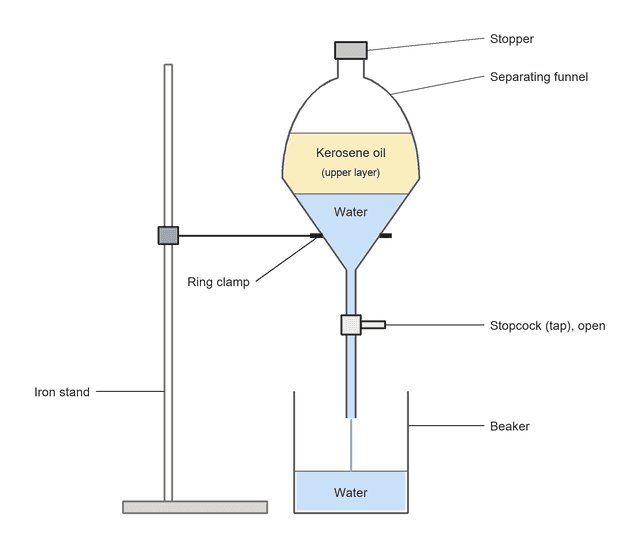
Draw a well-labelled diagram to show the separation of a mixture of kerosene oil and water.
Solve with AIWritten solution
Solution:
Concept: Kerosene oil and water are immiscible, so they are separated with a separating funnel. Kerosene is lighter than water, so it forms the upper layer.
Step 1 — Draw the set-up.
The diagram shows the separating funnel held in a ring clamp on an iron stand, with a beaker below its stem.
Step 2 — Let the layers form.
Pour the mixture into the funnel, put in the stopper and let it stand. Two layers form: kerosene oil on top and water below.
Step 3 — Run off the lower layer.
Remove the stopper at the top and open the stopcock (tap). The heavier liquid, water, runs out into the beaker.
Step 4 — Collect the kerosene.
Close the stopcock as soon as all the water has run out. Kerosene oil stays in the funnel and is poured into another vessel.
Watch out: Remove the top stopper before opening the stopcock, or the liquid will not flow out smoothly.
Therefore, in a separating funnel the water (lower layer) is run off through the stopcock and the kerosene oil (upper layer) is left in the funnel.
- 405 marks
Question 40
Study the figure given below and answer the following questions :
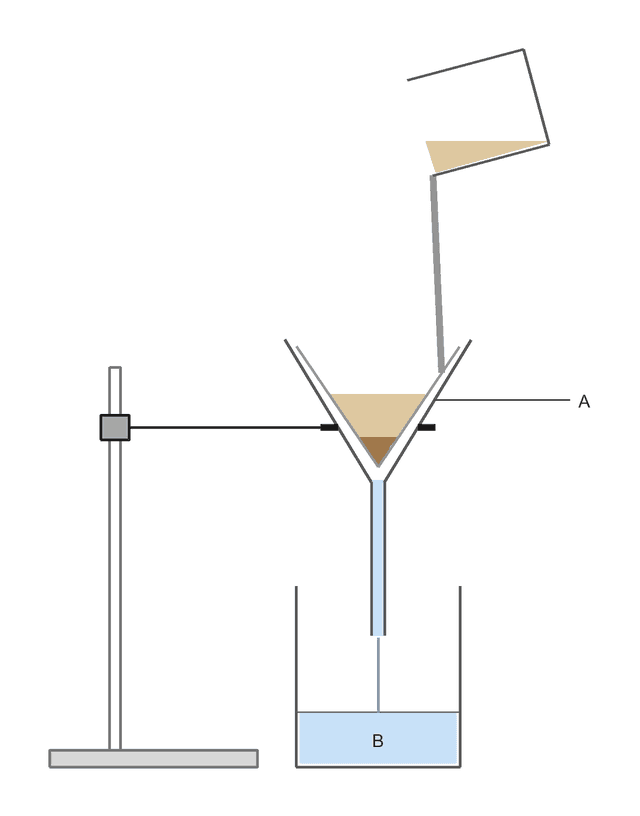
(a) Label A and B.
(b) Name the process shown.
(c) For what type of mixtures is this method used ?
(d) What is the substance left on the filter paper called ?
Solve with AIWritten solution
Solution:
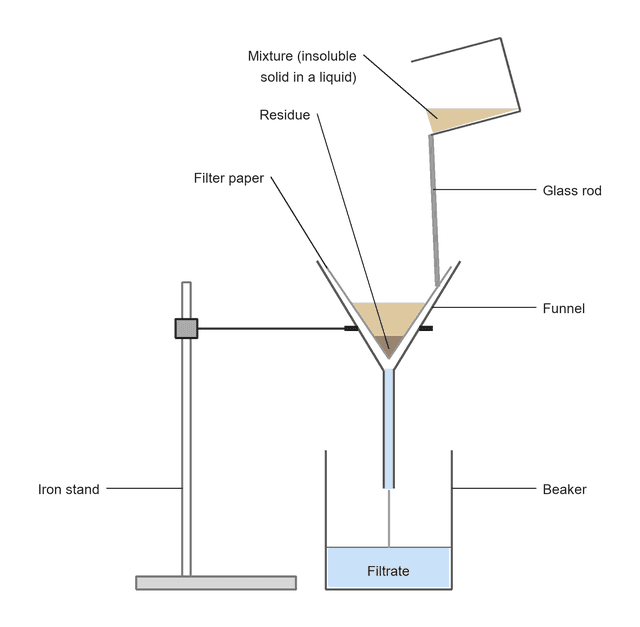
Concept: The figure shows a mixture being poured along a glass rod into a funnel lined with a filter-paper cone, with a beaker collecting the liquid that passes through.
Step 1 — (a) Label A and B.
A points to the funnel with its filter-paper cone. B is the clear liquid collected in the beaker, the filtrate. The labelled diagram is shown below.
Step 2 — (b) Name the process.
Separating a solid from a liquid by passing the mixture through filter paper is filtration.
Step 3 — (c) Mixtures it is used for.
Filtration is used for heterogeneous solid-liquid mixtures, in which an insoluble solid is mixed with a liquid, such as chalk and water or clay and water.
Step 4 — (d) Substance left on the filter paper.
The insoluble solid left on the filter paper is called the residue.
Watch out: Filtration cannot separate a dissolved solid such as salt; it passes through the paper with the water.
Therefore, (a) A is the funnel with the filter-paper cone and B is the filtrate, (b) filtration, (c) insoluble solid in a liquid (heterogeneous solid-liquid mixtures), (d) residue.
- 415 marks
Question 41
A chemistry teacher had taught the concept of elements, compounds and mixtures to her students in the class.
Aaliya, one of the students, was watching her father cook food one day after she was taught about homogeneous and heterogeneous mixtures. He mixed flour, water and common salt and kneaded them into a dough to prepare breads, all of which tasted the same throughout. She also observed her mother serving fruit cream after the dinner which had different kinds of fruits mixed with cream.
(a) What kind of substance is the dough ?
(b) Give the chemical name of common salt. Name a method by which common salt is separated from its salt solution.
(c) Why is fruit cream a heterogeneous mixture ?
(d) Define an 'element'. Name the elements from which sugar is made up of ?
Solve with AIWritten solution
Solution:
Concept: In a homogeneous mixture the components are spread evenly throughout and cannot be seen separately. In a heterogeneous mixture they are not spread evenly, and the parts can usually be seen. An element is a pure substance made up of only one kind of atoms.
Step 1 — (a) The dough.
Flour, water and salt are only mixed, not combined chemically, so the dough is a mixture. The passage says the bread tasted the same throughout, so the parts are evenly spread: a homogeneous mixture.
Step 2 — (b) Common salt.
The chemical name of common salt is sodium chloride (NaCl). It is recovered from salt solution by evaporation, which removes the water and leaves the salt.
Step 3 — (c) The fruit cream.
In fruit cream the fruit pieces and the cream are not spread evenly, and each can be seen separately and keeps its own taste. So fruit cream is a heterogeneous mixture.
Step 4 — (d) Element, and the elements in sugar.
An element is a pure substance made up of only one kind of atoms, which cannot be broken down into anything simpler by chemical methods. Sugar (cane sugar, ) is made of the elements carbon, hydrogen and oxygen.
Watch out: Salt and water in the dough are not combined chemically, so the dough is not a compound.
Note: Looked at closely, dough is not perfectly uniform (flour grains can be seen under a lens), so it can also be called heterogeneous; the passage's clue that the bread tasted the same throughout points to homogeneous, which is the answer expected here.
Therefore, (a) a homogeneous mixture, (b) sodium chloride, separated by evaporation, (c) its parts are unevenly spread and seen separately, (d) an element has one kind of atoms, and sugar is made of carbon, hydrogen and oxygen.
What Class 7 Chemistry Ch 3 covers
The sections of the chapter, in the order the book takes them. Every question above comes from one of these.
- 01Elements
- 02Classification of Elements
- 03Symbols of Elements
- 04Compounds
- 05Characteristics of Compounds
- 06Mixtures
More ways to study this chapter
The same chapter asked three other ways. Practise it, revise it, and see what the board has set on Ch 3 before.
Class 7 Chemistry Ch 3 questions students ask
How many questions are there in Class 7 Chemistry Ch 3?
41 questions. Every one is solved step by step on this page.
Are these Class 7 Chemistry solutions free?
Yes. Every question and its full working is free to read, with no account needed.
Can I download the Class 7 Chemistry Ch 3 solutions as a PDF?
There is no PDF to download. Every solution is on this page instead, which means it is searchable, always the current syllabus, and readable on a phone. Use your browser's print option if you want it on paper.