
Opening your dashboard
Class 7 Chemistry Chapter 3 Elements, Compounds and Mixtures: Competency-Based Questions (CBQ)
40 questions on Chapter 3, each worked through on its own page with the AI tutor. Class 7 Chemistry, ICSE 2026-27.
40 questions
1–5 marks · Mixed difficulty
- 11 mark
Question 1
Cognitive domain: Application
During the monsoon, rain water leaks into a can of groundnut oil in Meena's kitchen. Her brother pours the liquid into a separating funnel from the school laboratory and lets it stand. Two clear layers form. Then he slowly opens the tap (stopper) of the funnel over a beaker.
What will happen?
- 21 mark
Question 2
Cognitive domain: Analysis
A food inspector buys three white powders, P, Q and R. All three are sold as "pure glucose". Glucose is a compound with the formula . A laboratory finds the mass of each element in 100 g of each powder. It also notes how each powder melts.
Powder Carbon Hydrogen Oxygen On heating P 40.0 g 6.7 g 53.3 g Melts at one fixed temperature Q 40.0 g 6.7 g 53.3 g Melts at the same fixed temperature as P R 41.6 g 6.5 g 51.9 g Melts slowly, over a range of temperatures Which conclusion is best supported by these results?
- 31 mark
Question 3
Cognitive domain: Understanding
A new helper in the school laboratory writes all his labels in capital letters. On a jar of the metal cobalt he writes CO. The teacher asks him to change the label at once.
Why is the label wrong?
- 41 mark
Question 4
Cognitive domain: Application
In a factory that makes electric bulbs, the air is pumped out of each glass bulb. Then argon gas is filled in and the bulb is sealed. When the bulb glows, the thin wire inside it becomes white-hot. In air, this hot wire would react with oxygen and burn away very quickly.
Why is argon a good gas to fill in the bulb?
- 51 mark
Question 5
Cognitive domain: Understanding
Assertion (A): Cane sugar is a sweet, white solid, although one of the elements in it is carbon, which is a black solid.
Reason (R): The properties of a compound are entirely different from the properties of the elements of which it is made.
- 61 mark
Question 6
Cognitive domain: Understanding
Assertion (A): A mixture of nitrogen gas and oxygen gas is a heterogeneous mixture.
Reason (R): All gases mix with one another in all proportions.
- 71 mark
Question 7
Cognitive domain: Understanding
On the coast of Gujarat, salt workers let sea water into wide, shallow beds and leave it in the sun for many days. Fill in the blanks.
The water slowly changes into ________ and escapes into the air. This process is called ________. The salt cannot be seen before this happens, because sea water is a ________ mixture in which the salt is spread evenly.
- 81 mark
Question 8
Cognitive domain: Application
The label on a packet of washing soda gives its formula as .
Name the element that has the largest number of atoms in this formula. How many atoms of it are there?
- 91 mark
Question 9
Cognitive domain: Application
A sweet-maker uses a green food colour. It is made by mixing a blue dye and a yellow dye. Zoya puts a drop of this green colour just above a pencil line near the bottom of a strip of filter paper. She dips the end of the strip in water, so that the drop stays above the water. In water, the yellow dye is more soluble than the blue dye.
Predict what Zoya will see on the strip after the water has risen up the paper.
- 102 marks
Question 10
Cognitive domain: Evaluation
Rahul watches a goldsmith cut a small bar of pure gold into tiny pieces and then melt the pieces. Rahul says, "Gold can be cut into smaller pieces, and it can even be melted. So gold is not an element."
Is Rahul right? Give two points to support your answer.
- 112 marks
Question 11
Cognitive domain: Evaluation
At a rice mill, the rice is cleaned and polished by iron machines. Just before packing, the rice is made to pass under a strong magnet. A new worker says, "This step is a waste of time. Rice is not attracted by a magnet, so the magnet does nothing."
Judge the worker's statement. In your answer, say what the magnet removes and why this step is needed.
- 122 marks
Question 12
Cognitive domain: Analysis
Before Diwali, a painter gets ready to whitewash a house. He does two things.
- Drum 1: He adds water to lumps of quicklime. The drum hisses and becomes too hot to touch. A new white substance, called slaked lime, is formed.
- Drum 2: He stirs dry sand and dry cement together. The drum stays cool. Grains of sand can still be seen in it.
In which drum is a compound formed? Give two pieces of evidence from the observations.
- 134 marks
Question 13
Cognitive domain: Application
The science club of a school near the sea builds a simple "solar still" to get drinking water from sea water. Salty water is poured into a black tray. A sloping sheet of glass covers the tray. In the hot sun, the water in the tray slowly turns into vapour. The vapour touches the cooler glass and turns back into drops of water. The drops run down the glass into a clean bottle. By evening, the bottle holds clear water and a white crust is left in the tray.
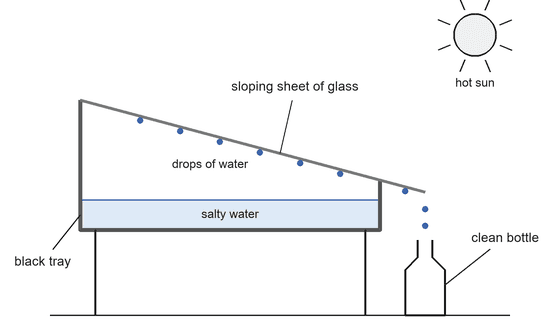
(a) Name the two changes that the water goes through in the still. Which laboratory method of separation works in the same way?
(b) What is the white crust? What special name is given to the water collected in the bottle? How will its taste differ from the taste of sea water?
(c) Kabir says, "Filtering sea water through a filter paper is quicker, and it will also remove the salt." Explain why Kabir's method will not work.
- 144 marks
Question 14
Cognitive domain: Analysis
For a school project, Gurpreet collects soil from three places in her village. She dries each sample and gets 100 g of each one tested. The results are shown in the table. She notices that the soil from the river bank feels gritty, while the soil from the pond side feels sticky. In every sample she can pick out small pebbles and bits of dry leaves with her fingers.
Soil from Sand Clay Other matter (pebbles, rotted leaves, etc.) River bank 70 g 20 g 10 g Wheat field 45 g 35 g 20 g Pond side 20 g 65 g 15 g (a) Is soil a homogeneous mixture or a heterogeneous mixture? Give one observation from the passage to support your answer.
(b) Use the table to give one reason why soil cannot be a compound.
(c) Sand is mostly silica, . Why can a formula be written for silica but not for soil? Also explain, from the table, why the river-bank soil feels gritty but the pond-side soil feels sticky.
- 155 marks
Question 15
Cognitive domain: Creativity
Asha's family uses three kinds of water: tap water, well water, and rain water collected in a clean vessel. All three look clear. Asha wants to find out, by an experiment, which sample has the most dissolved solid in it and which sample is closest to pure water. Her teacher gives her three identical evaporating dishes, a measuring cylinder, a balance that reads to 0.01 g, and a burner with a tripod stand.
(a) Design the experiment. Write the steps in order.
(b) State two things Asha must keep the same for all three samples, so that the test is fair.
(c) How will she use her results to answer her two questions?
(d) All three samples looked clear at the start. What does this experiment teach us about clear liquids and pure substances?
- 161 mark
Question 16
Cognitive domain: Application
Carbon dioxide is collected from three different sources: the gas from burning charcoal, the gas that bubbles out of a fizzy cold drink, and the air we breathe out. Each sample is purified so that only carbon dioxide is left. A laboratory then finds the masses of carbon and oxygen in each sample.
Which result should the laboratory expect?
- 171 mark
Question 17
Cognitive domain: Analysis
Three boxes P, Q and R each hold a different sample, drawn with particles. A dark circle is an atom of element X and a light circle is an atom of element Y. Atoms that touch are joined together chemically.
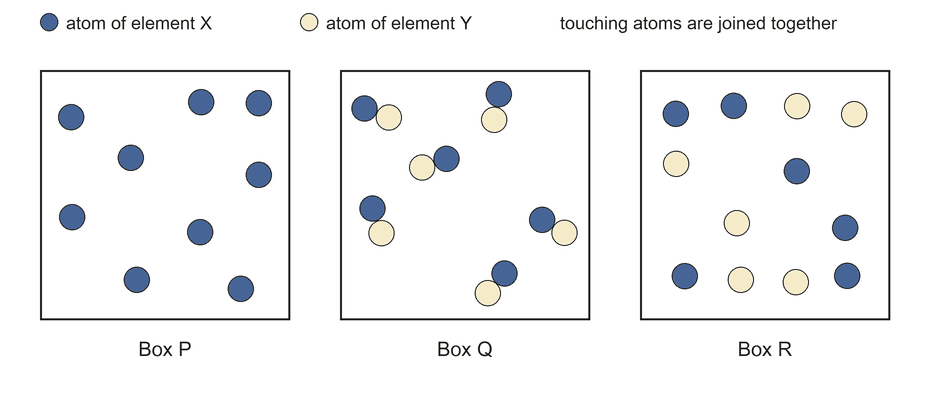
Which option describes the three samples correctly?
- 181 mark
Question 18
Cognitive domain: Application
In a science demonstration, the teacher shows four situations.
- Situation 1: Sugar is stirred into water until it cannot be seen.
- Situation 2: Iron filings are sprinkled into dry sand.
- Situation 3: A strip of magnesium ribbon is held in a flame. It burns with a dazzling white light and leaves a white powder, magnesium oxide, .
- Situation 4: Salt and chilli powder are mixed on a plate.
In which situation is a compound formed, and what is the best evidence?
- 191 mark
Question 19
Cognitive domain: Application
Three situations are described.
- X: Before sowing, a farmer sieves his wheat seeds to take out the small weed seeds mixed with them.
- Y: At a sugar mill, the water is boiled off from sugarcane juice to get sugar, which is sold for use in homes.
- Z: A medicine factory purifies common salt until it is completely pure, and then uses it to make the salt solution (saline) given to patients through a drip.
The three purposes of separating the parts of a mixture are: to get a useful substance, to remove an undesirable substance, and to get a completely pure substance for preparing another useful substance.
Which option matches each situation with its main purpose?
- 201 mark
Question 20
Cognitive domain: Application
Farmers separate the husk (the dry outer covering) from threshed wheat by pouring the wheat slowly from a height on a windy day. One morning there is no wind at all. When Gopal pours the wheat, the husk falls into the same heap as the grains.
Which change will make the separation work, and why?
- 211 mark
Question 21
Cognitive domain: Application
In the school laboratory, a teacher places a mixture of powdered camphor and sand in a dish. She covers the dish with an inverted funnel, plugs the top of the funnel stem with cotton wool, and heats the dish gently with a burner, S, as shown.
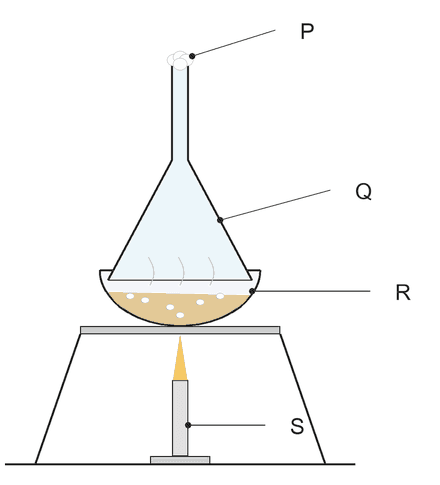
After a few minutes, where will the solid camphor and the sand be found?
- 221 mark
Question 22
Cognitive domain: Analysis
A student made a table to classify four mixtures. One row has a mistake.
Row Mixture States of its components Type of mixture 1 Aerated cold drink gas and liquid homogeneous 2 Smoke in air solid and gas heterogeneous 3 Iodine in alcohol solid and liquid heterogeneous 4 Sand and sugar solid and solid heterogeneous Which row is wrong, and why?
- 231 mark
Question 23
Cognitive domain: Evaluation
Ravi heats a clear salt solution in an evaporating dish until it is dry. The water goes off as steam and a white solid is left in the dish. Ravi says, "Common salt is a compound. Heating has split it into sodium and chlorine, and the white solid is something new."
Which judgement of Ravi's statement is correct?
- 241 mark
Question 24
Cognitive domain: Understanding
Assertion (A): The air around us contains a small amount of argon.
Reason (R): Noble gases combine easily with other elements and compounds, so they are found in air.
- 251 mark
Question 25
Cognitive domain: Understanding
Assertion (A): When a mixture of sand and common salt is stirred in water, the whole mixture dissolves.
Reason (R): Common salt is soluble in water, but sand is insoluble in water.
- 262 marks
Question 26
Cognitive domain: Analysis
A chart in the science laboratory gives the formulae of five substances:
- oxygen gas,
- ozone,
- nitrogen gas,
- carbon monoxide,
- water,
Meera says, "Every one of these molecules has more than one atom, so all five substances must be compounds."
(a) Sort the five substances into elements and compounds, and state the rule you used.
(b) Explain what is wrong with Meera's reasoning.
- 272 marks
Question 27
Cognitive domain: Application
Reena's mother makes tea by boiling water with tea leaves and sugar. She then pours the hot tea through a strainer into a cup.
(a) Name the method of separation used. Name the residue and the filtrate.
(b) Reena's brother says, "We do not need the strainer. We can let the tea stand for a minute and then pour it gently into the cup, leaving the tea leaves behind." Will this work as well as the strainer? Give a reason.
- 282 marks
Question 28
Cognitive domain: Evaluation
A garage owner fills a car battery with distilled water. A neighbour says, "Tap water is also clear. It is as good as distilled water, and distilling it is a waste of fuel."
Evaluate the neighbour's statement. Give two points from what you have learnt.
- 292 marks
Question 29
Cognitive domain: Analysis
When copper powder is heated strongly in air, it combines with oxygen to form black copper oxide, a compound. A class does this three times with different masses of copper and weighs the copper oxide formed each time. (Hypothetical data.)
Trial Mass of copper taken Mass of copper oxide formed 1 0.80 g 1.00 g 2 1.60 g 2.00 g 3 2.40 g 2.80 g (a) Find the mass of oxygen that combined with the copper in each trial, and the ratio of copper to oxygen by mass.
(b) Which trial does not fit the fixed composition of a compound? What mass of copper oxide should it have given if all its copper had combined?
- 302 marks
Question 30
Cognitive domain: Creativity
Kabir has red clay balls to stand for atoms of element X, white clay balls to stand for atoms of element Y, and toothpicks to join balls together. He wants to make two models for a Class 6 display: one of a compound of X and Y, and one of a mixture of X and Y.
Design the two models. For each model, state one feature that shows the difference between a compound and a mixture.
- 312 marks
Question 31
Cognitive domain: Application
At a roadside stall, a vendor picks out by hand the few small stones and dry twigs from a 2 kg basket of groundnuts before roasting them. His daughter then tries to pick out by hand the sand from a cup of common salt mixed with an equal amount of fine sand.
(a) Give two features of the groundnut mixture that make hand-picking suitable for the vendor.
(b) Give two reasons why hand-picking will not work for his daughter's mixture.
- 323 marks
Question 32
Cognitive domain: Application
A science club makes cards for three unknown elements P, Q and R.
Element State What is known P gas found in air only in traces; hardly combines with any other element or compound Q solid hard; shows some properties of metals and some properties of non-metals R solid its Latin name is Plumbum (a) Name the class of elements to which each of P, Q and R belongs.
(b) Write the symbol of R.
(c) Give one example of an element of the same class as P and one of the same class as Q.
- 333 marks
Question 33
Cognitive domain: Understanding
A quiz card says, "Honey, tap water and a stainless steel spoon all look like pure substances, but they are not."
Explain why each of the three is a mixture. Name at least one component of each.
- 343 marks
Question 34
Cognitive domain: Analysis
A laboratory has a mixture of three liquids P, Q and R, which mix completely with one another. It is separated by fractional distillation, with a fractionating column fixed over the flask. The boiling points of the liquids are given. (Hypothetical data.)
Liquid Boiling point P 56 °C Q 118 °C R 82 °C (a) In what order will the three liquids be collected in the receiver? Give the reason.
(b) The student stops heating as soon as all of P has been collected. Which liquids are still in the flask, and how can they be separated?
(c) What is the use of the fractionating column?
- 353 marks
Question 35
Cognitive domain: Evaluation
In a test, Aman writes three statements.
- Statement 1: The properties of a compound are the same as the properties of the elements in it.
- Statement 2: Formation of a compound involves a change in energy, but formation of a mixture usually involves little or no energy change.
- Statement 3: The components of a mixture can be separated only by complicated chemical processes.
Judge each statement as correct or wrong. Correct each wrong statement.
- 363 marks
Question 36
Cognitive domain: Application
The store-room at Tara's home has four white powders: baking soda, ; washing soda, ; cane sugar, ; and glucose, .
(a) Tara spills some baking soda into the jar of cane sugar and shakes the jar. Is the powder in the jar now a compound or a mixture? Give a reason.
(b) Which two of the four powders contain the same four elements? Name the elements.
(c) Cane sugar and glucose contain the same three elements. Are they the same compound? Explain.
- 374 marks
Question 37
Cognitive domain: Application
At a salt works on the coast, workers let sea water into wide, shallow beds. In the hot sun the water slowly escapes into the air and a white crust of salt is left behind. The manager records, for three beds, the mass of sea water let in and the mass of salt collected after all the water had gone. (Hypothetical data.)
Bed Mass of sea water let in Mass of salt collected 1 400 kg 14 kg 2 600 kg 21 kg 3 1000 kg 35 kg (a) Is sea water a pure substance or a mixture? Give one reason from what happens in the beds.
(b) Find the mass of salt collected from every 100 kg of sea water in each bed. Use the result to predict the mass of salt from 2000 kg of sea water.
(c) The salt scraped from the beds tastes salty, just as the sea water did. What does this tell you about the components of a mixture? Sea water taken near the mouth of a river gives less salt from every 100 kg. Why does this agree with your answer to (a)?
- 385 marks
Question 38
Cognitive domain: Application
The science club of a school holds an "Element Hunt" for Class 7. Each team is given a bag of six everyday objects. The team must name the main element in each object, place that element in its class, and write its symbol on a card. The teams are not allowed to use a book, and the judges give marks for every correct class and every correct symbol.
Object Main element in it Aluminium foil wrapper aluminium Pencil lead (graphite) carbon Gas in a floating party balloon helium Iron nail iron Computer chip silicon Yellow garden powder sulphur (a) Put the six elements into these classes: metals, non-metals, metalloids and noble gases.
(b) Write the symbol of each element. Which symbol is taken from a Latin name? Give that Latin name.
(c) Arjun says, "Silicon is a hard solid, so it must be a metal." Evaluate his statement.
- 395 marks
Question 39
Cognitive domain: Creativity
At a science fair, Ira's team gets a tray holding a mixture of iron filings, camphor powder, sand and common salt. The team may use a magnet, an evaporating dish, an inverted funnel with a cotton wool plug, a burner, water, beakers, a filter funnel with filter paper and a glass rod. The team must get back all four substances, separate from one another. (Hypothetical data.)
(a) Write a plan for the separation, with the steps in order. Name the method used in each step.
(b) For each method, state the property of the substance being separated that makes the method work.
(c) The team starts with 40 g of the mixture. It recovers 6 g of iron, 4 g of camphor, 18 g of sand and 11 g of salt. Find the total mass recovered and the mass lost. Suggest one step where some mass may have been lost.
- 404 marks
Question 40
Cognitive domain: Analysis
A metal workshop makes brass taps. The workers melt copper and zinc together and pour the melt into moulds. The foreman keeps a record of three batches, made on three different days. In each batch the two metals were mixed in the molten state in a different proportion. When the taps cooled, the foreman cut one open and saw that every batch has the same golden-yellow colour all through, with no separate bits of copper or zinc. (Hypothetical data.)
Batch Copper in 100 g of brass Zinc in 100 g of brass A 70 g 30 g B 65 g 35 g C 60 g 40 g (a) Is brass a compound or a mixture? Give two reasons from the record.
(b) Is brass a homogeneous or a heterogeneous mixture? Explain why most mixtures of two solids differ from it.
(c) A brass tap from batch C has a mass of 250 g. Find the mass of zinc and the mass of copper in it.