
Opening your dashboard
Class 7 Chemistry Chapter 1: Matter and Its Composition Solutions
27 textbook questions with step-by-step answers, free to read, for ICSE 2026-27.
Get talked through Ch 1, not just shown the answer
Reading a finished solution is not the same as being able to do it. The AI tutor takes one question at a time and works it with you, in your own words, until you can.
- Ask it out loud, in your own words
- It gives you the next step, not the answer
- Stuck on part (ii)? Start there
27 questions with solutions
1–5 marks · Mixed difficulty
- 11 mark
Question 1
The intermolecular forces are weakest in:
Solve with AIAnswer
(A) solids
(B) liquids
- Correct
(C) gases
(D) both (A) and (B)
Answer: (C) gases
Concept: In solids the particles are packed closest, with the strongest force of attraction and the least space between them; in liquids the attraction is weaker and the spaces larger; in gases the attraction is very weak and the spaces are the largest.
Step 1 — Recall the order of the force.
The intermolecular force of attraction becomes weaker as we go from a solid to a liquid to a gas.
Step 2 — Pick the weakest.
Gas particles are far apart and hardly pull on one another, which is why a gas spreads out to fill any container. So the force is weakest in gases.
Why the other options are wrong:
- (A) solids: In solids the force is the strongest of the three states, which is why a solid keeps its own shape.
- (B) liquids: In liquids the force is weaker than in solids but still much stronger than in gases.
- (D) both (A) and (B): Both solids and liquids have stronger forces than gases, so neither of them has the weakest force.
Therefore, the intermolecular forces are weakest in gases, option (C).
- 21 mark
Question 2
The intermolecular spaces are the least in:
Solve with AIAnswer
- Correct
(A) aluminium
(B) water
(C) oxygen
(D) carbon dioxide
Answer: (A) aluminium
Concept: In solids the particles are packed closest, with the strongest force of attraction and the least space between them; in liquids the attraction is weaker and the spaces larger; in gases the attraction is very weak and the spaces are the largest.
Step 1 — Find the state of each substance.
At room temperature aluminium is a solid, water is a liquid, and oxygen and carbon dioxide are gases.
Step 2 — Pick the state with the least space.
The intermolecular spaces are smallest in solids, where the particles are closely packed. So aluminium has the least intermolecular space.
Why the other options are wrong:
- (B) water: Water is a liquid; its intermolecular spaces are larger than those in a solid.
- (C) oxygen: Oxygen is a gas, and gases have the largest intermolecular spaces.
- (D) carbon dioxide: Carbon dioxide is also a gas at room temperature, with very large intermolecular spaces.
Therefore, the intermolecular spaces are the least in aluminium, option (A).
- 31 mark
Question 3
The state of matter which has a definite volume but takes the shape of a container is:
Solve with AIAnswer
(A) solids
- Correct
(B) liquids
(C) gases
(D) none
Answer: (B) liquids
Concept: A solid has a definite shape and a definite volume; a liquid has a definite volume but no definite shape; a gas has neither.
Step 1 — Read the two conditions.
The state asked for must have a definite volume and must take the shape of its container.
Step 2 — Match with the states.
Only a liquid does both: one litre of water stays one litre, but it takes the shape of a bottle, a jug or a glass. So the answer is liquids.
Watch out: A gas also takes the shape of its container, but it has no definite volume, because it spreads to fill the whole container.
Why the other options are wrong:
- (A) solids: Solids have a definite shape of their own, so they do not take the shape of the container.
- (C) gases: Gases have no definite volume; they fill the whole of any container they are put in.
- (D) none: Liquids fit both conditions exactly, so "none" is wrong.
Therefore, the state with a definite volume that takes the shape of its container is the liquid state, option (B).
- 41 mark
Question 4
Which of the following is transparent?
Solve with AIAnswer
- Correct
(A) Diamond
(B) Graphite
(C) Wood
(D) Coal
Answer: (A) Diamond
Concept: A transparent substance lets light pass through it, so we can see clearly through it. Most solids are opaque (they do not let light through), but a few, such as diamond and glass, are transparent.
Step 1 — Check each solid for light passing through.
Graphite, wood and coal do not let light through, so they are opaque. Diamond lets light pass through it and sparkles, so it is transparent.
Step 2 — Pick the transparent one.
Of the four solids, only diamond is transparent.
Watch out: Diamond and graphite are both forms of carbon, yet only diamond is transparent; the arrangement of the particles, not only the element, decides this property.
Why the other options are wrong:
- (B) Graphite: Graphite is a black, shiny but opaque solid; light does not pass through it.
- (C) Wood: Wood is opaque; we cannot see through a wooden plank.
- (D) Coal: Coal is a black, opaque solid.
Therefore, diamond is transparent, option (A).
- 51 mark
Question 5
The process by which a solid changes directly from the solid state to the gaseous state is called:
Solve with AIAnswer
(A) diffusion
- Correct
(B) sublimation
(C) evaporation
(D) melting
Answer: (B) sublimation
Concept: Each change of state has its own name. When a solid changes directly into a gas (vapour) on heating, without first becoming a liquid, the change is called sublimation.
Step 1 — Read what the question describes.
The change starts with a solid and ends with a gas, and there is no liquid stage in between.
Step 2 — Match it with the right term.
This direct change from solid to gas is sublimation. Camphor, iodine, naphthalene balls and dry ice (solid carbon dioxide) are common examples.
Watch out: Do not mix up sublimation (solid to gas) with evaporation (liquid to gas) or melting (solid to liquid).
Why the other options are wrong:
- (A) diffusion: Diffusion is the intermixing of the particles of two substances; it is not a change of state.
- (C) evaporation: Evaporation is the change of a liquid into its vapour, so it starts with a liquid, not a solid.
- (D) melting: Melting is the change of a solid into a liquid, not into a gas.
Therefore, a solid changing directly into a gas is called sublimation, option (B).
- 61 mark
Question 6
Assertion (A): Matter exists in three states, i.e. solids, liquids and gases.
Reason (R): All matter can change from one state to another on changing temperature and pressure.
Solve with AIAnswer
(A) Both A and R are true and R is the correct explanation of A.
(B) Both A and R are true but R is not the correct explanation of A.
- Correct
(C) A is true but R is false.
(D) A is false but R is true.
Answer: (C) A is true but R is false.
Concept: Judge the Assertion (A) first, then the Reason (R), and only then decide whether R explains A.
Step 1 — Judge the Assertion.
Matter around us exists as solids, liquids and gases, the three states studied in this chapter. So A is true.
Step 2 — Judge the Reason.
R says that all matter can change from one state to another when the temperature and pressure change. This is not so: wood and paper do not melt or boil on heating; they char or burn, forming new substances. So R is false.
Step 3 — Choose the option.
A is true and R is false, which is option (C).
Watch out: One counter-example (wood, paper) is enough to make an "all" statement false.
Note: solids, liquids and gases are the three common states; plasma, a fourth state, is met in higher classes and does not change the answer.
Why the other options are wrong:
- (A): R is false, so it cannot be the correct explanation of A.
- (B): This needs both statements to be true, but R is false.
- (D): A is true, not false; matter does exist as solids, liquids and gases.
Therefore, A is true but R is false, option (C).
- 71 mark
Question 7
Assertion (A): When a gas is cooled, the intermolecular gaps decrease.
Reason (R): The kinetic energy of the gaseous particles decrease upon cooling.
Solve with AIAnswer
- Correct
(A) Both A and R are true and R is the correct explanation of A.
(B) Both A and R are true but R is not the correct explanation of A.
(C) A is true but R is false.
(D) A is false but R is true.
Answer: (A) Both A and R are true and R is the correct explanation of A.
Concept: Judge the Assertion (A) first, then the Reason (R), and only then decide whether R explains A.
Step 1 — Judge the Assertion.
When a gas is cooled (at the same pressure), its particles come closer together, so the intermolecular gaps decrease. Cooling it enough finally turns the gas into a liquid. So A is true.
Step 2 — Judge the Reason.
Cooling takes energy away from the particles, so they move more slowly; their kinetic energy decreases. So R is true.
Step 3 — Decide whether R explains A.
Because the slower particles can no longer stay as far apart against the force of attraction, they draw closer and the gaps shrink. The fall in kinetic energy is the reason for the smaller gaps, so R explains A.
Watch out: This holds for a gas that is free to contract; in a closed, rigid container the particles slow down but the volume they occupy stays the same.
Why the other options are wrong:
- (B): R is the very reason why the gaps decrease, so it is the correct explanation, not just a true statement.
- (C): R is true: the kinetic energy of gas particles decreases when the gas is cooled.
- (D): A is true: cooling makes the gaps decrease, which is how a gas finally changes into a liquid.
Therefore, both A and R are true and R is the correct explanation of A, option (A).
- 81 mark
Question 8
Assertion (A): Most of the liquids have their own shape.
Reason (R): Liquids can flow from a higher to lower level.
Solve with AIAnswer
(A) Both A and R are true and R is the correct explanation of A.
(B) Both A and R are true but R is not the correct explanation of A.
(C) A is true but R is false.
- Correct
(D) A is false but R is true.
Answer: (D) A is false but R is true.
Concept: Judge the Assertion (A) first, then the Reason (R), and only then decide whether R explains A.
Step 1 — Judge the Assertion.
A liquid has a definite volume but no definite shape; it takes the shape of the container it is poured into. So the statement that most liquids have their own shape is false.
Step 2 — Judge the Reason.
Liquids are fluids: they flow from a higher level to a lower level, as water flows downhill. So R is true.
Step 3 — Choose the option.
A is false and R is true, which is option (D).
Why the other options are wrong:
- (A): A is false, so R cannot be the correct explanation of it.
- (B): This needs both statements to be true, but A is false.
- (C): It is the other way round: A is false and R is true.
Therefore, A is false but R is true, option (D).
- 91 mark
Question 9
Assertion (A): Particles of matter are always in a random motion.
Reason (R): Particles of matter possess kinetic energy.
Solve with AIAnswer
- Correct
(A) Both A and R are true and R is the correct explanation of A.
(B) Both A and R are true but R is not the correct explanation of A.
(C) A is true but R is false.
(D) A is false but R is true.
Answer: (A) Both A and R are true and R is the correct explanation of A.
Concept: Judge the Assertion (A) first, then the Reason (R), and only then decide whether R explains A.
Step 1 — Judge the Assertion.
The particles of matter never stop moving; they move about in all directions at random. Sawdust jiggling on water and ink spreading through water show this. So A is true.
Step 2 — Judge the Reason.
Particles of matter possess kinetic energy, the energy an object has because it is moving. So R is true.
Step 3 — Decide whether R explains A.
The particles keep moving precisely because they possess kinetic energy. So R explains A.
Why the other options are wrong:
- (B): R gives the very reason for the motion, so it is the correct explanation, not just a true statement.
- (C): R is true: the particles of matter do possess kinetic energy.
- (D): A is true: the particles of matter are always in random motion.
Therefore, both A and R are true and R is the correct explanation of A, option (A).
- 101 mark
Question 10
Assertion (A): A piece of wood is a hard solid, while that of chalk is a soft solid.
Reason (R): In solids, the intermolecular forces of attraction are very strong.
Solve with AIAnswer
(A) Both A and R are true and R is the correct explanation of A.
- Correct
(B) Both A and R are true but R is not the correct explanation of A.
(C) A is true but R is false.
(D) A is false but R is true.
Answer: (B) Both A and R are true but R is not the correct explanation of A.
Concept: Judge the Assertion (A) first, then the Reason (R), and only then decide whether R explains A.
Step 1 — Judge the Assertion.
Wood does not break easily, while chalk breaks when only a little force is applied. So wood is a hard solid and chalk a soft solid, and A is true.
Step 2 — Judge the Reason.
In every solid the particles are held together by strong intermolecular forces of attraction. So R is true.
Step 3 — Decide whether R explains A.
A is about a difference between two solids. Wood is harder because the force between its particles is stronger than in chalk. R only says that solids in general have strong forces; it does not say why one solid is harder than another. So R does not explain A.
Watch out: A true Reason that is too general to account for the difference in the Assertion is not its explanation.
Why the other options are wrong:
- (A): R does not explain why wood is harder than chalk, so it is not the correct explanation of A.
- (C): R is true: the intermolecular forces in solids are very strong.
- (D): A is true: wood is hard and chalk is soft.
Therefore, both A and R are true but R is not the correct explanation of A, option (B).
- 115 marks
Question 11
Fill in the blanks:
(a) Air is a matter because it has ________ and ________ and it can be ________.
(b) The molecules are made up of ________
(c) The quantity of matter in an object is called its ________.
(d) The state of matter with definite volume and definite shape is called ________.
(e) The substances which can flow are called ________.
Solve with AIWritten solution
Solution:
Concept: Matter is anything that has mass, occupies space and can be perceived by our senses. The quantity of matter in an object is its mass, and substances that can flow are called fluids.
Step 1 — (a) Why air is matter.
Air has mass (a blown-up balloon weighs more than an empty one), it occupies space (it fills the balloon), and it can be felt (we feel the wind on our face).
Step 2 — (b) What molecules are made of.
Every molecule is built from smaller particles called atoms.
Step 3 — (c) Quantity of matter.
The quantity of matter in an object is called its mass.
Step 4 — (d) Definite volume and definite shape.
Only a solid keeps both its own volume and its own shape.
Step 5 — (e) Substances which can flow.
Liquids and gases can flow, and together they are called fluids.
Watch out: Volume is the space an object occupies; mass is the quantity of matter in it, so the two are not the same.
Therefore, (a) mass, occupies space, felt; (b) atoms; (c) mass; (d) solid; (e) fluids.
- 125 marks
Question 12
Write whether the following statements are true or false.
(a) Solids can diffuse very fast.
(b) The quantity of matter in an object is called volume.
(c) Atoms combine to form molecules.
(d) Particles of matter can move because they possess kinetic energy.
(e) When a liquid is heated, it solidifies.
Solve with AIWritten solution
Solution:
Concept: Check each statement against the properties of matter, and correct every false one.
Step 1 — (a) Diffusion in solids.
Solid particles are held tightly in place, so solids diffuse extremely slowly, if at all, under ordinary conditions; gases diffuse the fastest. The statement is false.
Step 2 — (b) Quantity of matter.
The quantity of matter in an object is its mass; its volume is the space it occupies. The statement is false.
Step 3 — (c) Atoms and molecules.
Atoms join together to form molecules, for example two hydrogen atoms form one hydrogen molecule. The statement is true.
Step 4 — (d) Why particles move.
Particles of matter move because they possess kinetic energy, the energy of motion. The statement is true.
Step 5 — (e) Heating a liquid.
Heating a liquid changes it into its vapour (gas); a liquid solidifies when it is cooled. The statement is false.
Watch out: In (e) heating and cooling do opposite things: heating takes a substance towards the gas state, cooling towards the solid state.
Therefore, (a) false, (b) false, (c) true, (d) true, (e) false.
- 135 marks
Question 13
Match the following:
Column A Column B (a) Fluids (i) space between the molecules (b) Melting point (ii) change of state from gas to liquid (c) Atoms (iii) substances which can flow (d) Intermolecular space (iv) the smallest particles of matter. (e) Condensation (iv) the temperature at which a solid changes to a liquid. Solve with AIWritten solution
Solution:
Concept: Match each term in Column A with its meaning in Column B, using each meaning once.
Step 1 — Read Column B carefully.
Column B has two items numbered (iv), so below they are told apart by their words: "the smallest particles of matter" and "the temperature at which a solid changes to a liquid".
Step 2 — Match each term.
Fluids are substances that flow; the melting point is a temperature; atoms are the smallest particles; the intermolecular space is the gap between molecules; condensation is a change from gas to liquid.
Column A Column B (a) Fluids (iii) substances which can flow (b) Melting point (iv) the temperature at which a solid changes to a liquid (c) Atoms (iv) the smallest particles of matter (d) Intermolecular space (i) space between the molecules (e) Condensation (ii) change of state from gas to liquid Watch out: Condensation is gas to liquid; its reverse, liquid to gas, is evaporation (vaporisation).
Therefore, (a) matches (iii), (b) matches the melting-point item (iv), (c) matches the smallest-particles item (iv), (d) matches (i), (e) matches (ii).
- 145 marks
Question 14
Classify the following into solid, liquid and gas:
Coal, kerosene, wood, oxygen, sugar, blood, water vapour, milk, wax.
Solve with AIWritten solution
Solution:
Concept: At room temperature a solid has a definite shape and volume, a liquid has a definite volume but takes the shape of its container, and a gas has neither.
Step 1 — Decide the state of each substance at room temperature.
Coal, wood, sugar and wax keep their own shape, so they are solids. Kerosene, blood and milk flow and take the shape of the vessel, so they are liquids. Oxygen and water vapour spread to fill any container, so they are gases.
Step 2 — Arrange them in a table.
Each substance goes in the column of its state.
Solid Liquid Gas Coal Kerosene Oxygen Wood Blood Water vapour Sugar Milk Wax Watch out: Water vapour is a gas even though water and ice are not; the state depends on the conditions.
Therefore, the solids are coal, wood, sugar and wax; the liquids are kerosene, blood and milk; the gases are oxygen and water vapour.
- 155 marks
Question 15
Give appropriate terms for the following:
(a) The change of a solid into liquid.
(b) The force of attraction between the molecules of matter.
(c) The particles of matter which may or may not have independent existence.
(d) The process due to which a solid directly changes into its vapours.
(e) The change of vapour into a liquid.
Solve with AIWritten solution
Solution:
Concept: Each change of state and each kind of particle has its own name in this chapter.
Step 1 — (a) Solid into liquid.
A solid changing into a liquid on heating is melting (fusion).
Step 2 — (b) Force between molecules.
The force that holds the molecules of matter together is the intermolecular force of attraction.
Step 3 — (c) Particles that may or may not exist independently.
Atoms are such particles: atoms of most elements cannot exist on their own, but atoms of noble gases such as helium can.
Step 4 — (d) Solid directly into vapour.
A solid changing directly into vapour, with no liquid stage, is sublimation.
Step 5 — (e) Vapour into liquid.
A vapour changing into a liquid on cooling is condensation (liquefaction).
Watch out: A molecule always exists independently; it is the atom that may or may not.
Therefore, (a) melting, (b) intermolecular force of attraction, (c) atoms, (d) sublimation, (e) condensation.
- 165 marks
Question 16
Give two examples for the following:
(a) substances which can flow
(b) substances which can sublime
(c) substances which can diffuse.
Solve with AIWritten solution
Solution:
Concept: Liquids and gases can flow and can diffuse (spread into one another); a few solids change straight into vapour on heating, which is sublimation.
Step 1 — (a) Substances which can flow.
Any liquid or gas can flow, for example water and milk (oil and air are other examples).
Step 2 — (b) Substances which can sublime.
Camphor and naphthalene change directly into vapour without melting (iodine and dry ice are other examples).
Step 3 — (c) Substances which can diffuse.
Ink spreads through water and the smell of perfume spreads through the air of a room, because their particles intermix with those of water and air.
Watch out: A substance that sublimes skips the liquid stage, so it does not drip or leave a puddle as it disappears.
Therefore, (a) water and milk, (b) camphor and naphthalene, (c) ink (in water) and perfume (in air).
- 172 marks
Question 17
Define matter.
Solve with AIWritten solution
Solution:
Concept: Matter is recognised by three things: it has mass, it takes up space, and our senses can detect it.
Step 1 — State the three properties.
Anything that has mass, occupies space and can be perceived by our senses (seen, touched, smelt or felt) is matter.
Step 2 — Give examples.
Water, air, sugar and wood all have mass and take up space, so they are all matter. Light and sound are not matter, because they have no mass and take up no space.
Watch out: Air is matter even though we cannot see it, because it has mass and occupies space.
Therefore, matter is anything that has mass, occupies space and can be perceived by our senses.
- 182 marks
Question 18
Differentiate between an atom and a molecule.
Solve with AIWritten solution
Solution:
Concept: Atoms and molecules are both particles of matter. Atoms join to form molecules, and a molecule is the particle of a substance that can exist on its own.
Step 1 — Describe an atom.
An atom is the smallest particle of an element that can take part in a chemical reaction. Atoms of most elements cannot exist on their own; only atoms of noble gases such as helium can.
Step 2 — Describe a molecule.
A molecule is the smallest particle of an element or a compound that can exist independently and shows the chemical properties of that substance. It is made of one or more atoms joined together.
Step 3 — Set the differences side by side.
The table compares the two point by point.
Atom Molecule The smallest particle of an element that can take part in a chemical reaction. The smallest particle of an element or a compound that can exist on its own. Usually does not have an independent existence (noble-gas atoms are an exception). Always capable of independent existence. Is a single particle; it is not made of smaller atoms. Is made of one or more atoms joined together, so it is usually bigger than an atom. Example: a hydrogen atom, . Example: a hydrogen molecule, , made of two hydrogen atoms. Watch out: A single atom or molecule shows the chemical properties of the substance, but not bulk properties such as its colour or melting point; those belong to large numbers of particles together.
Therefore, an atom usually cannot exist on its own, while a molecule, made of one or more atoms, always can.
- 194 marks
Question 19
What do you understand by:
(a) Intermolecular force of attraction,
(b) Intermolecular space?
Solve with AIWritten solution
Solution:
Concept: The kinetic theory of matter says that matter is made of tiny particles that are always moving, with spaces between them (intermolecular spaces) and a force of attraction between them (intermolecular force of attraction).
Step 1 — (a) Intermolecular force of attraction.
The particles (molecules) of matter pull on one another. This force of attraction, which holds the particles together, is the intermolecular force of attraction. It is strongest in solids and weakest in gases.
Step 2 — (b) Intermolecular space.
The particles of matter are not packed solid; there are gaps between them. This gap is the intermolecular (interparticle) space. It is smallest in solids and largest in gases.
Watch out: The stronger the force between the particles, the smaller the spaces between them, so the two always change in opposite directions from solid to gas.
Therefore, the intermolecular force of attraction is the force that holds the particles of matter together, and the intermolecular space is the gap between those particles.
- 202 marks
Question 20
Why are liquids and gases called as fluids?
Solve with AIWritten solution
Solution:
Concept: All substances that can flow are called fluids.
Step 1 — Look at the particles of liquids and gases.
In liquids and gases the intermolecular force of attraction is weak and the intermolecular spaces are large, so the particles can slide past one another and move about.
Step 2 — Connect this to flowing.
Because their particles are free to move, liquids flow from a higher level to a lower level, and gases flow and spread in all directions.
Step 3 — Draw the conclusion.
Both liquids and gases can flow, so both are called fluids.
Watch out: Solids are not fluids: their particles are held in fixed places, so a solid keeps its shape instead of flowing.
Therefore, liquids and gases are called fluids because their loosely held particles let them flow.
- 215 marks
Question 21
Define:
(a) Solid
(b) Liquid
(c) Gas
Give two examples of each type.
Solve with AIWritten solution
Solution:
Concept: The three states differ in whether they have a definite shape and a definite volume, which depends on how strongly their particles attract one another and how much space lies between them.
Step 1 — (a) Solid.
A solid has a definite shape and a definite volume. Its particles are tightly packed, the force between them is very strong, and the spaces are very small, so the particles can only vibrate in place. Examples: iron and stone (wood and coal are others).
Step 2 — (b) Liquid.
A liquid has a definite volume but no definite shape; it takes the shape of its container. Its particles are less tightly packed and can move about within the liquid. Examples: water and milk (oil and petrol are others).
Step 3 — (c) Gas.
A gas has neither a definite shape nor a definite volume; it fills the whole space available to it. Its particles are far apart, with very weak forces between them, and move freely in all directions. Examples: air (a mixture of gases) and oxygen (hydrogen and carbon dioxide are others).
Watch out: A liquid's volume stays the same when it is poured into a different vessel; only its shape changes.
Therefore, a solid has a definite shape and volume (iron, stone), a liquid has a definite volume only (water, milk), and a gas has neither (air, oxygen).
- 225 marks
Question 22
Write your observations and conclusions for the following:
(a) A few marbles are put in a glass half filled with water.
(b) Ice is kept at room temperature.
Solve with AIWritten solution
Solution:
Concept: Matter occupies space, and a change in temperature can change the state of matter.
Step 1 — (a) Observe the marbles in water.
When the marbles are dropped into the half-filled glass, they sink and the water level rises.
Step 2 — (a) Draw the conclusion.
Each marble is matter and occupies space. Two things cannot occupy the same space at the same time, so the sunken marbles push the water up by an amount equal to their own volume.
Step 3 — (b) Observe the ice.
Ice kept at room temperature slowly melts and changes into water.
Step 4 — (b) Draw the conclusion.
Room temperature is higher than the melting point of ice (0 °C). The ice takes in heat from the surroundings, its particles gain energy and move apart, and the solid changes into a liquid. So matter changes its state when its temperature changes.
Watch out: The water rises by the volume of the marbles only because they sink completely; a floating object would push aside less water.
Therefore, (a) the water level rises because the marbles occupy space, and (b) the ice melts because heating changes the state of matter.
- 233 marks
Question 23
State three main characteristics of the particles of matter.
Solve with AIWritten solution
Solution:
Concept: Particles of every kind of matter share three characteristics: they have spaces between them, they attract one another, and they are always moving.
Step 1 — Particles have space between them.
There are gaps between the particles, called the intermolecular space. When sugar dissolves in water, its particles fit into these gaps, so the water level rises only very slightly.
Step 2 — Particles attract one another.
A force of attraction, the intermolecular force of attraction, holds the particles together. This is why a wooden block does not break easily.
Step 3 — Particles are always in random motion.
The particles keep moving in all directions because they possess kinetic energy. This is why a drop of ink spreads through a glass of water on its own.
Watch out: These three hold for all matter; the states differ only in how large the spaces and forces are.
Therefore, the particles of matter have spaces between them, attract one another, and are always in random motion.
- 245 marks
Question 24
(a) Define interconversion of states of matter.
(b) Why do solids, liquids and gases differ in their physical state?
(c) Under what conditions do solids, liquids and gases change their state?
Solve with AIWritten solution
Solution:
Concept: The state of a substance depends on the force of attraction and the space between its particles, and both change when the temperature or the pressure changes.
Step 1 — (a) Define interconversion of states.
Interconversion of states of matter is the change of matter from one state to another, and back to its original state, by changing the conditions, without any change in its chemical composition. For example, ice changes into water and then steam on heating, and steam changes back into water and then ice on cooling.
Step 2 — (b) Explain why the three states differ.
They differ because their particles have different forces of attraction and different spaces between them.
- Solids: very strong force, very small spaces; the particles only vibrate in place.
- Liquids: weaker force, larger spaces; the particles move about within the liquid.
- Gases: very weak force, very large spaces; the particles move freely in all directions.
Step 3 — (c) State the conditions for a change of state.
Matter changes its state when the temperature or the pressure is changed. Heating turns a solid into a liquid and a liquid into a gas; cooling does the reverse. Increasing the pressure (with cooling if needed) can turn a gas into a liquid; for example, LPG is stored as a liquid in cylinders under pressure.
Watch out: In interconversion the substance stays the same substance: water, ice and steam are all water.
Therefore, (a) interconversion is a change of state and back without a change in composition, (b) the states differ in the force and space between their particles, and (c) they change state when the temperature or pressure is changed.
- 253 marks
Question 25
Name the processes marked as A, B, C, D, E and F.
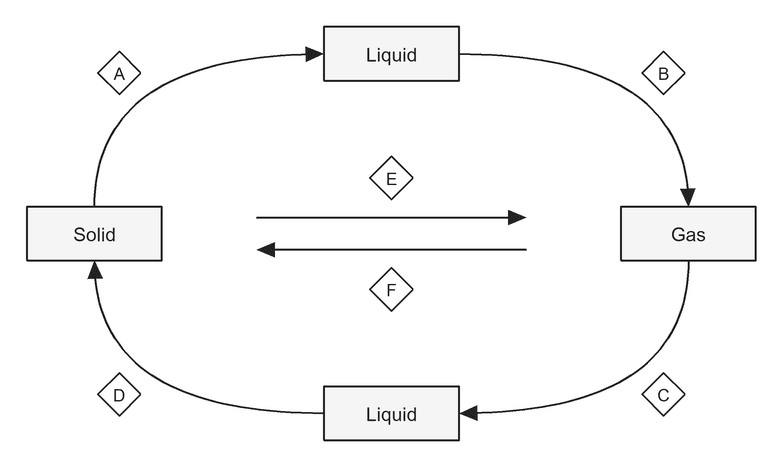 Solve with AI
Written solution
Solution:
Concept: Follow each arrow in the figure: heating takes a substance from solid towards gas, and cooling takes it back. Each change has its own name.
Step 1 — Name the changes on the upper arrows.
Arrow A goes from solid to liquid, which is melting. Arrow B goes from liquid to gas, which is evaporation (vaporisation); rapid vaporisation at the boiling point is called boiling.
Step 2 — Name the changes on the lower arrows.
Arrow C goes from gas to liquid, which is condensation (liquefaction). Arrow D goes from liquid to solid, which is freezing (solidification).
Step 3 — Name the direct changes in the middle.
Arrow E goes straight from solid to gas, which is sublimation. Arrow F goes straight from gas to solid, which is deposition.
Watch out: Some books call both direct changes sublimation; strictly, solid to gas is sublimation and gas to solid is deposition.
Therefore, A is melting, B is evaporation, C is condensation, D is freezing, E is sublimation and F is deposition.
- 265 marks
Question 26
Give reasons:
(a) When a stone is dipped in a glass containing some water, the level of water rises but when a spoon of sugar is added to it and stirred, the water level does not rise.
(b) A drop of ink added to water in a glass turns the whole water blue.
Solve with AIWritten solution
Solution:
Concept: The kinetic theory of matter says that matter is made of tiny particles that are always moving, with spaces between them (intermolecular spaces) and a force of attraction between them (intermolecular force of attraction).
Step 1 — (a) Explain the stone.
A stone does not dissolve. It occupies space, so when it is dipped in the water it pushes the water up, and the level rises by the stone's own volume.
Step 2 — (a) Explain the sugar.
Sugar dissolves, and its tiny particles fit into the intermolecular spaces between the water molecules. So the sugar takes up hardly any extra room, and the water level does not rise noticeably.
Step 3 — (b) Explain the ink.
The particles of ink and of water are in continuous random motion. Moving about, the ink particles spread into the spaces between the water particles all through the glass (the ink diffuses), so the whole water turns blue.
Watch out: The sugar does not vanish: the water tastes sweet, and the sugar can be got back by evaporating the water.
Note: measured carefully, the level does rise very slightly when sugar dissolves, but by far less than the volume of the sugar added.
Therefore, (a) the stone occupies space while dissolved sugar fills the spaces between water molecules, and (b) the ink spreads because its particles and the water particles are always moving.
- 275 marks
Question 27
Sapna was making an orange flavoured drink. She poured 3-4 teaspoons of concentrated orange juice into a glass. She then added water until the glass was full and stirred it slowly.

(a) Explain how the orange juice spread into water?
(b) What is the effect of stirring?
(c) What is this intermixing of particles called? Name the type of substances which show this phenomenon the fastest.
(d) "There is no more movement in the liquid in the glass once the orange colour of the juice has stopped spreading."
Is this statement correct? Justify your answer.
Solve with AIWritten solution
Solution:
Concept: Particles of matter have spaces between them and are always in random motion, so particles of different substances mix by themselves. This mixing is diffusion.
Step 1 — (a) Explain how the juice spreads.
The particles of orange juice and of water are in continuous random motion. The juice particles move into the intermolecular spaces between the water particles, and the water particles move into the spaces between the juice particles, so the juice spreads through the whole glass.
Step 2 — (b) Explain the effect of stirring.
Stirring carries the juice particles all through the water, so the juice mixes faster and the colour becomes even sooner than by diffusion alone.
Step 3 — (c) Name the process and the fastest state.
The intermixing of particles on their own is diffusion. Gases show it the fastest, because their particles move fastest and have the most space between them; liquids diffuse more slowly, and solids hardly at all.
Step 4 — (d) Judge Sapna's statement.
The statement is not correct. The particles of matter are always in random motion because they possess kinetic energy. When the colour stops spreading, the juice particles are simply spread evenly through the water, so no further change can be seen, but the particles keep moving.
Watch out: An even colour means the mixing is complete, not that the particles have stopped.
Therefore, (a) the juice spreads by the random motion of particles into the spaces between them, (b) stirring speeds up the mixing, (c) the process is diffusion and gases show it fastest, and (d) the statement is incorrect because the particles never stop moving.
What Class 7 Chemistry Ch 1 covers
The sections of the chapter, in the order the book takes them. Every question above comes from one of these.
- 01Composition of Matter
- 02Characteristics of Particles of Matter
- 03States of Matter
- 04Interconversion of States of Matter
More ways to study this chapter
The same chapter asked three other ways. Practise it, revise it, and see what the board has set on Ch 1 before.
Class 7 Chemistry Ch 1 questions students ask
How many questions are there in Class 7 Chemistry Ch 1?
27 questions. Every one is solved step by step on this page.
Are these Class 7 Chemistry solutions free?
Yes. Every question and its full working is free to read, with no account needed.
Can I download the Class 7 Chemistry Ch 1 solutions as a PDF?
There is no PDF to download. Every solution is on this page instead, which means it is searchable, always the current syllabus, and readable on a phone. Use your browser's print option if you want it on paper.