
Opening your dashboard
Class 7 Chemistry Chapter 1 Matter and Its Composition: Competency-Based Questions (CBQ)
40 questions on Chapter 1, each worked through on its own page with the AI tutor. Class 7 Chemistry, ICSE 2026-27.
40 questions
1–5 marks · Mixed difficulty
- 11 mark
Question 1
Cognitive domain: Application
The water tank of Aman's house is on the roof. When a tap in the kitchen downstairs is opened, water comes out of it, even though no pump is running.
Which property of liquids makes this possible?
- 21 mark
Question 2
Cognitive domain: Analysis
In a science exhibition, a chart shows the mass of one litre of three substances.
Substance State Mass of 1 litre Iron Solid about 7,900 g Water Liquid 1,000 g Air Gas about 1.2 g Which statement about the particles best explains this pattern?
- 31 mark
Question 3
Cognitive domain: Application
Lata keeps a glass bottle of pure coconut oil on a kitchen shelf. During the year she notes how the oil looks at different room temperatures.
Room temperature How the oil looks 12 °C White solid 20 °C White solid 28 °C Clear liquid 38 °C Clear liquid Which conclusion can Lata draw from her notes?
- 41 mark
Question 4
Cognitive domain: Application
Bunty has fever. His grandmother dips a strip of cloth in water kept at room temperature, squeezes it and lays it on his forehead. After some time the cloth is nearly dry, and his forehead feels cooler.
What is the best explanation?
- 51 mark
Question 5
Cognitive domain: Understanding
Assertion (A): After a shower of rain, the puddles on a road dry up, even though the water in them never boils.
Reason (R): Evaporation can take place at room temperature also.
- 61 mark
Question 6
Cognitive domain: Analysis
Assertion (A): A gold bangle and a silver bangle worn side by side for many years do not mix into each other.
Reason (R): Solids have a definite shape and a definite volume.
- 71 mark
Question 7
Cognitive domain: Understanding
Early on a winter morning, Tara sees tiny round drops of dew on the grass in the school garden. Her teacher explains why the drops are round. Complete the explanation.
The drops are round because water molecules ________ one another and tend to stick together. This force between molecules is called the intermolecular force of ________. It is strongest in ________ and weakest in ________.
- 81 mark
Question 8
Cognitive domain: Recall
A goldsmith cuts a small bar of gold into smaller and smaller pieces. Every piece, however tiny, still looks and behaves like gold. Imagine that he could go on cutting for ever.
Name the smallest particle of gold that would still show all the properties of gold.
- 91 mark
Question 9
Cognitive domain: Application
Zoya presses a dry paper napkin firmly into the bottom of an empty glass tumbler. She turns the tumbler upside down and pushes it straight down into a bucket of water, until the whole tumbler is under the water. Then she lifts it straight out.
Predict whether the napkin will be wet or dry, and give the reason.
- 102 marks
Question 10
Cognitive domain: Understanding
During a swimming lesson, Kabir notices three things. He can walk through air without feeling anything in his way. He can walk through the water of the pool, but only by pushing it aside. He cannot push his hand through the wall of the pool at all.
Explain the three observations by comparing the force of attraction between the particles of a gas, a liquid and a solid.
- 112 marks
Question 11
Cognitive domain: Application
A small pump sends bubbles of air into one corner of a fish tank. Some oxygen from the bubbles dissolves in the water. Fish in every part of the tank, even far from the bubbles, are able to get this dissolved oxygen.
Use two characteristics of the particles of matter to explain where the dissolved oxygen is held in the water, and how it reaches every part of the tank.
- 122 marks
Question 12
Cognitive domain: Understanding
In her notebook Riya writes: "The smallest particle of water is an atom of water. We can see it under the microscope in the school laboratory."
Find the two mistakes in Riya's note and correct them.
- 134 marks
Question 13
Cognitive domain: Analysis
After her birthday party, Shreya wants to find out what happens to the air inside a balloon. She picks a balloon filled with air and ties a thread once round its widest part. The length of thread needed tells her how big the balloon is. She measures the balloon four times, as shown in the table. The knot of the balloon stays tight all through the experiment. She checks the balloon carefully and finds no hole in it.
Step What Shreya does Length of thread round the balloon 1 Measures the balloon in her room, which is at 30 °C 60 cm 2 Keeps the balloon in the fridge for one hour 58 cm 3 Puts it back in the room for one hour 60 cm 4 Leaves it in the room for six days 54 cm (a) Explain, in terms of the particles of air, why the balloon becomes smaller in Step 2 and comes back to its first size in Step 3.
(b) Shreya's brother says: "In the fridge the balloon became smaller, so it also became lighter." Is he right? Use the result of Step 3 to support your answer.
(c) In Step 4 the balloon becomes smaller even though the knot is tight and there is no hole. Use two characteristics of the particles of matter to suggest how this can happen.
- 144 marks
Question 14
Cognitive domain: Evaluation
At a school science fair, Class 7 runs a stall called Solid, liquid or gas? Three everyday things are kept on the table and visitors are asked to vote on each. A notice on the table gives one extra fact: a kitchen sponge is full of tiny holes, and these holes are filled with air. Most visitors vote wrongly. The table shows what they noticed and how they voted.
Thing on the table What the visitors noticed How most visitors voted Sugar in a jar It can be poured, and it takes the shape of the jar Liquid Kitchen sponge It can be pressed to half its size Not a solid Rubber band It becomes longer when it is pulled Not a solid (a) Give two reasons why sugar is a solid and not a liquid, although it can be poured.
(b) Solids cannot be compressed easily. Explain how a sponge, which is a solid, can still be pressed to half its size.
(c) One visitor says: "If the shape of a thing can be changed, it is not a solid." Do you agree? Use the rubber band to judge this statement, and state the test you would use to decide whether a thing is a solid.
- 155 marks
Question 15
Cognitive domain: Creativity
Meera's mother spreads sliced raw mangoes in the sun to dry them for pickle. Meera wonders whether water really evaporates faster in a warm place than in a cool place. She has three identical steel plates, a tablespoon, water, a clean dry glass, a clock, a sunny window sill and a cool shady shelf.
Design an investigation for Meera.
(a) Describe what she should do with the plates and the water.
(b) State what she must keep the same so that the test is fair, and what she should observe or measure.
(c) State the result you expect, and explain it in terms of the particles of water.
(d) Meera's little brother says the water on the plates has simply vanished. Suggest how Meera could use the dry glass to show him that the water has changed into vapour.
- 161 mark
Question 16
Cognitive domain: Evaluation
Matter is anything that has mass and occupies space. Tanya wants to show her younger brother that air has mass, not only that it takes up space. She thinks of four observations.
Which observation shows that air has mass?
- 171 mark
Question 17
Cognitive domain: Understanding
Four samples of water are found in a kitchen at the same time: ice cubes taken from the freezer at −5 °C, tap water at 25 °C, water for tea at 80 °C and steam rising from a kettle at 100 °C.
In which sample are the particles moving fastest, on average?
- 181 mark
Question 18
Cognitive domain: Understanding
A molecule of ozone gas is made of three oxygen atoms joined together, and a molecule of oxygen gas is made of two oxygen atoms.
Assertion (A): Ozone gas () and oxygen gas () are both made only of oxygen atoms, yet they are different substances.
Reason (R): Atoms usually do not have an independent existence, so they join together to form molecules.
- 191 mark
Question 19
Cognitive domain: Analysis
A chemistry teacher gives the melting points and the boiling points of three substances.
Substance Melting point Boiling point Naphthalene 80 °C 218 °C Bromine −7 °C 59 °C Oxygen −219 °C −183 °C The room temperature is 25 °C. What is the state of naphthalene, bromine and oxygen, in this order, at room temperature?
- 201 mark
Question 20
Cognitive domain: Application
In a school laboratory a teacher, working in a fume cupboard, gently heats a few dark crystals of iodine in a dry boiling tube. Violet vapour rises, and no liquid is seen in the tube. Soon shiny dark crystals appear on the cooler upper part of the tube.
Which description of the changes is correct?
- 211 mark
Question 21
Cognitive domain: Analysis
Hospitals store oxygen as a liquid in large insulated tanks, because a liquid takes up much less space than the same mass of gas.
Assertion (A): Liquid oxygen is made by cooling oxygen gas strongly and pressing it into a smaller space.
Reason (R): When pressure is applied on a gas, its particles move farther apart.
- 221 mark
Question 22
Cognitive domain: Application
Ravi fits a funnel tightly into the neck of an empty bottle and seals the gap round the neck with clay. When he pours water into the funnel, the water stays in the funnel and hardly any of it runs down. When he removes the clay, the water runs down at once.
Which statement explains this?
- 231 mark
Question 23
Cognitive domain: Application
Small gaps are left between the ends of two consecutive iron rails of a railway track. An engineer notes that on a hot afternoon in May the gaps are narrower than on a cold morning in December.
Which explanation is correct?
- 241 mark
Question 24
Cognitive domain: Analysis
The diagrams show how the particles are arranged in three samples X, Y and Z, each kept in a closed container of the same size. (Hypothetical diagrams.)
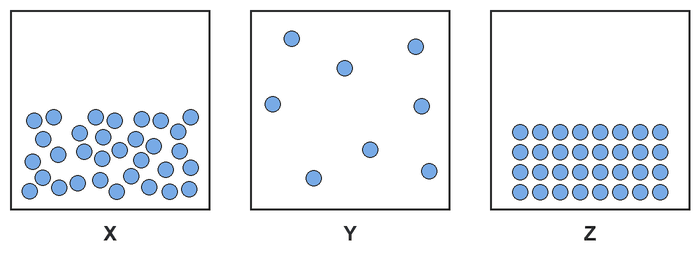
One of the samples can be compressed easily and spreads out to fill its whole container. Which diagram shows it, and why?
- 251 mark
Question 25
Cognitive domain: Evaluation
Farah heats 200 mL of water in an open pan on a steady flame and reads the temperature every two minutes. From the sixth minute onwards she sees bubbles rising all through the water and steam coming out of the pan. (Hypothetical data.)
Time (min) 0 2 4 6 8 10 Temperature (°C) 28 52 76 100 100 100 Which statement about the readings is correct?
- 262 marks
Question 26
Cognitive domain: Analysis
On a winter morning Meena stands in the school garden and notices four things: the smell of jasmine flowers, the shadow of a tree, the sound of the school bell and the mist hanging over a pond.
Sort the four into matter and not matter. Give a reason for each.
- 272 marks
Question 27
Cognitive domain: Evaluation
Party balloons that float are filled with helium gas. In helium, each particle that exists on its own is a single atom of helium. In hydrogen gas, each particle that exists on its own is a molecule made of two hydrogen atoms.
In her notebook Riya writes: "Atoms can never exist on their own."
(a) Judge Riya's statement, using helium.
(b) Name the smallest particle that has an independent existence in helium gas and in hydrogen gas.
- 282 marks
Question 28
Cognitive domain: Application
A pure substance X melts at 44 °C and boils at 280 °C. (Hypothetical data.)
(a) State the freezing point and the condensation point of X.
(b) Liquid X at 100 °C is left to cool to 30 °C. Name the change of state that takes place, and the temperature at which it begins.
- 292 marks
Question 29
Cognitive domain: Understanding
A closed transparent plastic box is half filled with water. The rest of the box holds air. Kiran tilts the box to one side and holds it still.
(a) Describe the surface of the water and the air in the tilted box.
(b) Explain, in terms of the particles, why the water has a free surface of its own but the air does not.
- 302 marks
Question 30
Cognitive domain: Application
Rahul puts three ice cubes into a glass of warm lemon juice. After some time the ice cubes have melted and the juice has become cool.
(a) Name the change of state of the ice, and say whether the ice absorbs heat or gives it out.
(b) Explain from where the ice gets the heat, and why the juice cools.
- 312 marks
Question 31
Cognitive domain: Evaluation
Ria weighs a cup of tea on a kitchen balance and the balance reads 250 g. She adds 10 g of sugar, stirs until no sugar can be seen, and weighs the cup again. The balance now reads 260 g. The level of the tea in the cup has not risen noticeably.
Ria says, "The sugar has been destroyed." Do you agree? Give two reasons, one from the readings of the balance and one from the particles of matter.
- 323 marks
Question 32
Cognitive domain: Analysis
A science magazine gives the volume of 1 kg of water in each of its three states.
State Mass Volume Ice at 0 °C 1 kg about Liquid water at 4 °C 1 kg Steam at 100 °C 1 kg about (a) How many times the volume of the liquid water is the volume of the steam?
(b) The mass is the same in all three states, but the steam takes up far more space. Explain this in terms of the particles.
(c) For most substances the solid takes up less space than the liquid. What does the table show about water? Give one everyday sign of it.
- 333 marks
Question 33
Cognitive domain: Evaluation
Three students make claims during a revision class.
Asha: "When we can smell a camphor tablet from across the room, some particles of camphor have left the tablet, so the tablet is slowly losing mass."
Bhavna: "When a gas is cooled, the force of attraction between its particles becomes weaker."
Chetan: "Mercury is a liquid at room temperature, so its particles are farther apart than the particles of steam."
Judge each claim as true or false, and give a reason.
- 343 marks
Question 34
Cognitive domain: Application
Engineers choose the state of matter that suits each job in a truck.
- The tyres are filled with air.
- The brakes use oil in thin pipes: pressing the brake pedal pushes the oil, and the oil pushes the brake pads at the wheels.
- The wheel rims are made of steel.
Liquids are very hard to compress. Using the properties of the three states, explain why each choice suits its job.
- 353 marks
Question 35
Cognitive domain: Analysis
A pure solid substance S is heated steadily and its temperature is noted every two minutes. (Hypothetical data.)
Time (min) 0 2 4 6 8 10 12 14 Temperature (°C) 60 70 80 80 80 80 88 96 (a) Find the melting point of S, and the number of minutes for which it was melting.
(b) State the physical state or states of S at the eighth minute.
(c) The experiment is repeated with twice the mass of S on the same flame. Predict the temperature of the flat part of the new readings and whether the flat part lasts longer or shorter than before. Give a reason for each.
- 363 marks
Question 36
Cognitive domain: Application
In a fume cupboard, a teacher gently heats a mixture of powdered ammonium chloride and sand in a china dish. The dish is covered by an inverted funnel with a cotton-wool plug in its stem. After some time a white solid collects on the cooler inner wall of the funnel, and the sand is left behind in the dish.
(a) Name the process that separates the ammonium chloride from the sand.
(b) Describe the changes of state that take place, in order.
(c) Explain why the sand is left behind in the dish.
- 374 marks
Question 37
Cognitive domain: Analysis
In the salt pans of Kutch in Gujarat, sea water is let into wide, flat, shallow pans. Under the hot sun and dry wind the water slowly changes into vapour and escapes into the air. After many days a layer of white salt is left behind, and the workers rake it into heaps.
A trainee wants to know whether the shape of a pan matters. She uses the same sea water, the same sunny spot and the same volume of water in two pans. (Hypothetical data.)
Pan Surface area of water Depth of water Days taken to dry up P 4 square metres 10 cm 12 Q 1 square metre 40 cm 48 (a) Name the change of state that dries up the sea water, and say why the salt is left behind.
(b) Which pan dries up faster? State the factor that explains this.
(c) A third pan R has a surface area of 2 square metres and holds the same volume of water. Find the depth of water in R. If the water level in R falls by the same amount each day as in pan P, how many days will R take to dry up?
- 384 marks
Question 38
Cognitive domain: Evaluation
Dev made a chart for the school science corner to compare solids, liquids and gases. His teacher read it and wrote at the top: "Three of the entries in this chart are wrong. Find them, correct them and explain each correction." Dev had copied some of the entries from memory while he was rushing to finish the chart before the science fair opened, and he had not checked them with his notes.
Property Solid Liquid Gas Shape Fixed Fixed Takes the shape of its container Volume Fixed Fixed Fixed Space between particles Least More than in a solid Most Force of attraction between particles Strongest Weaker than in a solid Strongest Movement of particles Vibrate about fixed positions Slide past one another Move freely in all directions (a) Find the wrong entry in the row for shape, correct it, and explain the correction.
(b) Find the wrong entry in the row for volume, correct it, and explain the correction.
(c) Find the wrong entry in the row for the force of attraction, correct it, and explain the correction.
- 395 marks
Question 39
Cognitive domain: Creativity
For Science Day, Class 7 plans a role play in the school hall in which 30 students act as the particles of one substance. The teacher sets three rules. The students must show everything only by where they stand and how they move, with no models in their hands. The audience must be able to tell the three states apart without being told. The play must also show the substance being heated and being cooled.
(a) Describe how the students should stand and move to show a solid, a liquid and a gas.
(b) Describe how the students show the solid melting and then the liquid changing into a gas when the teacher signals 'heat'.
(c) Give one way in which this model does not match real particles, and say why it is still useful.
- 405 marks
Question 40
Cognitive domain: Evaluation
Pooja measures the mass and the volume of four objects for a project on matter. She finds the masses with a weighing balance. She measures the iron block, the wooden block and the cork piece with a ruler, and she found the volume of the glass marble earlier with a measuring cylinder. Her teacher tells her that the mass of of a material is found by dividing its mass by its volume. (Hypothetical data.)
Object Mass Volume Iron block 47 g Wooden block 24 g Cork piece 6 g Glass marble 54 g (a) Arrange the four objects in increasing order of mass, and then in increasing order of volume.
(b) Pooja's brother says, "The object with the larger mass always has the larger volume." Use two objects from the table to judge the statement.
(c) Pooja wants a piece of the same wood with the same mass as the iron block. Find the volume of wood needed, and say whether she can cut it from her wooden block.