Solution:
Concept: The three supporting tissues of plants are told apart by their cell walls: parenchyma has thin walls, collenchyma is thickened at the corners, and sclerenchyma has very thick walls and dead cells.
Step 1 — (i) Name A, B and C.
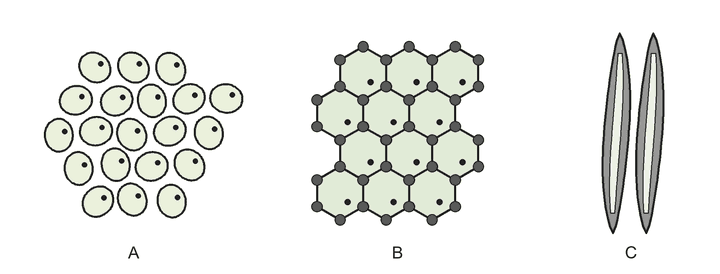
A has rounded, thin-walled cells with spaces between them, so it is parenchyma. B has cells thickened at the corners, so it is collenchyma. C has long, narrow, thick-walled fibres, so it is sclerenchyma.
Step 2 — (ii) Structural difference between A and B.
A (parenchyma) cells have thin walls all round and large spaces between them; B (collenchyma) cells are thickened at the corners and have little space between them.
Step 3 — (iii) In the petiole.
B, collenchyma, is found in the leaf stalk (petiole), where it gives flexible support.
Step 4 — (iv) Functional difference between A and C.
A (parenchyma) stores food (and makes food when it has chloroplasts); C (sclerenchyma) gives strength and rigid support to the plant.
Step 5 — (v) Long, narrow, thick-walled, dead cells.
These describe sclerenchyma (C).
Watch out: Collenchyma is thickened only at the corners; sclerenchyma is thick all round and its cells are dead.
Therefore, (i) A parenchyma, B collenchyma, C sclerenchyma; (ii) A thin-walled with large spaces, B thickened at the corners; (iii) B (collenchyma); (iv) A stores food, C gives strength; (v) sclerenchyma.