Solution:
Concept: Muscular tissue contracts and relaxes to cause movement. There are three kinds: striated (skeletal, voluntary), unstriated (smooth, involuntary) and cardiac (heart muscle, involuntary).
Step 1 — (i) Identify A, B and C.
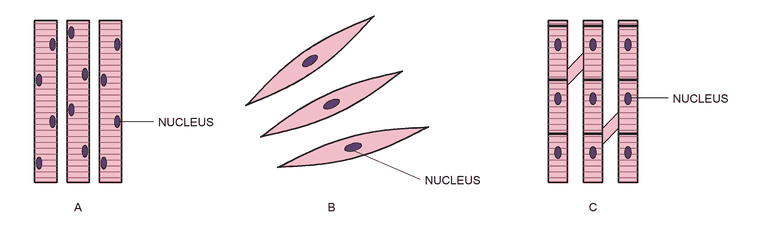
A has long, unbranched fibres with cross stripes and many nuclei, so it is striated (skeletal) muscle. B has spindle-shaped cells without stripes, each with one nucleus, so it is unstriated (smooth) muscle. C has striped fibres that branch and join, with cross bands between the cells, so it is cardiac (heart) muscle.
Step 2 — (ii) One location of each.
A: the muscles of the arms and legs, attached to bones. B: the wall of the alimentary canal, such as the stomach and intestine. C: the wall of the heart.
Step 3 — (iii) One common function.
All three contract and relax to bring about movement: of the limbs (A), of food along the gut (B) and of blood by the heartbeat (C).
Step 4 — (iv) Structural difference between A and B.
A has long, cylindrical fibres with cross stripes (striations) and many nuclei; B has spindle-shaped (tapering) cells without stripes, each with a single nucleus.
Step 5 — (v) Not under our will.
B (unstriated muscle) and C (cardiac muscle) work on their own, so they are involuntary.
Watch out: Cardiac muscle is striated like A, but it is involuntary like B.
Therefore, (i) A striated, B unstriated, C cardiac muscle; (ii) arms and legs, alimentary canal, heart; (iii) contraction for movement; (iv) A is striped with many nuclei, B is plain and spindle-shaped with one nucleus; (v) B and C.