
Question 263 marksEasy
For each letter of the English alphabet, draw the maximum possible number of lines of symmetry.
Confirming your payment
Sign up now and get 250 free tokens.
Symmetry · Question 26 of 48
For each letter of the English alphabet, draw the maximum possible number of lines of symmetry.
Solution:
Concept: A line of symmetry (axis of symmetry) divides a figure into two parts that fit exactly on each other when the figure is folded along that line, so each part is the mirror image of the other. For a capital letter, a vertical line works when the left half is the mirror image of the right half, and a horizontal line works when the top half is the mirror image of the bottom half.
Step 1 — Test each letter.
For each capital letter we test two folds: a vertical fold (does the left half fit the right half?) and a horizontal fold (does the top half fit the bottom half?).
Step 2 — Draw the lines.
The dashed lines in the figure show every fold that works.
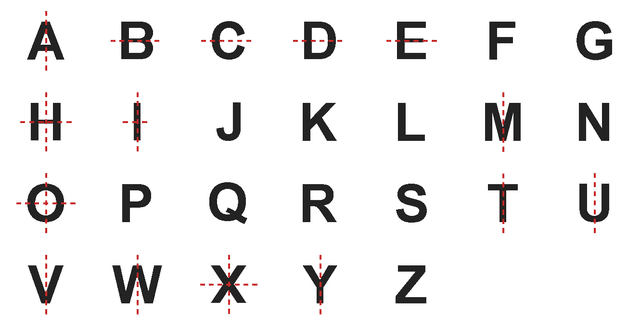
Step 3 — Sort the letters.
We group the letters by the number of lines of symmetry they have.
| Lines of symmetry | Letters |
|---|---|
| One (vertical) | A, M, T, U, V, W, Y |
| One (horizontal) | B, C, D, E |
| Two (vertical and horizontal) | H, I, O, X |
| None | F, G, J, K, L, N, P, Q, R, S, Z |
Watch out: The answer depends a little on how the letters are written: the groups above use the shapes shown in this chapter (O as an oval, K with its lower arm starting on the upper arm).
Note: If O is drawn as a perfect circle it has unlimited lines of symmetry, and if K is written with both arms meeting the middle of the upright it has one horizontal line.
Therefore, A, M, T, U, V, W, Y have one vertical line; B, C, D, E have one horizontal line; H, I, O, X have two lines; F, G, J, K, L, N, P, Q, R, S, Z have none.