
Question 93 marksEasy
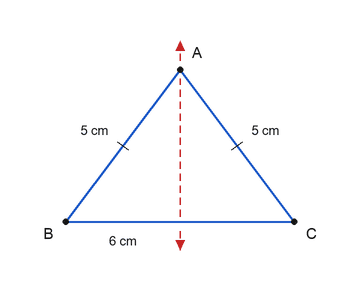
Construct a triangle ABC in which AB = AC = 5 cm and BC = 6 cm. Draw all its lines of symmetry.
Confirming your payment
Sign up now and get 250 free tokens.
Symmetry · Question 9 of 48
Construct a triangle ABC in which AB = AC = 5 cm and BC = 6 cm. Draw all its lines of symmetry.
Solution:
Concept: A triangle has a line of symmetry only through a vertex where two equal sides meet: the fold along the bisector of that angle puts one equal side on the other. So a scalene triangle has no line, an isosceles triangle has one and an equilateral triangle has three.
Given: AB and AC are each 5 cm long, and BC is 6 cm long.
Step 1 — Draw the base.
We draw the line segment BC, 6 cm long, with a ruler.
Step 2 — Locate A.
With B as centre and radius 5 cm we draw an arc above BC. With C as centre and the same radius 5 cm we draw another arc cutting the first one. The point where the arcs cut is A, because it is 5 cm from both B and C.
Step 3 — Complete the triangle.
We join AB and AC. The sides AB and AC are both 5 cm long, so triangle ABC is an isosceles triangle.
Step 4 — Draw the line of symmetry.
With B and C as centres and equal radii (more than 3 cm) we draw arcs on both sides of BC; the line through the two crossing points is the perpendicular bisector of BC. Because A is equally far from B and C, this line passes through A. We draw it as a dashed line.
Step 5 — Check that there are no other lines.
BC (6 cm) is longer than AB and AC (5 cm), so no fold can put BC on another side. Only the fold through A works.
Watch out: Draw the line through A perpendicular to BC; a line from B or C does not fold the triangle onto itself here.
Therefore, triangle ABC is isosceles and has only one line of symmetry, the line through A perpendicular to BC (it bisects ∠A and BC).