
Opening your dashboard
Class 6 Biology Chapter 8: Habitat and Adaptation Solutions
36 textbook questions with step-by-step answers, free to read, for ICSE 2026-27.
Get talked through Ch 8, not just shown the answer
Reading a finished solution is not the same as being able to do it. The AI tutor takes one question at a time and works it with you, in your own words, until you can.
- Ask it out loud, in your own words
- It gives you the next step, not the answer
- Stuck on part (ii)? Start there
36 questions with solutions
1–10 marks · Mixed difficulty
- 11 mark
Question 1
In a cactus plant, photosynthesis occurs in :
Solve with AIAnswer
(A) leaves
(B) spines
(C) modified roots
- Correct
(D) modified stem
Answer: (D) modified stem
Concept: In the hot, dry desert, plants and animals must save water: a cactus has spines in place of leaves and a green, fleshy stem that stores water and makes food; a camel loses very little water.
Step 1 — Find the green part of a cactus.
Photosynthesis needs a green part. In a cactus the leaves are reduced to spines, and the thick, green, fleshy stem takes over the job of the leaves.
Step 2 — Pick the option.
So in a cactus photosynthesis occurs in the modified stem, option (D).
Watch out: The flat green parts of some cacti look like leaves, but they are stems.
Why the other options are wrong:
- (A) leaves: a cactus has no normal green leaves; they are reduced to spines.
- (B) spines: they are not green; they cut down water loss and protect the plant from animals.
- (C) modified roots: the roots spread through the soil to absorb water; being underground, they do not make food.
Therefore, in a cactus plant, photosynthesis occurs in the modified stem, option (D).
- 21 mark
Question 2
The animals such as birds have :
Solve with AIAnswer
- Correct
(A) light bones with air cavities
(B) solid heavy bones
(C) heavy pointed bones
(D) no bones
Answer: (A) light bones with air cavities
Concept: An adaptation is a feature of the body or behaviour that helps an organism survive in its habitat. Desert plants and animals save water, aquatic ones float and swim, birds are built for flight, and mountain animals keep warm.
Step 1 — Think about flight.
A flying animal must keep its body weight low.
Step 2 — Recall the bones of birds.
Many bones of a bird are hollow, with air cavities inside, so they are light yet strong. So birds have light bones with air cavities, option (A).
Why the other options are wrong:
- (B) solid heavy bones: solid, heavy bones would make flying much harder.
- (C) heavy pointed bones: heavy bones of any shape would add weight, which flying birds avoid.
- (D) no bones: birds are vertebrates, so they do have a bony skeleton.
Therefore, birds have light bones with air cavities, option (A).
- 31 mark
Question 3
The biotic components of the environment includes :
Solve with AIAnswer
(A) green plants
(B) animals
(C) decomposers
- Correct
(D) all of these
Answer: (D) all of these
Concept: The habitat of an organism is its natural home and surroundings. Its biotic factors are the living things (plants, animals and decomposers such as bacteria and fungi); its abiotic factors are the non-living things (soil, water, air, light and temperature).
Step 1 — List the living components.
Green plants (producers), animals (consumers) and decomposers such as bacteria and fungi are all living, so all three are biotic components.
Step 2 — Pick the option.
Since every option is biotic, the answer is ‘all of these’, option (D).
Why the other options are wrong:
- (A) green plants: they are biotic, but they are not the only biotic component.
- (B) animals: they are biotic, but plants and decomposers are biotic too.
- (C) decomposers: they are biotic, but so are plants and animals.
Therefore, the biotic components include green plants, animals and decomposers, option (D).
- 41 mark
Question 4
The presence of hollow plant stems is a characteristic of :
Solve with AIAnswer
(A) desert plants
- Correct
(B) aquatic plants
(C) mountainous trees
(D) none of these
Answer: (B) aquatic plants
Concept: Aquatic plants and animals are adapted to life in water: plants have air spaces in their stems and leaf-stalks to stay afloat, and fish have a streamlined body, fins for swimming and gills for breathing.
Step 1 — Recall the stems of water plants.
Aquatic plants such as the lotus, the water lily and Hydrilla have soft stems and leaf-stalks with large air spaces (hollow channels). The air keeps them light and helps them float and reach the light.
Step 2 — Pick the option.
So hollow plant stems are a characteristic of aquatic plants, option (B).
Why the other options are wrong:
- (A) desert plants: they have thick, fleshy stems that store water.
- (C) mountainous trees: mountain trees such as pine have strong, woody stems.
- (D) none of these: aquatic plants do show this feature, so ‘none of these’ is wrong.
Therefore, hollow plant stems are a characteristic of aquatic plants, option (B).
- 51 mark
Question 5
Slow breathing is the characteristic of :
Solve with AIAnswer
- Correct
(A) desert animals
(B) aquatic animals
(C) aerial animals
(D) land animals
Answer: (A) desert animals
Concept: In the hot, dry desert, plants and animals must save water: a cactus has spines in place of leaves and a green, fleshy stem that stores water and makes food; a camel loses very little water.
Step 1 — Link breathing with water loss.
The air we breathe out carries some water vapour, so every breath loses a little water.
Step 2 — Pick the option.
Desert animals such as the camel breathe slowly to save this water, so slow breathing is a characteristic of desert animals, option (A).
Why the other options are wrong:
- (B) aquatic animals: they live in water, so they do not need to save water by breathing slowly.
- (C) aerial animals: flying animals use a lot of energy, so they breathe fast.
- (D) land animals: ‘land animals’ is too general; slow breathing is a special water-saving adaptation of desert animals.
Therefore, slow breathing is a characteristic of desert animals, option (A).
- 61 mark
Question 6
Diversity of organisms is found in different habitats because of different adaptations for :
Solve with AIAnswer
(A) average temperature
(B) soil type
(C) annual precipitation
- Correct
(D) all of these
Answer: (D) all of these
Concept: An adaptation is a feature of the body or behaviour that helps an organism survive in its habitat. Desert plants and animals save water, aquatic ones float and swim, birds are built for flight, and mountain animals keep warm. Habitats differ in their abiotic factors.
Step 1 — List the factors that differ.
Habitats differ in their average temperature, their soil type and their yearly rainfall (precipitation).
Step 2 — Pick the option.
Organisms are adapted to all these factors, so each habitat has its own kinds of organisms, option (D).
Why the other options are wrong:
- (A) average temperature: temperature is one such factor, but not the only one.
- (B) soil type: it is one such factor, but not the only one.
- (C) annual precipitation: rainfall is one such factor, but not the only one.
Therefore, diversity of organisms is due to adaptations for all of these, option (D).
- 71 mark
Question 7
Which of the following is an aquatic plant ?
Solve with AIAnswer
(A) Rice
(B) Mango
- Correct
(C) Vallisneria
(D) Cactus
Answer: (C) Vallisneria
Concept: Aquatic plants and animals are adapted to life in water: plants have air spaces in their stems and leaf-stalks to stay afloat, and fish have a streamlined body, fins for swimming and gills for breathing.
Step 1 — Check each plant.
Vallisneria (eel grass) is a water plant that grows rooted at the bottom of ponds and lakes, with its ribbon-like leaves under water; it is often grown in aquariums.
Step 2 — Pick the option.
So the aquatic plant is Vallisneria, option (C).
Why the other options are wrong:
- (A) Rice: it grows in flooded fields, but it is a crop plant of farm land, not a true aquatic plant that lives under water.
- (B) Mango: it is a land tree.
- (D) Cactus: it is a desert plant.
Therefore, Vallisneria is an aquatic plant, option (C).
- 81 mark
Question 8
Which of the following categories of animals have a streamlined body shape ?
Solve with AIAnswer
(A) Birds and Reptiles
(B) Fish and Amphibians
- Correct
(C) Fish and Birds
(D) Birds and Mammals
Answer: (C) Fish and Birds
Concept: A streamlined body is narrow at both ends and wide in the middle, so it meets the least resistance when moving through water or air.
Step 1 — Find who needs a streamlined shape.
A fish moves through water and a bird moves through air; both have streamlined bodies.
Step 2 — Pick the option.
So fish and birds have a streamlined body shape, option (C).
Why the other options are wrong:
- (A) Birds and Reptiles: most reptiles, such as lizards and tortoises, do not have a streamlined body.
- (B) Fish and Amphibians: amphibians such as frogs and toads do not have a streamlined body.
- (D) Birds and Mammals: most mammals do not have a streamlined body; whales and dolphins are exceptions.
Therefore, fish and birds have a streamlined body shape, option (C).
- 91 mark
Question 9
Gill cover is technically termed as :
Solve with AIAnswer
(A) Exoskeleton
- Correct
(B) Operculum
(C) Flippers
(D) None of these
Answer: (B) Operculum
Concept: Aquatic plants and animals are adapted to life in water: plants have air spaces in their stems and leaf-stalks to stay afloat, and fish have a streamlined body, fins for swimming and gills for breathing.
Step 1 — Recall the gill cover.
In a bony fish the gills on each side of the head are protected by a hard flap called the operculum.
Step 2 — Pick the option.
So the gill cover is technically termed the operculum, option (B).
Why the other options are wrong:
- (A) Exoskeleton: an exoskeleton is a hard outer covering of the whole body, as in insects and crabs; it is not the gill cover.
- (C) Flippers: they are paddle-like front limbs, as in whales and turtles.
- (D) None of these: the gill cover does have a technical name, the operculum.
Therefore, the gill cover is technically termed the operculum, option (B).
- 101 mark
Question 10
The animal which has a thick skin covered with fur is :
Solve with AIAnswer
(A) Whale
(B) Cat
(C) Camel
- Correct
(D) Yak
Answer: (D) Yak
Concept: Mountain animals are adapted to the cold: the yak and the mountain goat have a thick skin covered with long fur.
Step 1 — Find the cold-climate animal.
The yak lives high in the cold Himalayas. Its thick skin and long, shaggy fur keep its body warm.
Step 2 — Pick the option.
So the animal with a thick skin covered with fur is the yak, option (D).
Why the other options are wrong:
- (A) Whale: a whale has smooth skin with no fur; a thick layer of fat (blubber) keeps it warm.
- (B) Cat: a cat has fur, but its skin is thin and it is not the cold-mountain animal described.
- (C) Camel: a camel lives in hot deserts; its coat is not the thick fur coat of a mountain animal.
Therefore, the animal with a thick skin covered with fur is the yak, option (D).
- 111 mark
Question 11
Assertion (A): Adaptations are the changes in the body or behaviour of an organism that enable it to survive comfortably and successfully in a habitat.
Reason (R): Adaptations occur according to the climatic conditions of the surroundings, specific requirements of the body and habitat of the organisms.
Solve with AIAnswer
- Correct
(A) (1) Both A and R are true and R is the correct explanation of A.
(B) (2) Both A and R are true but R is not the correct explanation of A.
(C) (3) A is true but R is false.
(D) (4) A is false but R is true.
Answer: (A) (1) Both A and R are true and R is the correct explanation of A.
Concept: In an assertion-reason item, first judge the Assertion (A) and the Reason (R) separately as true or false; only when both are true do we ask whether R correctly explains A.
Step 1 — Judge the Assertion.
A is true. It gives the meaning of adaptation: features of the body or behaviour that help an organism survive in its habitat.
Step 2 — Judge the Reason.
R is true. Adaptations suit the climate, the needs of the body and the habitat of the organism.
Step 3 — Decide whether R explains A.
Because adaptations match the climate, the body's needs and the habitat, they let the organism live comfortably there. So R explains A, and the answer is option (A).
Why the other options are wrong:
- (B): R does explain why adaptations help survival in a habitat.
- (C): R is true: adaptations do suit the climate and habitat.
- (D): A is true: it is the meaning of adaptation.
Therefore, both A and R are true and R is the correct explanation of A, option (A).
- 121 mark
Question 12
Assertion (A): Biotic factors of the environment include plants, animals and humans whereas soil, water, air and sunlight belong to abiotic factors.
Reason (R): All the living and non-living components of the environment are classified as biotic and abiotic factors which are inter-related to each other. They are also dependent on each other for various purposes.
Solve with AIAnswer
(A) (1) Both A and R are true and R is the correct explanation of A.
- Correct
(B) (2) Both A and R are true but R is not the correct explanation of A.
(C) (3) A is true but R is false.
(D) (4) A is false but R is true.
Answer: (B) (2) Both A and R are true but R is not the correct explanation of A.
Concept: In an assertion-reason item, first judge the Assertion (A) and the Reason (R) separately as true or false; only when both are true do we ask whether R correctly explains A.
Step 1 — Judge the Assertion.
A is true. Plants, animals and humans are living, so they are biotic factors; soil, water, air and sunlight are non-living, so they are abiotic.
Step 2 — Judge the Reason.
R is true. The living and non-living components are linked and depend on each other; for example, plants need soil, water and sunlight.
Step 3 — Decide whether R explains A.
R talks about how the two groups depend on each other. It does not say why plants are biotic and soil is abiotic. So R is not the explanation, and the answer is option (B).
Why the other options are wrong:
- (A): R does not explain the grouping given in A.
- (C): R is true: biotic and abiotic factors are inter-related.
- (D): A is true: it groups the factors correctly.
Therefore, both A and R are true but R is not the correct explanation of A, option (B).
- 131 mark
Question 13
Assertion (A): The feathers on the tail of a bird help to slow down its speed and also help in steering (changing direction) while flying.
Reason (R): The strong breast muscles of the bird help in the movement of wings, regulate speed and steering.
Solve with AIAnswer
(A) (1) Both A and R are true and R is the correct explanation of A.
- Correct
(B) (2) Both A and R are true but R is not the correct explanation of A.
(C) (3) A is true but R is false.
(D) (4) A is false but R is true.
Answer: (B) (2) Both A and R are true but R is not the correct explanation of A.
Concept: In an assertion-reason item, first judge the Assertion (A) and the Reason (R) separately as true or false; only when both are true do we ask whether R correctly explains A.
Step 1 — Judge the Assertion.
A is true. The tail feathers act like a rudder and brakes: spread out, they slow the bird down, and tilted, they help it change direction.
Step 2 — Judge the Reason.
R is true. The strong breast muscles move the wings, and the wing beats control the speed and the turns.
Step 3 — Decide whether R explains A.
R is about the breast muscles and wings, not the tail feathers, so it does not explain A. The answer is option (B).
Why the other options are wrong:
- (A): R describes the breast muscles, not the tail feathers.
- (C): R is true: the breast muscles do move the wings.
- (D): A is true: tail feathers help in braking and steering.
Therefore, both A and R are true but R is not the correct explanation of A, option (B).
- 141 mark
Question 14
Assertion (A): An event of distribution of seeds far away from the parent plant is significant to spread in large area/different climatic conditions and to develop some new, better adaptations.
Reason (R): Dispersal of seeds avoids over-crowding, otherwise all the seeds will get insufficient space, water and nutrients.
Solve with AIAnswer
- Correct
(A) (1) Both A and R are true and R is the correct explanation of A.
(B) (2) Both A and R are true but R is not the correct explanation of A.
(C) (3) A is true but R is false.
(D) (4) A is false but R is true.
Answer: (A) (1) Both A and R are true and R is the correct explanation of A.
Concept: In an assertion-reason item, first judge the Assertion (A) and the Reason (R) separately as true or false; only when both are true do we ask whether R correctly explains A.
Step 1 — Judge the Assertion.
A is true. When seeds are carried far from the parent plant, the plant spreads to new areas with different conditions.
Step 2 — Judge the Reason.
R is true. If all the seeds fell under the parent, the seedlings would be over-crowded and would not get enough space, water and nutrients.
Step 3 — Decide whether R explains A.
R gives the reason why carrying seeds far away matters, so R explains A, and the answer is option (A).
Why the other options are wrong:
- (B): R gives the very reason dispersal is needed, so it does explain A.
- (C): R is true: seeds that fall together compete for space, water and nutrients.
- (D): A is true: dispersal spreads the plant to new areas.
Therefore, both A and R are true and R is the correct explanation of A, option (A).
- 155 marks
Question 15
Fill in the blanks with a suitable word :
(i) In birds, .......... are modified into wings.
(ii) The mountain goat has strong .......... for running up on rocky slopes of the mountains.
(iii) The hump of a camel is full of .......... which serves as the reserved food.
(iv) Whales are .......... mammals.
(v) The kind of flowers in which pollination occurs with the help of water is termed as .......... flower.
Solve with AIWritten solution
Solution:
Concept: An adaptation is a feature of the body or behaviour that helps an organism survive in its habitat. Desert plants and animals save water, aquatic ones float and swim, birds are built for flight, and mountain animals keep warm.
Step 1 — (i) to (iii).
In birds, the forelimbs are modified into wings. The mountain goat has strong hooves for running up rocky slopes. The hump of a camel is full of fat, which serves as reserved food.
Step 2 — (iv) and (v).
Whales live in the sea, so they are marine (aquatic) mammals. Flowers pollinated with the help of water are called hydrophilous flowers (hydro = water, philous = loving).
Watch out: The camel's hump stores fat, not water.
Therefore, (i) forelimbs, (ii) hooves, (iii) fat, (iv) marine, (v) hydrophilous.
- 165 marks
Question 16
Write true or false against the following statements. Rewrite and correct the false statements :
(i) Dorsal and ventral fins of a fish are paired fins.
(ii) Fishes breathe by means of nostrils.
(iii) A camel urinates very less and its urine is comparatively thicker.
(iv) The leaves of water lily are reduced in the form of spines to reduce transpiration.
(v) The claws of a bird help in steering (changing direction).
Solve with AIWritten solution
Solution:
Concept: Aquatic plants and animals are adapted to life in water: plants have air spaces in their stems and leaf-stalks to stay afloat, and fish have a streamlined body, fins for swimming and gills for breathing.
Step 1 — (i) Fins.
The dorsal fin on the back and the ventral (anal) fin on the underside are single fins in the middle line of the body, so the statement is False. Correct: Dorsal and ventral fins of a fish are unpaired (median) fins.
Step 2 — (ii) Breathing.
Fish take oxygen from the water through their gills, so the statement is False. Correct: Fishes breathe by means of gills.
Step 3 — (iii) Camel's urine.
A camel passes very little urine, and it is thick (concentrated), which saves water. The statement is True.
Step 4 — (iv) Spines.
The water lily has broad, floating leaves; it is the cactus whose leaves are reduced to spines. The statement is False. Correct: The leaves of cactus are reduced to spines to reduce transpiration.
Step 5 — (v) Steering.
A bird uses its claws for perching and holding food; the tail feathers do the steering. The statement is False. Correct: The tail feathers of a bird help in steering (changing direction).
Note: Here the ventral fin means the single anal fin on the underside near the tail. The pelvic fins, which some books also call ventral fins, are paired.
Therefore, (i) False (unpaired fins), (ii) False (gills), (iii) True, (iv) False (cactus), (v) False (tail feathers).
- 175 marks
Question 17
Match the terms given in column A with those of column B :
Column A Column B (i) Penguins (a) Desert habitat (ii) Pine trees (b) Very small stems (iii) Camel (c) Mountain habitat (iv) Cactus (d) Polar habitat (v) Water lily (e) Modified fleshy stem Solve with AIWritten solution
Solution:
Concept: The habitat of an organism is its natural home and surroundings. Its biotic factors are the living things (plants, animals and decomposers such as bacteria and fungi); its abiotic factors are the non-living things (soil, water, air, light and temperature).
Step 1 — (i) to (iii).
Penguins live in the cold Antarctic, so (i) matches (d) Polar habitat. Pine trees grow on cold mountains, so (ii) matches (c) Mountain habitat. The camel lives in hot deserts, so (iii) matches (a) Desert habitat.
Step 2 — (iv) and (v).
The green, fleshy part of a cactus is its stem, so (iv) matches (e) Modified fleshy stem. The pair left for the water lily is (v) matches (b) Very small stems.
Step 3 — Write the matched table.
The pairs are collected below.
Column A Column B (i) Penguins (d) Polar habitat (ii) Pine trees (c) Mountain habitat (iii) Camel (a) Desert habitat (iv) Cactus (e) Modified fleshy stem (v) Water lily (b) Very small stems Note: The water lily has a short stem buried in the mud, and its leaves float on long leaf-stalks.
Therefore, (i) matches (d), (ii) matches (c), (iii) matches (a), (iv) matches (e) and (v) matches (b).
- 182 marks
Question 18
List any four abiotic factors which affect different living beings.
Solve with AIWritten solution
Solution:
Concept: The habitat of an organism is its natural home and surroundings. Its biotic factors are the living things (plants, animals and decomposers such as bacteria and fungi); its abiotic factors are the non-living things (soil, water, air, light and temperature).
Step 1 — List four abiotic factors.
Four non-living factors that affect living beings are temperature, water, air and soil. Sunlight and rocks are also correct.
Therefore, four abiotic factors are temperature, water, air and soil.
- 194 marks
Question 19
Define the following : habitat, adaptation.
Solve with AIWritten solution
Solution:
Concept: A definition gives the exact meaning of a term in one clear sentence.
Step 1 — Habitat.
The natural home of an organism, together with its immediate surroundings, is called its habitat.
Step 2 — Adaptation.
Adaptation is the presence of any structure or function in an organism that makes it better able to survive in a particular habitat.
Therefore, a habitat is the natural home of an organism, and an adaptation is a feature that helps it survive there.
- 202 marks
Question 20
Briefly explain the term "Habitat".
Solve with AIWritten solution
Solution:
Concept: The habitat of an organism is its natural home and surroundings. Its biotic factors are the living things (plants, animals and decomposers such as bacteria and fungi); its abiotic factors are the non-living things (soil, water, air, light and temperature).
Step 1 — Say what a habitat is.
The natural home of an organism and its immediate surroundings is called its habitat.
Step 2 — Say what it includes and gives.
A habitat includes the physical conditions (air, water, temperature) and the plants and animals around the organism. It gives the organism shelter, food and water and suitable conditions for breeding; for example, a pond is the habitat of a fish.
Therefore, a habitat is the natural home of an organism, which gives it food, shelter and conditions to breed.
- 212 marks
Question 21
Give two adaptations in animals found in the mountain habitat.
Solve with AIWritten solution
Solution:
Concept: Mountain animals must survive cold, snow, rocky slopes and thin air (less oxygen).
Step 1 — Protection from cold.
Animals such as the yak and the mountain goat have a thick skin covered with fur, which keeps them warm.
Step 2 — Getting enough oxygen.
Their blood has more red blood cells, which helps them take in enough oxygen from the thin mountain air.
Note: Other correct answers are strong hooves for running on rocky slopes, and hibernation in winter by some animals.
Therefore, mountain animals have thick skin with fur, and more red blood cells in their blood.
- 222 marks
Question 22
How is a whale similar to a fish in adaptation to life in water ? Explain any two features.
Solve with AIWritten solution
Solution:
Concept: A whale is a mammal, but it lives in water, so it has some of the same adaptations as a fish.
Step 1 — Streamlined body.
Like a fish, the whale has a huge spindle-shaped (streamlined) body, which meets the least resistance while moving through water.
Step 2 — Flippers like fins.
The front limbs of a whale are modified into flippers (paddles), which push against the water like the fins of a fish and help it to swim and steer.
Therefore, the whale has a streamlined body and flippers that work like the fins of a fish.
- 232 marks
Question 23
List the environmental factors that influence a habitat.
Solve with AIWritten solution
Solution:
Concept: The habitat of an organism is its natural home and surroundings. Its biotic factors are the living things (plants, animals and decomposers such as bacteria and fungi); its abiotic factors are the non-living things (soil, water, air, light and temperature).
Step 1 — Abiotic factors.
The non-living factors are temperature, water, air, sunlight (light), soil and rocks.
Step 2 — Biotic factors.
The living factors are the plants, animals and decomposers living around the organism.
Therefore, a habitat is influenced by abiotic factors (temperature, water, air, light, soil) and biotic factors (plants, animals, decomposers).
- 241 mark
Question 24
Name any three types of terrestrial habitat.
Solve with AIWritten solution
Solution:
Concept: Terrestrial habitats are habitats on land.
Step 1 — Name three.
Three terrestrial habitats are the desert habitat, the mountain habitat and the polar habitat; forests and grasslands are also correct.
Therefore, three terrestrial habitats are desert, mountain and polar habitats.
- 251 mark
Question 25
Name two types of terrestrial habitats with low temperatures.
Solve with AIWritten solution
Solution:
Concept: Some land habitats stay very cold for much of the year.
Step 1 — Name two.
The two cold terrestrial habitats are the polar habitat and the mountain habitat.
Therefore, the polar and mountain habitats have low temperatures.
- 266 marks
Question 26
Complete the table given below. Write down two points in each given column.
Habitat Environmental factors Adaptations: Plants Adaptations: Animals Aquatic habitat Mountain habitat Desert habitat Solve with AIWritten solution
Solution:
Concept: An adaptation is a feature of the body or behaviour that helps an organism survive in its habitat. Desert plants and animals save water, aquatic ones float and swim, birds are built for flight, and mountain animals keep warm.
Step 1 — Aquatic habitat.
There is plenty of water all around, but less light and oxygen inside it. Plants have soft stems and leaf-stalks with air spaces (lotus, water lily, Hydrilla) to float, and thin ribbon-like leaves (Vallisneria) or broad floating leaves with a waxy coat and stomata on the upper surface (water lily). Fish have a streamlined body, fins for swimming and gills for breathing.
Step 2 — Mountain habitat.
It is very cold and windy, with snow in certain months, rocky land and thin air. Trees such as pine and fir are cone-shaped with sloping branches and needle-like leaves, so snow and rain slide off. Animals such as the yak have thick skin with fur, strong hooves and more red blood cells.
Step 3 — Desert habitat.
It is very hot by day and cold at night, with very little water and sandy land. Plants have leaves reduced to spines and a thick, green, fleshy stem that stores water; their roots spread wide or go deep. The camel has broad padded feet and long legs for sand, stores fat in its hump, and passes little urine and sweats little to save water.
Step 4 — Write the completed table.
The two points for each column are shown below.
Habitat Environmental factors Adaptations: Plants Adaptations: Animals Aquatic habitat 1. Plenty of water all around. 2. Less light and oxygen inside the water. 1. Stems and leaf-stalks with air spaces to float (lotus, water lily). 2. Thin ribbon-like leaves (Vallisneria), or broad floating leaves with a waxy coat. 1. Streamlined body of fish for easy swimming. 2. Gills for breathing and fins for swimming. Mountain habitat 1. Very cold and windy; snow in certain months. 2. Rocky land and thin air (less oxygen). 1. Trees such as pine and fir are cone-shaped with sloping branches. 2. Needle-like leaves, so snow and rain slide off easily. 1. Thick skin with fur (yak, mountain goat) against cold. 2. Strong hooves for rocky slopes; more red blood cells. Desert habitat 1. Very hot by day and cold at night. 2. Very little water; sandy land. 1. Leaves reduced to spines to reduce transpiration. 2. Thick, green, fleshy stem that stores water and makes food. 1. Camel has broad padded feet and long legs for walking on sand. 2. Hump stores fat; passes little urine and sweats little. Therefore, the table lists two environmental factors and two plant and two animal adaptations for the aquatic, mountain and desert habitats.
- 272 marks
Question 27
State the "water-saving methods" in a camel.
Solve with AIWritten solution
Solution:
Concept: In the hot, dry desert, plants and animals must save water: a cactus has spines in place of leaves and a green, fleshy stem that stores water and makes food; a camel loses very little water.
Step 1 — Little water lost in wastes.
A camel passes very little urine, and the urine is thick (concentrated). Its dung is quite dry, so little water leaves the body with it.
Step 2 — Little water lost as sweat.
The camel's body temperature can rise to about 41 °C by day before it starts to sweat, so it perspires very little.
Step 3 — Little water lost in breath.
It breathes slowly, so less water vapour leaves the body in the air it breathes out.
Step 4 — Coping with a shortage.
When water is short, its body tissues give up a lot of water while the blood stays fluid, and they fill up again when it drinks a large amount at one time.
Step 5 — Water from the hump.
When food is short, the fat in the hump is used up (oxidised), which gives energy and also some water.
Watch out: The hump stores fat, not water.
Therefore, a camel saves water by passing little, thick urine and dry dung, sweating little, breathing slowly, letting its tissues give up water, and using the fat of its hump.
- 285 marks
Question 28
Name the following :
(i) Three major categories of habitats
(ii) Four types of terrestrial habitats
(iii) Two components of the environment
(iv) Two categories of dispersing agents
(v) Three plants found in the mountainous regions
Solve with AIWritten solution
Solution:
Concept: The habitat of an organism is its natural home and surroundings. Its biotic factors are the living things (plants, animals and decomposers such as bacteria and fungi); its abiotic factors are the non-living things (soil, water, air, light and temperature).
Step 1 — (i) and (ii).
The three major categories of habitats are aquatic, terrestrial and aerial. Four types of terrestrial habitats are desert, mountain, polar, and forests and grasslands.
Step 2 — (iii) and (iv).
The two components of the environment are biotic and abiotic. Two agents that disperse seeds are wind and water; animals also disperse seeds.
Step 3 — (v).
Three plants of mountainous regions are pine, fir and cedar (deodar).
Therefore, (i) aquatic, terrestrial, aerial; (ii) desert, mountain, polar, forests and grasslands; (iii) biotic and abiotic; (iv) wind and water; (v) pine, fir and cedar.
- 2910 marks
Question 29
Define the terms given below :
(i) Habitat
(ii) Adaptation
(iii) Abiotic factors
(iv) Biotic factors
(v) Seed dispersal
Solve with AIWritten solution
Solution:
Concept: A definition gives the exact meaning of a term in one clear sentence.
Step 1 — (i) Habitat.
The natural home of an organism and its immediate surroundings is called its habitat.
Step 2 — (ii) Adaptation.
The features of the body or behaviour of an organism that enable it to survive comfortably and successfully in its habitat are called adaptations.
Step 3 — (iii) and (iv) Abiotic and biotic factors.
The non-living components of the environment, such as soil, rocks, air, water and temperature, are called abiotic factors. The living components, such as plants, animals and decomposers, are called biotic factors.
Step 4 — (v) Seed dispersal.
The carrying of seeds away from the parent plant by wind, water or animals, so that they do not crowd together, is called seed dispersal.
Therefore, (i) habitat is an organism's natural home, (ii) adaptations help it survive there, (iii) abiotic factors are non-living, (iv) biotic factors are living, (v) seed dispersal carries seeds away from the parent.
- 305 marks
Question 30
Write one important function of the following :
(i) Fins
(ii) Gills
(iii) Swim bladder of a fish
(iv) Hump of a camel
(v) Streamlined body of a bird
Solve with AIWritten solution
Solution:
Concept: Aquatic plants and animals are adapted to life in water: plants have air spaces in their stems and leaf-stalks to stay afloat, and fish have a streamlined body, fins for swimming and gills for breathing.
Step 1 — (i) and (ii) Fins and gills.
Fins help the fish to swim and to keep its balance and steer in water. Gills let the fish breathe: they take in oxygen dissolved in the water and give out carbon dioxide.
Step 2 — (iii) Swim bladder.
The swim bladder is a gas-filled bag that keeps the fish buoyant; by changing the amount of gas in it, the fish can rise or sink.
Step 3 — (iv) and (v) Hump and streamlined body.
The hump of a camel stores fat as reserved food, which gives energy (and some water) when food is scarce. The streamlined body of a bird meets the least resistance from the air while flying.
Therefore, fins help in swimming, gills in breathing, the swim bladder in floating, the hump in storing fat, and the streamlined body in cutting through the air.
- 3110 marks
Question 31
Choose the odd one and give reason in support of your answer :
(i) Neem, Pine, Fir, Cedar
(ii) Reindeer, Deer, Polar bears, Penguins
(iii) Scales, Fins, Fur, Gills
(iv) Seeds of — Cotton, Poppy, Drumstick, Mango
(v) Water lily, Lotus, Cactus, Vallisneria
Solve with AIWritten solution
Solution:
Concept: In an odd-one-out item, first find what three items have in common; the fourth does not share it.
Step 1 — (i) Neem, Pine, Fir, Cedar.
Pine, fir and cedar are cone-shaped trees of the mountain habitat, while neem grows in the plains. The odd one is neem.
Step 2 — (ii) Reindeer, Deer, Polar bears, Penguins.
Reindeer, polar bears and penguins live in polar regions, while the deer lives in forests and grasslands. The odd one is deer.
Step 3 — (iii) Scales, Fins, Fur, Gills.
Scales, fins and gills are features of a fish, while fur is found in mammals such as the yak. The odd one is fur.
Step 4 — (iv) Seeds of cotton, poppy, drumstick, mango.
The seeds of cotton (hairy), poppy (tiny and light) and drumstick (winged) are dispersed by wind, while the mango seed is large and heavy. The odd one is mango.
Step 5 — (v) Water lily, Lotus, Cactus, Vallisneria.
Water lily, lotus and Vallisneria are aquatic plants, while the cactus is a desert plant. The odd one is cactus.
Therefore, the odd ones are (i) neem, (ii) deer, (iii) fur, (iv) mango and (v) cactus.
- 323 marks
Question 32
Describe any two adaptations seen in desert plants.
Solve with AIWritten solution
Solution:
Concept: In the hot, dry desert, plants and animals must save water: a cactus has spines in place of leaves and a green, fleshy stem that stores water and makes food; a camel loses very little water.
Step 1 — Leaves reduced to spines.
The leaves of a cactus are reduced to spines. Spines have a very small surface, so very little water is lost by transpiration; they also protect the plant from animals.
Step 2 — Green, fleshy stem.
The green part of a cactus is really its stem. It is thick and fleshy and stores water; being green, it carries out photosynthesis; and its thick waxy coat holds the water in.
Step 3 — Look at the figure.
The labelled cactus below shows the spines and the green, fleshy stem.
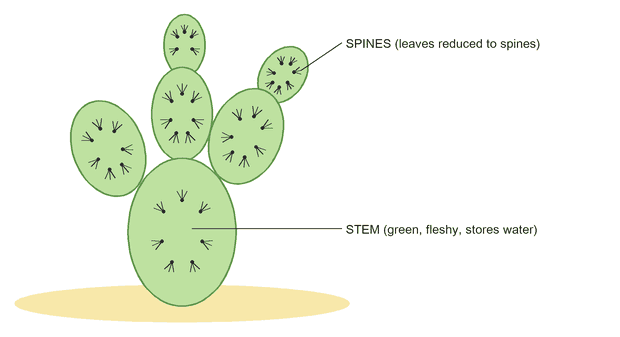
Watch out: The green, flat parts of a cactus are stems, not leaves.
Note: Cacti also have roots that spread wide just below the surface, or go deep, to absorb water.
Therefore, desert plants have leaves reduced to spines to cut water loss, and a green, fleshy stem that stores water and makes food.
- 333 marks
Question 33
Describe the aerial adaptations in birds.
Solve with AIWritten solution
Solution:
Concept: A bird's whole body is built for flying: a streamlined shape, wings, strong muscles and a light body.
Step 1 — Body shape.
The body is streamlined: the head is pointed, the neck stretches forward and the tail narrows, and the feathers make the surface smooth. This shape meets the least resistance from the air.
Step 2 — Wings.
The forelimbs are modified into wings, which carry long flight feathers.
Step 3 — Steering and brakes.
The tail feathers help the bird to slow down and to steer (change direction).
Step 4 — Wing muscles.
Strong, large breast muscles move the wings up and down.
Step 5 — Light body.
Apart from the heavy flight muscles, the body is light: the bones are hollow with air cavities, and birds pass their wastes as a semi-solid paste (uric acid) instead of storing liquid urine in a bladder.
Therefore, birds are adapted to flight by a streamlined body, wings, tail feathers for steering, strong breast muscles and a light body.
- 342 marks
Question 34
Differentiate between an aquatic habitat and a terrestrial habitat.
Solve with AIWritten solution
Solution:
Concept: An aquatic habitat is in water; a terrestrial habitat is on land.
Step 1 — Compare the two habitats.
The two habitats differ in where the organisms live, the places that form them and the organisms found there.
Aquatic habitat Terrestrial habitat Plants and animals live in water. Plants and animals live on land. Formed by rivers, lakes, ponds and seas. Includes deserts, mountains, polar regions, forests and grasslands. Examples: fish, water lily, lotus, Vallisneria. Examples: camel, cactus, yak, pine. Therefore, organisms of an aquatic habitat live in water, while those of a terrestrial habitat live on land.
- 353 marks
Question 35
Describe how pollination occurs in vallismaria ?
Solve with AIWritten solution
Solution:
Concept: Vallisneria (eel grass) has male and female flowers on separate plants, and it is pollinated with the help of water, so its flowers are hydrophilous.
Step 1 — Separate plants.
Vallisneria has separate male plants and female plants, both rooted at the bottom of the water.
Step 2 — Male flowers float up.
The male flowers are very small. When they mature, they break free from the male plant and float up to the surface of the water.
Step 3 — Female flowers reach the surface.
Each female flower grows on a very long, spiral stalk, which lengthens until the flower floats on the water surface.
Step 4 — Pollination on the surface.
The floating male flowers drift on the water and touch the female flowers, so their pollen reaches the stigma and pollination takes place on the water surface.
Step 5 — After pollination.
The stalk of the female flower then coils tightly and pulls the flower back under water, where the fruit develops.
Step 6 — Look at the figure.
The figure below shows the female and male plants, the male flowers rising and floating, and the female flower held at the surface on its long spiral stalk.
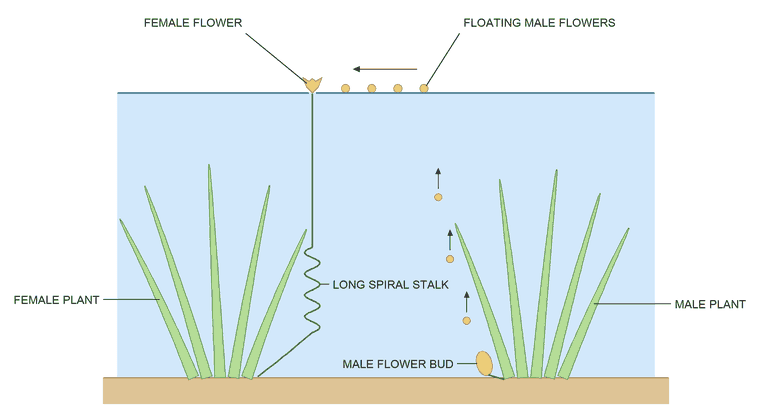
Watch out: Pollination happens on the water surface, not under water.
Therefore, in Vallisneria the male flowers float up and drift to the female flowers held at the surface on long stalks, and pollination takes place on the water surface.
- 366 marks
Question 36
Ankur and his classmates went on a virtual field trip to the Great Himalayas, the highest mountain range in the country. As they travelled up the mountain, they noticed how different animals adapt to the cold, rocky environment. Mountain habitats are extremely cold and windy, and for several months they remain covered in snow. Despite the cold, a wide variety of plants and animals survive there. Answer the following questions:
(i) Name two plants that Ankur and his classmates could observe at high mountains.
(ii) What is the technical term for the ability of organisms to survive in any habitat by making specific changes in their bodies?
(iii) Give two examples of mountain animals.
(iv) What changes occur in the blood of mountain animals to help them survive in low-oxygen conditions?
(v) What is the advantage of hibernation among these animals?
Solve with AIWritten solution
Solution:
Concept: Mountain plants and animals are adapted to cold, snow and thin air.
Step 1 — (i) Plants.
Ankur's class could see pine and fir (cedar is also correct).
Step 2 — (ii) Technical term.
The ability to survive in a habitat through special features of the body is adaptation.
Step 3 — (iii) Animals.
Two mountain animals are the yak and the mountain goat.
Step 4 — (iv) Blood.
The blood of these animals has more red blood cells, so it can carry enough oxygen even though the air is thin and the air pressure is low.
Step 5 — (v) Hibernation.
During hibernation, a long winter sleep, the animals save energy and survive the coldest months, when food is scarce, on the fat stored in their bodies.
Therefore, (i) pine and fir, (ii) adaptation, (iii) yak and mountain goat, (iv) more red blood cells, (v) hibernation saves energy through the cold, foodless winter.
What Class 6 Biology Ch 8 covers
The sections of the chapter, in the order the book takes them. Every question above comes from one of these.
- 01Habitat
- 02What Is Meant by Adaptation
- 03Adaptations in Aquatic Habitat
- 04Adaptations in Desert Habitat
- 05Adaptations in Mountain Habitat
- 06Adaptations in Aerial Habitat
More ways to study this chapter
The same chapter asked three other ways. Practise it, revise it, and see what the board has set on Ch 8 before.
Class 6 Biology Ch 8 questions students ask
How many questions are there in Class 6 Biology Ch 8?
36 questions. Every one is solved step by step on this page.
Are these Class 6 Biology solutions free?
Yes. Every question and its full working is free to read, with no account needed.
Can I download the Class 6 Biology Ch 8 solutions as a PDF?
There is no PDF to download. Every solution is on this page instead, which means it is searchable, always the current syllabus, and readable on a phone. Use your browser's print option if you want it on paper.