
Opening your dashboard
Class 6 Biology Chapter 8 Habitat and Adaptation: Competency-Based Questions (CBQ)
40 questions on Chapter 8, each worked through on its own page with the AI tutor. Class 6 Biology, ICSE 2026-27.
40 questions
1–5 marks · Mixed difficulty
- 11 mark
Question 1
Cognitive domain: Application
At a fish market in Kolkata, a live rohu fish is lifted out of the water tank and kept on a tray. There is plenty of oxygen in the air around it, yet the fish soon begins to gasp. Why can the fish not use the oxygen of the air ?
- 21 mark
Question 2
Cognitive domain: Analysis
A group of trekkers climbed a mountain in Sikkim. At noon on five days of the same week, they noted the temperature at five camps.
Height of the camp above sea level Temperature at noon 500 m 1500 m 2500 m 3500 m 4500 m The trekkers saw yaks only near the two highest camps. Which statement fits both the table and this observation ?
- 31 mark
Question 3
Cognitive domain: Application
Villagers in Kutch are digging a pit near a cactus bush. They find that the roots of the cactus go down much deeper than the roots of the small grasses growing beside it. In the dry months the grasses dry up, but the cactus stays green. How do the long roots help the cactus ?
- 41 mark
Question 4
Cognitive domain: Analysis
Over thousands of years, the water of a lake slowly became more and more salty. From the remains found in the mud, scientists learn that five kinds of fish once lived in the lake. Today only two of those kinds are found there. What is the best explanation ?
- 51 mark
Question 5
Cognitive domain: Understanding
Assertion (A): A bird needs much less water in its body than many other animals do.
Reason (R): Birds excrete solid urine formed of uric acid, instead of urea which requires much water to be excreted out.
- 61 mark
Question 6
Cognitive domain: Analysis
Assertion (A): The roots of Vallisneria are small in size.
Reason (R): Vallisneria is a dioecious plant, in which the male and female plants are separate.
- 71 mark
Question 7
Cognitive domain: Understanding
Ria splits open a dry drumstick pod from the tree in her courtyard in Madurai. Each seed inside is very light and has thin, papery wings. When she drops a few seeds from the terrace on a breezy day, they land far away from the tree.
Complete the sentence :
The wings and the light weight show that drumstick seeds are dispersed by ______, and landing far from the parent plant is useful because it avoids ______ of the young plants.
- 81 mark
Question 8
Cognitive domain: Application
Every December, the frogs of a hill stream near Shimla seem to vanish. Arnav finds one of them lying still under mud and dead leaves. It hardly moves and does not eat. In March, the frogs are hopping about again.
Complete the sentence :
During the cold months the frog was ______ (name the long winter sleep), and by staying inactive it could conserve its ______ and survive the winter without food.
- 91 mark
Question 9
Cognitive domain: Application
For the boat races of Kerala, boat-builders make long, narrow boats that taper at both ends — much like the body of a fish. These boats cut through the water very fast.
Complete the sentence :
A body that tapers at both ends is called a ______ body, and it helps the boat (and the fish) because this shape offers the least ______ during forward movement in water.
- 102 marks
Question 10
Cognitive domain: Understanding
A farmer from the plains of Punjab takes his goats up to a high, rocky pasture in Himachal Pradesh, where snow has just fallen. Wild mountain goats are moving about there comfortably. But the farmer's goats shiver in the cold, and they keep slipping on the steep rocks.
Explain why the mountain goats are comfortable there. Use two features of their body in your answer.
- 112 marks
Question 11
Cognitive domain: Evaluation
On a windy day, Sana sees white, fluffy cotton seeds floating high above a field. She says, "Birds, bats and butterflies live in the aerial habitat. These seeds are also flying. So the cotton plant is a plant of the aerial habitat."
Is Sana right ? Justify your answer.
- 122 marks
Question 12
Cognitive domain: Application
A pigeon is pecking at grains in a park in Delhi. A dog runs towards it. The pigeon takes off at once with strong beats of its wings. In the air it turns sharply to avoid a tree, and then it slows down and lands on a wall.
Which part of the pigeon's body gave the power for the strong wing beats ? Which part helped it to turn and to slow down ? Explain the work of each.
- 134 marks
Question 13
Cognitive domain: Evaluation
Case: A hill town in Himachal Pradesh gets heavy snowfall every winter, and its ground is rocky. The town council wants to plant trees along a new road. The gardener suggests trees of kind Y, because they give more shade. The forest officer suggests trees of kind X. The figure shows both kinds of trees and their leaves.
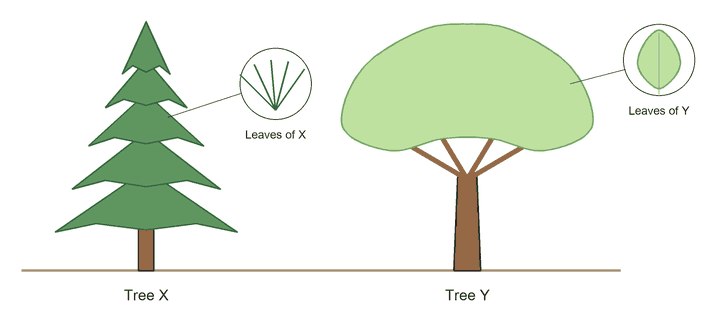
(a) Which kind of tree is the better choice for this town ? Justify your answer using two features of the tree that you can see in the figure.
(b) The gardener says, "The thin leaves of tree X are of no use to the tree." Is he right ? Give a reason.
(c) What is likely to happen to a tree of kind Y during a heavy snowfall ? Give a reason.
- 145 marks
Question 14
Cognitive domain: Analysis
Case: A wildlife researcher studied the desert rats of the Thar desert near Jaisalmer. On a day in May, she fixed one thermometer on the surface of the sand and another deep inside a rat's burrow. She noted both temperatures every four hours.
Time Temperature of the sand surface Temperature inside the burrow 6 a.m. 10 a.m. 2 p.m. 6 p.m. 10 p.m. 2 a.m. She saw the rats outside their burrows only at night.
(a) At 2 p.m., how much hotter was the sand surface than the inside of the burrow ?
(b) Find the difference between the highest and the lowest temperature of the day on the sand surface. Then find the same difference for the inside of the burrow. What do these two results tell you about the burrow ?
(c) Use the table to explain why the rats stay in their burrows during the day and come out only at night.
(d) A camel cannot hide in a burrow. Give two ways in which a camel is adapted to bear the heat of the day.
- 155 marks
Question 15
Cognitive domain: Creativity
Case: Kavya has learnt that a fish can rise or sink in water with the help of its air bladder. For the science corner of her class, she wants to make a simple working model that shows this idea. She has a small plastic bottle with a tight cap, a few small pebbles, a bucket of water and a mug.
(a) Plan the model for Kavya. Write the steps she should follow.
(b) Draw a table for her observations, and fill in the result you expect in each case.
(c) Explain how the model is like the air bladder of a fish. Point out one way in which a real fish is different from the model.
- 161 mark
Question 16
Cognitive domain: Analysis
Three places were studied by a group of Class 6 students. The conditions and the organisms found there are given in the table. (Hypothetical data.)
Place Main conditions Organisms found P Sandy land with very little water; very hot by day and cold at night Cactus, camel Q Rich vegetation and plenty of water; many kinds of plants and animals live together Trees, grasses, a variety of animals R Rocky land; cooler in the lower parts and extremely icy and cold at greater heights; covered with snow in certain months Pine, fir, yak, mountain goat Which row names the three habitats correctly ?
- 171 mark
Question 17
Cognitive domain: Understanding
At a natural history museum, Anil sees the front limbs of a pigeon and of a whale shown side by side. He asks the guide how each pair is adapted to its habitat. Which answer is correct ?
- 181 mark
Question 18
Cognitive domain: Analysis
Assertion (A): The stem of a cactus is covered with a thick waxy layer.
Reason (R): The wax makes the stem green, so that the stem can make food by photosynthesis.
- 191 mark
Question 19
Cognitive domain: Understanding
Assertion (A): A bird has bones with air cavities, but it also has large and heavy breast muscles.
Reason (R): Except for the wing muscles, which have to be bulky, the rest of a bird's body is kept light to make flight easier.
- 201 mark
Question 20
Cognitive domain: Application
In a large open field, Zoya found one parent plant (P). In the same season she counted its young plants (seedlings) and marked their positions on the map below. The arrow shows the direction in which the wind blew during that season.
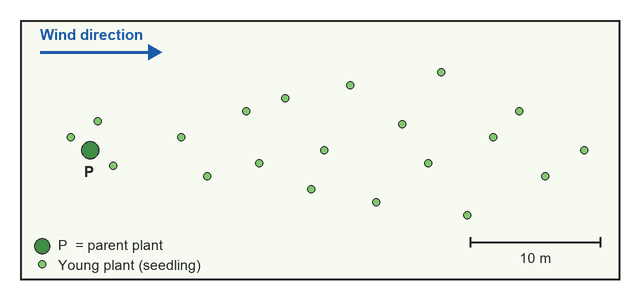
What can Zoya conclude about the way the seeds of the plant reached the places where the seedlings grew ?
- 211 mark
Question 21
Cognitive domain: Understanding
Rina watches a rohu in the school aquarium. The fish keeps opening and closing its mouth, and the gill covers on the two sides of its head open and close as it does so. She wants to know how the fish gets oxygen. Which description is correct ?
- 221 mark
Question 22
Cognitive domain: Application
During the summer, the village pond near Sneha's school changed in four ways.
- The level of the water fell.
- The water became warmer.
- The number of fish in the pond decreased.
- Green algae grew more thickly on the surface.
Which statements describe changes in the abiotic factors of the pond ?
- 231 mark
Question 23
Cognitive domain: Application
Organisms adapt themselves for four purposes: to find their food; to protect themselves from their enemies (predators); to find favourable conditions for reproduction; and to protect themselves from the unfavourable effects of a changing environment.
Four observations are given.
- A camel easily chews thorny cactus with its thick lips.
- A caterpillar sits on a branch and looks just like a twig.
- The small male flowers of Vallisneria break off and float on the water surface towards the female flowers.
- A frog lies buried in mud through the cold winter.
Match each observation with the purpose it serves, in the same order.
- 241 mark
Question 24
Cognitive domain: Analysis
A student made a chart of organisms, the places where they live and one feature of each. Only one row is correct.
Row Organism Where it lives Feature (A) Mountain goat Mountain habitat Thin skin with no fur on its feet and toes (B) Cactus Desert habitat Leaves reduced to spines, and a thick green stem that makes food (C) Pine Mountain habitat Broad leaves that hold the snow (D) Cotton seed Carried through the air Heavy and smooth, so that it falls straight down Which row is correct ?
- 251 mark
Question 25
Cognitive domain: Analysis
In winter on a high mountain, a yak keeps moving about on the snow-covered slope, while a hedgehog stays in its burrow and sleeps for weeks. Which statement compares the way in which the two animals survive the cold ?
- 262 marks
Question 26
Cognitive domain: Understanding
Meena's grandfather is cleaning a fish bought from the market. He scrapes off a layer of small, hard, overlapping scales that covered the whole body of the fish. Give two ways in which this covering of scales is useful to the fish in its water habitat.
- 272 marks
Question 27
Cognitive domain: Evaluation
Rohan says, "An aeroplane is a big bird made of metal. It has the three things that the chapter says a flying organism must have: wings, flight muscles and a streamlined body." Is Rohan right ? Justify your answer.
- 282 marks
Question 28
Cognitive domain: Application
On a hot day in the Thar desert, a camel breathes about times in a minute, and a cow standing nearby breathes about times in a minute. Some water vapour leaves the body along with the air that is breathed out. Assume that each breath carries away the same small amount of water vapour. (Hypothetical data.)
(a) How many breaths does each animal take in one hour ? How many times more water vapour does the cow lose than the camel in that hour ?
(b) Which feature of the camel is shown by this comparison ?
- 292 marks
Question 29
Cognitive domain: Analysis
A bird-lover kept a pair of pigeons in a large closed room. The room has a bowl of clean water, plenty of grain on the floor and a strong roof that protects the birds from rain. The walls and the floor are bare and smooth, with no ledge, box or corner, and there are no twigs or straw in the room. After a year the pigeons had not raised any young ones. Which need of a good habitat is missing in the room ? Which other needs are met ?
- 302 marks
Question 30
Cognitive domain: Evaluation
Kabir says, "The mountains of Himachal Pradesh and the polar regions are the same habitat, because both are cold and have snow." Is he right ? Give two points of difference to support your answer.
- 312 marks
Question 31
Cognitive domain: Creativity
Plan a three-panel cartoon for Class 4 pupils with the title "Why do seeds travel ?". Write one short caption for each panel, and say which seed from the chapter is the hero of your cartoon.
- 323 marks
Question 32
Cognitive domain: Application
Before a trek to a snow-covered mountain pass, Mira's guide asked everybody to carry three things.
- A thick woollen jacket.
- Shoes with strong, rough soles.
- A small oxygen cylinder for the highest camp.
For each item, name the feature of a mountain animal that does the same job for the animal, and name an animal that has it.
- 333 marks
Question 33
Cognitive domain: Analysis
Three desert organisms deal with the heat and the shortage of water in three different ways.
- X: Its leaves are reduced to spines, and its thick, fleshy stem is full of stored water.
- Y: It spends the hot day in a burrow under the ground and comes out only at night to search for food.
- Z: On a very hot day its body temperature may rise by to above normal with no harm to it.
Name each organism, and say whether it stores water, avoids the heat or tolerates the heat.
- 343 marks
Question 34
Cognitive domain: Evaluation
In a class discussion, Dev says, "Every adaptation of an organism can be seen just by looking at its outside." Do you agree ? Support your answer with two examples of adaptations that can be seen on the outside and two that cannot, all taken from this chapter.
- 353 marks
Question 35
Cognitive domain: Application
Three water lily plants grow in three village ponds. The roots of each plant are fixed in the mud at the bottom. The leaf-blade must lie on the water surface, where its stomata can take in air. (Hypothetical data.)
Plant Depth of water in its pond Length of its leaf-stalk P Q R (a) The leaf-blade of which plant cannot reach the surface ? By how much does its leaf-stalk fall short ?
(b) Why is this a problem for the leaf-blade of that plant ?
(c) During the summer, the water in the pond of plant Q falls by . Can its leaf-blade now reach the surface ? Give a reason.
- 363 marks
Question 36
Cognitive domain: Understanding
Four water bodies are named: Dal Lake, the Arabian Sea, the River Godavari and the Bay of Bengal.
(a) Sort them into fresh water bodies and marine water bodies.
(b) Name one actively swimming animal that is found in both fresh water and marine water.
(c) Besides fishes, the chapter names other actively swimming animals. Name one such animal that lives in fresh water, and one that lives in the sea.
- 375 marks
Question 37
Cognitive domain: Analysis
Case: A class studied two plants, P and Q, which grow in an open field. Plant P has heavy, smooth seeds. Plant Q has very light seeds with a tuft of silky hairs. The students counted the young plants (seedlings) of each plant at different distances from it. (Hypothetical data.)
Distance from the parent plant Seedlings of P Seedlings of Q to to to to (a) Find the total number of seedlings of each plant. What percentage of the seedlings of P, and what percentage of the seedlings of Q, are within of the parent plant ? Give the answer to the nearest whole number.
(b) How do the data show that the seeds of Q are carried far from the parent plant ? Name one plant from the chapter whose seeds are like those of Q.
(c) Explain why many seedlings of P may not survive, and how the way the seeds of Q travel helps that plant.
- 384 marks
Question 38
Cognitive domain: Application
Case: Neel bought one Vallisneria plant from a shop and set it up in a large home aquarium with a few fish. After some weeks, flowers on long, thin stalks floated on the water surface. His teacher looked at them and said, "This is a female plant. Vallisneria is a dioecious plant, so it will not form any seeds in your tank." The teacher added that the plant has a special way of being pollinated.
(a) What does dioecious mean ? Why will Neel's plant not form seeds ?
(b) What must Neel add to the aquarium so that seeds can form ?
(c) How would the pollen then reach the female flowers ? What name is given to such flowers, and what does the name mean ?
- 395 marks
Question 39
Cognitive domain: Creativity
Case: Hari's teacher says that the broad leaf-blades of a water lily have an oily coat which keeps water off the leaf. Hari wants to test this in the classroom. The teacher gives him one fresh water lily leaf, a paper napkin, a dropper, a tray and a small cup of water.
(a) Plan a fair test for Hari. Write the steps, and say what must be kept the same for both surfaces.
(b) Draw a table to record the observations, and fill in the result that you expect.
(c) Say what the result shows about the leaf, why this suits a water lily, and one thing Hari should do to make the test more reliable.
- 404 marks
Question 40
Cognitive domain: Evaluation
Case: In a school quiz, a team gave four statements as its answers.
- "Vallisneria is pollinated by insects, like most flowering plants."
- "The body of a bird is streamlined, with its neck stretched forward and a narrowed tail, so that it meets less resistance in the air."
- "The hump of a camel stores water, so a camel needs no water for many days."
- "In a water lily, the stomata are present only on the upper surface of the leaves."
(a) Which statements are correct ?
(b) Correct each wrong statement in one sentence.
(c) Write one more true statement about an animal of the mountain habitat, and name the condition of the habitat that it suits.