
Opening your dashboard
Class 6 Biology Chapter 7: Disease and Hygiene Solutions
36 textbook questions with step-by-step answers, free to read, for ICSE 2026-27.
Get talked through Ch 7, not just shown the answer
Reading a finished solution is not the same as being able to do it. The AI tutor takes one question at a time and works it with you, in your own words, until you can.
- Ask it out loud, in your own words
- It gives you the next step, not the answer
- Stuck on part (ii)? Start there
36 questions with solutions
1–16 marks · Mixed difficulty
- 11 mark
Question 1
Malaria is caused by
Solve with AIAnswer
(A) Bacteria
- Correct
(B) Protozoan
(C) Fungi
(D) Virus
Answer: (B) Protozoan
Concept: A disease is any change from the normal working of the body that causes discomfort or disability. Communicable (infectious) diseases are caused by germs (pathogens) such as viruses, bacteria, protozoa and worms, and they spread from person to person. Non-communicable diseases are not caused by germs, so they do not spread.
Step 1 — Recall the germ of malaria.
Malaria is caused by a tiny one-celled organism called Plasmodium. Such one-celled animal-like organisms are protozoa.
Step 2 — How it enters the body.
Plasmodium is passed into the blood by the bite of an infected female Anopheles mosquito, so malaria is caused by a protozoan, option (B).
Watch out: The mosquito only carries the germ; the germ itself is the protozoan Plasmodium.
Why the other options are wrong:
- (A) Bacteria: it cause diseases such as cholera, typhoid and tuberculosis, not malaria.
- (C) Fungi: it cause diseases such as ringworm and athlete's foot, not malaria.
- (D) Virus: viruses cause diseases such as the common cold, measles and polio, not malaria.
Therefore, malaria is caused by a protozoan, option (B).
- 21 mark
Question 2
Deficiency of vitamin C causes
Solve with AIAnswer
(A) Night blindness
- Correct
(B) Scurvy
(C) Anaemia
(D) Polio
Answer: (B) Scurvy
Concept: A deficiency disease is caused when the diet lacks a nutrient for a long time. Each vitamin or mineral has its own disease: vitamin A, nightblindness; vitamin , beri-beri; vitamin , pellagra; vitamin C, scurvy; vitamin D, rickets; iron, anaemia; iodine, goitre.
Step 1 — Recall the disease of vitamin C.
Vitamin C (ascorbic acid) keeps the gums and skin healthy. When it is missing from the diet for a long time, the gums swell and bleed and wounds heal slowly. This disease is scurvy.
Step 2 — Pick the option.
So a deficiency of vitamin C causes scurvy, option (B).
Why the other options are wrong:
- (A) Night blindness: nightblindness is caused by a lack of vitamin A.
- (C) Anaemia: it is usually caused by a lack of iron.
- (D) Polio: it is caused by a virus; it is not a deficiency disease.
Therefore, deficiency of vitamin C causes scurvy, option (B).
- 31 mark
Question 3
Hay fever and asthma are
Solve with AIAnswer
(A) Deficiency diseases
(B) Genetic diseases
(C) Organic diseases
- Correct
(D) Allergic diseases
Answer: (D) Allergic diseases
Concept: The chapter groups non-communicable diseases into kinds: deficiency diseases (a nutrient is missing from the diet), genetic diseases (passed from parents to children), metabolic diseases (a body process goes wrong, such as diabetes), allergies (an unusual reaction to a substance), degenerative diseases (parts wear out with age) and cancer (uncontrolled growth of cells).
Step 1 — Recall what an allergy is.
An allergy is an unusual (over-strong) reaction of the body to a substance that is harmless to most people, such as dust or pollen. Such a substance is an allergen.
Step 2 — Place hay fever and asthma.
In hay fever the lining of the nose reacts to pollen or dust; in allergic asthma the air passages narrow when allergens are breathed in. Both are allergic diseases, option (D).
Why the other options are wrong:
- (A) Deficiency diseases: they are caused by a missing nutrient, as in scurvy or rickets.
- (B) Genetic diseases: they are passed from parents to children, as in haemophilia.
- (C) Organic diseases: this is not the group the chapter uses for these two; they are reactions of the body to allergens, so they are allergies.
Therefore, hay fever and asthma are allergic diseases, option (D).
- 41 mark
Question 4
Which one of the following is a genetic disease ?
Solve with AIAnswer
(A) Scurvy
(B) Leukemia
(C) Goitre
- Correct
(D) Haemophilia
Answer: (D) Haemophilia
Concept: The chapter groups non-communicable diseases into kinds: deficiency diseases (a nutrient is missing from the diet), genetic diseases (passed from parents to children), metabolic diseases (a body process goes wrong, such as diabetes), allergies (an unusual reaction to a substance), degenerative diseases (parts wear out with age) and cancer (uncontrolled growth of cells).
Step 1 — Recall what a genetic disease is.
A genetic disease is caused by a faulty gene and is passed from parents to their children.
Step 2 — Check the options.
Haemophilia, in which the blood does not clot properly, is passed on in this way, so it is a genetic disease, option (D).
Why the other options are wrong:
- (A) Scurvy: it is a deficiency disease caused by a lack of vitamin C.
- (B) Leukemia: leukaemia is a cancer of the blood-forming cells; the chapter groups it under cancer, and most cases are not inherited.
- (C) Goitre: it is a deficiency disease caused by a lack of iodine.
Therefore, haemophilia is a genetic disease, option (D).
- 51 mark
Question 5
Which one of the following is a degenerative disease ?
Solve with AIAnswer
(A) Thalassemia
(B) Beri-beri
- Correct
(C) Cataract
(D) Diabetes
Answer: (C) Cataract
Concept: The chapter groups non-communicable diseases into kinds: deficiency diseases (a nutrient is missing from the diet), genetic diseases (passed from parents to children), metabolic diseases (a body process goes wrong, such as diabetes), allergies (an unusual reaction to a substance), degenerative diseases (parts wear out with age) and cancer (uncontrolled growth of cells).
Step 1 — Recall what a degenerative disease is.
A degenerative disease appears as parts of the body wear out, mostly with old age.
Step 2 — Check the options.
In a cataract the lens of the eye slowly becomes cloudy, most often in old people, so cataract is a degenerative disease, option (C).
Why the other options are wrong:
- (A) Thalassemia: thalassaemia is a genetic disease passed from parents to children.
- (B) Beri-beri: it is a deficiency disease caused by a lack of vitamin .
- (D) Diabetes: the chapter groups diabetes as a metabolic disease: the body cannot control the sugar level in its blood.
Therefore, cataract is a degenerative disease, option (C).
- 61 mark
Question 6
Pellagra is caused by the deficiency of :
Solve with AIAnswer
- Correct
(A) Vit.
(B) Vit.
(C) Vit. C
(D) Vit. D
Answer: (A) Vit.
Concept: A deficiency disease is caused when the diet lacks a nutrient for a long time. Each vitamin or mineral has its own disease: vitamin A, nightblindness; vitamin , beri-beri; vitamin , pellagra; vitamin C, scurvy; vitamin D, rickets; iron, anaemia; iodine, goitre.
Step 1 — Recall the vitamin behind pellagra.
Pellagra is caused by a lack of vitamin (niacin). It inflames the skin (dermatitis) and can also upset the gut and the brain.
Step 2 — Pick the option.
So pellagra is caused by the deficiency of vitamin , option (A).
Watch out: Vitamins and are both B vitamins, but they cause different diseases.
Why the other options are wrong:
- (B) Vit. : a lack of vitamin causes beri-beri.
- (C) Vit. C: a lack of vitamin C causes scurvy.
- (D) Vit. D: a lack of vitamin D causes rickets.
Therefore, pellagra is caused by the deficiency of vitamin , option (A).
- 71 mark
Question 7
Deficiency of Iodine in one's food can cause :
Solve with AIAnswer
(A) Beri-beri
- Correct
(B) Goitre
(C) Scurvy
(D) Pellagra
Answer: (B) Goitre
Concept: A deficiency disease is caused when the diet lacks a nutrient for a long time. Each vitamin or mineral has its own disease: vitamin A, nightblindness; vitamin , beri-beri; vitamin , pellagra; vitamin C, scurvy; vitamin D, rickets; iron, anaemia; iodine, goitre.
Step 1 — Recall the job of iodine.
The thyroid gland in the neck needs iodine to make its hormone. When the diet has too little iodine, the gland grows larger and the neck swells. This is goitre.
Step 2 — Pick the option.
So a deficiency of iodine can cause goitre, option (B). Sea food and iodised salt supply iodine.
Why the other options are wrong:
- (A) Beri-beri: it is caused by a lack of vitamin .
- (C) Scurvy: it is caused by a lack of vitamin C.
- (D) Pellagra: it is caused by a lack of vitamin .
Therefore, deficiency of iodine in one's food can cause goitre, option (B).
- 81 mark
Question 8
Which one of the following vitamin deficiency diseases can be cured by eating a diet which includes carrot, yellow fruits, vegetables, butter, milk, fish ?
Solve with AIAnswer
(A) Beri-beri
(B) Dermatitis
- Correct
(C) Nightblindness
(D) Scurvy
Answer: (C) Nightblindness
Concept: A deficiency disease is caused when the diet lacks a nutrient for a long time. Each vitamin or mineral has its own disease: vitamin A, nightblindness; vitamin , beri-beri; vitamin , pellagra; vitamin C, scurvy; vitamin D, rickets; iron, anaemia; iodine, goitre.
Step 1 — Find the vitamin in these foods.
Carrots and yellow fruits and vegetables contain carotene, which the body turns into vitamin A; butter, milk and fish also give vitamin A.
Step 2 — Name its deficiency disease.
A lack of vitamin A causes nightblindness, so eating these foods helps to cure it, option (C).
Why the other options are wrong:
- (A) Beri-beri: it is cured by vitamin , from whole grains, eggs and nuts.
- (B) Dermatitis: it of pellagra is cured by vitamin , from meat, liver, milk and eggs.
- (D) Scurvy: it is cured by vitamin C, from citrus fruits and tomatoes.
Therefore, nightblindness can be cured by such a diet, option (C).
- 91 mark
Question 9
Which one of the following is a communicable disease ?
Solve with AIAnswer
- Correct
(A) Measles
(B) Cancer
(C) Heart stroke
(D) Allergy
Answer: (A) Measles
Concept: A disease is any change from the normal working of the body that causes discomfort or disability. Communicable (infectious) diseases are caused by germs (pathogens) such as viruses, bacteria, protozoa and worms, and they spread from person to person. Non-communicable diseases are not caused by germs, so they do not spread.
Step 1 — Look for a disease caused by a germ.
A communicable disease is caused by a germ that passes from a sick person to a healthy one.
Step 2 — Check measles.
Measles is caused by a virus that spreads through droplets when an infected person coughs or sneezes, so it is a communicable disease, option (A).
Why the other options are wrong:
- (B) Cancer: it is not caused by a germ passed between people, so it does not spread from person to person.
- (C) Heart stroke: a heart attack or a stroke happens when the blood supply to the heart or the brain is blocked; it is not caused by a germ and does not spread.
- (D) Allergy: an allergy is the body's own reaction to an allergen; it does not spread to other people.
Therefore, measles is a communicable disease, option (A).
- 101 mark
Question 10
The infamous COVID-19 was a contagious disease spread by :
Solve with AIAnswer
(A) Bacteria
(B) Protozoa
- Correct
(C) Viruses
(D) Worms
Answer: (C) Viruses
Concept: A disease is any change from the normal working of the body that causes discomfort or disability. Communicable (infectious) diseases are caused by germs (pathogens) such as viruses, bacteria, protozoa and worms, and they spread from person to person. Non-communicable diseases are not caused by germs, so they do not spread.
Step 1 — Name the germ of COVID-19.
COVID-19 is caused by a virus, the coronavirus called SARS-CoV-2.
Step 2 — How it spread.
The virus spreads in droplets and smaller airborne particles breathed, coughed or sneezed out by an infected person, so the answer is option (C).
Why the other options are wrong:
- (A) Bacteria: it cause diseases such as cholera and tuberculosis, not COVID-19.
- (B) Protozoa: it cause diseases such as malaria and amoebiasis.
- (D) Worms: it cause diseases such as ascariasis, taeniasis and filariasis.
Therefore, COVID-19 was spread by viruses, option (C).
- 111 mark
Question 11
Which of the following is a lung disease caused by bacteria ?
Solve with AIAnswer
(A) Rabies
- Correct
(B) Pneumonia
(C) Malaria
(D) Cholera
Answer: (B) Pneumonia
Concept: A disease is any change from the normal working of the body that causes discomfort or disability. Communicable (infectious) diseases are caused by germs (pathogens) such as viruses, bacteria, protozoa and worms, and they spread from person to person. Non-communicable diseases are not caused by germs, so they do not spread.
Step 1 — Find the lung disease.
Pneumonia is an infection of the lungs, in which the air sacs fill with fluid and breathing becomes hard.
Step 2 — Name its usual germ.
Pneumonia is very often caused by bacteria, so it is the lung disease caused by bacteria in this list, option (B).
Watch out: Pneumonia can also be caused by viruses (and, rarely, fungi); among these options it is the only lung disease.
Why the other options are wrong:
- (A) Rabies: it is a viral disease of the nervous system.
- (C) Malaria: it is caused by a protozoan that lives in the liver and the red blood cells.
- (D) Cholera: it is a bacterial disease of the intestine, not of the lungs.
Therefore, pneumonia is a lung disease caused by bacteria, option (B).
- 121 mark
Question 12
Kwashiorkor disease is caused due to the deficiency of :
Solve with AIAnswer
- Correct
(A) Proteins
(B) Proteins and fats
(C) Carbohydrates
(D) Carbohydrates and proteins
Answer: (A) Proteins
Concept: Kwashiorkor is a disease of young children whose diet has too little protein. Marasmus is caused when the child gets too little food of every kind, that is, too little protein and too little energy food (carbohydrates and fats).
Step 1 — Recall the cause of kwashiorkor.
In kwashiorkor the child may get some energy food, but it lacks proteins, so the belly and legs swell and growth stops.
Step 2 — Pick the option.
So kwashiorkor is caused by the deficiency of proteins, option (A).
Watch out: Do not mix up kwashiorkor (lack of protein) with marasmus (lack of all food).
Why the other options are wrong:
- (B) Proteins and fats: fats are energy foods; kwashiorkor is due to a shortage of proteins, not of fats.
- (C) Carbohydrates: a shortage of carbohydrates mainly means too little energy; it does not cause kwashiorkor.
- (D) Carbohydrates and proteins: a long shortage of carbohydrates together with proteins, that is, of all food, causes marasmus.
Therefore, kwashiorkor is caused due to the deficiency of proteins, option (A).
- 131 mark
Question 13
Which of the following is a specific symptom of the disease — scurvy ?
Solve with AIAnswer
(A) Skin inflammation
- Correct
(B) Bleeding gums
(C) Drying of cornea
(D) Bones turning soft
Answer: (B) Bleeding gums
Concept: A deficiency disease is caused when the diet lacks a nutrient for a long time. Each vitamin or mineral has its own disease: vitamin A, nightblindness; vitamin , beri-beri; vitamin , pellagra; vitamin C, scurvy; vitamin D, rickets; iron, anaemia; iodine, goitre.
Step 1 — Recall what vitamin C does.
Vitamin C keeps the gums and the walls of the small blood vessels strong. In scurvy, its deficiency disease, the gums swell and bleed.
Step 2 — Pick the option.
So bleeding gums are a specific symptom of scurvy, option (B).
Why the other options are wrong:
- (A) Skin inflammation: an inflamed skin (dermatitis) is a symptom of pellagra.
- (C) Drying of cornea: drying of the cornea is a symptom of a lack of vitamin A.
- (D) Bones turning soft: softening of the bones is a symptom of rickets (a lack of vitamin D).
Therefore, the specific symptom of scurvy is bleeding gums, option (B).
- 141 mark
Question 14
Swelling in the neck is a symptom of :
Solve with AIAnswer
(A) Anaemia
(B) Mumps
- Correct
(C) Goitre
(D) Rabies
Answer: (C) Goitre
Concept: A deficiency disease is caused when the diet lacks a nutrient for a long time. Each vitamin or mineral has its own disease: vitamin A, nightblindness; vitamin , beri-beri; vitamin , pellagra; vitamin C, scurvy; vitamin D, rickets; iron, anaemia; iodine, goitre.
Step 1 — Find the gland in the neck.
The thyroid gland lies at the front of the neck. When the diet lacks iodine, this gland grows larger and the neck swells.
Step 2 — Pick the option.
A swelling in the neck is therefore a symptom of goitre, option (C).
Watch out: Mumps also causes a swelling, but it is at the sides of the face, near the jaw.
Why the other options are wrong:
- (A) Anaemia: this tissue (usually a lack of iron) makes a person pale, weak and tired; it does not swell the neck.
- (B) Mumps: in mumps the parotid salivary glands, just in front of and below the ears, swell, so the swelling is at the jaw rather than the front of the neck.
- (D) Rabies: it affects the nervous system and causes a fear of water.
Therefore, a swelling in the neck is a symptom of goitre, option (C).
- 151 mark
Question 15
Which of the following is not a disease spread by the bite of a mosquito ?
Solve with AIAnswer
(A) Dengue
- Correct
(B) Typhoid
(C) Elephantiasis
(D) Malaria
Answer: (B) Typhoid
Concept: Some insects carry germs (they are vectors): the female Anopheles mosquito spreads malaria, the female Culex mosquito spreads filaria (elephantiasis), the Aedes mosquito spreads dengue, and houseflies carry germs from garbage and sewage to our food.
Step 1 — Check how each disease spreads.
Dengue, elephantiasis and malaria are all passed on by the bite of a mosquito. Typhoid is a bacterial disease that spreads through contaminated food and water.
Step 2 — Pick the option.
So typhoid is not spread by the bite of a mosquito, option (B).
Watch out: The question asks for the one that is NOT spread by mosquitoes.
Why the other options are wrong:
- (A) Dengue: it is spread by the bite of the Aedes mosquito.
- (C) Elephantiasis: this tissue (filariasis) is spread by the bite of the female Culex mosquito.
- (D) Malaria: it is spread by the bite of the female Anopheles mosquito.
Therefore, typhoid is not a disease spread by the bite of a mosquito, option (B).
- 161 mark
Question 16
Assertion (A): Genetic diseases like haemophilia and thalassemia are transmitted from mothers to newly born babies if the mother herself is suffering from the same disease.
Reason (R): Father's chromosomes do not play any role in the transmission of genetic diseases from him to the newly born babies.
Solve with AIAnswer
(A) (1) Both A and R are true and R is the correct explanation of A.
(B) (2) Both A and R are true but R is not the correct explanation of A.
- Correct
(C) (3) A is true but R is false.
(D) (4) A is false but R is true.
Answer: (C) (3) A is true but R is false.
Concept: In an assertion-reason item, first judge the Assertion (A) and the Reason (R) separately as true or false; only when both are true do we ask whether R correctly explains A.
Step 1 — Judge the Assertion.
A is true. A mother who suffers from haemophilia or thalassaemia carries the faulty gene, and she passes it on to her children, so the disease can be transmitted to the baby.
Step 2 — Judge the Reason.
R is false. A baby gets half of its chromosomes from the mother and half from the father, so the father's chromosomes can also pass on a genetic disease.
Step 3 — Pick the option.
A is true and R is false, so the answer is option (C).
Watch out: Genetic diseases can come from either parent, not from the mother alone.
Note: Whether the baby actually suffers from the disease depends on the genes from both parents; for example, a child has thalassaemia major only when it gets a faulty gene from each parent.
Why the other options are wrong:
- (A): R is false, so it cannot explain A.
- (B): R is false, so ‘both true’ cannot be right.
- (D): A is true: an affected mother does pass the faulty gene to her baby.
Therefore, A is true but R is false, option (C).
- 171 mark
Question 17
Assertion (A): Nightblindness is a kind of deficiency disease in which a person is not able to see during the night even if the room is well illuminated.
Reason (R): The person suffering from nightblindness should eat plenty of yellow fruits like carrots, papayas, etc. to meet the required demand of vitamin-A needed by the body.
Solve with AIAnswer
(A) (1) Both A and R are true and R is the correct explanation of A.
- Correct
(B) (2) Both A and R are true but R is not the correct explanation of A.
(C) (3) A is true but R is false.
(D) (4) A is false but R is true.
Answer: (B) (2) Both A and R are true but R is not the correct explanation of A.
Concept: In an assertion-reason item, first judge the Assertion (A) and the Reason (R) separately as true or false; only when both are true do we ask whether R correctly explains A.
Step 1 — Judge the Assertion.
A is true in the book's sense. Nightblindness is a deficiency disease, caused by a lack of vitamin A, in which the person cannot see well at night.
Step 2 — Judge the Reason.
R is true. Carrots, papayas and other yellow fruits and vegetables are rich in carotene, which the body turns into vitamin A, so eating them meets the body's need.
Step 3 — Decide whether R explains A.
A tells us what nightblindness is. R only gives the cure (what to eat); it does not say why the person cannot see at night. So R is not the explanation, and the answer is option (B).
Watch out: A true remedy is not the same as the explanation of the disease.
Note: Strictly, a person with nightblindness sees poorly in dim light; in a brightly lit room the eyes usually see normally. A is taken as true in the sense that the person cannot see well at night.
Why the other options are wrong:
- (A): R gives the remedy, not the explanation of A.
- (C): R is true: yellow fruits and vegetables do supply vitamin A.
- (D): A is taken as true: nightblindness is a vitamin A deficiency disease.
Therefore, both A and R are true but R is not the correct explanation of A, option (B).
- 181 mark
Question 18
Assertion (A): Mumps is a viral disease in which parotid glands swell and become painful. It is a communicable disease.
Reason (R): The mumps virus infects the salivary glands, causing inflammation of the tissue.
Solve with AIAnswer
- Correct
(A) (1) Both A and R are true and R is the correct explanation of A.
(B) (2) Both A and R are true but R is not the correct explanation of A.
(C) (3) A is true but R is false.
(D) (4) A is false but R is true.
Answer: (A) (1) Both A and R are true and R is the correct explanation of A.
Concept: In an assertion-reason item, first judge the Assertion (A) and the Reason (R) separately as true or false; only when both are true do we ask whether R correctly explains A.
Step 1 — Judge the Assertion.
A is true. Mumps is caused by a virus and spreads from person to person, so it is communicable. The parotid glands swell and become painful.
Step 2 — Judge the Reason.
R is true. The parotid glands are salivary glands, and the mumps virus infects them, so the tissue becomes inflamed.
Step 3 — Decide whether R explains A.
Inflammation means swelling and pain, so R tells us why the parotid glands swell and hurt. R explains A, and the answer is option (A).
Watch out: The parotid glands are salivary glands, so R is about the same glands as A.
Why the other options are wrong:
- (B): R does explain the swelling and pain described in A.
- (C): R is true: the mumps virus does infect the salivary glands.
- (D): A is true: mumps is a communicable viral disease.
Therefore, both A and R are true and R is the correct explanation of A, option (A).
- 191 mark
Question 19
Assertion (A): The disease malaria is caused by a parasite – Plasmodium which enters the human body through the bite of a female Anopheles mosquito.
Reason (R): Plasmodium is a parasite which completes its life-cycle in two hosts – Anopheles mosquitoes and human beings.
Solve with AIAnswer
(A) (1) Both A and R are true and R is the correct explanation of A.
- Correct
(B) (2) Both A and R are true but R is not the correct explanation of A.
(C) (3) A is true but R is false.
(D) (4) A is false but R is true.
Answer: (B) (2) Both A and R are true but R is not the correct explanation of A.
Concept: In an assertion-reason item, first judge the Assertion (A) and the Reason (R) separately as true or false; only when both are true do we ask whether R correctly explains A.
Step 1 — Judge the Assertion.
A is true. Malaria is caused by the protozoan parasite Plasmodium, which enters the blood through the bite of an infected female Anopheles mosquito.
Step 2 — Judge the Reason.
R is true. Plasmodium lives part of its life in the mosquito and part in human beings, so it has two hosts.
Step 3 — Decide whether R explains A.
R only describes the parasite's life-cycle. It does not tell us how malaria is caused or how the germ enters the body. So R is not the explanation, and the answer is option (B).
Why the other options are wrong:
- (A): R does not explain the cause of malaria given in A.
- (C): R is true: Plasmodium needs both the mosquito and the human host.
- (D): A is true: the female Anopheles mosquito passes Plasmodium into the blood.
Therefore, both A and R are true but R is not the correct explanation of A, option (B).
- 204 marks
Question 20
Fill in the blanks by selecting suitable words given below :
(goitre, insulin, rickets, iron, proteins)
(a) Anaemia is caused due to the deficiency of ..........
(b) Deficiency of Vit. D causes .......... in children.
(c) Deficiency of iodine in the diet may cause ..........
(d) Kwashiorkor is caused due to the deficiency of ..........
Solve with AIWritten solution
Solution:
Concept: A deficiency disease is caused when the diet lacks a nutrient for a long time. Each vitamin or mineral has its own disease: vitamin A, nightblindness; vitamin , beri-beri; vitamin , pellagra; vitamin C, scurvy; vitamin D, rickets; iron, anaemia; iodine, goitre.
Step 1 — (a) and (b).
Anaemia is caused due to the deficiency of iron, which the body needs to make haemoglobin. Deficiency of Vit. D causes rickets in children, so their bones become soft.
Step 2 — (c) and (d).
Deficiency of iodine in the diet may cause goitre, a swelling of the thyroid gland. Kwashiorkor is caused due to the deficiency of proteins.
Step 3 — The word left over.
The word ‘insulin’ is not needed. Insulin is a hormone; too little of it causes diabetes, which is not a dietary deficiency disease.
Therefore, (a) iron, (b) rickets, (c) goitre and (d) proteins.
- 214 marks
Question 21
Find the odd one out :
(a) Typhoid, cholera, jaundice, tuberculosis, tetanus.
(b) Cold, malaria, measles, mumps.
(c) Scurvy, rickets, polio, pellagra, nightblindness.
(d) Proteins, carbohydrates, fats, minerals, cancer.
Solve with AIWritten solution
Solution:
Concept: In an odd-one-out item, first find what most items have in common, such as the kind of germ or the kind of nutrient; the item that does not share it is the odd one.
Step 1 — (a) Typhoid, cholera, jaundice, tuberculosis, tetanus.
Typhoid, cholera, tuberculosis and tetanus are caused by bacteria. Jaundice, the yellowing seen in liver disease, is mostly caused by hepatitis viruses, so the odd one is jaundice.
Step 2 — (b) Cold, malaria, measles, mumps.
Cold, measles and mumps are caused by viruses, while malaria is caused by a protozoan. The odd one is malaria.
Step 3 — (c) Scurvy, rickets, polio, pellagra, nightblindness.
Scurvy, rickets, pellagra and nightblindness are vitamin deficiency diseases. Polio is caused by a virus, so the odd one is polio.
Step 4 — (d) Proteins, carbohydrates, fats, minerals, cancer.
Proteins, carbohydrates, fats and minerals are nutrients in our food. Cancer is a disease, so the odd one is cancer.
Watch out: Jaundice is really a sign (yellow skin and eyes) of a liver problem; in the chapter it stands for viral hepatitis.
Therefore, the odd ones are (a) jaundice, (b) malaria, (c) polio and (d) cancer.
- 225 marks
Question 22
Match the terms given in column A with those of column B :
Column A Column B (i) Cancer (a) Asthma (ii) Allergies (b) Sunburn (iii) Hydrophobia (c) Lead poisoning (iv) Physical agent (d) Leukemia (v) Chemical agent (e) Rabies Solve with AIWritten solution
Solution:
Concept: A match pairs each kind of disease or cause with an example. Work out the sure pairs first.
Step 1 — (i) and (ii).
Leukaemia is a cancer of the blood-forming cells, so (i) Cancer matches (d) Leukemia. Asthma is a common allergy, so (ii) Allergies matches (a) Asthma.
Step 2 — (iii).
Hydrophobia means ‘fear of water’, a typical sign of rabies, so (iii) matches (e) Rabies.
Step 3 — (iv) and (v).
Sunburn is caused by a physical agent, the ultraviolet rays of the Sun, so (iv) matches (b) Sunburn. Lead is a harmful chemical, so (v) Chemical agent matches (c) Lead poisoning.
Step 4 — Write the matched table.
The pairs are collected below.
Column A Column B (i) Cancer (d) Leukemia (ii) Allergies (a) Asthma (iii) Hydrophobia (e) Rabies (iv) Physical agent (b) Sunburn (v) Chemical agent (c) Lead poisoning Therefore, (i) matches (d), (ii) matches (a), (iii) matches (e), (iv) matches (b) and (v) matches (c).
- 234 marks
Question 23
Fill in the blanks in the following table :
Vitamin Name of the deficiency diseases Source of vitamin (a) Vitamin A .......... .......... (b) .......... Beri-beri .......... (c) Ascorbic acid .......... .......... (d) .......... Rickets (in childhod) bones turn soft .......... Solve with AIWritten solution
Solution:
Concept: A deficiency disease is caused when the diet lacks a nutrient for a long time. Each vitamin or mineral has its own disease: vitamin A, nightblindness; vitamin , beri-beri; vitamin , pellagra; vitamin C, scurvy; vitamin D, rickets; iron, anaemia; iodine, goitre.
Step 1 — (a) Vitamin A.
A lack of vitamin A causes nightblindness and drying of the cornea. It is got from carrots, yellow fruits and vegetables, butter, milk and fish.
Step 2 — (b) Beri-beri.
Beri-beri is caused by a lack of vitamin (thiamine). Its sources are whole grains, eggs, nuts, pulses and yeast.
Step 3 — (c) Ascorbic acid.
Ascorbic acid is vitamin C, and its lack causes scurvy (bleeding gums). It is got from citrus fruits such as lemon and orange, tomatoes and sprouted seeds.
Step 4 — (d) Rickets.
Rickets is caused by a lack of vitamin D (calciferol). It is got from egg yolk, fish-liver oil, milk and butter, and the skin also makes it in sunlight.
Step 5 — Write the completed table.
The filled table is shown below.
Vitamin Name of the deficiency diseases Source of vitamin (a) Vitamin A Nightblindness, drying of cornea Carrot, yellow fruits and vegetables, butter, milk, fish (b) Vitamin (Thiamine) Beri-beri Whole grains, eggs, nuts, pulses, yeast (c) Ascorbic acid Scurvy (bleeding gums) Citrus fruits, tomatoes, sprouted seeds (d) Vitamin D (Calciferol) Rickets (in childhood) bones turn soft Egg yolk, fish-liver oil, milk, butter; made in the skin in sunlight Watch out: Sunlight is not a food; it helps the skin make vitamin D.
Therefore, (a) nightblindness, from carrots and yellow fruits; (b) vitamin B₁, from whole grains and eggs; (c) scurvy, from citrus fruits; (d) vitamin D, from egg yolk, fish-liver oil and sunlight.
- 2411 marks
Question 24
Name the following :
(a) A bacterial disease caused due to contaminated water.
(b) A disease caused due to Plasmodium.
(c) A disease caused due to the bite of female Culex mosquito.
(d) A viral disease spread by the bite of a dog.
(e) Two diseases caused due to the deficiency of protein in the diet of a child.
(f) Any three water-borne diseases.
(g) Two common eye infections
(h) Two stimulants harmful for human consumption
(i) Two diseases that are spread via contaminated food and water
(j) Two diseases caused by protozoans
(k) Two communicable diseases
Solve with AIWritten solution
Solution:
Concept: A disease is any change from the normal working of the body that causes discomfort or disability. Communicable (infectious) diseases are caused by germs (pathogens) such as viruses, bacteria, protozoa and worms, and they spread from person to person. Non-communicable diseases are not caused by germs, so they do not spread. Some insects carry germs (they are vectors): the female Anopheles mosquito spreads malaria, the female Culex mosquito spreads filaria (elephantiasis), the Aedes mosquito spreads dengue, and houseflies carry germs from garbage and sewage to our food.
Step 1 — (a) to (d).
Each disease is named from its germ or its carrier.
- (a) A bacterial disease from contaminated water: cholera (typhoid is also correct).
- (b) The disease caused by Plasmodium: malaria.
- (c) The disease spread by the female Culex mosquito: elephantiasis (filariasis).
- (d) The viral disease spread by the bite of a dog: rabies (hydrophobia).
Step 2 — (e) and (f).
These parts ask for diseases from the diet and from water.
- (e) A lack of protein in a child's diet causes kwashiorkor; a lack of protein together with energy food causes marasmus.
- (f) Three water-borne diseases: cholera, typhoid and jaundice (hepatitis); amoebiasis is also correct.
Step 3 — (g) and (h).
These parts ask for eye infections and harmful stimulants.
- (g) Two common eye infections: conjunctivitis and trachoma.
- (h) Two harmful stimulants: tobacco (its nicotine is a stimulant) and too much caffeine (in strong tea, coffee and energy drinks).
Step 4 — (i) to (k).
These parts ask for diseases by the way they spread or by their germ.
- (i) Two diseases spread through contaminated food and water: cholera and typhoid.
- (j) Two diseases caused by protozoans: malaria and amoebiasis (amoebic dysentery).
- (k) Two communicable diseases: measles and tuberculosis (cold, mumps or chicken pox are also correct).
Note: Alcohol is also harmful, but it is a depressant (it slows down the brain), not a stimulant.
Therefore, (a) cholera, (b) malaria, (c) elephantiasis, (d) rabies, (e) kwashiorkor and marasmus, (f) cholera, typhoid and jaundice, (g) conjunctivitis and trachoma, (h) tobacco and too much caffeine, (i) cholera and typhoid, (j) malaria and amoebiasis, (k) measles and tuberculosis.
- 255 marks
Question 25
Write the technical names of the following vitamins :
(i) Vitamin A
(ii) Vitamin
(iii) Vitamin
(iv) Vitamin C
(v) Vitamin D
Solve with AIWritten solution
Solution:
Concept: Besides its letter name, each vitamin has a chemical (technical) name.
Step 1 — Vitamins A and B.
Vitamin A is retinol; vitamin is thiamine; vitamin is niacin.
Step 2 — Vitamins C and D.
Vitamin C is ascorbic acid, and vitamin D is calciferol.
Therefore, (i) retinol, (ii) thiamine, (iii) niacin, (iv) ascorbic acid and (v) calciferol.
- 265 marks
Question 26
Identify the disease with the help of the clues given below :
(i) Highly swollen legs
(ii) Locked jaws due to painful contractions of the jaw and neck muscles
(iii) Vomiting and watery stools
(iv) Diarrhoea, stool mixed with mucus and blood
(v) Chills, high temperature, profuse sweating.
Solve with AIWritten solution
Solution:
Concept: Each clue is the main symptom of one disease, so link the symptom with the body part it affects.
Step 1 — (i) and (ii).
Highly swollen legs are the sign of elephantiasis (filariasis), in which filarial worms block the lymph vessels. Locked jaws from painful contractions of the jaw and neck muscles are the sign of tetanus (lockjaw).
Step 2 — (iii) and (iv).
Vomiting and very watery stools that quickly dry out the body point to cholera. Diarrhoea with mucus and blood in the stool points to amoebiasis (amoebic dysentery).
Step 3 — (v).
Chills, a high temperature and then heavy sweating, coming again and again, are the signs of malaria.
Therefore, (i) elephantiasis, (ii) tetanus, (iii) cholera, (iv) amoebiasis and (v) malaria.
- 275 marks
Question 27
Give two examples of each :
(i) Metabolic diseases
(ii) Genetic diseases
(iii) Allergies
(iv) Dietary deficiency diseases
(v) Cancer
Solve with AIWritten solution
Solution:
Concept: The chapter groups non-communicable diseases into kinds: deficiency diseases (a nutrient is missing from the diet), genetic diseases (passed from parents to children), metabolic diseases (a body process goes wrong, such as diabetes), allergies (an unusual reaction to a substance), degenerative diseases (parts wear out with age) and cancer (uncontrolled growth of cells).
Step 1 — (i) and (ii).
Metabolic diseases: diabetes and kidney stones. Genetic diseases: haemophilia and thalassaemia.
Step 2 — (iii) and (iv).
Allergies: hay fever and asthma. Dietary deficiency diseases: beri-beri and scurvy.
Step 3 — (v).
Cancer: breast cancer and leukaemia (blood cancer).
Therefore, (i) diabetes, kidney stones; (ii) haemophilia, thalassaemia; (iii) hay fever, asthma; (iv) beri-beri, scurvy; (v) breast cancer, leukaemia.
- 285 marks
Question 28
Write 'True' and 'False' against each of the following statements :
(i) Malaria is an infectious disease.
(ii) Rickets is caused due to the deficiency of vitamin A.
(iii) Viruses carry germs from garbage and sewage.
(iv) Filarial germs are transmitted by the bite of female Culex mosquito.
(v) Nightblindness is the disease in which people are not able to see at night even if light is available.
Solve with AIWritten solution
Solution:
Concept: A disease is any change from the normal working of the body that causes discomfort or disability. Communicable (infectious) diseases are caused by germs (pathogens) such as viruses, bacteria, protozoa and worms, and they spread from person to person. Non-communicable diseases are not caused by germs, so they do not spread. Some insects carry germs (they are vectors): the female Anopheles mosquito spreads malaria, the female Culex mosquito spreads filaria (elephantiasis), the Aedes mosquito spreads dengue, and houseflies carry germs from garbage and sewage to our food.
Step 1 — (i) and (ii).
Malaria germs pass from person to person through mosquito bites, so (i) is True. Rickets is caused by a lack of vitamin D, not vitamin A, so (ii) is False.
Step 2 — (iii).
Viruses are germs themselves; it is houseflies that carry germs from garbage and sewage to our food. So (iii) is False.
Step 3 — (iv) and (v).
Filarial worms are passed on by the bite of the female Culex mosquito, so (iv) is True. In the book's sense nightblindness is the disease in which people cannot see at night, so (v) is True.
Note: Strictly, a person with nightblindness sees poorly in dim light; in bright light the eyes usually see normally.
Therefore, (i) True, (ii) False, (iii) False, (iv) True and (v) True.
- 2910 marks
Question 29
Define the terms given below :
(i) Health
(ii) Disease
(iii) Pathogen
(iv) Allergen
(v) Hygiene
Solve with AIWritten solution
Solution:
Concept: A definition gives the exact meaning of a term in one clear sentence.
Step 1 — (i) Health.
Health is a state of complete physical, mental and social well-being, and not merely the absence of disease or infirmity.
Step 2 — (ii) Disease.
Any physical or functional change in the body from the normal state that causes discomfort or disability is called a disease.
Step 3 — (iii) Pathogen.
A disease-causing germ, such as a virus, a bacterium or a protozoan, is called a pathogen.
Step 4 — (iv) Allergen.
A substance, such as dust, pollen or certain medicines, to which some people's bodies show an unusual reaction (allergy) is called an allergen.
Step 5 — (v) Hygiene.
Hygiene is the science and practice of keeping good health, for example by keeping the body, food and surroundings clean.
Therefore, health is complete physical, mental and social well-being; disease is a change from the normal state causing discomfort; a pathogen is a disease-causing germ; an allergen is a substance causing allergy; hygiene is the science and practice of keeping good health.
- 306 marks
Question 30
Write short notes (1-2 sentences) on each of the following :
Disease, pathogen, allergy.
Solve with AIWritten solution
Solution:
Concept: A short note gives one or two clear sentences saying what the term means, with an example.
Step 1 — Disease.
Disease means ‘not at ease’. It is any change in the body from its normal state that causes discomfort or disability, for example malaria or diabetes.
Step 2 — Pathogen.
A pathogen is a disease-causing germ, such as a virus, a bacterium or a protozoan. It spreads through air, water, food or insects and causes communicable diseases.
Step 3 — Allergy.
An allergy is an unusual reaction of the body to a substance called an allergen, such as dust or pollen. Asthma and hay fever are common allergies.
Therefore, a disease is a change from the normal state that causes discomfort, a pathogen is a disease-causing germ, and an allergy is an unusual reaction of the body to an allergen.
- 3116 marks
Question 31
(a) What is a non-communicable disease?
(b) What is a deficiency disease ?
(c) What are communicable diseases?
(d) Biting nails should be strictly avoided. Give reason.
(e) Regular exercise and proper rest is a must. Give reason.
(f) Children eating more fast foods tend to suffer from obesity (overweight). Comment.
(g) How can you control the spreading of diseases by mosquitoes and houseflies ?
(h) Public hygiene is equally important as personal hygiene. Give reasons.
Solve with AIWritten solution
Solution:
Concept: A disease is any change from the normal working of the body that causes discomfort or disability. Communicable (infectious) diseases are caused by germs (pathogens) such as viruses, bacteria, protozoa and worms, and they spread from person to person. Non-communicable diseases are not caused by germs, so they do not spread.
Step 1 — (a) Non-communicable disease.
A non-communicable disease is not caused by a germ, so it cannot spread from one person to another. It is caused by poor working of a body organ or a lack of some nutrient, for example diabetes or rickets.
Step 2 — (b) Deficiency disease.
A deficiency disease is caused when the diet lacks a nutrient such as a protein, a vitamin or a mineral for a long time, for example scurvy (lack of vitamin C) or goitre (lack of iodine).
Step 3 — (c) Communicable diseases.
Communicable diseases are caused by germs (pathogens) and spread from an infected person to a healthy person through air, water, food or insect bites, for example cholera and malaria.
Step 4 — (d) Biting nails.
Dirt and germs collect under the nails. When we bite our nails, they go into the mouth and can cause illness, such as stomach infections or worms, so nail biting should be avoided.
Step 5 — (e) Exercise and rest.
Exercise keeps the muscles strong and makes the heart and lungs work well. Rest and sleep let the body recover and grow; children of your age need about 9 to 12 hours of sleep a night. Together they keep us fit and healthy.
Step 6 — (f) Fast food and obesity.
The statement is true. Fast foods such as burgers, pizzas and fried snacks are rich in fats, sugar and calories but poor in vitamins and fibre. Eating them often, with little exercise, adds extra fat to the body, which leads to obesity.
Step 7 — (g) Controlling mosquitoes and houseflies.
We stop these insects from breeding and from reaching us:
- do not let water stagnate; cover tanks and drains and empty coolers, pots and old tyres every week, so mosquitoes cannot breed;
- use mosquito nets, screens on windows and repellents to avoid bites;
- keep garbage in covered bins and away from the house, so flies do not breed on it;
- cover food and do not leave cut fruits in the open, so flies cannot sit on it.
Step 8 — (h) Public hygiene.
Diseases spread from dirty surroundings: garbage, stagnant water and open drains breed flies and mosquitoes, and dirty water spreads cholera and typhoid. Even a clean person can fall ill if the neighbourhood is dirty, so keeping public places clean protects everyone, just as personal cleanliness protects each one of us.
Therefore, (a) a non-communicable disease does not spread; (b) a deficiency disease is due to a missing nutrient; (c) communicable diseases spread through germs; (d) nail biting carries germs into the mouth; (e) exercise and rest keep the body fit; (f) fast food leads to obesity; (g) stop breeding and cover food; (h) public hygiene protects everyone.
- 3211 marks
Question 32
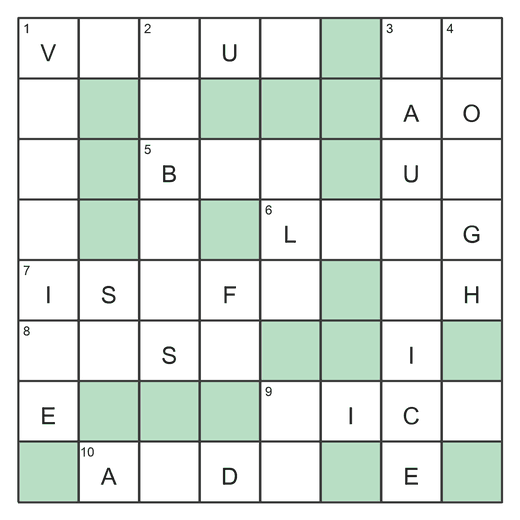
Given below is a crossword puzzle. Read the clues across and clues down, and fill up the blank squares. Check your performance with the correct solutions given at the end of the chapter.
Clues down
1. Germs or germ - substances introduced into the body to prevent occurrence of an infectious disease.
2. A disease caused by an infected dog that affects the central nervous system.
3. A disease in which the eyes, the skin and the urine turn yellow.
4. The disease pertussis is popularly known as whooping ..........
Clues across
1. Category of pathogen that causes diseases like common cold and mumps.
5. This is the vaccine for preventing tuberculosis.
6. An organ usually affected by tuberculosis.
7. Jumbled spelling of one of the most common insect which visits our exposed foods and contaminates them.
8. Cover this part of your body by a handkerchief while sneezing to prevent droplet infection to others.
9. These may readily grow in your hair, if you do not wash it regularly.
10. A disease that weakens body's defence system against infections.
 Solve with AI
Written solution
Solution:
Concept: Solve each clue from the chapter, then check that its letters fit the letters already printed in the grid and the crossing words.
Step 1 — Solve the clues down.
Each answer runs downwards from its numbered square.
Down Clue Answer 1 Germs or germ substances given to prevent an infectious disease VACCINE 2 Disease caused by an infected dog, affecting the nervous system RABIES 3 Eyes, skin and urine turn yellow JAUNDICE 4 Pertussis is popularly known as whooping … COUGH Step 2 — Solve the clues across.
Each answer runs to the right from its numbered square. For clue 7 the grid already shows I, S and F, so the jumbled spelling of FLIES that fits is ISEFL.
Across Clue Answer 1 Category of pathogen that causes cold and mumps VIRUS 5 Vaccine for preventing tuberculosis BCG 6 Organ usually affected by tuberculosis LUNG 7 Jumbled spelling of a common insect on exposed food ISEFL (FLIES jumbled) 8 Cover it with a handkerchief while sneezing NOSE 9 These grow in unwashed hair LICE 10 Disease that weakens the body's defence system AIDS Step 3 — Check the crossings.
The words agree where they cross: VIRUS and VACCINE share V, RABIES starts with the R of VIRUS, BCG gives the B of RABIES, LUNG shares N with JAUNDICE and G with COUGH, and LICE shares C with JAUNDICE. The completed grid (answers in blue) is shown below.
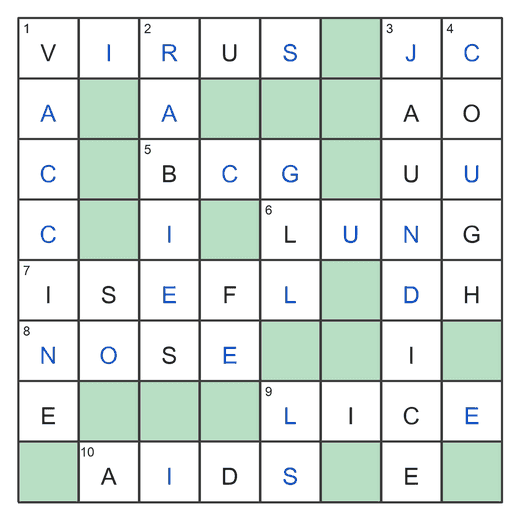
Therefore, down: 1 vaccine, 2 rabies, 3 jaundice, 4 cough; across: 1 virus, 5 BCG, 6 lung, 7 ISEFL (flies), 8 nose, 9 lice, 10 AIDS.
- 333 marks
Question 33
Describe the ways in which communicable diseases are transmitted through various indirect methods.
Solve with AIWritten solution
Solution:
Concept: In indirect transmission the germs reach a healthy person without direct contact with the patient: through air, food, water, objects or animals.
Step 1 — Through air (droplet infection).
When a person with a cold or tuberculosis sneezes or coughs, tiny droplets carrying germs spread into the air, and others breathe them in.
Step 2 — Through contaminated food and water.
The germs of cholera, typhoid, jaundice and amoebiasis enter the body when we eat or drink contaminated food or water.
Step 3 — Through insects (vectors).
Houseflies carry germs from garbage and sewage to our food. Mosquitoes inject germs into the blood when they bite: malaria by the female Anopheles, elephantiasis by the female Culex and dengue by Aedes.
Step 4 — Through articles used by the patient.
Sharing towels, handkerchiefs, combs or utensils of an infected person can spread diseases such as eye infections and skin infections.
Step 5 — Through animal bites and soil.
Rabies spreads through the bite of a rabid dog, and tetanus germs from the soil enter the body through open wounds.
Therefore, communicable diseases spread indirectly through air (droplets), contaminated food and water, insect vectors, articles used by the patient, and animal bites or soil.
- 343 marks
Question 34
List 3 ways by which you should keep your environment clean.
Solve with AIWritten solution
Solution:
Concept: A clean environment stops the breeding of mosquitoes, houseflies and germs, so diseases spread less.
Step 1 — Garbage.
Keep garbage in covered bins and dispose of it regularly, so that flies do not breed on it.
Step 2 — Stagnant water.
Do not let water stagnate around the house or in the neighbourhood, and keep all drains covered, so that mosquitoes do not breed.
Step 3 — Sewage.
Use proper sewer lines connected to sewage treatment plants, and never let faeces or dung contaminate drinking water.
Therefore, keep garbage in covered bins, do not let water stagnate and keep drains covered, and use proper sewer lines so drinking water stays clean.
- 3510 marks
Question 35
Distinguish between the following pairs on the basis of the words indicated in the brackets [ ] :
(i) Elephantiasis and Malaria [mode of transmission]
(ii) Jaundice and Tuberculosis [affected organs]
(iii) Rickets and Smallpox [characteristic symptoms]
(iv) Anaemia and Goitre [deficient mineral]
(v) Metabolic diseases and Mental illness [one example of each]
Solve with AIWritten solution
Solution:
Concept: Compare the two items of each pair only on the point given in the brackets.
Step 1 — (i) Mode of transmission.
Both diseases are spread by mosquitoes, but by different ones.
Elephantiasis Malaria Spread by the bite of the female Culex mosquito. Spread by the bite of the female Anopheles mosquito. Step 2 — (ii) Affected organs.
Each disease attacks a different organ.
Jaundice Tuberculosis Affects the liver. Usually affects the lungs. Step 3 — (iii) Characteristic symptoms.
The two diseases show very different signs.
Rickets Smallpox Bones of growing children turn soft; the legs become bow-shaped. Fever and small fluid-filled pustules (spots) all over the body. Step 4 — (iv) Deficient mineral.
Each disease is due to the lack of a different mineral.
Anaemia Goitre Lack of iron. Lack of iodine. Step 5 — (v) One example of each.
One example is given for each group.
Metabolic diseases Mental illness Diabetes Depression Note: Smallpox has been wiped out worldwide by vaccination; the World Health Organization declared it eradicated in 1980.
Therefore, (i) Culex vs Anopheles mosquito, (ii) liver vs lungs, (iii) soft, bent bones vs pustules, (iv) iron vs iodine, (v) diabetes vs depression.
- 364 marks
Question 36
Students of class 6 were excited about their upcoming sports day and had been practising hard all week. But just two days before the event, five students from one team fell sick with cough and cold. They were sneezing and feeling tired. The teacher suspected that the illness could spread to the rest of the class, so she decided to keep them isolated from others and eventually sent them home. Answer the following questions:
(i) What do you mean by "communicable diseases" ?
(ii) Mention the kind of pathogen that causes cough and cold.
(iii) What is the main mode of transmission of the above pathogen?
(iv) Give two examples of non-communicable diseases.
Solve with AIWritten solution
Solution:
Concept: A disease is any change from the normal working of the body that causes discomfort or disability. Communicable (infectious) diseases are caused by germs (pathogens) such as viruses, bacteria, protozoa and worms, and they spread from person to person. Non-communicable diseases are not caused by germs, so they do not spread.
Step 1 — (i) Communicable diseases.
Communicable diseases are diseases caused by germs (pathogens) that spread from an infected person to a healthy person through air, water, food or insects.
Step 2 — (ii) The pathogen.
Cough and cold are caused by a virus.
Step 3 — (iii) Mode of transmission.
The virus spreads mainly by droplet infection: when a sick child sneezes or coughs, droplets carrying the virus spread into the air and other children breathe them in. That is why the teacher kept the sick children apart.
Step 4 — (iv) Non-communicable diseases.
Two non-communicable diseases are diabetes and heart disease (rickets or cancer are also correct).
Therefore, (i) diseases that spread from person to person through germs, (ii) a virus, (iii) droplet infection through the air, (iv) diabetes and heart disease.
What Class 6 Biology Ch 7 covers
The sections of the chapter, in the order the book takes them. Every question above comes from one of these.
- 01Health
- 02What Is a Disease
- 03Types of Non-communicable or Non-infectious Diseases
- 04Spread of Communicable Diseases
- 05Diseases Caused by Viruses
- 06Diseases Caused by Bacteria
- 07Diseases Caused by Protozoa
More ways to study this chapter
The same chapter asked three other ways. Practise it, revise it, and see what the board has set on Ch 7 before.
Class 6 Biology Ch 7 questions students ask
How many questions are there in Class 6 Biology Ch 7?
36 questions. Every one is solved step by step on this page.
Are these Class 6 Biology solutions free?
Yes. Every question and its full working is free to read, with no account needed.
Can I download the Class 6 Biology Ch 7 solutions as a PDF?
There is no PDF to download. Every solution is on this page instead, which means it is searchable, always the current syllabus, and readable on a phone. Use your browser's print option if you want it on paper.