
Opening your dashboard
Class 6 Biology Chapter 7 Disease and Hygiene: Competency-Based Questions (CBQ)
40 questions on Chapter 7, each worked through on its own page with the AI tutor. Class 6 Biology, ICSE 2026-27.
40 questions
1–5 marks · Mixed difficulty
- 11 mark
Question 1
Cognitive domain: Application
Four people come to a clinic in Jaipur. P has diabetes, Q has chicken pox, R has sunburn and S has asthma. The nurse lets P, R and S sit together in the waiting hall, but she takes Q to a separate room. Why does she keep only Q away from the others ?
- 21 mark
Question 2
Cognitive domain: Analysis
Typhoid broke out in a village in West Bengal. All the families take their drinking water from the same pond. A health worker noted these facts about four families.
Family Is the water boiled before drinking ? Members who got typhoid P No 3 out of 5 Q Yes 0 out of 6 R No 2 out of 4 S Yes 0 out of 5 Which conclusion is best supported by this record ?
- 31 mark
Question 3
Cognitive domain: Application
Sunil has mumps. There is a painful swelling below his ears. His mother gives him a separate plate, glass and handkerchief, and makes him rest in a separate room. Why is this the right thing to do ?
- 41 mark
Question 4
Cognitive domain: Analysis
Three students of a hostel in Bhopal fall ill together. They have diarrhoea with gripping pain. The day before, only these three had eaten cut salad at a roadside stall. All the other students ate only in the hostel mess and are well. The doctor finds Entamoeba in the three patients. What is the most reasonable conclusion ?
- 51 mark
Question 5
Cognitive domain: Understanding
Assertion (A): A person who has no illness in the body, but is always worried and cannot get along with anyone, is not in complete health.
Reason (R): Health is a state of complete physical, mental and social well-being, and not merely an absence of disease or infirmity.
- 61 mark
Question 6
Cognitive domain: Analysis
Assertion (A): A family can protect itself from elephantiasis just by drinking boiled water.
Reason (R): Elephantiasis spreads by the bite of the female Culex mosquito.
- 71 mark
Question 7
Cognitive domain: Application
Eight-year-old Rehana lives in a flat in a narrow, crowded lane where sunlight never enters. She rarely goes out to play, and she does not like milk, butter or eggs. Her legs are slowly becoming bow-shaped.
Complete the sentence :
Rehana's bones are not hardening because her body lacks vitamin ______, and playing outdoors every morning would help her because ______ is also a source of this vitamin.
- 81 mark
Question 8
Cognitive domain: Understanding
At a roadside stall, Vikram eats a meat kebab that is still raw inside. Some weeks later he has pain in the abdomen, and the doctor finds a long, flat worm living in his intestine.
Complete the sentence :
Vikram is suffering from ______, and he is not getting the full benefit of his meals because the worm in his intestine ______ the digested food.
- 91 mark
Question 9
Cognitive domain: Application
In a school hostel in Dehradun, Aryan gets conjunctivitis — his eyes turn red and watery. Within a week, three room-mates who had wiped their faces with Aryan's towel also get it. The boys in the other rooms stay well.
Complete the sentence :
The eye infection passed from Aryan to his room-mates through contamination by the shared ______, and this shows that conjunctivitis is a ______ disease.
- 102 marks
Question 10
Cognitive domain: Understanding
In a village, some families still use the open field near their homes as a toilet. Flies are seen everywhere — in the field and in the kitchens. A health worker warns that the children of the village could get polio.
Explain how the germs of polio can travel from the open field into the body of a child. Name two measures given in your chapter that prevent polio.
- 112 marks
Question 11
Cognitive domain: Evaluation
In the week before her examination, Tara changes her routine. She eats her dinner at 11 p.m., goes to bed straight after the meal, and sleeps for only 4 hours. She says, "Less sleep means more time to study, so this routine is good for me."
Is Tara's routine good for her health ? Judge it, using two points from your chapter.
- 122 marks
Question 12
Cognitive domain: Application
Mr Rao, who works at a busy tea stall in Hyderabad, has tuberculosis (TB). He coughs without covering his mouth, and he often spits on the ground near the stall.
Explain how his habits can pass the disease to the people around him. Suggest two changes he must make in his habits.
- 135 marks
Question 13
Cognitive domain: Evaluation
Case: Sunita is an anganwadi worker in a village in Madhya Pradesh. She visits three children and notes their problems. She also notes what each family plans to do. The doctor at the health centre tells her that Bablu's problem is due to the lack of a vitamin, and that Chinki and Dolly each lack a mineral.
Child Problem What the family plans to do Bablu He cannot see in the dark, though he sees well in the daytime. Give him a brighter torch. Chinki She has a swelling in the neck. Tie a warm scarf round her neck. Dolly Her bones and teeth are weak and brittle. Stop her from playing. (a) Name the vitamin that Bablu lacks, and the mineral that each of the two girls lacks.
(b) Will the plan of each family remove the cause of the problem ? Judge the three plans, and suggest two foods that each child should be given.
(c) Chinki's neighbour does not let her children play with Chinki. She says, "They will catch the swelling from her." Is the neighbour right ? Justify your answer.
- 145 marks
Question 14
Cognitive domain: Analysis
Case: The health centre of a village in Odisha counts the people who come to it with malaria every month. The bar chart shows the count from April to November of last year. The rains came in July and went on till the end of September. Rainwater stayed in the pits, ditches and open drains of the village till October.
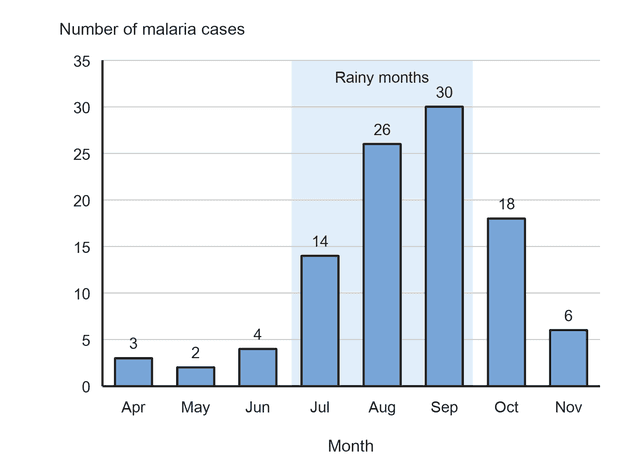
(a) In which month were the malaria cases the highest ? Find the total number of cases in the four months from July to October, and in the three months from April to June.
(b) What does the chart tell you about the rains and malaria ? Explain it, using what you know about how malaria spreads.
(c) The panchayat decides to fill up the pits and cover all the drains before next June. How is next year's chart likely to change ? Give a reason.
(d) A villager says, "If there are no mosquitoes, cholera will also disappear from our village." Is he right ? Give a reason.
- 155 marks
Question 15
Cognitive domain: Creativity
Case: For Health Week, the Class 6 students of a school in Kochi have to show their juniors that germs can pass from one person to another by direct contact and by sharing articles such as handkerchiefs and pencils. Real germs cannot be seen, so Anjali decides to use a little coloured chalk powder as "pretend germs". She has chalk powder, a clean handkerchief, a pencil and six student volunteers.
(a) Plan a simple demonstration for Anjali. Write the steps she should follow.
(b) Draw a table in which the class can record what they see.
(c) What result should the juniors expect to see, and what does it tell them about the spread of communicable diseases ? Write two good habits that this demonstration supports.
- 161 mark
Question 16
Cognitive domain: Understanding
At a school health camp, the doctor checks four Class 6 students, P, Q, R and S, against the features of a healthy person given in the chapter. She writes Yes or No in each box. (Hypothetical data.)
Student Clear skin Bright, clear eyes Good appetite Sound sleep Regular bladder and bowel activity P Yes Yes Yes No Yes Q Yes No Yes Yes Yes R Yes Yes Yes Yes Yes S No Yes No Yes Yes Which student shows all five of these features of good health ?
- 171 mark
Question 17
Cognitive domain: Understanding
In the school health club, Meena makes a chart of three diseases and the way each one mainly spreads. Which one of the following rows of the chart is entirely correct ?
- 181 mark
Question 18
Cognitive domain: Application
A doctor in a village examines a child who has an inflamed skin, with dark marks on the neck in the shape of a necklace. She says that it is pellagra, a deficiency disease, and advises the mother to change the child's diet. Which advice is correct ?
- 191 mark
Question 19
Cognitive domain: Analysis
Four lanes of a colony in Nagpur keep their household garbage in different ways. The health worker counts, in each lane, the houses (out of 20) where houseflies are seen on the food and the number of people who had loose motions with vomiting in one month. (Hypothetical data.)
Lane How the garbage is kept Houses with flies on food (out of 20) People with stomach illness 1 Open heap on the road 18 15 2 Covered bins, emptied every day 4 3 3 Open heap behind a fence 17 13 4 Covered bins, emptied once in 10 days 9 7 The colony committee can pay for only one measure for the whole colony. Which measure do the data support best ?
- 201 mark
Question 20
Cognitive domain: Analysis
Assertion (A): Houseflies can spread cholera.
Reason (R): A person with cholera has vomiting and loose motions that look like rice water.
- 211 mark
Question 21
Cognitive domain: Understanding
Assertion (A): A person who keeps away from every sick person can never fall ill.
Reason (R): Diseases can also be caused by an unhygienic environment, a diet that is not balanced, the use of tobacco, alcohol or drugs, and allergic reactions.
- 221 mark
Question 22
Cognitive domain: Understanding
A school nurse prepares a card on the two protozoan diseases of the chapter, malaria and amoebiasis. Four students copy the card, but only one copy has no mistake in it. Which copy is entirely correct ?
- 231 mark
Question 23
Cognitive domain: Analysis
Imran's gums bleed. His mother says it must be scurvy. The doctor finds that Imran eats an orange or tomatoes every day, but he brushes his teeth only on Sundays. Which is the most reasonable conclusion and advice ?
- 241 mark
Question 24
Cognitive domain: Evaluation
Four neighbours describe how they handle food at home. Whose habits all follow the advice on hygienic food given in the chapter ?
- 251 mark
Question 25
Cognitive domain: Analysis
A health camp in a village examined 45 children. Each child had only one problem. The table also gives the foods that help, as listed in the chapter. (Hypothetical data.)
Problem Number of children Foods that help Anaemia 10 Green leafy vegetables, cereals, egg yolk Goitre 8 Sea food, iodised table salt Rickets 14 Egg yolk, fish liver oil, milk, butter (and sunlight) Night blindness 13 Carrot, yellow fruits, butter, fish, milk The camp can add one food item, which the vegetarian children can also eat, to the mid-day meal of all the children. Which item will help the largest number of children ?
- 262 marks
Question 26
Cognitive domain: Application
A school canteen keeps its boiled dal and rice in open vessels on a table near the window. A heap of rotting kitchen waste lies in an uncovered corner of the yard just outside, and rats run about in the store room.
(a) Name the two carriers of disease-causing germs mentioned in the chapter that this canteen invites.
(b) State one simple measure that the canteen staff should take against each of them.
- 272 marks
Question 27
Cognitive domain: Understanding
In one family, the grandfather has cataract, the father has diabetes and the young son has haemophilia.
(a) Name the type of non-communicable disease to which each of the three conditions belongs.
(b) The neighbour's children play with the young son every day. Explain why they will not catch any of these diseases from him.
- 282 marks
Question 28
Cognitive domain: Evaluation
During the examinations, Dhruv's friend says, "Chew a little tobacco and you will not feel sleepy at night. All the big boys do it."
Using the chapter, give two reasons why Dhruv is right to refuse, and name one healthy habit that can help him stay fresh for his studies.
- 292 marks
Question 29
Cognitive domain: Application
Five-year-old Anaya coughs in fits, and each fit ends with a peculiar sound. The doctor says that she has whooping cough. Her elder brother has no cough so far.
(a) What kind of pathogen causes this disease, and how does it spread ?
(b) Name one precaution that the family should take so that the brother does not catch it.
- 302 marks
Question 30
Cognitive domain: Application
A few days after he ate chaat at a roadside stall and drank water from a public tap, Ravi's skin and the whites of his eyes became yellow, and his urine turned yellow too.
(a) Name the disease and the organ of the body that it affects.
(b) How did Ravi most likely catch it ?
- 313 marks
Question 31
Cognitive domain: Understanding
Three Class 6 students fall ill.
- Meena sat next to a classmate who coughed and sneezed all day without covering his face. After two days, Meena has a cold.
- Joseph shared the towel and the bedsheet of his cousin who had chicken pox, and then he got chicken pox.
- Asha ate sweets at a wedding feast where the sweets were left uncovered and flies kept sitting on them, and she got cholera.
For each student, write how the germs reached her or him (by droplets in the air, by articles used by the patient, or by contaminated food), and name one measure that would have prevented it.
- 323 marks
Question 32
Cognitive domain: Analysis
A health volunteer visits three villagers and notes what each does and what the complaint is. (Hypothetical data.)
Villager Habit Complaint Lata Eats half-cooked grilled meat at festivals Pain in the abdomen Manoj Sleeps outdoors in summer without a mosquito net Highly swollen legs Nisha Eats a raw salad of unwashed vegetables Pain in the abdomen and vomiting (a) Name the disease that each villager is most likely to have.
(b) Write one measure that would have protected each villager.
- 333 marks
Question 33
Cognitive domain: Analysis
The Mehta family of Lucknow boils its drinking water every day. Yet the children often have loose motions. A health worker finds that the boiled water is poured into an open bucket kept on the kitchen floor, and the children dip a used glass into it with unwashed hands.
(a) Find two faults in the way the family stores and uses the water.
(b) Explain why boiling the water does not protect the children in this house.
(c) Suggest what the family should do.
- 343 marks
Question 34
Cognitive domain: Analysis
At a nutrition centre, two small children are examined. Child P is very thin, has weak muscles and has eaten very little of anything for months: hardly any cereals, oil or ghee, dal or milk. Child Q has a swollen belly; he eats rice and roti twice a day but almost never has milk, dal, eggs or fish.
(a) Name the deficiency disease of P and of Q.
(b) Child Q gets plenty of energy-giving food, yet his body does not grow and repair itself well. Explain why.
(c) Name two body-building foods that would help Q to recover.
- 353 marks
Question 35
Cognitive domain: Application
Three cases are reported in a newspaper.
(i) A fielder playing a cricket match at noon in May, without a cap, falls ill with heat stroke.
(ii) A farmer is poisoned after eating a wild plant by mistake.
(iii) A family drinks water from a pond into which a factory releases waste containing lead and mercury, and many members fall ill.
(a) Say whether the disease in each case is due to a physical agent or to a chemical agent.
(b) Explain why none of these diseases can spread from a patient to the people who look after him.
- 364 marks
Question 36
Cognitive domain: Analysis
Case: The class teacher of a Class 6 in Pune counted the students who stayed away from school because of illness during the monsoon term. Each student was absent because of one illness only. The bar chart shows the counts. (Hypothetical data.)

(a) Which illness kept the largest number of students away ? Find the total number of students absent. What percentage of all the absent students had a cold ?
(b) Two of these illnesses spread mainly through contaminated food and water. Name them and find how many students they kept away together.
(c) Suggest one measure for each of the three groups: cold, conjunctivitis, and the two illnesses of part (b).
- 375 marks
Question 37
Cognitive domain: Analysis
Case: In a girls' hostel in Shillong, 6 of the 40 girls developed swollen and bleeding gums after about two months of the monsoon. The warden looked at the mess record for the 30 days. (Hypothetical data.)
Food served Days served out of 30 Rice 30 Dal 30 Fried vegetable pakoras 24 Green leafy vegetables 3 Citrus fruits or tomatoes 2 Milk 6 (a) Name the disease that the six girls most probably have, and the vitamin that is missing from their food.
(b) Using the table, name the food that is the source of this vitamin and was served on the fewest days. Name the food in the table that the chapter advises us to avoid taking too much of, and say why.
(c) Suggest three changes that the warden should make in the mess so that the girls keep healthy.
- 385 marks
Question 38
Cognitive domain: Creativity
Case: The Class 6 students of a school in Mysuru are making a poster for Health Week. They want to show younger children how germs from an open garbage heap can reach a child's stomach, and how this can be stopped.
(a) Draw a flow chart of at least four boxes, joined by arrows, that shows how the germs travel from the open garbage heap to the child.
(b) On your flow chart, mark three places where the chain can be broken, and write one measure at each place.
(c) Write a slogan of not more than ten words for the poster, and name two habits that the poster should urge.
- 394 marks
Question 39
Cognitive domain: Evaluation
Case: Ten-year-old Arjun is bitten on the leg by a stray dog near the bus stand. The bite is not deep, and the dog runs away. His grandmother rubs turmeric on the wound and says, "It is only a scratch. He needs no doctor and no injection." His father takes Arjun to the hospital all the same.
(a) Name the disease that Arjun may get from this bite, and how its germ enters the body.
(b) Evaluate the grandmother's advice.
(c) Name the treatment that Arjun needs, and one measure that the neighbourhood should take so that children are safe from this disease.
- 405 marks
Question 40
Cognitive domain: Evaluation
Case: A Class 6 teacher asks the 40 students of her class whether they wash their hands before every meal, and then notes how many of them had a stomach upset in the last month. (Hypothetical data.)
Group Number of students Number with a stomach upset Wash hands before every meal 30 3 Do not wash hands before every meal 10 4 (a) Find the percentage of students with a stomach upset in each group.
(b) What does the survey suggest about washing the hands before meals ? Give the reason from the chapter.
(c) Three students who wash their hands before meals also had a stomach upset. Give two other possible causes from the chapter, and name one more habit that the whole class should follow.