
Opening your dashboard
Class 5 Science Chapter 7: Interdependence in Living Beings Solutions
33 textbook questions with step-by-step answers, free to read, for ICSE 2026-27.
Get talked through Ch 7, not just shown the answer
Reading a finished solution is not the same as being able to do it. The AI tutor takes one question at a time and works it with you, in your own words, until you can.
- Ask it out loud, in your own words
- It gives you the next step, not the answer
- Stuck on part (ii)? Start there
33 questions with solutions
1–5 marks · Mixed difficulty
- 11 mark
Question 1
Give one word for the following.
The process by which green plants make their food ________
Solve with AIWritten solution
Solution:
Concept: Green plants make their own food in their leaves. They use sunlight, water and carbon dioxide to do this, and they give out oxygen.
Step 1 — What is asked.
We need the name of the process in which green plants make their food.
Step 2 — Recall the term.
This process is called photosynthesis. 'Photo' means light, because the plant needs sunlight to make its food.
Therefore, the answer is photosynthesis.
- 21 mark
Question 2
Give one word for the following.
The relationship that shows that plants and animals are dependent on each other ________
Solve with AIWritten solution
Solution:
Concept: Plants and animals need each other. Animals get food and oxygen from plants, and animals help plants with pollination and seed dispersal.
Step 1 — What is asked.
We need one word for the way plants and animals depend on each other.
Step 2 — Recall the term.
When two groups of living things depend on each other, we call it interdependence.
Therefore, the answer is interdependence.
- 31 mark
Question 3
Give one word for the following.
The continuous pattern of eating and being eaten ________
Solve with AIWritten solution
Solution:
Concept: In nature one living thing becomes food for another. For example, grass is eaten by a deer, and the deer is eaten by a tiger.
Step 1 — What is asked.
We need the name for this pattern in which living things eat and are eaten, one after another.
Step 2 — Recall the term.
Such a chain of eating and being eaten is called a food chain.
Therefore, the answer is food chain.
- 41 mark
Question 4
Give one word for the following.
Animals that eat plants as their food ________
Solve with AIWritten solution
Solution:
Concept: Animals cannot make their own food. Some animals, such as cows, deer and giraffes, eat only plants.
Step 1 — What is asked.
We need the name for animals that eat plants as their food.
Step 2 — Recall the term.
Plant-eating animals are called herbivores. In a food chain they are the primary consumers.
Therefore, the answer is herbivores (primary consumers).
- 51 mark
Question 5
Give one word for the following.
The cutting down of trees in a forest ________
Solve with AIWritten solution
Solution:
Concept: People cut down forests to get wood and to make space for houses, factories and farms.
Step 1 — What is asked.
We need one word for cutting down the trees of a forest.
Step 2 — Recall the term.
The cutting down of forests is called deforestation.
Therefore, the answer is deforestation.
- 61 mark
Question 6
Choose the correct option.
Which of the following will be a biotic component in an environment?
Solve with AIAnswer
(A) Air
(B) Water
(C) Soil
- Correct
(D) Grass
Answer: (D) Grass
Concept: The living parts of the environment, such as plants and animals, are its biotic components. The non-living parts, such as air, water, soil and sunshine, are its abiotic components.
Step 1 — What is asked.
We must find the one option that is a living (biotic) component.
Step 2 — Check each option.
Air, water and soil are non-living. Grass is a plant, and plants are living things.
Step 3 — Choose the answer.
So grass is the biotic component.
Step 4 — Check the other options.
Each of the other options is wrong for the reason given below.
- (A): Air is non-living. It is an abiotic component, even though living things need it to breathe.
- (B): Water is non-living. It is an abiotic component that all living things need.
- (C): Soil is non-living. It is an abiotic component in which plants grow.
Therefore, grass is a biotic component: option (D).
- 71 mark
Question 7
Choose the correct option.
Animals that kill other animals for eating are called
Solve with AIAnswer
(A) primary consumer
- Correct
(B) secondary consumer
(C) decomposer
(D) producer
Answer: (B) secondary consumer
Concept: In a food chain, primary consumers (herbivores) eat plants. Secondary consumers (carnivores such as tigers and wolves) eat other animals.
Step 1 — What is asked.
We need the name for animals that kill other animals and eat them.
Step 2 — Recall the groups.
Animals that eat other animals are carnivores. They come after the herbivores in a food chain, so they are secondary consumers.
Step 3 — Choose the answer.
So such animals are secondary consumers.
Step 4 — Check the other options.
Each of the other options is wrong for the reason given below.
- (A): A primary consumer is a herbivore, such as a cow. It eats plants, not other animals.
- (C): A decomposer is a tiny living thing, such as a bacterium or a fungus. It breaks down dead remains; it does not kill animals.
- (D): A producer is a green plant. It makes its own food and does not eat animals.
Therefore, animals that kill other animals for food are secondary consumers: option (B).
- 81 mark
Question 8
Choose the correct option.
Plants are called green lungs because
Solve with AIAnswer
(A) they take in the carbon dioxide from the air
(B) they are green in colour
(C) they release oxygen in the air
- Correct
(D) both (A) and (C)
Answer: (D) both (A) and (C)
Concept: During photosynthesis, green plants take in carbon dioxide from the air and give out oxygen into the air. In this way they clean the air for us, so they are called our 'green lungs'.
Step 1 — What is asked.
We must find why plants are called green lungs.
Step 2 — Check option (A).
Plants take in carbon dioxide from the air to make food. This is true and is one reason.
Step 3 — Check option (C).
Plants give out oxygen into the air during photosynthesis. This is true and is the other reason.
Step 4 — Choose the answer.
Both (A) and (C) are correct reasons, so the best answer is option (D).
Step 5 — Check the other options.
Each of the other options is wrong for the reason given below.
- (A): Taking in carbon dioxide is true, but it is only half of the reason. Plants also give out oxygen, so option (D) is more complete.
- (B): The green colour comes from chlorophyll. Colour alone does not clean the air, so it is not the reason.
- (C): Giving out oxygen is true, but it is only half of the reason. Plants also take in carbon dioxide, so option (D) is more complete.
Therefore, plants are called green lungs because they take in carbon dioxide and release oxygen: option (D).
- 91 mark
Question 9
Choose the correct option.
Which of the following is a primary consumer?
Solve with AIAnswer
(A) Carnivores
- Correct
(B) Herbivores
(C) Omnivores
(D) Scavengers
Answer: (B) Herbivores
Concept: Primary consumers are the animals that eat plants directly. These plant-eaters are called herbivores, for example cows and giraffes.
Step 1 — What is asked.
We must find which group of animals are primary consumers.
Step 2 — Recall the meaning.
Primary consumers eat the food made by plants directly, by eating the plants.
Step 3 — Choose the answer.
Herbivores eat only plants, so they are the primary consumers.
Step 4 — Check the other options.
Each of the other options is wrong for the reason given below.
- (A): Carnivores, such as tigers and wolves, eat other animals. They are secondary consumers.
- (C): Omnivores, such as humans and crows, eat both plants and animals. Because they also eat animals, they are grouped with the secondary consumers. Herbivores eat only plants, so they are always primary consumers.
- (D): Scavengers, such as jackals and vultures, eat the dead bodies of animals. They do not feed on plants.
Therefore, herbivores are primary consumers: option (B).
- 101 mark
Question 10
Choose the correct option.
Which of the following feeds on the dead animals?
Solve with AIAnswer
- Correct
(A) Scavengers
(B) Decomposers
(C) Primary consumers
(D) Producers
Answer: (A) Scavengers
Concept: Scavengers are animals, such as jackals and vultures, that eat the dead bodies of other animals. They eat the bodies quickly and keep the environment clean.
Step 1 — What is asked.
We need the group of animals that eat dead animals.
Step 2 — Recall the term.
Animals that feed on the dead bodies of other animals are called scavengers.
Step 3 — Choose the answer.
So the answer is scavengers.
Step 4 — Check the other options.
Each of the other options is wrong for the reason given below.
- (B): Decomposers do act on dead remains too, but they are tiny bacteria and fungi that slowly break down decaying matter into nutrients. The animals that eat dead bodies are scavengers, so option (A) is the better answer.
- (C): Primary consumers, such as cows, are herbivores. They eat plants, not dead animals.
- (D): Producers are green plants. They make their own food and do not eat anything.
Therefore, scavengers feed on dead animals: option (A).
- 111 mark
Question 11
Fill in the blanks.
Word box: nutrients · oxygen · roots · omnivores · hunting
Plants release ________ during photosynthesis.
Solve with AIWritten solution
Solution:
Concept: In photosynthesis, green plants use sunlight, water and carbon dioxide to make food, and they give out a gas.
Step 1 — What is asked.
We need the gas that plants give out during photosynthesis.
Step 2 — Pick the word from the box.
Plants give out oxygen, the gas that we breathe in.
Therefore, the answer is: Plants release oxygen during photosynthesis.
- 121 mark
Question 12
Fill in the blanks.
Word box: nutrients · oxygen · roots · omnivores · hunting
________ of plants prevent soil erosion.
Solve with AIWritten solution
Solution:
Concept: Soil erosion is the washing or blowing away of the top layer of soil by rain water or wind.
Step 1 — What is asked.
We need the part of a plant that stops soil from being washed or blown away.
Step 2 — Pick the word from the box.
Roots spread through the soil and hold it firmly in place.
Therefore, the answer is: Roots of plants prevent soil erosion.
- 131 mark
Question 13
Fill in the blanks.
Word box: nutrients · oxygen · roots · omnivores · hunting
Dead and decayed plants and animals turn into ________.
Solve with AIWritten solution
Solution:
Concept: Decomposers, such as bacteria and fungi, break down dead plants and animals into simple substances.
Step 1 — What is asked.
We need what dead and decayed plants and animals change into.
Step 2 — Pick the word from the box.
The simple substances made by decomposers are nutrients, such as nitrogen and phosphorus. They mix with the soil and help plants to grow.
Therefore, the answer is: Dead and decayed plants and animals turn into nutrients.
- 141 mark
Question 14
Fill in the blanks.
Word box: nutrients · oxygen · roots · omnivores · hunting
________ eat both plants and animals.
Solve with AIWritten solution
Solution:
Concept: Animals are grouped by what they eat: herbivores eat plants, carnivores eat animals, and omnivores eat both.
Step 1 — What is asked.
We need the group of animals that eat both plants and animals.
Step 2 — Pick the word from the box.
Such animals are omnivores. Humans and crows are examples.
Therefore, the answer is: Omnivores eat both plants and animals.
- 151 mark
Question 15
Fill in the blanks.
Word box: nutrients · oxygen · roots · omnivores · hunting
The act of killing or capturing animals is called ________.
Solve with AIWritten solution
Solution:
Concept: People sometimes kill or catch wild animals for food, skin, horns, tusks or fur, or as a sport.
Step 1 — What is asked.
We need the word for killing or capturing animals.
Step 2 — Pick the word from the box.
This act is called hunting. It has made some kinds of animals very rare.
Therefore, the answer is: The act of killing or capturing animals is called hunting.
- 161 mark
Question 16
Write T for True statements or F for False statements.
All the food chains start from plants.
Solve with AIWritten solution
Solution:
Concept: Green plants are producers. They make food using the energy of sunlight. Animals get their food from plants, either directly or by eating other animals.
Step 1 — Read the statement.
It says that every food chain begins with a plant.
Step 2 — Check it.
A food chain begins with a living thing that makes its own food. Green plants make food, so food chains start from plants, for example grass → deer → tiger.
Note: Some food chains start with dead leaves or other dead remains, for example dead leaves → earthworm → bird. The food stored in these remains was first made by green plants. In ponds and seas, tiny green living things called algae start many food chains.
Therefore, the statement is True (T).
- 171 mark
Question 17
Write T for True statements or F for False statements.
Green plants are called consumers.
Solve with AIWritten solution
Solution:
Concept: Green plants make their own food, so they are called producers. Animals cannot make their own food; they eat plants or other animals, so they are called consumers.
Step 1 — Read the statement.
It says that green plants are consumers.
Step 2 — Check it.
Green plants make food by photosynthesis. They produce food, so they are producers, not consumers.
Step 3 — Correct it.
The correct statement is: Green plants are called producers.
Therefore, the statement is False (F).
- 181 mark
Question 18
Write T for True statements or F for False statements.
Carnivores eat herbivores.
Solve with AIWritten solution
Solution:
Concept: Carnivores are flesh-eating animals, such as tigers and wolves. Herbivores are plant-eating animals, such as deer and rabbits.
Step 1 — Read the statement.
It says that carnivores eat herbivores.
Step 2 — Check it.
Carnivores kill and eat other animals. A tiger eats a deer, and a wolf eats a rabbit. So carnivores do eat herbivores.
Therefore, the statement is True (T).
- 191 mark
Question 19
Write T for True statements or F for False statements.
Scavengers and decomposers help in keeping the environment clean.
Solve with AIWritten solution
Solution:
Concept: Scavengers (such as jackals and vultures) eat dead bodies quickly. Decomposers (bacteria and fungi) break down dead remains into nutrients.
Step 1 — Read the statement.
It says that both scavengers and decomposers keep the environment clean.
Step 2 — Check it.
Scavengers remove dead bodies before they rot and spread diseases. Decomposers break down whatever remains, so dead matter does not pile up. Both clean the environment.
Therefore, the statement is True (T).
- 201 mark
Question 20
Write T for True statements or F for False statements.
Forest fire does not affect the air quality.
Solve with AIWritten solution
Solution:
Concept: When a forest burns, the burning wood and leaves give out smoke, ash and carbon dioxide into the air.
Step 1 — Read the statement.
It says that a forest fire does not change the air.
Step 2 — Check it.
Smoke and ash from a forest fire make the air dirty, and the fire adds carbon dioxide to the air. So a forest fire causes air pollution.
Step 3 — Correct it.
The correct statement is: Forest fire makes the air quality poor.
Therefore, the statement is False (F).
- 215 marks
Question 21
Match the following.
Column A Column B 1. Photosynthesis a. Increased carbon dioxide 2. Forest fire b. Nitrogen 3. Decomposers c. Extinction of animals 4. Hunting d. Clean environment 5. Scavengers e. Increased oxygen Solve with AIWritten solution
Solution:
Concept: Each term in column A is linked to one result or fact in column B. Use each item of column B only once.
Step 1 — Match 1 (Photosynthesis).
In photosynthesis, plants give out oxygen into the air. So 1 matches e.
Step 2 — Match 2 (Forest fire).
A forest fire burns wood and leaves, which gives out carbon dioxide into the air. So 2 matches a.
Step 3 — Match 3 (Decomposers).
Decomposers break down dead remains into nutrients such as nitrogen. So 3 matches b.
Step 4 — Match 4 (Hunting).
Too much hunting kills so many animals of one kind that the kind can die out completely. So 4 matches c.
Step 5 — Match 5 (Scavengers).
Scavengers eat dead bodies and keep the surroundings clean. So 5 matches d.
Step 6 — Write the matched pairs.
The table below shows each term with its match.
Column A Column B 1. Photosynthesis e. Increased oxygen 2. Forest fire a. Increased carbon dioxide 3. Decomposers b. Nitrogen 4. Hunting c. Extinction of animals 5. Scavengers d. Clean environment Therefore, 1 matches e, 2 matches a, 3 matches b, 4 matches c and 5 matches d.
- 222 marks
Question 22
How do plants prevent soil erosion?
Solve with AIWritten solution
Solution:
Concept: Soil erosion is the removal of the top layer of soil by flowing rain water or strong wind. This top layer is the most useful part of the soil for growing plants.
Step 1 — Roots hold the soil.
The roots of plants spread deep and wide in the soil. They hold the soil particles together firmly, so water and wind cannot carry them away easily.
Step 2 — Plants cover the soil.
The leaves and branches of plants and a cover of grass break the force of falling rain and slow down the wind. So the soil underneath is not washed or blown away.
Therefore, plants prevent soil erosion because their roots hold the soil firmly and their cover protects the soil from heavy rain and strong wind.
- 232 marks
Question 23
How do animals help plants? List two ways.
Solve with AIWritten solution
Solution:
Concept: Plants and animals depend on each other. Animals help plants to make new plants and to grow well.
Step 1 — Pollination.
Bees, butterflies and birds visit flowers for nectar. They carry pollen grains from flower to flower. This helps plants to form fruits and seeds.
Step 2 — Seed dispersal.
Birds and animals such as squirrels eat fruits and drop or throw away the seeds in other places. New plants can then grow in new places.
Note: Animals also help in other ways: their wastes and dead bodies add nutrients to the soil, and they give out carbon dioxide, which plants use to make food.
Therefore, animals help plants by carrying pollen from flower to flower (pollination) and by spreading their seeds to new places (seed dispersal).
- 242 marks
Question 24
What are producers?
Solve with AIWritten solution
Solution:
Concept: Every living thing needs food. Only some living things can make their own food.
Step 1 — Define producers.
Producers are the green plants that make their own food by photosynthesis. They use sunlight, water and carbon dioxide to make it.
Step 2 — Say why they are important.
Animals cannot make their own food. All animals get their food from producers, directly or indirectly. So every food chain starts with a producer. Examples are grass, trees and wheat plants.
Therefore, producers are green plants that make their own food by photosynthesis and provide food for all other living things.
- 252 marks
Question 25
What are consumers?
Solve with AIWritten solution
Solution:
Concept: Animals cannot make their own food. They have to eat other living things to get food.
Step 1 — Define consumers.
Consumers are animals that eat plants or other animals for food, because they cannot make their own food.
Step 2 — Give the kinds with examples.
Primary consumers (herbivores), such as cows, eat plants. Secondary consumers eat other animals: carnivores, such as tigers, eat animals, and omnivores, such as humans, eat both plants and animals.
Therefore, consumers are animals that cannot make their own food and get it by eating plants or other animals.
- 262 marks
Question 26
Why are scavengers important?
Solve with AIWritten solution
Solution:
Concept: Scavengers are animals, such as jackals and vultures, that eat the dead bodies of other animals.
Step 1 — They clean up quickly.
Scavengers eat dead bodies quickly, before they rot. Decomposers would take a long time to break down a whole dead body.
Step 2 — They prevent diseases.
A rotting body smells bad, and germs grow in it and spread diseases. By eating the body, scavengers keep the environment clean and healthy.
Therefore, scavengers are important because they quickly eat the dead bodies of animals, which keeps the environment clean and stops diseases from spreading.
- 274 marks
Question 27
How are plants and animals interdependent?
Solve with AIWritten solution
Solution:
Concept: Interdependence means depending on each other. Plants need animals and animals need plants.
Step 1 — Animals need plants for food.
Animals cannot make their own food. Herbivores, such as cows, eat plants directly. Carnivores, such as tigers, eat herbivores, so they also depend on plants, but indirectly.
Step 2 — Animals need plants for oxygen and shelter.
Plants give out oxygen, which animals breathe in. Trees also give shelter to many animals, such as birds and monkeys.
Step 3 — Plants need animals for pollination and seed dispersal.
Bees and butterflies carry pollen from flower to flower. Birds and squirrels spread seeds to new places. Both help new plants to grow.
Step 4 — Plants need animals for carbon dioxide and nutrients.
Animals breathe out carbon dioxide, which plants use to make food. Animal wastes and dead bodies are broken down into nutrients that enrich the soil for plants.
Therefore, plants and animals are interdependent: animals get food, oxygen and shelter from plants, and plants get help with pollination, seed dispersal, carbon dioxide and soil nutrients from animals.
- 283 marks
Question 28
Give an example of food chain. Identify all the parts in it.
Solve with AIWritten solution
Solution:
Concept: A food chain shows who eats whom. The arrow (→) means 'is eaten by'. Every food chain has producers and consumers, and decomposers act on all its members after they die.
Step 1 — Write a food chain.
A simple food chain in a forest is: Grass → Deer → Tiger.
Step 2 — Identify the producer.
Grass is a green plant that makes its own food by photosynthesis. It is the producer.
Step 3 — Identify the consumers.
The deer eats grass, so it is the primary consumer (a herbivore). The tiger eats the deer, so it is the secondary consumer (a carnivore).
Step 4 — Identify the decomposers.
When the grass, the deer or the tiger dies, decomposers (bacteria and fungi) break down the dead remains into nutrients. The nutrients go back into the soil and help new grass to grow.
Therefore, in the food chain Grass → Deer → Tiger, grass is the producer, the deer is the primary consumer, the tiger is the secondary consumer, and bacteria and fungi are the decomposers.
- 294 marks
Question 29
Describe the different types of consumers. Give examples.
Solve with AIWritten solution
Solution:
Concept: Consumers are animals that cannot make their own food and so eat plants or other animals.
Step 1 — Primary consumers.
Primary consumers eat plants directly. They are herbivores (plant-eaters). Examples: cow, giraffe, deer, rabbit.
Step 2 — Secondary consumers: carnivores.
Carnivores eat herbivores. They use the food made by plants indirectly. Examples: tiger, wolf, lion.
Step 3 — Secondary consumers: omnivores.
Omnivores eat both plants and animals. They are also grouped with the secondary consumers. Examples: humans, crows.
Step 4 — Scavengers.
Scavengers are consumers that eat the dead bodies of other animals. They clean up the environment. Examples: jackal, vulture.
Therefore, consumers are of these types: primary consumers or herbivores (cow, giraffe), secondary consumers, which are carnivores (tiger, wolf) and omnivores (humans, crows), and scavengers (jackal, vulture).
- 304 marks
Question 30
What are the harms done by deforestation?
Solve with AIWritten solution
Solution:
Concept: Deforestation is the cutting down of forests to get wood or to make space for houses, factories and farms.
Step 1 — Animals lose their homes and food.
Many animals live in forests and eat forest plants. When the forest is cut, they lose shelter and food. Some come out into nearby villages and fields to look for food.
Step 2 — Carbon dioxide in the air increases.
Trees take in carbon dioxide from the air. With fewer trees, less carbon dioxide is taken in, so its amount in the air goes up.
Step 3 — Rainfall can decrease.
Trees give out water vapour into the air through transpiration. With fewer trees, an area can get less rain, which can lead to drought.
Step 4 — Soil erosion increases.
Tree roots hold the soil firmly. Without trees, rain water and wind carry the top soil away, and floods become more likely.
Therefore, deforestation takes away the homes and food of animals, increases carbon dioxide in the air, can reduce rainfall, and causes soil erosion.
- 315 marks
Question 31
List the biotic and abiotic components in this picture.
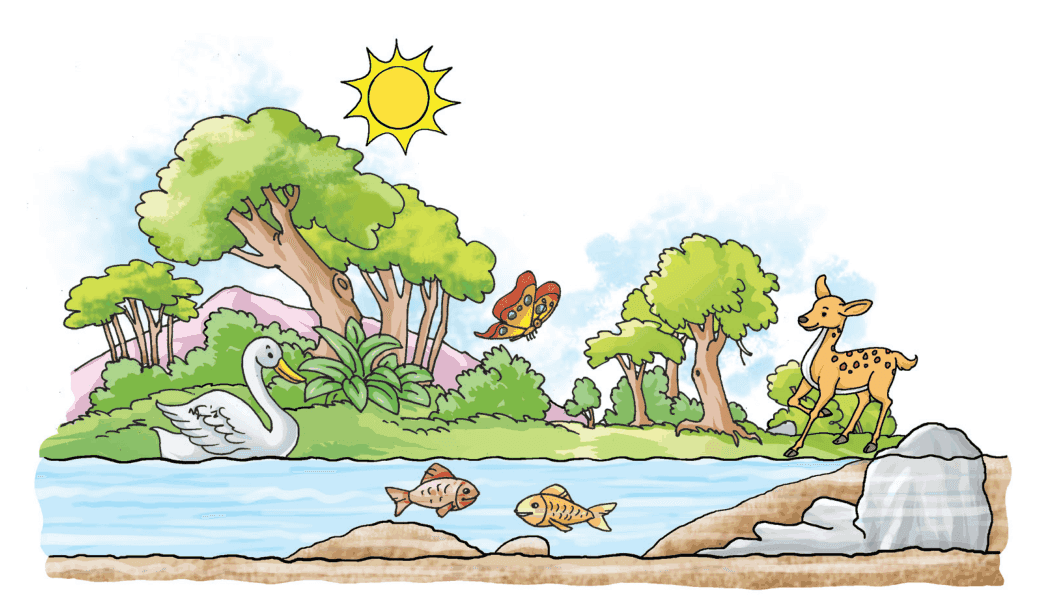 Solve with AI
Written solution
Solution:
Concept: Biotic components are the living things in the environment: plants and animals. Abiotic components are the non-living things: air, water, soil, sunshine, rocks and so on.
Step 1 — Find the abiotic (non-living) components.
In the picture we can see the Sun (sunlight), the air all around, the water of the stream, the soil (ground), the rocks (stones) and the clouds. None of these is alive.
Step 2 — Find the biotic (living) components.
We can see trees, bushes and small plants, grass, a swan, a butterfly, a deer and two fish. All of these are living things.
Step 3 — Write them in two lists.
The table below sorts the components.
Abiotic components Biotic components Sun (sunlight) Trees Air Bushes and small plants, grass Water Swan Soil Butterfly Rocks (stones) Deer, fish Clouds Therefore, the abiotic components are the Sun, air, water, soil, rocks and clouds, and the biotic components are the trees, bushes, grass, swan, butterfly, deer and fish.
- 323 marks
Question 32
Both deforestation and forest fire lead to increased amount of carbon dioxide in the air due to different reasons. Can you elaborate how?
Solve with AIWritten solution
Solution:
Concept: Trees take in carbon dioxide from the air during photosynthesis. Burning wood gives out carbon dioxide into the air.
Step 1 — How deforestation increases carbon dioxide.
When forests are cut down, there are fewer trees left to take in carbon dioxide from the air. The carbon dioxide that living things and vehicles give out is no longer used up, so it collects in the air.
Step 2 — How forest fire increases carbon dioxide.
In a forest fire, wood and leaves burn. Burning gives out a lot of carbon dioxide, together with smoke and ash, straight into the air. The fire also kills trees, so fewer trees are left to take the carbon dioxide in.
Step 3 — Compare the two reasons.
Deforestation mainly removes the trees that use up carbon dioxide. A forest fire mainly adds new carbon dioxide to the air by burning.
Therefore, deforestation increases carbon dioxide because fewer trees are left to take it in, while a forest fire increases it because burning wood gives out carbon dioxide directly into the air.
- 332 marks
Question 33
What would happen if there are no decomposers in the world?
Solve with AIWritten solution
Solution:
Concept: Decomposers (bacteria and fungi) break down dead plants, dead animals and animal wastes into simple nutrients that go back into the soil.
Step 1 — Dead matter would pile up.
Dead leaves, dead animals and wastes would not rot away. They would keep piling up everywhere, making the surroundings dirty.
Step 2 — The soil would lose its nutrients.
Nutrients such as nitrogen and phosphorus locked in dead bodies would not go back into the soil. Plants take these nutrients from the soil, so slowly the soil would run short of them and plants would not grow well.
Step 3 — All living things would suffer.
With fewer plants, herbivores would get less food, and then carnivores would get less food too. Every food chain would be affected.
Therefore, without decomposers, dead matter would pile up, the soil would lose its nutrients, plants would not grow well, and all food chains would be affected.
What Class 5 Science Ch 7 covers
The sections of the chapter, in the order the book takes them. Every question above comes from one of these.
- 01Importance of plants and animals
- 02Interdependence of plants and animals
- 03Food chain
- 04Balance in nature
- 05Deforestation, hunting, forest fire
More ways to study this chapter
The same chapter asked three other ways. Practise it, revise it, and see what the board has set on Ch 7 before.
Class 5 Science Ch 7 questions students ask
How many questions are there in Class 5 Science Ch 7?
33 questions. Every one is solved step by step on this page.
Are these Class 5 Science solutions free?
Yes. Every question and its full working is free to read, with no account needed.
Can I download the Class 5 Science Ch 7 solutions as a PDF?
There is no PDF to download. Every solution is on this page instead, which means it is searchable, always the current syllabus, and readable on a phone. Use your browser's print option if you want it on paper.