
Opening your dashboard
Class 5 Science Chapter 7 Interdependence in Living Beings: Competency-Based Questions (CBQ)
40 questions on Chapter 7, each worked through on its own page with the AI tutor. Class 5 Science, ICSE 2026-27.
40 questions
1–5 marks · Mixed difficulty
- 11 mark
Question 1
Cognitive domain: Application
Meena makes a bottle garden. She puts soil, a few pebbles, small fern plants and some moss inside a glass jar, waters it and closes the lid. She keeps the jar near a sunny window. Which of these gives the ferns the energy they need to make their food?
- 21 mark
Question 2
Cognitive domain: Analysis
In Kabir's garden, tiny insects called aphids suck the juice of rose plants. Ladybird beetles eat the aphids. In this food chain, which living thing is the primary consumer?
- 31 mark
Question 3
Cognitive domain: Analysis
Vultures have become rare in many parts of India. Scientists say this is bad for the environment.
Assertion (A): Vultures help to keep the environment clean.
Reason (R): Vultures eat the dead bodies of animals before the bodies rot and spread diseases.
- 41 mark
Question 4
Cognitive domain: Evaluation
A large forest near a city was cut down to build new houses.
Assertion (A): Cutting down forests can increase the amount of carbon dioxide in the air.
Reason (R): Trees give out carbon dioxide during photosynthesis.
- 51 mark
Question 5
Cognitive domain: Application
A mango farmer keeps boxes of honeybees in his orchard when the mango trees are in flower. He gets more mangoes than his neighbour, who keeps no bees. What is the best explanation?
- 61 mark
Question 6
Cognitive domain: Evaluation
Sana says that a cow is a secondary consumer.
Assertion (A): A cow is a secondary consumer.
Reason (R): A cow eats grass, which is a green plant.
- 73 marks
Question 7
Cognitive domain: Analysis
Wolves eat deer in a grassland. In Year 2, hunters killed all the wolves. A forest officer recorded the numbers below. (Hypothetical data.)
Year Wolves Deer Grass 1 20 300 Thick 2 0 450 Thinner 3 0 700 In patches 4 0 400 Almost bare (a) What happened to the number of deer from Year 1 to Year 3, and why? (1 mark)
(b) Why did the grass become thinner year after year? (1 mark)
(c) Why did the number of deer fall in Year 4? (1 mark)
- 82 marks
Question 8
Cognitive domain: Understanding
Arjun wrote this food chain in his notebook:
Tiger → Deer → Grass
His teacher said that the living things are correct, but the chain is written the wrong way round.
(a) What does the arrow in a food chain mean? (1 mark)
(b) Write the food chain correctly and name its producer. (1 mark)
- 93 marks
Question 9
Cognitive domain: Evaluation
Rats eat the grain in farmer Ramesh's store. His neighbour uses rat poison. Ramesh instead puts up wooden nest boxes near his fields for barn owls, which hunt rats at night.
(a) How do the owls help Ramesh? (1 mark)
(b) Owls and snakes sometimes eat rats that have eaten poison. Why is this a problem? (1 mark)
(c) Whose way keeps the balance in nature better? Give a reason. (1 mark)
- 102 marks
Question 10
Cognitive domain: Application
Class 5 dug a compost pit in the school garden. They filled it with dry leaves, vegetable peels and a little soil. After about three months, the waste had turned into dark, crumbly compost.
(a) Which living things turned the waste into compost? (1 mark)
(b) How will this compost help the plants in the school garden? (1 mark)
- 113 marks
Question 11
Cognitive domain: Evaluation
A news report says: "A herd of elephants entered a village at night and ate the crops in the fields. Last year a large part of the nearby forest was cut down to build a factory."
(a) Why did the elephants come into the village? (1 mark)
(b) The villagers are angry with the elephants. Is it the elephants' fault? Give a reason. (1 mark)
(c) Suggest one way to stop this from happening again. (1 mark)
- 123 marks
Question 12
Cognitive domain: Application
On a picnic in a forest, Neha sees a group leave their cooking fire still burning. Then a man throws a lit matchstick into a heap of dry leaves.
(a) What human cause of forest fire do you see in this story? (1 mark)
(b) Name one natural cause of forest fire. (1 mark)
(c) Write one safety rule that every picnic group should follow. (1 mark)
- 133 marks
Question 13
Cognitive domain: Analysis
Read the passage and answer the questions.
In many places, the number of bees is falling. One reason is that some farmers spray strong insect-killing chemicals, called pesticides, on crops while the crops are in flower.
(a) What do bees get from flowers, and what do they do for the flowers? (1 mark)
(b) Why is the link between bees and flowering plants an example of interdependence? (1 mark)
(c) Suggest one way a farmer can help the bees. (1 mark)
- 145 marks
Question 14
Cognitive domain: Application
On a nature walk, Class 5 saw these five living things: a neem tree, a goat, a lion, a vulture and a mushroom.
Write the role of each living thing in nature. Choose from: producer, primary consumer, secondary consumer, scavenger, decomposer. Use each role once. (5 marks)
- 154 marks
Question 15
Cognitive domain: Analysis
The table shows how much of a hill was covered with forest, and how much soil the rain washed from the hill into a river during each rainy season. (Hypothetical data.)
Year Forest cover on the hill Soil washed into the river 2000 80 out of every 100 parts 50 tonnes 2008 60 out of every 100 parts 120 tonnes 2016 35 out of every 100 parts 300 tonnes 2024 20 out of every 100 parts 520 tonnes (a) How did the forest cover change from 2000 to 2024? (1 mark)
(b) How did the amount of soil washed away change in the same years? (1 mark)
(c) Explain the link between the two changes. (1 mark)
(d) Suggest one way to reduce the soil washed away. (1 mark)
- 161 mark
Question 16
Cognitive domain: Analysis
In a science class, Tara ties a clear polythene bag tightly around a leafy branch of a potted plant. She keeps the plant in the sun for two hours. When she looks again, she sees tiny drops of water on the inside of the bag. Which statement explains what she saw?
- 171 mark
Question 17
Cognitive domain: Understanding
Aman sorts the things in his school bag by what they are made from. He wants one group in which every item comes from a plant. Which group should he choose?
- 181 mark
Question 18
Cognitive domain: Application
A glass tank in a bright room has a few goldfish and some water plants growing in it. Neha says that the fish and the plants help each other, even though they do not eat each other. Which statement tells how they help each other?
- 191 mark
Question 19
Cognitive domain: Analysis
The food chain of a village pond is shown below.

One summer, a disease kills most of the small fish in the pond. What is most likely to happen next?
- 201 mark
Question 20
Cognitive domain: Application
At lunch, a farmer eats roti, dal, a vegetable curry and a fried fish. Which word best describes the farmer?
- 211 mark
Question 21
Cognitive domain: Evaluation
Many tigers in a forest were killed by hunters for their skin. A forest officer warns that the forest plants may also be harmed.
Assertion (A): Hunting too many tigers can harm the plants of a forest.
Reason (R): Tigers feed on the plants of the forest.
- 221 mark
Question 22
Cognitive domain: Analysis
A lion eats a deer, and the deer had eaten grass. Where did the energy in the lion's body come from in the first place?
- 231 mark
Question 23
Cognitive domain: Evaluation
In a wheat field, rats eat the wheat grains and snakes eat the rats. Kunal writes the food chain Wheat → Rat → Snake.
Assertion (A): The wheat plants are the producers in this food chain.
Reason (R): Wheat plants give out oxygen into the air during photosynthesis.
- 241 mark
Question 24
Cognitive domain: Application
Kavya covers a small patch of green grass in her garden with a large black sheet. She leaves it covered for three weeks and then removes the sheet. What will she most likely see, and why?
- 251 mark
Question 25
Cognitive domain: Understanding
Living things depend on the living and the non-living parts of their surroundings. In which example does a living thing depend on a non-living part of the environment?
- 262 marks
Question 26
Cognitive domain: Understanding
Ramesh's uncle has a mango orchard. His goats eat the grass that grows under the mango trees, and at night they stay in the orchard. In the morning, the goat droppings are left on the ground.
(a) How do the goat droppings help the mango trees? (1 mark)
(b) Name one thing that the goats get from the plants of the orchard. (1 mark)
- 272 marks
Question 27
Cognitive domain: Application
Grass is food for many different animals.
Write two different food chains that both begin with grass. Each chain must have three living things, and the last animal in the two chains must be different. (2 marks)
- 282 marks
Question 28
Cognitive domain: Evaluation
Reena says, "I am only one person, so planting one tree makes no difference to our environment."
Do you agree with Reena? Give two points from what you have learned about trees to support your answer. (2 marks)
- 292 marks
Question 29
Cognitive domain: Application
In a forest, Ishan sees a fallen log. It is covered with mushrooms, and the wood is soft and crumbles in his hand.
(a) To which group of living things do the mushrooms belong, producers, consumers or decomposers? (1 mark)
(b) What will finally happen to the substances in the log? (1 mark)
- 302 marks
Question 30
Cognitive domain: Analysis
Pooja wrote this chain: Sun → Grass → Deer → Tiger. Her teacher says that a food chain is a chain of living things and that it starts with a green plant.
(a) Why is the Sun not counted as a part of the food chain? (1 mark)
(b) What does the grass use from the Sun, and what does it make? (1 mark)
- 312 marks
Question 31
Cognitive domain: Creativity
Class 5 is making a poster called "Thank you, decomposers!" for the school notice board.
(a) Write a short slogan of one line for the poster. (1 mark)
(b) Write one fact about decomposers that the poster should show. (1 mark)
- 323 marks
Question 32
Cognitive domain: Application
A peepal tree grows near Meena's house. Birds eat its small fruits. Some seeds fall with the bird's droppings into a crack of an old wall, and a young peepal plant begins to grow there.
(a) How do the birds help the peepal tree? (1 mark)
(b) What does the peepal tree give to the birds? (1 mark)
(c) After many years, a bird dies and falls on the ground under the tree. How can its body help the tree? (1 mark)
- 333 marks
Question 33
Cognitive domain: Analysis
Over thirty years, many trees were cut down in a district. The table shows the number of trees, and the graph shows the yearly rainfall. (Hypothetical data.)
Year Trees in the district (lakhs) 1995 50 2005 40 2015 28 2025 18 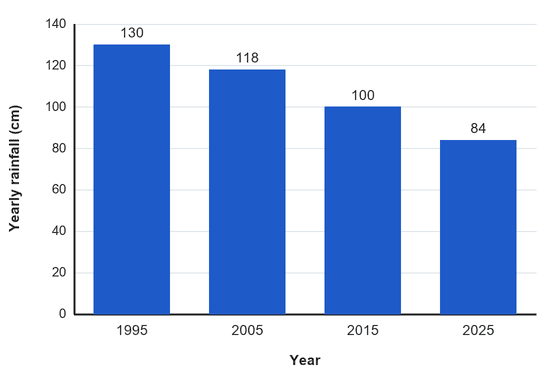
(a) By how many centimetres did the yearly rainfall fall from 1995 to 2025? (1 mark)
(b) What link do you see between the number of trees and the rainfall? (1 mark)
(c) If this goes on, what may happen to the district? (1 mark)
- 343 marks
Question 34
Cognitive domain: Evaluation
A town wants to widen a road and has to cut down 30 old trees. The council says, "Do not worry. We will plant 30 small saplings in the park, so nothing is lost." Rina is not sure that this is fair.
(a) Name two benefits that the old trees give to the people and animals of the area. (1 mark)
(b) Why is planting 30 saplings not the same as keeping the 30 old trees? (1 mark)
(c) Suggest one way to widen the road and still save most of the trees. (1 mark)
- 353 marks
Question 35
Cognitive domain: Analysis
In a village, people began to catch frogs in the rice fields to sell them. The table shows what the farmers saw in one field over four years. (Hypothetical data.)
Year Frogs counted Insects on the rice plants 1 200 Few 2 120 Some 3 50 Many 4 20 Very many (a) By how many did the frogs decrease from Year 1 to Year 4? (1 mark)
(b) Why did the insects increase as the frogs decreased? (1 mark)
(c) Snakes eat frogs. What will happen to the snakes in this field? Give a reason. (1 mark)
- 363 marks
Question 36
Cognitive domain: Analysis
Ria wants to find out whether the tiny living things in soil really break down dead leaves. Her teacher helps her to set up two glass jars. Each jar has the same amount of damp garden soil and the same amount of dry leaves. The teacher bakes the soil for the second jar, which kills the bacteria and fungi in it. Both jars are kept in the same place for six weeks.
(a) What is the one thing that is different in the two jars? (1 mark)
(b) Name two things that must be kept the same in both jars. (1 mark)
(c) What do you expect to see in each jar after six weeks, and why? (1 mark)
- 375 marks
Question 37
Cognitive domain: Analysis
Ananya's school planted a butterfly garden. She counted, every second week, the number of plants in bloom, the number of butterflies seen each day and the number of seed pods formed. (Hypothetical data.) The graph shows her counts.
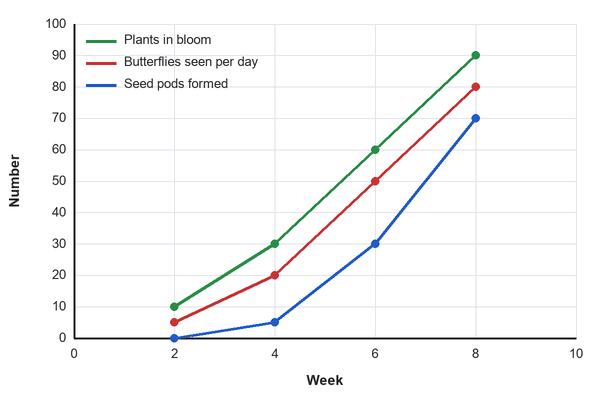
(a) In which week were 50 butterflies seen each day, and how many plants were in bloom in that week? (1 mark)
(b) Why did the number of butterflies increase as more plants came into bloom? (2 marks)
(c) Why did the seed pods increase later than the butterflies, and how does this show interdependence? (2 marks)
- 384 marks
Question 38
Cognitive domain: Evaluation
A village panchayat has two plans for new farmland. There is a patch of forest of 60 hectares and a patch of empty, unused land of 15 hectares. (Hypothetical data.)
Plan P Plan Q What will be done Cut down the whole forest and use the empty land as well Keep the forest and use only the empty land New farmland (hectares) 75 15 Forest left (hectares) 0 60 (a) How much more farmland does Plan P give than Plan Q? (1 mark)
(b) Name one harm that Plan P will do to the animals and one harm that it will do to the soil or the air. (1 mark)
(c) Which plan would you choose? Give two reasons. (2 marks)
- 394 marks
Question 39
Cognitive domain: Analysis
A forest officer studies a grassland park through the year. The table shows what she noted. (Hypothetical data.)
Month Rain (mm) Height of the grass (cm) Spotted deer seen July 200 60 120 September 150 45 110 November 40 15 70 January 5 3 30 (a) Name two abiotic components and two biotic components of this grassland. (1 mark)
(b) By how many centimetres did the grass become shorter from July to January? (1 mark)
(c) Explain how the fall in rain led to fewer deer in the grassland. (2 marks)
- 404 marks
Question 40
Cognitive domain: Analysis
A forest office keeps a record of the causes of the forest fires that happened in its area in one year. (Hypothetical data.)
Cause of the fire Number of fires A burning matchstick or cigarette thrown on the ground 24 A cooking fire left burning by visitors 18 Lightning 6 Cause not known 12 (a) How many of the fires were started by careless human acts shown in the table? (1 mark)
(b) What fraction of all the fires is this? Write the fraction in its simplest form. (1 mark)
(c) A student says, "Most forest fires are caused by nature." Does the table support this? Give a reason and suggest one way to reduce forest fires. (2 marks)