
Opening your dashboard
Class 5 Science Chapter 6: Solids, Liquids, Gases Solutions
35 textbook questions with step-by-step answers, free to read, for ICSE 2026-27.
Get talked through Ch 6, not just shown the answer
Reading a finished solution is not the same as being able to do it. The AI tutor takes one question at a time and works it with you, in your own words, until you can.
- Ask it out loud, in your own words
- It gives you the next step, not the answer
- Stuck on part (ii)? Start there
35 questions with solutions
1–5 marks · Mixed difficulty
- 11 mark
Question 1
Name the following.
A matter found in all three states ________
Solve with AIWritten solution
Solution:
Concept: Matter can be a solid, a liquid or a gas. Heating or cooling can change some kinds of matter from one state to another.
Step 1 — What is asked.
We need the name of one kind of matter that we commonly see as a solid, as a liquid and as a gas.
Step 2 — Recall the example.
Water is a liquid. When it is cooled enough, it freezes into ice, which is a solid. When it is heated, it changes into water vapour (steam), which is a gas.
Therefore, the answer is water.
- 21 mark
Question 2
Name the following.
Water in gaseous form ________
Solve with AIWritten solution
Solution:
Concept: Water exists in three states: ice (solid), water (liquid) and water vapour (gas).
Step 1 — What is asked.
We need the name of water when it is a gas.
Step 2 — Recall the term.
When water is heated, it changes into a gas called water vapour. The water vapour that comes out of boiling water is also called steam.
Therefore, the answer is water vapour (steam).
- 31 mark
Question 3
Name the following.
Gas in air which is essential for living and burning ________
Solve with AIWritten solution
Solution:
Concept: Air is a mixture of gases. About 78 % of it is nitrogen and about 21 % is oxygen. Living things need oxygen to breathe, and things need oxygen to burn.
Step 1 — What is asked.
We need the gas in air that we need for staying alive and that is also needed for burning.
Step 2 — Recall the gas.
We breathe in oxygen to stay alive. A fire also uses up oxygen from the air as it burns. Nitrogen, the gas present in the largest amount, does not support burning.
Therefore, the answer is oxygen.
- 41 mark
Question 4
Name the following.
Wind that blows from sea to land ________
Solve with AIWritten solution
Solution:
Concept: During the day, the land becomes warmer than the sea. The warm air over the land rises, and cooler air from over the sea moves in to take its place. This wind is the sea breeze.
Step 1 — What is asked.
We need the name of the wind that blows from the sea towards the land.
Step 2 — Recall the term.
A wind is named after the place it comes from. A wind coming from the sea is a sea breeze. It blows during the day.
Therefore, the answer is sea breeze.
- 51 mark
Question 5
Name the following.
Wind that blows from land to sea ________
Solve with AIWritten solution
Solution:
Concept: At night, the land cools down faster than the sea. The warmer air over the sea rises, and cooler air from over the land moves out to take its place. This wind is the land breeze.
Step 1 — What is asked.
We need the name of the wind that blows from the land towards the sea.
Step 2 — Recall the term.
A wind coming from the land is a land breeze. It blows at night.
Therefore, the answer is land breeze.
- 61 mark
Question 6
Choose the correct option.
The state of matter depends upon which of the following?
Solve with AIAnswer
(A) Temperature of molecules
- Correct
(B) Arrangement of molecules
(C) Amount of the matter
(D) Weight of the matter
Answer: (B) Arrangement of molecules
Concept: Matter is made of very tiny particles called molecules. Whether a piece of matter is a solid, a liquid or a gas depends on how its molecules are arranged: very close together, a little apart, or far apart.
Step 1 — What is asked.
We must find what decides whether matter is a solid, a liquid or a gas.
Step 2 — Recall the three arrangements.
In a solid the molecules are packed very closely in a regular way. In a liquid they are loosely packed and can move around each other. In a gas they are far apart and move quickly in all directions.
Step 3 — Choose the answer.
So the state of matter depends on the arrangement of its molecules.
Step 4 — Check the other options.
Each of the other options is wrong for the reason given below.
- (A): Heating or cooling can change the state of a substance, but it does so by changing how its molecules are arranged and how they move. Temperature is a property of the whole substance, so the arrangement of the molecules is the better answer.
- (C): A spoonful of water and a bucketful of water are both liquid. The amount does not change the state.
- (D): A heavy iron nail and a light pin are both solids. The weight does not decide the state.
Therefore, the state of matter depends upon the arrangement of its molecules: option (B).
- 71 mark
Question 7
Choose the correct option.
Which of the following will be solute in lemonade?
Solve with AIAnswer
(A) Lemon juice
(B) Sugar
(C) Water
- Correct
(D) Both (A) and (B)
Answer: (D) Both (A) and (B)
Concept: A solution is formed when a solute dissolves in a solvent. The solvent is the substance that does the dissolving (usually the larger amount). The solutes are the substances that get dissolved in it.
Step 1 — What is asked.
We must find the solute or solutes in lemonade.
Step 2 — Find the solvent.
Lemonade is made by mixing lemon juice and sugar in water. Water dissolves the other two, so water is the solvent.
Step 3 — Find the solutes.
Lemon juice and sugar both get dissolved in the water. So both of them are solutes.
Step 4 — Check the other options.
Each of the other options is wrong for the reason given below.
- (A): Lemon juice is a solute, but sugar is also dissolved in lemonade. This choice leaves the sugar out.
- (B): Sugar is a solute, but lemon juice is also dissolved in lemonade. This choice leaves the lemon juice out.
- (C): Water is the solvent in lemonade. It dissolves the lemon juice and the sugar.
Therefore, lemon juice and sugar are both solutes in lemonade: option (D).
- 81 mark
Question 8
Choose the correct option.
This process shows change of water vapour to liquid water.
Solve with AIAnswer
- Correct
(A) Condensation
(B) Evaporation
(C) Filtration
(D) Decantation
Answer: (A) Condensation
Concept: When water vapour (a gas) is cooled, it changes into liquid water. This change is called condensation.
Step 1 — What is asked.
We need the name of the change from water vapour (gas) to water (liquid).
Step 2 — Recall the process.
Drops of water form on the outside of a glass of ice-cold water. Water vapour in the air touches the cold glass, cools down and turns into liquid water. This is condensation.
Step 3 — Check the other options.
Each of the other options is wrong for the reason given below.
- (B): Evaporation is the opposite change. In evaporation, liquid water changes into water vapour.
- (C): Filtration separates an insoluble solid, such as sand, from a liquid by passing the mixture through a filter. It does not change a gas into a liquid.
- (D): Decantation means pouring off the clear liquid after the solid has settled. It does not change a gas into a liquid.
Therefore, the change of water vapour into liquid water is condensation: option (A).
- 91 mark
Question 9
Choose the correct option.
Which of the following is not a property of air?
Solve with AIAnswer
(A) It has weight
(B) It exerts pressure
(C) It occupies space
- Correct
(D) It has a fixed volume
Answer: (D) It has a fixed volume
Concept: Air is a mixture of gases. Like every gas, air has weight, takes up space and exerts pressure. But a gas spreads out to fill all the space available to it, so it has no fixed volume.
Step 1 — What is asked.
We must find the one option that is NOT true for air.
Step 2 — Check each property.
Air has weight, it exerts pressure and it occupies space. These are the main properties of air.
Step 3 — Find the odd one.
Air does not have a fixed volume. A little air let into an empty room spreads out to fill the whole room.
Step 4 — Check the other options.
Each of the other options is wrong for the reason given below.
- (A): An inflated balloon is heavier than the same balloon when it is empty. So air does have weight.
- (B): Air pushes on everything around it in all directions. A balloon blown up inside a bowl can even lift the bowl. So air does exert pressure.
- (C): When we blow air into a balloon or a tyre, it swells up. So air does take up space.
Therefore, having a fixed volume is not a property of air: option (D).
- 101 mark
Question 10
Choose the correct option.
Moving air which blows gently is called ________.
Solve with AIAnswer
(A) monsoon
(B) storm
- Correct
(C) breeze
(D) all of these
Answer: (C) breeze
Concept: Moving air is called wind. A gentle wind is called a breeze, and a very strong wind is called a storm.
Step 1 — What is asked.
We need the name for air that moves gently.
Step 2 — Recall the terms.
A light, gentle wind is a breeze. We feel a cool breeze near the sea on a sunny afternoon.
Step 3 — Check the other options.
Each of the other options is wrong for the reason given below.
- (A): A monsoon is a seasonal wind that blows from the sea over the land in summer and brings the rainy season. The word does not mean a gentle wind.
- (B): A storm is a very strong wind. It is the opposite of a gentle wind.
- (D): Only a breeze is a gentle wind. A storm is strong, and a monsoon is a seasonal wind, so all three cannot be right.
Therefore, moving air which blows gently is called a breeze: option (C).
- 111 mark
Question 11
Choose the correct option.
The monsoon in India starts from ________.
Solve with AIAnswer
(A) west
(B) north
(C) east
- Correct
(D) south
Answer: (D) south
Concept: In summer the land of India becomes very hot, and the hot air above it rises. Moist winds from the Arabian Sea, the Indian Ocean and the Bay of Bengal then rush towards the land. These are the monsoon winds, and they reach India first from the south.
Step 1 — What is asked.
We need the direction from which the monsoon first comes into India.
Step 2 — Look at the seas around India.
The southern part of India has the Arabian Sea on the west, the Bay of Bengal on the east and the Indian Ocean to the south.
Step 3 — Follow the monsoon winds.
The monsoon winds blow in from these seas towards the hot land, starting from the south. The monsoon usually reaches Kerala, at the southern tip, around the beginning of June, and then moves northwards.
Step 4 — Check the other options.
Each of the other options is wrong for the reason given below.
- (A): The monsoon winds blow in from the south-west over the Arabian Sea, but they first reach the southern tip of India, not the western edge of the country.
- (B): The north of India has the Himalayas and no sea. The monsoon reaches the north last, not first.
- (C): Most of eastern India gets its monsoon rain later, after the monsoon has started in the south.
Therefore, the monsoon in India starts from the south: option (D).
- 121 mark
Question 12
Fill in the blanks.
Word box: distillation · matter · storm · molecule · crystal
Anything that has mass and occupies space is called ________.
Solve with AIWritten solution
Solution:
Concept: Matter is anything that has mass and occupies (takes up) space. Air, water, books and our own bodies are all matter.
Step 1 — What is asked.
We need the word for anything that has mass and takes up space.
Step 2 — Pick the word from the box.
This is the definition of matter.
Therefore, the answer is: Anything that has mass and occupies space is called matter.
- 131 mark
Question 13
Fill in the blanks.
Word box: distillation · matter · storm · molecule · crystal
Matter is made of tiny particles named ________.
Solve with AIWritten solution
Solution:
Concept: All matter is made of very tiny particles called molecules. They are far too small to be seen even with a magnifying glass.
Step 1 — What is asked.
We need the name of the tiny particles that make up matter.
Step 2 — Pick the word from the box.
The word in the box is 'molecule'. Matter is made of many of them, so we write it as 'molecules'.
Therefore, the answer is: Matter is made of tiny particles named molecules.
- 141 mark
Question 14
Fill in the blanks.
Word box: distillation · matter · storm · molecule · crystal
Salt and sugar grains are found in ________ form.
Solve with AIWritten solution
Solution:
Concept: Pieces of some solids have a regular geometrical shape, with flat faces and straight edges. Such pieces are called crystals.
Step 1 — What is asked.
We need the form in which salt and sugar grains are found.
Step 2 — Pick the word from the box.
Under a magnifying glass, sugar grains and salt grains look like tiny blocks with flat faces. They are crystals.
Therefore, the answer is: Salt and sugar grains are found in crystal form.
- 151 mark
Question 15
Fill in the blanks.
Word box: distillation · matter · storm · molecule · crystal
Liquids can be separated from solid-liquid mixture through ________.
Solve with AIWritten solution
Solution:
Concept: Distillation uses two processes one after the other: evaporation (the liquid is heated and changes into vapour) and condensation (the vapour is cooled and changes back into liquid).
Step 1 — What is asked.
We need the method that gets the liquid back from a mixture of a solid dissolved in a liquid.
Step 2 — Pick the word from the box.
In distillation, salt water is heated so that the water changes into steam. The steam is then cooled so that it turns back into pure water, which is collected. The salt is left behind.
Therefore, the answer is: Liquids can be separated from solid-liquid mixture through distillation.
- 161 mark
Question 16
Fill in the blanks.
Word box: distillation · matter · storm · molecule · crystal
Strong wind is called ________.
Solve with AIWritten solution
Solution:
Concept: Moving air is called wind. A gentle wind is a breeze, and a very strong wind is a storm.
Step 1 — What is asked.
We need the word for a strong wind.
Step 2 — Pick the word from the box.
A very strong wind that can break branches and blow things away is a storm.
Therefore, the answer is: Strong wind is called storm.
- 171 mark
Question 17
Write T for True statements or F for False statements.
Evaporation is used to separate soluble solids from liquids.
Solve with AIWritten solution
Solution:
Concept: A soluble solid, such as salt, dissolves in water and cannot be filtered out. When the solution is heated, the water evaporates and the solid is left behind.
Step 1 — Read the statement.
It says that evaporation separates a dissolved (soluble) solid from a liquid.
Step 2 — Check it.
When salt water is heated in a dish, the water changes into vapour and goes into the air. The salt is left behind in the dish. So the statement is correct.
Therefore, the statement is True (T).
- 181 mark
Question 18
Write T for True statements or F for False statements.
Air exerts pressure only in downward direction.
Solve with AIWritten solution
Solution:
Concept: Air presses on everything around it from all directions: from above, from below and from the sides.
Step 1 — Read the statement.
It says that air pushes only downwards.
Step 2 — Check it.
Turn a glass full of water upside down with a card held on its rim, and then let go of the card. The card and the water do not fall, because air pushes up on the card from below. So air pushes upwards too, and the statement is wrong.
Step 3 — Correct it.
The correct statement is: Air exerts pressure in all directions.
Therefore, the statement is False (F).
- 191 mark
Question 19
Write T for True statements or F for False statements.
Land breeze blows during day time.
Solve with AIWritten solution
Solution:
Concept: The land breeze blows from the land to the sea at night, when the land is cooler than the sea. During the day the sea breeze blows.
Step 1 — Read the statement.
It says that the land breeze blows in the daytime.
Step 2 — Check it.
In the daytime the land is warmer than the sea, so the wind blows from the sea to the land. That is the sea breeze. The land breeze blows at night.
Step 3 — Correct it.
The correct statement is: Land breeze blows during night time.
Therefore, the statement is False (F).
- 201 mark
Question 20
Write T for True statements or F for False statements.
Monsoon rains come in winter season.
Solve with AIWritten solution
Solution:
Concept: The monsoon winds blow from the seas over India when the land is very hot. They bring the rainy season, which comes after the hot summer, from about June to September.
Step 1 — Read the statement.
It says that the monsoon rains come in winter.
Step 2 — Check it.
The monsoon winds blow in from the sea when the land is much hotter than the sea. That happens in summer, not in winter. So most of India gets its monsoon rain from about June to September.
Step 3 — Correct it.
The correct statement is: Monsoon rains come in the rainy season, after the hot summer.
Note: From about October to December, winds blowing from the north-east bring rain to the coast of Tamil Nadu. This is called the north-east monsoon. It comes after the main rainy season and before the coldest months.
Therefore, the statement is False (F).
- 211 mark
Question 21
Write T for True statements or F for False statements.
Ventilation allows circulation of fresh air.
Solve with AIWritten solution
Solution:
Concept: Ventilation is the movement of fresh air into a closed space, such as a room, through openings like windows, ventilators and exhaust fans.
Step 1 — Read the statement.
It says that ventilation lets fresh air move in and around.
Step 2 — Check it.
Ventilators and windows let stale air, which has more carbon dioxide, go out, and fresh air come in. So the statement is correct.
Therefore, the statement is True (T).
- 225 marks
Question 22
Match the columns.
Column A Column B 1. Sedimentation a. Circulation of air 2. Evaporation b. Change of gas into liquid 3. Distillation c. Insoluble substances separation 4. Ventilation d. Combination of two processes 5. Condensation e. Soluble substances separation Solve with AIWritten solution
Solution:
Concept: Each term in column A is linked to one fact about it in column B. Use each item of column B only once.
Step 1 — Match 1 (Sedimentation).
In sedimentation, an insoluble solid such as sand settles at the bottom of the water. It helps to separate insoluble substances. So 1 matches c.
Step 2 — Match 2 (Evaporation).
Evaporation removes the water from a solution and leaves the dissolved solid behind. It separates soluble substances. So 2 matches e.
Step 3 — Match 3 (Distillation).
Distillation uses two processes, evaporation and then condensation. So 3 matches d.
Step 4 — Match 4 (Ventilation).
Ventilation lets fresh air move into a room and stale air move out. So 4 matches a.
Step 5 — Match 5 (Condensation).
Condensation is the change of a gas, such as water vapour, into a liquid. So 5 matches b.
Step 6 — Write the matched pairs.
The table below shows each term with its match.
Column A Column B 1. Sedimentation c. Insoluble substances separation 2. Evaporation e. Soluble substances separation 3. Distillation d. Combination of two processes 4. Ventilation a. Circulation of air 5. Condensation b. Change of gas into liquid Therefore, 1 matches c, 2 matches e, 3 matches d, 4 matches a and 5 matches b.
- 232 marks
Question 23
What are the three states of matter?
Solve with AIWritten solution
Solution:
Concept: Matter is anything that has mass and occupies space. It is found in three main states.
Step 1 — Name the states.
The three states of matter are solid, liquid and gas.
Step 2 — Give an example of each.
A stone and a pencil are solids. Water and milk are liquids. Air is a mixture of gases.
Therefore, the three states of matter are solid, liquid and gas.
- 242 marks
Question 24
Why are solid materials hard?
Solve with AIWritten solution
Solution:
Concept: Matter is made of tiny particles called molecules. How tightly they are packed decides how the matter behaves.
Step 1 — Look at the molecules in a solid.
In a solid, the molecules are packed very closely together in a regular way. They hold on to one another strongly.
Step 2 — Explain the hardness.
Because they are so tightly packed, the molecules get no space to move around. They can only shake a little in their places. So a solid keeps its shape and does not give way easily when we press it. That is why solid materials are hard.
Note: Not every solid is hard. A sponge, cotton wool and a rubber ball are soft solids. They are still solids because they keep their own shape and do not flow.
Therefore, solid materials are hard because their molecules are very tightly packed and cannot move around.
- 252 marks
Question 25
How are the molecules in solids and liquids arranged differently?
Solve with AIWritten solution
Solution:
Concept: Whether matter is a solid or a liquid depends on how its molecules are arranged.
Step 1 — Describe a solid.
In a solid, the molecules are closely packed and arranged in a regular way. They cannot move from their places.
Step 2 — Describe a liquid.
In a liquid, the molecules are loosely packed and arranged in a random way. They are held close together, but they can move around each other. That is why a liquid can flow.
Watch out: Water is a special case. The molecules in ice are arranged in an open pattern, so ice takes up a little more space (about 9 % more) than the water it was made from. That is why ice floats on water.
Therefore, the molecules of a solid are closely packed in a regular way, while the molecules of a liquid are loosely packed in a random way and can move around each other.
- 262 marks
Question 26
In what condition state of matter may change?
Solve with AIWritten solution
Solution:
Concept: Matter may change from one state to another when it is heated or cooled.
Step 1 — Say what heating does.
Heating can change a solid into a liquid, for example ice melts into water. More heating can change a liquid into a gas, for example water changes into water vapour.
Step 2 — Say what cooling does.
Cooling can change a gas into a liquid, for example water vapour condenses into water drops. More cooling can change a liquid into a solid, for example water freezes into ice.
Therefore, the state of matter may change when it is heated or cooled.
- 272 marks
Question 27
Give three examples of liquid-liquid solution.
Solve with AIWritten solution
Solution:
Concept: A liquid-liquid solution is formed when one liquid dissolves evenly in another liquid.
Step 1 — Give the first example.
Lemon juice mixes evenly with water, so lemon juice in water is a liquid-liquid solution.
Step 2 — Give the second example.
Honey dissolves in warm milk when stirred, so honey in milk is a liquid-liquid solution.
Step 3 — Give the third example.
Vinegar mixes evenly with water, so vinegar in water is a liquid-liquid solution.
Note: Other correct examples are glycerine in water and rose water mixed in water. Oil and water do not form a solution, because oil does not dissolve in water.
Therefore, three examples are lemon juice in water, honey in milk and vinegar in water.
- 282 marks
Question 28
How is filtration different from evaporation?
Solve with AIWritten solution
Solution:
Concept: Both are methods of separating a solid from a liquid. Which one we use depends on whether the solid dissolves in the liquid.
Step 1 — Explain filtration.
Filtration separates an insoluble solid, such as sand or tea leaves, from a liquid. The mixture is poured through a filter (filter paper or a strainer). The solid stays on the filter and the clear liquid passes through.
Step 2 — Explain evaporation.
Evaporation separates a soluble solid, such as salt, from a liquid. The solution is heated until the liquid changes into vapour and goes away. The solid is left behind.
Step 3 — State the difference.
In filtration we keep both the solid and the liquid. In evaporation we get the solid back, but the liquid is lost into the air.
Therefore, filtration separates insoluble solids by passing the mixture through a filter, while evaporation separates soluble solids by heating away the liquid.
- 293 marks
Question 29
Mention any two properties for each of these – Solids, liquids, and gases.
Solve with AIWritten solution
Solution:
Concept: Solids, liquids and gases behave differently because their molecules are arranged differently: closely packed in solids, loosely packed in liquids, and far apart in gases.
Step 1 — Give two properties of solids.
Solids have a fixed shape and a fixed size (volume). Solids cannot flow.
Step 2 — Give two properties of liquids.
Liquids have no fixed shape; they take the shape of the container they are poured into. But liquids have a fixed volume, and they flow from a higher level to a lower level.
Step 3 — Give two properties of gases.
Gases have no fixed shape and no fixed volume; they spread out to fill all the space available to them. Gases are often invisible.
Step 4 — Show them in a table.
The table below puts the properties side by side.
Property Solids Liquids Gases Shape Fixed Not fixed Not fixed Volume Fixed Fixed Not fixed Can it flow? No Yes Yes Therefore, solids have a fixed shape and cannot flow; liquids have a fixed volume but take the shape of their container; and gases have no fixed shape or volume and spread out to fill all the space.
- 304 marks
Question 30
How does water change its state in three forms? Explain with the help of a drawing.
Solve with AIWritten solution
Solution:
Concept: Water exists in three states: ice (solid), water (liquid) and water vapour (gas). Heating changes it one way, and cooling changes it back.
Step 1 — Ice changes into water.
When ice is heated, for example when an ice cube is kept out of the freezer, it changes into water. This is called melting. Ice melts at 0 °C.
Step 2 — Water changes into water vapour.
When water is heated, it changes into water vapour. This is called evaporation. Water boils at 100 °C, but it also evaporates slowly at lower temperatures, which is how wet clothes dry.
Step 3 — Water vapour changes back into water.
When water vapour is cooled, it changes back into water drops. This is called condensation. Drops on the lid of a pan of boiling water are formed this way.
Step 4 — Water changes back into ice.
When water is cooled to 0 °C in a freezer, it changes into ice. This is called freezing.
Step 5 — Draw the changes.
The drawing below shows the three states of water and the four changes between them. Arrows to the right show heating, and arrows to the left show cooling.

Therefore, ice melts into water and water evaporates into water vapour on heating, while water vapour condenses into water and water freezes into ice on cooling.
- 313 marks
Question 31
What causes sea breeze?
Solve with AIWritten solution
Solution:
Concept: A sea breeze is the cool wind that blows from the sea towards the land during the day. It is caused because land heats up much faster than water.
Step 1 — The land heats up quickly.
During the day, the Sun heats the land much faster than the water of the sea. So the land becomes warmer than the sea.
Step 2 — The warm air over the land rises.
The warm land heats the air above it. Warm air is lighter than the same amount of cool air, so it rises upwards.
Step 3 — Cool air moves in from the sea.
The air over the sea stays cooler, because the water heats up slowly. This cooler, heavier air moves towards the land to take the place of the rising warm air.
Step 4 — The breeze blows.
This movement of cool air from the sea towards the land is the sea breeze. That is why places near the sea feel cool on sunny afternoons.
Therefore, the sea breeze is caused because in the daytime the land heats up faster than the sea, so the warm air over the land rises and cooler air from the sea moves in to take its place.
- 325 marks
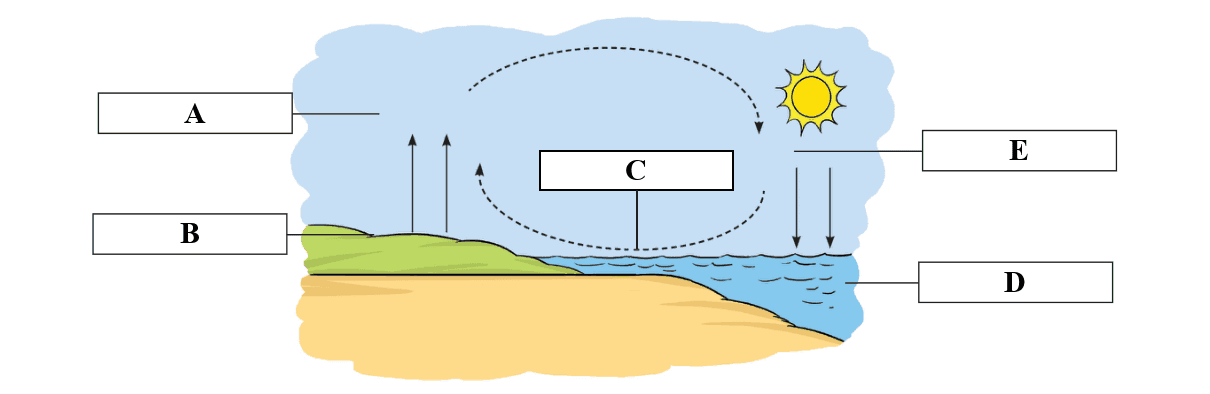
Question 32
Label the picture given below. What does it show?
 Solve with AI
Written solution
Solution:
Concept: The Sun in the picture tells us it is daytime. In the day, the land is warmer than the sea, so warm air rises over the land and cool air sinks over the sea. The cool air then moves across from the sea to the land.
Step 1 — Read the arrows.
Over the land, the straight arrows point upwards, so air is rising there. Over the sea, the straight arrows point downwards, so air is sinking there. Near the ground, the dashed arrow runs from the sea towards the land.
Step 2 — Name the boxes on the left.
A points to the air rising over the land, so A is rising warm air. B points to the ground on the left, so B is land.
Step 3 — Name the boxes on the right.
E points to the air sinking over the sea, so E is descending cool air. D points to the water, so D is the sea (ocean).
Step 4 — Name the box in the middle.
C points down to the lower dashed arrow, which is the air moving from the sea towards the land near the ground, so C is the sea breeze.
Step 5 — Say what the picture shows.
Air moves from the sea to the land in the daytime, so the picture shows a sea breeze. The labelled picture is shown below.
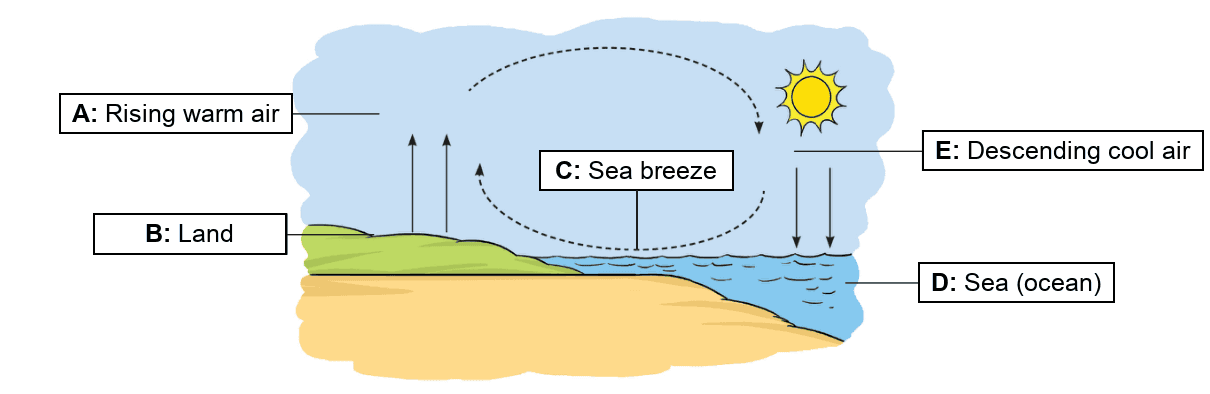
Therefore, A is rising warm air, B is land, C is the sea breeze, D is the sea (ocean) and E is descending cool air, and the picture shows a sea breeze.
- 333 marks
Question 33
Rehan has mixed sand in the salt-water solution. How can he separate both salt and sand from this mixture?
Solve with AIWritten solution
Solution:
Concept: Sand does not dissolve in water, so it can be filtered out. Salt does dissolve in water, so it passes through a filter and must be got back by evaporation.
Step 1 — Remove the sand.
Rehan should pour the mixture through a filter paper fitted in a funnel. The sand stays on the filter paper, and the salt water (the filtrate) passes through into a beaker. He can also first let the sand settle and pour off the liquid (sedimentation and decantation), and then filter it.
Step 2 — Dry the sand.
He should spread the sand from the filter paper in the sun to dry. Now he has the sand back.
Step 3 — Get the salt back.
He should pour the clear salt water into a dish and heat it (or keep it in the sun). The water evaporates, and the salt is left behind in the dish.
Note: If Rehan also wants to keep the water, he can use distillation in the last step: the water is evaporated and then condensed and collected, and the salt is left behind.
Therefore, Rehan can separate the sand by filtration and then get the salt back by evaporating the water from the filtrate.
- 342 marks
Question 34
Can monsoon come in winter season?
Solve with AIWritten solution
Solution:
Concept: The monsoon winds blow from the sea towards the land when the land is much hotter than the sea. These moist winds bring the rainy season to India.
Step 1 — Think about winter.
In winter, the land is cool. It is not hotter than the sea, so the moist winds from the sea do not rush in over the land.
Step 2 — Say what happens instead.
In winter, the winds blow mostly from the cool land towards the sea. These winds are dry, so most of India gets little rain in winter.
Note: From about October to December, winds from the north-east pick up water vapour over the Bay of Bengal and bring rain to the coast of Tamil Nadu. This is called the north-east monsoon. It is much smaller than the main monsoon and comes before the coldest months.
Therefore, no, the rain-bringing monsoon does not come in the winter season; it comes after the hot summer, when the land is much hotter than the sea.
- 352 marks
Question 35
Which state will receive monsoon sooner – Kerala or Uttar Pradesh?
Solve with AIWritten solution
Solution:
Concept: The monsoon winds come in from the seas in the south and then move northwards across India.
Step 1 — Find where each state is.
Kerala is at the southern tip of India, beside the Arabian Sea. Uttar Pradesh is far to the north, in the plains of northern India, with no sea near it.
Step 2 — Follow the monsoon.
The monsoon reaches Kerala first, usually around the beginning of June. It takes a few more weeks to move north, and it usually reaches Uttar Pradesh in the second half of June.
Therefore, Kerala will receive the monsoon sooner than Uttar Pradesh.
What Class 5 Science Ch 6 covers
The sections of the chapter, in the order the book takes them. Every question above comes from one of these.
- 01What is Matter?
- 02States of Matter and their Properties
- 03Changing States of Matter
- 04Solutions
- 05Methods of Separation
- 06Air – Composition and Properties
- 07Sea and Land Breeze
More ways to study this chapter
The same chapter asked three other ways. Practise it, revise it, and see what the board has set on Ch 6 before.
Class 5 Science Ch 6 questions students ask
How many questions are there in Class 5 Science Ch 6?
35 questions. Every one is solved step by step on this page.
Are these Class 5 Science solutions free?
Yes. Every question and its full working is free to read, with no account needed.
Can I download the Class 5 Science Ch 6 solutions as a PDF?
There is no PDF to download. Every solution is on this page instead, which means it is searchable, always the current syllabus, and readable on a phone. Use your browser's print option if you want it on paper.