
Opening your dashboard
Class 5 Science Chapter 6 Solids, Liquids, Gases: Competency-Based Questions (CBQ)
40 questions on Chapter 6, each worked through on its own page with the AI tutor. Class 5 Science, ICSE 2026-27.
40 questions
1–5 marks · Mixed difficulty
- 11 mark
Question 1
Cognitive domain: Application
Ishaan squeezes a kitchen sponge in his fist and it becomes small. When he opens his hand, the sponge goes back to its own shape. His sister says, "A sponge can be squeezed, so it cannot be a solid." Which statement is correct?
- 21 mark
Question 2
Cognitive domain: Analysis
On a hot day, Diya takes a bottle of water out of the fridge. After a few minutes, small drops of water appear on the outside of the bottle, even though the cap is tight. Where did these drops come from?
- 31 mark
Question 3
Cognitive domain: Analysis
Kabir drops some ice cubes into a glass of water. He sees that the ice cubes float.
Assertion (A): Ice floats on water.
Reason (R): Water expands when it freezes, so a piece of ice is lighter than the same amount (volume) of water.
- 41 mark
Question 4
Cognitive domain: Application
The science teacher gives four groups four mixtures and one filter paper each. She says, "Only one group will get its solid back by filtration." Which group has that mixture?
- 51 mark
Question 5
Cognitive domain: Application
Riya drinks mango juice through a straw. When she sucks, the juice rises up the straw into her mouth. What pushes the juice up the straw?
- 61 mark
Question 6
Cognitive domain: Analysis
On a hot afternoon at Chennai beach, a cool wind blows from the sea onto the shore.
Assertion (A): A sea breeze blows from the sea towards the land during the day.
Reason (R): In sunlight, the water of the sea heats up faster than the land.
- 72 marks
Question 7
Cognitive domain: Analysis
A class measured the temperature of the sand and of the sea water at a beach at two times of the same day. (Hypothetical data.)
Time Sand on the beach Sea water 2 p.m. 38 °C 30 °C 2 a.m. (night) 22 °C 27 °C (a) In which direction will the wind blow at 2 p.m.? Name this wind. (1 mark)
(b) In which direction will the wind blow at 2 a.m.? Name this wind. (1 mark)
- 83 marks
Question 8
Cognitive domain: Application
Along the coast of Gujarat, people let sea water into wide, shallow, flat fields called salt pans. After some weeks in the hot sun, a white layer of salt is left on the ground.
(a) Name the method of separation used in salt pans. (1 mark)
(b) Why are the salt pans made wide and shallow? (1 mark)
(c) Why is salt made this way in the hot, dry months and not in the rainy season? (1 mark)
- 92 marks
Question 9
Cognitive domain: Application
Grandmother washes two identical towels. She hangs one in the sunny, windy courtyard and the other inside a closed room. After two hours, the towel in the courtyard is dry, but the one in the room is still damp.
(a) Name the change of state that dries the towels. (1 mark)
(b) Give two reasons why the towel in the courtyard dried faster. (1 mark)
- 102 marks
Question 10
Cognitive domain: Analysis
At a fair, Neel watches a hot-air balloon. A burner below the opening of the big balloon heats the air inside it. Slowly the balloon, with its basket, rises into the sky.
(a) What happens to the air inside the balloon when it is heated? (1 mark)
(b) Use this idea to explain why the balloon rises. (1 mark)
- 112 marks
Question 11
Cognitive domain: Application
Climbers going to the top of Mount Everest carry cylinders of oxygen. Near the ground, they breathe easily without any cylinder.
(a) How is the air on a very high mountain different from the air near the ground? (1 mark)
(b) Why do the climbers need oxygen cylinders there? (1 mark)
- 123 marks
Question 12
Cognitive domain: Analysis
Read the information about the gases in dry air.
Gas Share of dry air (about) Nitrogen 78 % Oxygen 21 % Argon 0.93 % Carbon dioxide 0.04 % Other gases (neon, helium and others) very small (a) Which gas makes up the largest part of air? (1 mark)
(b) Nitrogen and oxygen together make up how much of the air? What share is left for all the other gases? (1 mark)
(c) Meena says, "Carbon dioxide is only 0.04 %, so it is not important." Do you agree? Give one reason. (1 mark)
- 133 marks
Question 13
Cognitive domain: Evaluation
Sara wants to find out whether heat makes ice melt faster. She takes two ice cubes from the same tray and puts each one on a steel plate. She keeps plate P in the sunshine and plate Q in the shade, and checks them every 5 minutes.
(a) Which ice cube will melt first? Give a reason. (1 mark)
(b) Name two things Sara kept the same so that her test is fair. (1 mark)
(c) What will she find on each plate when the ice has fully melted, and what is this change called? (1 mark)
- 144 marks
Question 14
Cognitive domain: Application
People on a small island have sea water all around them but very little drinking water. A teacher shows them a solar still: a black tray of sea water is covered with a sloping sheet of clear glass. The Sun warms the tray. Drops of water form on the inside of the cool glass, run down the slope and drip into a clean bottle at the lower edge.
(a) Name the two processes that take place in the solar still, in the right order. (2 marks)
(b) What is this method of separation called? (1 mark)
(c) Is the water in the bottle salty? What is left behind in the tray? (1 mark)
- 155 marks
Question 15
Cognitive domain: Evaluation & Creativity
Forty children sit in a classroom for a long test with the door and windows shut. After an hour, the room feels warm and stuffy and some children feel sleepy. The room has one small window, near the floor.
(a) Why has the air in the room become unhealthy? (1 mark)
(b) Where should a ventilator be fitted in this room? Give a reason. (2 marks)
(c) Suggest two other ways to keep fresh air moving through the classroom. (2 marks)
- 161 mark
Question 16
Cognitive domain: Analysis
The figure shows how the molecules of the same small amount of water are arranged when it is a solid, a liquid and a gas. The three boxes are labelled P, Q and R.
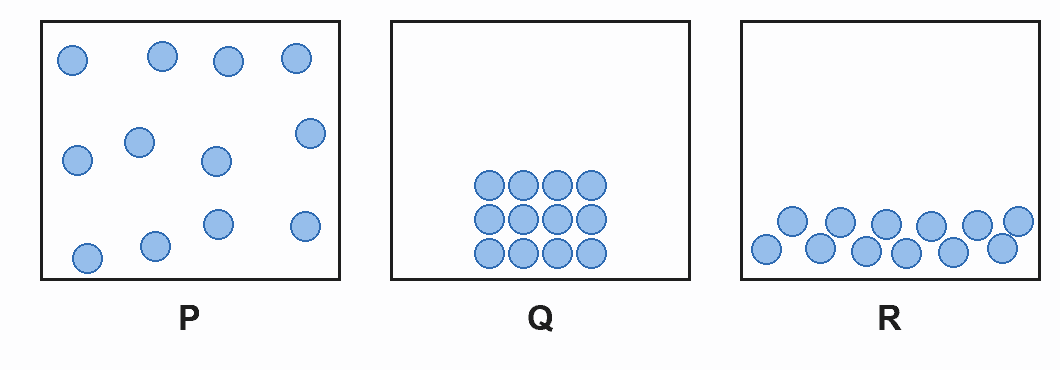
A piece of ice is heated until it has changed into water, and the water is then heated until it has changed into water vapour. In which order do the boxes show these three states?
- 171 mark
Question 17
Cognitive domain: Understanding
Seema pours sugar from a packet into a bowl, and the sugar flows out almost like water. "Sugar flows, so sugar is a liquid," she says. Her friend Imran looks at the sugar through a magnifying glass and says that she is wrong. Which observation proves that Imran is right?
- 181 mark
Question 18
Cognitive domain: Application
Meera takes three identical bowls with the same amount of sea water in each. She leaves bowl A as it is. She boils bowl B until only about half of the water is left and then lets it cool. She pours the water of bowl C once through a clean filter paper into another bowl. She then compares how salty the water in the three bowls is. Which result is correct?
- 191 mark
Question 19
Cognitive domain: Analysis
Sana opens a bottle of soda water and pours it into a glass. Tiny bubbles rise to the top. When the glass is left standing for many hours, the soda tastes flat.
Assertion (A): Soda water goes flat if it is left open for many hours.
Reason (R): Soda water is a solution of oxygen gas in water.
- 201 mark
Question 20
Cognitive domain: Analysis
Sunil buys a sealed packet of chips in a town on the plains. He takes it by bus to a hill station high in the mountains. There he sees that the packet looks more puffed up than it did in the town.
Assertion (A): A sealed packet of chips looks more puffed up high in the mountains than in the plains.
Reason (R): The air high in the mountains is thinner, so it presses less on the outside of the packet, while the gas shut inside the packet keeps pressing outwards.
- 211 mark
Question 21
Cognitive domain: Application
Riya fills two identical ice trays with water from the same jug. She puts tray 1 in the freezer of the refrigerator, where the temperature is about −18 °C. She puts tray 2 on a shelf in the main part of the refrigerator, where the temperature is about 4 °C. What will she find when she opens the refrigerator after four hours? (Hypothetical data.)
- 221 mark
Question 22
Cognitive domain: Application
Cooking gas (LPG) has no colour. Gas companies add a strong smell to it on purpose. How does this smell help a family?
- 231 mark
Question 23
Cognitive domain: Understanding
The water tank of a house is on the roof. When Ria opens the tap in the kitchen on the ground floor, water comes out and falls into her bucket without any pump. Which property of liquids makes this possible?
- 241 mark
Question 24
Cognitive domain: Application
On a beach in Goa, Kiran lights an incense stick at 11 p.m. and holds it still near the shore. The smoke drifts slowly towards the sea. Which wind is blowing, and why?
- 251 mark
Question 25
Cognitive domain: Evaluation
The table shows the approximate share of three gases in the air that a person breathes in and in the air that the person breathes out. (Approximate values.)
Gas Air breathed in Air breathed out Nitrogen 78 % 78 % Oxygen 21 % 16 % Carbon dioxide 0.04 % 4 % Which statement is supported by the table?
- 262 marks
Question 26
Cognitive domain: Analysis
In the kitchen at home, Tarun stirs two spoonfuls of sugar into a glass of drinking water until the sugar can no longer be seen. He tastes a drop from the top, a drop from the middle and a drop from the bottom with a clean spoon each time. All three drops taste equally sweet. Then he stirs two spoonfuls of chalk powder into another glass of water and leaves it undisturbed for half an hour.
(a) What does the equal sweetness show about how the sugar is spread in the water? (1 mark)
(b) What will Tarun see in the chalk glass after half an hour? Is it a solution? (1 mark)
- 272 marks
Question 27
Cognitive domain: Analysis
Ayaan writes this list in his notebook: a stone, the air inside a football, the shadow of a tree, the light from a torch, and the water vapour in a bathroom after a hot bath.
(a) Which two things in the list are not matter? Give a reason. (1 mark)
(b) Ayaan's friend says, "Air cannot be matter, because I cannot see it." Use the meaning of matter to show that the friend is wrong. (1 mark)
- 282 marks
Question 28
Cognitive domain: Analysis
When water boils in a kettle, Neha looks carefully at the spout. At the very mouth of the spout she sees nothing at all. A little higher up she sees a white cloud, which disappears again further up.
(a) What is coming out of the spout at its mouth, even though Neha cannot see it? Why is it not visible? (1 mark)
(b) Name the change of state that makes the white cloud appear above the spout. (1 mark)
- 292 marks
Question 29
Cognitive domain: Analysis
Sushma pours tea through a tea strainer, and all the tea leaves stay in the strainer. Later she pours some muddy water through the same tea strainer, but the water that comes through is still muddy.
(a) Why does the strainer hold back the tea leaves but not the mud? (1 mark)
(b) What should Sushma use instead of the strainer to remove most of the mud, and why will it work better? (1 mark)
- 302 marks
Question 30
Cognitive domain: Understanding
Arjun presses his finger hard on a block of wood. Then he gently dips the same finger into a bowl of water.
(a) Into which of the two can Arjun push his finger easily? (1 mark)
(b) Use the way the molecules are packed in each to explain this difference. (1 mark)
- 312 marks
Question 31
Cognitive domain: Application
After heavy rain, the water in a fast-flowing stream near Priya's village stays muddy for many days. A small pond beside it, in which the water is almost still, is muddy on the first day. After three days the pond water is much clearer, and a layer of mud lies at the bottom.
(a) Name the process by which the mud settles down in the pond. (1 mark)
(b) Why does this happen in the pond but not in the fast-flowing stream? (1 mark)
- 323 marks
Question 32
Cognitive domain: Analysis
A teacher gives three white powders, P, Q and R. Each pupil stirs one spoonful of a powder into a glass of water, pours the mixture through a filter paper and then lets the water that comes through dry on a plate in the Sun. The pupils record what they see. (Hypothetical data.)
Powder Mixture after stirring Left on the filter paper Plate after the water dried P Clear Nothing White solid left Q Cloudy White powder Nothing left R Cloudy Some white powder White solid left (a) Which powder is soluble in water and which is insoluble? (1 mark)
(b) What does powder R contain? (1 mark)
(c) How can the soluble part of R be got back from the mixture? (1 mark)
- 333 marks
Question 33
Cognitive domain: Understanding
A juice stall makes fizzy nimbu soda. For each glass, the stall owner stirs sugar and a pinch of salt into chilled water, adds lemon juice, and then tops the glass up with soda water from a bottle. The drink looks clear and has the same taste in every sip.
(a) Which substance is the solvent in this drink? Give a reason. (1 mark)
(b) Name the solutes in the drink, and for each one say which type of solution it forms with the water. (1 mark)
(c) Which one of the four types of solution (solid in liquid, liquid in liquid, gas in liquid, gas in gas) is not present in this drink? Give one everyday example of that missing type. (1 mark)
- 343 marks
Question 34
Cognitive domain: Creativity
Your class is making a chart to help younger children remember the sea breeze and the land breeze. Write a short rhyme of four lines or more for the chart. Your rhyme must tell (i) when each breeze blows, (ii) the direction in which each breeze blows, and (iii) one reason why the breezes blow. (3 marks)
- 353 marks
Question 35
Cognitive domain: Evaluation
Raman heats some water in an open pan on a gas stove. He measures its temperature every two minutes and draws the graph below. (Hypothetical data.)
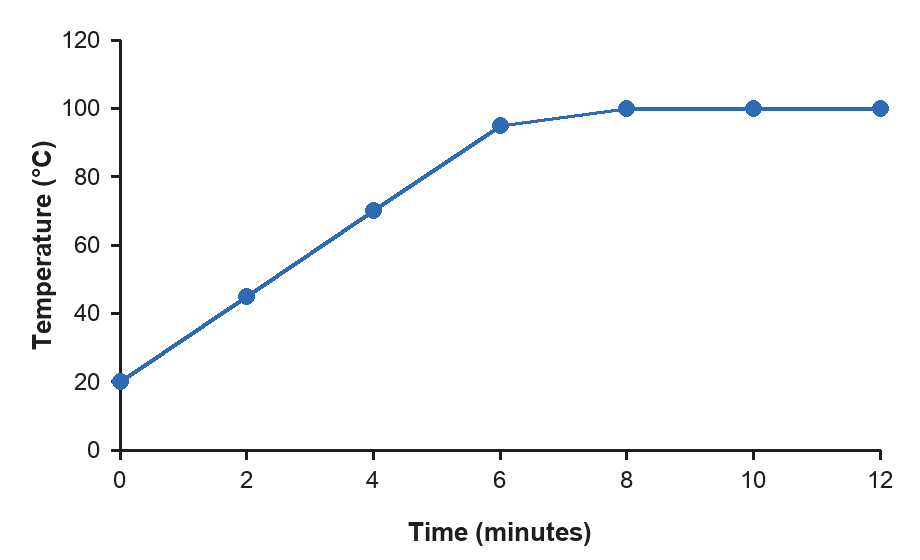
(a) What is the temperature of the water after 4 minutes? (1 mark)
(b) From 8 minutes onwards the temperature stays at 100 °C. What is happening to the water? (1 mark)
(c) Raman says, "If I keep heating for 4 more minutes, the water will reach 120 °C." Do you agree? Give a reason. (1 mark)
- 363 marks
Question 36
Cognitive domain: Application
In a science activity, the teacher hangs a paper spiral from a thread. The spiral is held well above a burning diya, at a safe distance. The spiral starts to turn slowly.
(a) What happens to the air just above the flame of the diya? (1 mark)
(b) Use this to explain why the spiral turns. (1 mark)
(c) The spiral is now hung at the same height beside the diya instead of above it. Will it turn as before? Give a reason. (1 mark)
- 374 marks
Question 37
Cognitive domain: Analysis
The science club finds three closed jars, X, Y and Z, each holding a different substance. The members open each jar and put its substance into an empty, larger transparent box. They record what they see. (Hypothetical data.)
Substance Keeps its own shape? Fills the whole box? X Yes No, it stays a lump Y No, it takes the shape of the bottom of the box No, it stays at the bottom Z No Yes (a) Name the state of matter of X, Y and Z. (1 mark)
(b) Which one has its molecules closely packed in a regular way? (1 mark)
(c) Explain why Z fills the whole box but Y does not. (2 marks)
- 384 marks
Question 38
Cognitive domain: Evaluation
Coconut oil is a clear liquid in most kitchens in Chennai. In a cold hill town, the same oil in a bottle often turns white and solid. The table shows what Meena saw in four places. (Hypothetical data.)
Place and time Room temperature State of the oil Chennai kitchen, afternoon 32 °C Liquid Shimla, early morning 12 °C Solid Delhi, January night 8 °C Solid Delhi, April afternoon 38 °C Liquid (a) In which places is the oil solid? (1 mark)
(b) Meena carries the bottle of solid oil from Shimla to a warm kitchen in Chennai. Name the change that takes place. Does it happen on heating or on cooling? (1 mark)
(c) Meena wants to pour out the solid oil. Her brother says, "Put the bottle on the gas flame." Meena says, "Keep the closed bottle in a bowl of warm water." Whose method is better? Give two reasons. (2 marks)
- 394 marks
Question 39
Cognitive domain: Evaluation
Anil does the distillation activity from his science book with his teacher. He heats salt-water solution in a kettle with its lid closed. He holds a frying pan with a plastic handle in a slanting position just above the spout of the kettle, so that the steam touches the bottom of the pan. But he forgets to put ice in the pan. After ten minutes he finds only a few drops of warm water in the beaker below the pan, and most of the steam has escaped into the air.
(a) Why did only a few drops of water collect? (1 mark)
(b) What should Anil do to collect more water, and why will it work? (2 marks)
(c) At the end of the activity, is the water collected in the beaker salty? Where is the salt? Give a reason. (1 mark)
- 405 marks
Question 40
Cognitive domain: Creativity
Your class wants to make a working model of molecules with 30 small marbles and a shallow tray that has a lid. You are asked to show the three states of matter and two changes of state with this model.
(a) Describe how you will arrange and move the marbles to show a solid and a liquid. (2 marks)
(b) How will you show a gas, and what will you do to show a liquid evaporating? (2 marks)
(c) Give one way in which your marble model is not like real molecules. (1 mark)