
Opening your dashboard
Class 5 Science Chapter 5: Plant Reproduction – Fertilization Solutions
28 textbook questions with step-by-step answers, free to read, for ICSE 2026-27.
Get talked through Ch 5, not just shown the answer
Reading a finished solution is not the same as being able to do it. The AI tutor takes one question at a time and works it with you, in your own words, until you can.
- Ask it out loud, in your own words
- It gives you the next step, not the answer
- Stuck on part (ii)? Start there
28 questions with solutions
1–12 marks · Mixed difficulty
- 11 mark
Question 1
A. Give one word for the following.
Outer covering of a seed ___________
Solve with AIWritten solution
Solution:
Concept: A seed has a protective outer covering. It keeps the parts inside safe from germs, injury and harsh weather.
Step 1 — What is asked.
We need the name of the outer covering of a seed.
Step 2 — Recall the fact.
The outer covering of a seed is called the seed coat. In a soaked bean or gram seed, it is the thin skin that peels off.
Therefore, the answer is seed coat.
- 21 mark
Question 2
A. Give one word for the following.
The part of a seed that contains stored food for the baby plant ___________
Solve with AIWritten solution
Solution:
Concept: Inside the seed coat there are thick, fleshy seed leaves. They store food for the baby plant.
Step 1 — What is asked.
We need the name of the part of a seed that stores food for the baby plant.
Step 2 — Recall the fact.
The fleshy seed leaves are called cotyledons. The baby plant uses their food until it grows its own roots and green leaves.
Therefore, the answer is cotyledon.
- 31 mark
Question 3
A. Give one word for the following.
A fruit that bursts with great force scattering the seeds ___________
Solve with AIWritten solution
Solution:
Concept: Some fruits are dry pods. When they are ripe and dry, they burst open with force and throw their seeds away from the parent plant. This way of scattering seeds is called explosion.
Step 1 — What is asked.
We need the name of a fruit that bursts open with force and scatters its seeds.
Step 2 — Recall the examples.
The pods of balsam burst open with force when they are ripe and throw the seeds far from the plant. Pea and bean pods also burst open in this way.
Therefore, the answer is balsam (pea or bean is also correct).
- 41 mark
Question 4
A. Give one word for the following.
A baby plant formed after germination ___________
Solve with AIWritten solution
Solution:
Concept: When a seed gets water, air and warmth, it grows into a baby plant. This process is called germination.
Step 1 — What is asked.
We need the name of the baby plant that comes out of a seed during germination.
Step 2 — Recall the fact.
The young plant that grows out of a germinating seed is called a seedling.
Therefore, the answer is seedling.
- 51 mark
Question 5
A. Give one word for the following.
A plant that gives rise to new plants if its leaf falls on moist soil ___________
Solve with AIWritten solution
Solution:
Concept: Some plants can grow new plants from their leaves, without seeds.
Step 1 — What is asked.
We need the name of a plant whose fallen leaf can give rise to new plants on moist soil.
Step 2 — Recall the example.
Bryophyllum has tiny buds along the edge (margin) of its leaf. When the leaf falls on moist soil, each bud can grow roots and become a new little plant.
Therefore, the answer is Bryophyllum.
- 61 mark
Question 6
B. Multiple Choice Questions (MCQs)
Seed leaves are also known as
Solve with AIAnswer
- Correct
(A) cotyledons
(B) seedling
(C) plant
(D) seed coat
Answer: (A) cotyledons
Concept: Inside the seed coat, a seed has thick, fleshy seed leaves. Their scientific name is cotyledons. They store food for the baby plant.
Step 1 — What is asked.
We need the other name for the seed leaves of a seed.
Step 2 — Recall the fact.
Seed leaves are called cotyledons. A bean seed has two of them, and a maize grain has one.
Step 3 — Check the other options.
Each of the other options is wrong for the reason given below.
- (B): A seedling is the young plant that grows out of a seed after germination. It is not a part inside the seed.
- (C): A plant is the whole living thing with roots, stem and leaves. The seed leaves are only one part of a seed.
- (D): The seed coat is the thin outer covering of the seed. It protects the seed and does not store its food.
Therefore, seed leaves are also known as cotyledons: option (A).
- 71 mark
Question 7
B. Multiple Choice Questions (MCQs)
What are the conditions for a seed to grow into a new plant?
Solve with AIAnswer
(A) Right amount of air
(B) Right amount of water
(C) Right amount of warmth
- Correct
(D) All of these
Answer: (D) All of these
Concept: A healthy seed grows into a new plant only when it gets the right conditions. It needs the right amount of water, air and warmth. Once the young plant has green leaves, it also needs light to make its food.
Step 1 — What is asked.
We must find the conditions a seed needs to grow into a new plant.
Step 2 — Check each condition.
Water makes the seed swell and burst its seed coat. Air gives the living baby plant the oxygen it needs. Warmth lets it grow. So air, water and warmth are all needed.
Step 3 — Choose the answer.
Since every one of the three conditions is needed, the best answer is 'All of these'.
Step 4 — Check the other options.
Each of the other options is wrong for the reason given below.
- (A): Air is needed, but a seed with air and no water stays dry and does not grow. So air alone is not enough.
- (B): Water is needed, but a wet seed in a very cold place or without air does not grow well. So water alone is not enough.
- (C): Warmth is needed, but a warm seed with no water stays as it is. So warmth alone is not enough.
Therefore, a seed needs the right amount of air, water and warmth: option (D).
- 81 mark
Question 8
B. Multiple Choice Questions (MCQs)
Underground stems like potato and ginger have __________ on them.
Solve with AIAnswer
(A) ears
(B) nose
- Correct
(C) eyes
(D) mouth
Answer: (C) eyes
Concept: A potato and a piece of ginger are underground stems. They have small buds on them. These buds look like tiny eyes, so they are called eyes. A new plant grows from an eye.
Step 1 — What is asked.
We need the name of the small buds found on potatoes and ginger.
Step 2 — Recall the fact.
The buds on a potato sit in small hollows on its skin. They are called eyes, and new shoots grow out of them.
Step 3 — Check the other options.
Each of the other options is wrong for the reason given below.
- (A): Ears are the parts animals hear with. The buds on a potato or ginger are never called ears.
- (B): A nose is the part animals smell with. No part of a potato or ginger is called a nose.
- (D): A mouth is the part animals eat with. Potato and ginger have buds, called eyes, but no mouth.
Therefore, potato and ginger have eyes on them: option (C).
- 91 mark
Question 9
B. Multiple Choice Questions (MCQs)
Which of the following plants can grow by the process of stem cutting?
Solve with AIAnswer
(A) Potato
(B) Rose
(C) Hibiscus
- Correct
(D) All of these
Answer: (D) All of these
Concept: Some plants can grow new plants from a part of their stem, without seeds. A piece of stem that is planted to grow a new plant is a stem cutting.
Step 1 — What is asked.
We must find which of these plants can be grown from a piece of stem.
Step 2 — Check rose and hibiscus.
A cut piece of a rose stem or a hibiscus stem, planted in moist soil, grows roots and becomes a new plant.
Step 3 — Check potato.
A potato is an underground stem. A piece of potato with an eye on it, planted in soil, grows into a new potato plant.
Step 4 — Choose the answer.
All three plants can be grown from a part of their stem, so the answer is 'All of these'.
Step 5 — Check the other options.
Each of the other options is wrong for the reason given below.
- (A): A potato can be grown from a stem piece, but so can rose and hibiscus. So potato alone is not the full answer.
- (B): Rose can be grown from a stem cutting, but so can potato and hibiscus. So rose alone is not the full answer.
- (C): Hibiscus can be grown from a stem cutting, but so can potato and rose. So hibiscus alone is not the full answer.
Therefore, potato, rose and hibiscus can all grow from parts of their stems: option (D).
- 101 mark
Question 10
B. Multiple Choice Questions (MCQs)
_______________ is a way to distribute seeds over a wide area.
Solve with AIAnswer
(A) Pollination
(B) Germination
(C) Fertilization
- Correct
(D) Dispersal
Answer: (D) Dispersal
Concept: The carrying of seeds to new places, away from the parent plant, is called seed dispersal. Wind, water, animals and explosion of pods spread seeds over a wide area.
Step 1 — What is asked.
We need the name of the process that spreads seeds over a wide area.
Step 2 — Recall the meaning.
'Dispersal' means scattering. In seed dispersal, seeds are scattered far and wide, so they do not all fall under the parent plant.
Step 3 — Check the other options.
Each of the other options is wrong for the reason given below.
- (A): Pollination is the transfer of pollen grains from the anther to the stigma of a flower. It does not carry seeds.
- (B): Germination is the growth of a seed into a seedling. It happens after the seed has reached a place to grow.
- (C): Fertilization is the joining of the male and female gametes inside the ovule. It happens before a seed is formed.
Therefore, dispersal is the way seeds are distributed over a wide area: option (D).
- 111 mark
Question 11
B. Multiple Choice Questions (MCQs)
Sycamore seeds have these special parts to help them in dispersal by air.
Solve with AIAnswer
(A) Hairy growth
- Correct
(B) Wing-like structures
(C) Eyes
(D) Seed coat
Answer: (B) Wing-like structures
Concept: Seeds that are carried by the wind are light. Many have special parts, such as wings or hairs, that help them stay in the air for a long time and travel far.
Step 1 — What is asked.
We need the special part of sycamore seeds that helps the wind carry them.
Step 2 — Recall the fact.
The sycamore has winged seeds. The flat wing makes the seed spin slowly as it falls, so the wind carries it far from the tree.
Step 3 — Check the other options.
Each of the other options is wrong for the reason given below.
- (A): Hairy growths that act like parachutes are found on dandelion seeds, not on sycamore seeds.
- (C): Eyes are the buds on potatoes and ginger. They help new plants grow, not seeds fly.
- (D): Every seed has a seed coat to protect it. It does not help a seed float in the air.
Therefore, sycamore seeds have wing-like structures for dispersal by air: option (B).
- 121 mark
Question 12
C. Fill in the blanks.
Word box: zygote, photosynthesis, explosion, gametes, ovary
The reproductive cells are also called ______________.
Solve with AIWritten solution
Solution:
Concept: In sexual reproduction, a male reproductive cell joins with a female reproductive cell. These special reproductive cells have their own name.
Step 1 — What is asked.
We need the other name for reproductive cells.
Step 2 — Pick the word.
Reproductive cells are called gametes. The male gamete comes from the pollen grain, and the female gamete (egg) is inside the ovule.
Therefore, the reproductive cells are also called gametes.
- 131 mark
Question 13
C. Fill in the blanks.
Word box: zygote, photosynthesis, explosion, gametes, ovary
The fertilized female reproductive cell is called ______________.
Solve with AIWritten solution
Solution:
Concept: In fertilization, a male gamete joins with the female gamete (egg) inside the ovule. They make one new cell.
Step 1 — What is asked.
We need the name of the female reproductive cell after it has been fertilized.
Step 2 — Pick the word.
The fertilized egg is called the zygote. It grows into the baby plant inside the seed, while the ovule around it becomes the seed.
Therefore, the fertilized female reproductive cell is called the zygote.
- 141 mark
Question 14
C. Fill in the blanks.
Word box: zygote, photosynthesis, explosion, gametes, ovary
The ______________ of a flower develops into a fruit.
Solve with AIWritten solution
Solution:
Concept: After fertilization, one part of the flower swells up and ripens. A fruit is this ripened part.
Step 1 — What is asked.
We need the part of a flower that becomes the fruit.
Step 2 — Pick the word.
The ovary swells up and develops into the fruit. The ovules inside it become the seeds. That is why a fruit is called the ripened ovary of a flower.
Therefore, the ovary of a flower develops into a fruit.
- 151 mark
Question 15
C. Fill in the blanks.
Word box: zygote, photosynthesis, explosion, gametes, ovary
After the colyledons fall off, the young plant makes food through ______________.
Solve with AIWritten solution
Solution:
Concept: A young plant first lives on the food stored in its cotyledons. After that food is used up, it must make its own food.
Step 1 — What is asked.
We need the process by which a young plant makes its own food.
Step 2 — Pick the word.
Green leaves make food from water and carbon dioxide, using sunlight. This process is called photosynthesis.
Note: The word 'colyledons' in the question is a printing slip for cotyledons (the seed leaves).
Therefore, after the cotyledons fall off, the young plant makes food through photosynthesis.
- 161 mark
Question 16
C. Fill in the blanks.
Word box: zygote, photosynthesis, explosion, gametes, ovary
Pods of balsam disperses through the method of ______________.
Solve with AIWritten solution
Solution:
Concept: Some dry pods burst open with force when they are ripe. This throws their seeds away from the parent plant.
Step 1 — What is asked.
We need the method by which balsam pods scatter their seeds.
Step 2 — Pick the word.
Ripe balsam pods burst open suddenly and fling their seeds out. This method is called explosion.
Therefore, pods of balsam disperse their seeds through the method of explosion.
- 1712 marks
Question 17
D. Draw lines to match each type of seed to its agent of dispersal.
Seeds:
- Apple
- Guava
- Datura
- Lotus
- Burdock
- Pea
- Coconut
- Dandelion
- Balsam
- Ladyfinger
- Orange
- Sycamore
Agents of dispersal: Wind, Water, Explosion, Animals
Solve with AIWritten solution
Solution:
Concept: Seeds are carried away from the parent plant in four main ways. Wind carries light seeds with wings or hairs. Water carries seeds that can float. Explosion happens when dry pods burst open. Animals eat juicy fruits and drop the seeds, or carry hooked seeds stuck to their fur.
Step 1 — Seeds carried by wind.
Dandelion seeds have fine hairs that work like parachutes. Sycamore seeds have wings. So 8. Dandelion and 12. Sycamore match Wind.
Step 2 — Seeds carried by water.
A coconut has a fibrous husk that traps air, so it floats. Lotus seeds grow in ponds and are carried by water. So 4. Lotus and 7. Coconut match Water.
Step 3 — Seeds scattered by explosion.
Pea, balsam and ladyfinger form dry pods that split open when ripe and scatter their seeds. So 6. Pea, 9. Balsam and 10. Ladyfinger match Explosion.
Step 4 — Seeds carried by animals.
Apple, guava and orange are juicy fruits. Animals and people eat them and leave the seeds in new places. Burdock and datura fruits have hooks or spines that catch on animal fur. So 1. Apple, 2. Guava, 3. Datura, 5. Burdock and 11. Orange match Animals.
Note: A ripe ladyfinger pod splits open along its sides rather than bursting violently, and a datura fruit also splits open and drops some seeds near the plant.
Therefore, Wind matches 8 and 12; Water matches 4 and 7; Explosion matches 6, 9 and 10; Animals match 1, 2, 3, 5 and 11.
- 182 marks
Question 18
A. Answer the questions in short.
What is fertilization?
Solve with AIWritten solution
Solution:
Concept: Sexual reproduction in plants has two main stages: pollination and then fertilization. Fertilization happens inside the ovule of the flower.
Step 1 — Say what joins.
In fertilization, a male gamete (male reproductive cell) from the pollen grain joins, or fuses, with the female gamete (egg) inside the ovule.
Step 2 — Say what it forms.
The joining forms one new cell, the zygote (fertilized egg). The zygote grows into the baby plant inside the seed.
Therefore, fertilization is the fusion of a male gamete with a female gamete to form a zygote.
- 192 marks
Question 19
A. Answer the questions in short.
What is germination?
Solve with AIWritten solution
Solution:
Concept: A seed has a baby plant resting inside it. When the seed gets the right conditions, the baby plant starts to grow.
Step 1 — Give the meaning.
Germination is the process in which a seed grows into a baby plant called a seedling.
Step 2 — Say how it happens.
The seed takes in water and swells. Its seed coat bursts, and the baby plant comes out. The root grows first, and then a small shoot grows from the other end.
Therefore, germination is the process by which a seed, given water, air and warmth, grows into a seedling.
- 202 marks
Question 20
A. Answer the questions in short.
What is the function of cotyledons?
Solve with AIWritten solution
Solution:
Concept: Cotyledons are the thick, fleshy seed leaves inside the seed coat.
Step 1 — Say what they store.
Cotyledons store food for the baby plant inside the seed.
Step 2 — Say when the food is used.
The baby plant uses this stored food while it germinates and grows. It lives on this food until it has its own roots and green leaves. After that, it makes its own food by photosynthesis, and the cotyledons shrink and fall off.
Therefore, cotyledons store food and feed the baby plant until it can make its own food.
- 212 marks
Question 21
A. Answer the questions in short.
Name the different ways plants disperse seeds, giving examples of each.
Solve with AIWritten solution
Solution:
Concept: Seed dispersal is the carrying of seeds away from the parent plant. There are four main ways.
Step 1 — Dispersal by wind.
Light seeds, or seeds with hairs or wings, are carried by the wind. Examples: dandelion, sycamore and orchid.
Step 2 — Dispersal by water.
Seeds that can float are carried by water. Examples: coconut, lotus and lily.
Step 3 — Dispersal by animals.
Animals eat juicy fruits and drop the seeds far away, or hooked seeds stick to their fur. Examples: guava, cherry, apple (eaten) and burdock (hooks).
Step 4 — Dispersal by explosion.
Dry pods burst open when ripe and scatter the seeds. Examples: balsam, pea and bean.
Therefore, seeds are dispersed by wind (dandelion), water (coconut), animals (guava, burdock) and explosion (balsam, pea).
- 224 marks
Question 22
B. Answer the questions in detail.
Describe the process of fertilization.
Solve with AIWritten solution
Solution:
Concept: Fertilization is the joining of a male gamete with a female gamete. In a flower, it takes place inside the ovule, which lies in the ovary at the base of the pistil.
Step 1 — The pollen grain grows a tube.
After pollination, the pollen grain sits on the sticky stigma. It starts to grow a long, thin pollen tube.
Step 2 — The tube travels to the ovary.
The pollen tube grows down through the style and reaches the ovary. It then enters an ovule.
Step 3 — The gametes join.
Inside the ovule, the pollen tube releases the male gamete. The male gamete joins (fuses) with the female gamete (egg) present in the ovule. This joining is fertilization.
Step 4 — A zygote is formed.
The fertilized egg is called the zygote. It grows into the baby plant (embryo), the ovule becomes the seed, and the ovary becomes the fruit.
Step 5 — See it in a diagram.
The diagram shows the pollen tube growing down to the ovule (left) and the male gamete joining the egg to form the zygote (right).
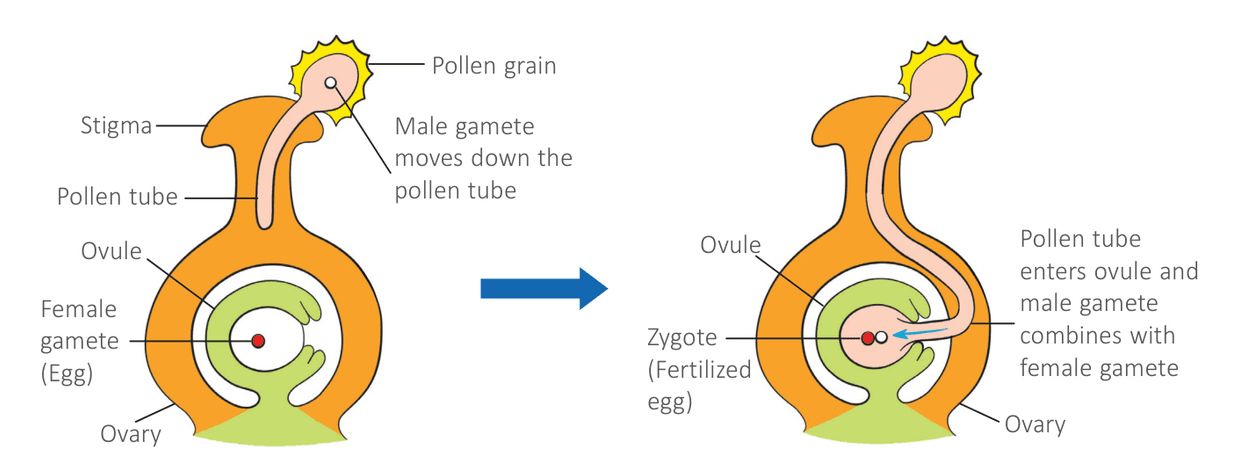
Therefore, in fertilization the pollen tube carries the male gamete down the style to the ovule, where it fuses with the egg to form a zygote that grows into the baby plant inside the seed.
- 233 marks
Question 23
B. Answer the questions in detail.
What changes lead to fruit formation after fertilization is over?
Solve with AIWritten solution
Solution:
Concept: A fruit is the ripened ovary of a flower. After fertilization, the parts of the flower that are no longer needed fade away, and the ovary grows.
Step 1 — Sepals, petals and stamens dry up.
The sepals, petals and stamens are of no more use to the plant. They usually dry up and fall off. In some plants, such as tomato, brinjal, apple and guava, the sepals stay on to guard and support the fruit.
Step 2 — The ovary swells.
The ovary swells up, grows bigger and ripens into the fruit. The fruit protects the seeds inside it.
Step 3 — The ovules become seeds.
Inside the ovary, the fertilized ovules develop into seeds. A fruit may have one seed (mango) or many seeds (pomegranate).
Therefore, after fertilization the sepals, petals and stamens dry and fall off, the ovary swells and ripens into the fruit, and the ovules inside it become the seeds.
- 243 marks
Question 24
B. Answer the questions in detail.
Describe the structure of a seed.
Solve with AIWritten solution
Solution:
Concept: A seed has three main parts: the seed coat, the cotyledons and the baby plant. We can see them clearly in a bean seed that has been soaked overnight and opened.
Step 1 — The seed coat.
The seed coat is the outer covering of the seed. It protects the seed from germs, injury and harsh weather.
Step 2 — The cotyledons.
Inside the seed coat are the thick, fleshy cotyledons (seed leaves). They store food for the baby plant. A seed with one cotyledon is a monocot seed (maize, wheat). A seed with two cotyledons is a dicot seed (bean, gram, pea).
Step 3 — The baby plant.
Attached to the cotyledons is a tiny baby plant (young plant). It has a small root part and a small shoot with tiny leaves. It grows into a seedling when the seed germinates.
Step 4 — See it in a diagram.
The labelled diagram of an opened bean seed shows these three parts.

Therefore, a seed has a protective seed coat, one or two food-storing cotyledons, and a baby plant that grows into a new plant.
- 253 marks
Question 25
B. Answer the questions in detail.
Why is seed dispersal important?
Solve with AIWritten solution
Solution:
Concept: Seed dispersal is the carrying of seeds to new places, away from the parent plant.
Step 1 — Think of seeds that fall below the parent.
If all the seeds fell just under the parent plant, they would be crowded together. They would not get enough space, light, water and minerals from the soil, because they would share them with the parent and with one another.
Step 2 — Think of seeds that travel.
When seeds are carried far away, each one has a better chance of landing where it has enough space, light, water and minerals to grow.
Step 3 — Think of the plant's spread.
Dispersal also helps a kind of plant to spread to new places and grow over a wide area.
Therefore, seed dispersal is important because it stops crowding under the parent plant, gives each seed a better chance to get what it needs to grow, and spreads the plant to new places.
- 263 marks
Question 26
B. Answer the questions in detail.
What features help seeds in dispersal by wind?
Solve with AIWritten solution
Solution:
Concept: Wind can carry a seed only if the seed is light or can stay in the air for a long time.
Step 1 — Very light seeds.
Some seeds are tiny and very light. Orchid seeds are almost as fine as dust, so even a gentle wind carries them.
Step 2 — Hairy parachutes.
Some seeds have fine hairs. The hairs of a dandelion seed act like a parachute and keep the seed floating in the air.
Step 3 — Wings.
Some seeds have flat wing-like parts. The wings of a sycamore seed make it spin slowly as it falls, so the wind carries it far from the tree.
Therefore, seeds dispersed by wind are very light (orchid), or have hairy parachutes (dandelion) or wings (sycamore).
- 273 marks
Question 27
Picture-based Question
A. Name the parts in the picture given below.
 Solve with AI
Written solution
Solution:
Concept: The picture shows a bean seed that has been opened into its two halves. A seed has a seed coat, cotyledons and a baby plant.
Step 1 — Part A.
The leader A ends on a tiny leaf of the small green shoot, which is attached between the two halves. This is the young plant (baby plant). It grows into the seedling.
Step 2 — Part B.
The leader B ends on the thin outer line around the seed. This is the seed coat, which protects the seed.
Step 3 — Part C.
The leader C ends on the large, thick half of the seed. This is a cotyledon (seed leaf), which stores food for the young plant.
Step 4 — See the labelled diagram.
The labelled diagram shows all three parts.
Therefore, A is the young plant, B is the seed coat and C is a cotyledon.
- 283 marks
Question 28
Application-based Questions
A. Collect five different kinds of seeds and soak them overnight. Next day, remove the seed coat and look for cotyledons in them. Note your observation in the given table.
S. No. Name of the plant from which seed is taken Number of cotyledons 1 2 3 4 5 Solve with AIWritten solution
Solution:
Concept: Seeds with two cotyledons are dicot seeds. Seeds with one cotyledon are monocot seeds. Soaking softens the seed, so the seed coat peels off easily.
Step 1 — Do the activity.
Soak the seeds overnight in water. Next day, gently peel off the seed coat with your fingers.
Step 2 — Look at the bean-family seeds.
A soaked kidney bean, gram or pea opens easily into two halves. Each half is one cotyledon, so these seeds have two cotyledons.
Step 3 — Look at the grains.
A soaked maize or wheat grain does not open into two halves. It has only one cotyledon, which is thin and hard to see.
Step 4 — Fill in the table.
A sample set of observations is shown below.
S. No. Name of the plant from which seed is taken Number of cotyledons 1 Kidney bean (rajma) 2 2 Gram (chana) 2 3 Pea 2 4 Maize (corn) 1 5 Wheat 1 Note: Your five seeds may be different. Moong, groundnut and other seeds that split into two halves have two cotyledons; rice and other cereal grains have one. Wash your hands after handling the soaked seeds.
Therefore, bean, gram and pea seeds have two cotyledons (dicots), while maize and wheat grains have one cotyledon (monocots).
What Class 5 Science Ch 5 covers
The sections of the chapter, in the order the book takes them. Every question above comes from one of these.
- 01Fertilization
- 02Fruit formation
- 03Seeds: structure and germination
- 04Growing plants from stem, roots, leaves
- 05Seed dispersal
More ways to study this chapter
The same chapter asked three other ways. Practise it, revise it, and see what the board has set on Ch 5 before.
Class 5 Science Ch 5 questions students ask
How many questions are there in Class 5 Science Ch 5?
28 questions. Every one is solved step by step on this page.
Are these Class 5 Science solutions free?
Yes. Every question and its full working is free to read, with no account needed.
Can I download the Class 5 Science Ch 5 solutions as a PDF?
There is no PDF to download. Every solution is on this page instead, which means it is searchable, always the current syllabus, and readable on a phone. Use your browser's print option if you want it on paper.