
Opening your dashboard
Class 5 Science Chapter 5 Plant Reproduction – Fertilization: Competency-Based Questions (CBQ)
40 questions on Chapter 5, each worked through on its own page with the AI tutor. Class 5 Science, ICSE 2026-27.
40 questions
1–5 marks · Mixed difficulty
- 11 mark
Question 1
Cognitive domain: Application
Riya sows five bean seeds in a pot of dry soil and five bean seeds in a pot of moist soil. She keeps both pots side by side in a warm room. After one week, which result is she most likely to see?
- 21 mark
Question 2
Cognitive domain: Analysis
A ripe coconut falls from a palm on a sea beach and rolls into the water. Months later, a coconut palm starts growing on a small island far across the sea.
Assertion (A): A coconut can be carried by sea water to a beach far away from its parent palm.
Reason (R): The fibrous husk of a coconut traps air, which helps it to float.
- 31 mark
Question 3
Cognitive domain: Application
After a walk through tall grass, Arjun finds small prickly burs stuck firmly to his socks and to his dog's fur. Which feature of these seeds made them stick, and how does it help the plant?
- 41 mark
Question 4
Cognitive domain: Analysis
Neha looks closely at a ripe tomato. She sees a small green star-shaped part still attached at the top.
Assertion (A): The juicy part of a tomato is formed from the ovary of the tomato flower.
Reason (R): The sepals of the tomato flower remain attached to the tomato fruit.
- 51 mark
Question 5
Cognitive domain: Understanding
At the vegetable shop, the teacher picks up four items and asks, "In science, a fruit is the ripened ovary of a flower with seeds inside. Which of these is a fruit?"
- 61 mark
Question 6
Cognitive domain: Analysis & Evaluation
Assertion (A): A healthy bean seed planted in completely dry sand will germinate if it is kept warm.
Reason (R): A seed needs water to swell and burst open its seed coat.
- 71 mark
Question 7
Cognitive domain: Application
Aman soaks some moong seeds overnight and ties them in a wet cotton cloth. The next day he sees small white thread-like parts coming out of the seeds. What are these white parts?
- 81 mark
Question 8
Cognitive domain: Understanding
Tanu grows a bean seedling in a glass jar. On the first day, its two cotyledons are big and fat. After a week, she sees that they have become small and wrinkled. Why have the cotyledons shrunk?
- 92 marks
Question 9
Cognitive domain: Analysis
Kabir opens a fresh pea pod and finds six green peas inside, in a row.
(a) Which part of the pea flower became the pod? (1 mark)
(b) Which part of the pea flower became each pea? (1 mark)
- 103 marks
Question 10
Cognitive domain: Analysis & Evaluation
Class 5 puts 10 healthy bean seeds on cotton wool in each of four trays. They count how many seeds have germinated after five days. (Hypothetical data.)
Tray Conditions Seeds germinated P Wet cotton, warm room, in light 9 Q Dry cotton, warm room, in light 0 R Wet cotton, inside a refrigerator (very cold) 0 S Wet cotton, warm room, inside a dark cupboard 9 (a) Which two trays show that seeds need water to germinate? (1 mark)
(b) Which two trays show that seeds need warmth to germinate? (1 mark)
(c) Tray S was dark, yet its seeds germinated. What does this tell you about light? (1 mark)
- 112 marks
Question 11
Cognitive domain: Application
Meera and her friends drop two sycamore seeds from the same height on a breezy day. One seed has its wing; on the other they have cut the wing off. The seed with the wing spins slowly and lands far away. The seed without a wing drops quickly close to them.
(a) How does the wing help the seed? (1 mark)
(b) Why is it good for the sycamore tree that its seeds land far away? (1 mark)
- 122 marks
Question 12
Cognitive domain: Application
A farmer cuts each seed potato into pieces before planting. He makes sure that every piece has at least one "eye" on it.
(a) What is an eye of a potato? (1 mark)
(b) What would happen if he planted a piece with no eye? Give a reason. (1 mark)
- 133 marks
Question 13
Cognitive domain: Analysis
A bird eats a ripe guava from a tree in Arjun's garden. Some days later, a small guava plant comes up near a wall at the far end of the park, where the bird often sits.
(a) Name the agent that dispersed the guava seed. (1 mark)
(b) Which part of the guava did the bird digest, and which part came out unharmed? (1 mark)
(c) Give one way in which this kind of dispersal helps the guava tree. (1 mark)
- 144 marks
Question 14
Cognitive domain: Analysis
Riddhi wrote these steps on cards, but they got mixed up.
- P: The male gamete joins the female gamete inside the ovule.
- Q: A pollen grain lands on the stigma.
- R: The pollen tube grows down through the style into the ovary.
- S: The pollen grain starts to grow a pollen tube.
(a) Write the cards in the correct order. (2 marks)
(b) What is the cell formed in card P called? (1 mark)
(c) Into what does this cell grow, and what does the ovule around it become? (1 mark)
- 155 marks
Question 15
Cognitive domain: Evaluation & Creativity
Class 5 is starting a kitchen garden. They have a sweet potato, a fresh piece of ginger, a long rose twig and a packet of mustard seeds.
(a) Three of these can give new plants without seeds. Name each one and the plant part that it is. (3 marks)
(b) The mustard seeds are tiny. Give two things the children must give the seeds so that they germinate. (2 marks)
- 161 mark
Question 16
Cognitive domain: Analysis
The diagram shows a section of a flower soon after pollination. A pollen grain has landed on the stigma and has started to grow. The letters P, Q, R and S mark four parts of the flower.
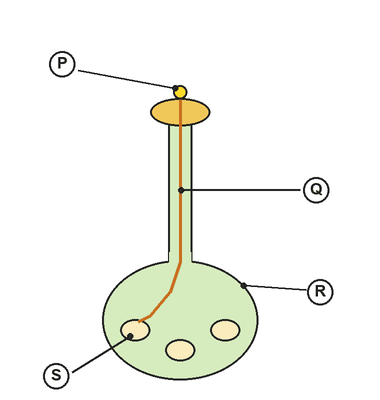
Which letter marks the part through which the male gamete travels down to the ovule?
- 171 mark
Question 17
Cognitive domain: Application
Seema has a brinjal plant on her balcony. A few of its flowers dropped off without forming any fruit, while other flowers grew into brinjals. Her teacher says that the flowers that dropped were never pollinated. Which statement best explains why no fruit formed from them?
- 181 mark
Question 18
Cognitive domain: Analysis
Class 5 puts 20 healthy bean seeds on wet cotton wool in each of five dishes. Each dish is kept at a different steady temperature. The bar chart shows how many seeds had germinated in each dish after one week. (Hypothetical data.)

Which conclusion is best supported by the bar chart?
- 191 mark
Question 19
Cognitive domain: Analysis
Mira holds a dry orchid seed pod in the open and gently shakes it. A cloud of tiny, dust-like seeds drifts away in the breeze.
Assertion (A): Orchid seeds can be carried far from the parent plant by the wind.
Reason (R): Orchid seeds are heavy and have thick, hard coats.
- 201 mark
Question 20
Cognitive domain: Analysis
Kabir reads that, after pollination, the pollen grain grows a tube.
Assertion (A): Fertilization in a flower takes place on the stigma.
Reason (R): The pollen tube carries the male gamete into the ovule, where it joins the female gamete.
- 211 mark
Question 21
Cognitive domain: Understanding
In a school nursery, four trays of young plants have come up. The tray cards say how each new plant was started. In which tray did the new plant grow from a stem?
- 221 mark
Question 22
Cognitive domain: Analysis
Nikhil cuts a ripe lemon and counts 8 seeds. Each seed forms from one fertilized ovule, and each fertilized ovule was reached by its own pollen tube. At least how many pollen tubes must have grown into the ovary of the lemon flower?
- 231 mark
Question 23
Cognitive domain: Evaluation
Aarav matches seed features with the way each seed is dispersed. Which of his pairs is NOT correct?
- 241 mark
Question 24
Cognitive domain: Analysis & Evaluation
Two identical bean seeds are sown in two pots. Pot X holds garden soil. Pot Y holds clean, washed sand. Both pots get the same water, the same air, the same light and the same warmth. After four weeks, the plant in pot X has 8 healthy green leaves. The plant in pot Y has only 2 small, pale leaves. (Hypothetical data.) What is the best conclusion?
- 251 mark
Question 25
Cognitive domain: Analysis & Evaluation
Rohit plants the cut top portion of 8 carrots in moist soil. In a second tray he plants the cut thin bottom end of 8 other carrots in the same kind of moist soil. After 10 days, 7 of the 8 top pieces have put out green shoots, and none of the bottom pieces has. (Hypothetical data.) What is the best conclusion?
- 262 marks
Question 26
Cognitive domain: Analysis
In a science activity, Zoya carefully cuts away the whole pistil (stigma, style and ovary) from a bean flower bud. She leaves the sepals, petals and stamens on the flower. Can this flower ever form a bean pod? Give two reasons.
- 272 marks
Question 27
Cognitive domain: Analysis
Asha sprouts a bean seed in a dark cupboard. The seedling grows into a small, weak plant that is pale yellow instead of green. It stays alive for about a week and then withers.
(a) Why can the seedling stay alive for a week even though it gets no light? (1 mark)
(b) Why does it wither after that? (1 mark)
- 282 marks
Question 28
Cognitive domain: Creativity
Design an imaginary seed that can be carried by both the wind and animals. Name two features that the seed must have and say how each feature helps.
- 292 marks
Question 29
Cognitive domain: Evaluation
Priya says, "A fruit must be sweet and juicy, so a bean pod is not a fruit." Rohit says, "A bean pod is a fruit." Who is right? Give two reasons.
- 302 marks
Question 30
Cognitive domain: Evaluation
Ravi writes: "The pollen tube carries the pollen grain into the ovule. The zygote is formed when the pollen grain joins the ovary." Find the two mistakes and correct them.
- 312 marks
Question 31
Cognitive domain: Application
Rohan takes 20 healthy moong seeds. He boils 10 of them in water for five minutes and lets them cool. He keeps the other 10 unboiled. He then places both sets on wet cotton wool, side by side in a warm room, and keeps the cotton wet.
(a) Predict which set will show white roots after two days. (1 mark)
(b) Explain why the other set will not. (1 mark)
- 323 marks
Question 32
Cognitive domain: Analysis & Evaluation
Ravi sows 10 healthy bean seeds in each of three pots of the same soil. All pots get the same warmth and light. The pots differ only in water. (Hypothetical data.)
Pot How the pot is watered Seeds germinated M No water at all 0 N A little water every day, so the soil stays moist 9 O The pot has no hole and is filled with water, so the seeds stay under water 1 (a) Which pot gave the best result? (1 mark)
(b) Why did pot O give a poor result although it had plenty of water? (1 mark)
(c) What do the three results together tell you about the water that seeds need? (1 mark)
- 333 marks
Question 33
Cognitive domain: Evaluation
A watermelon plant has some flowers with only stamens and other flowers with only a pistil. Sehaj says, "The flowers with only stamens will also grow into watermelons once pollen reaches them."
(a) Is Sehaj right? (1 mark)
(b) Which part of a flower forms the fruit, and which kind of watermelon flower has it? (1 mark)
(c) What must happen to the flower with only a pistil before it can form a fruit? (1 mark)
- 343 marks
Question 34
Cognitive domain: Application
Mother brings home kidney beans (rajma), spinach leaves, shelled green peas (matar), tomatoes, potatoes and gram from the market. Sort these six items into three groups: (a) those that are seeds, (b) those that are fruits and (c) those that are a leaf or a stem. (1 mark for each group)
- 353 marks
Question 35
Cognitive domain: Analysis
A garden plant makes 100 seeds. The table shows where they landed and how many of them grew into plants. (Hypothetical data.)
Where the seeds landed Number of seeds Seeds that grew into plants Under the parent plant, crowded together 40 2 Carried by wind to open, moist ground 30 15 Carried by wind onto dry, bare rock 20 0 Dropped by a bird in a damp garden bed 10 8 (a) Which place gave the highest percentage of seeds that grew? Give the percentage. (1 mark)
(b) Why did so few of the seeds under the parent plant grow? (1 mark)
(c) What percentage of all 100 seeds grew into plants? (1 mark)
- 363 marks
Question 36
Cognitive domain: Application
A ginger seller has 30 pieces of ginger. Each piece has 3 eyes. She cuts every piece so that each new piece has exactly one eye, and she plants all of them in damp soil. Later she finds that 6 of the new pieces have rotted and will not sprout. (Hypothetical data.)
(a) How many pieces does she plant? (1 mark)
(b) At most how many new ginger plants will she get? (1 mark)
(c) Does she need to use any seeds? Give a reason. (1 mark)
- 374 marks
Question 37
Cognitive domain: Analysis
Meena grows a bean seed in a pot of moist soil and sketches the seedling at four times. Her sketches got mixed up, so she lettered them A, B, C and D.
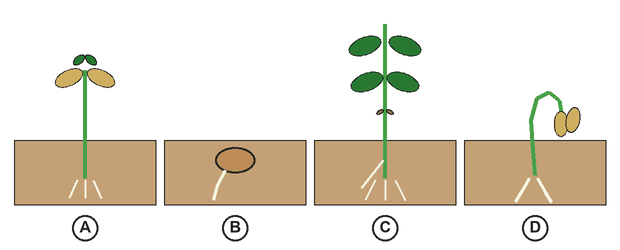
(a) Write the letters in the order in which the sketches were made, from the youngest to the oldest. (2 marks)
(b) In which two sketches is the young plant still getting all its food from the cotyledons? Give a reason from the sketches. (1 mark)
(c) Meena forgot to sketch the seed a day after sowing, before its root came out. Describe how the seed would look then. (1 mark)
- 384 marks
Question 38
Cognitive domain: Analysis
Class 5 cuts open five fruits and records what they find. (Hypothetical data.)
Fruit Fleshy or dry Number of seeds inside Mango Fleshy 1 Pea pod Dry 8 Pomegranate Fleshy 250 Litchi Fleshy 1 Bean pod Dry 6 (a) Name the dry fruit that has the larger number of seeds. (1 mark)
(b) Name the two fruits that have only one seed each. (1 mark)
(c) The number of seeds in a fruit is the same as the number of ovules that were fertilized. Which flower had at least 250 ovules, and how many ovules were fertilized in the ovary of each one-seeded fruit? (2 marks)
- 394 marks
Question 39
Cognitive domain: Analysis
In June, Dadi sows 100 bean seeds from her seed pot in a vegetable bed. She counts the seeds that have germinated at fixed times. (Hypothetical data.)
Day after sowing Seeds germinated so far 3 10 5 55 7 82 10 90 (a) How many of the 100 seeds had germinated by day 5? Write this as a percentage of the 100 seeds. (1 mark)
(b) How many more seeds germinated between day 5 and day 7? (1 mark)
(c) Not all 100 seeds had germinated even by day 10. Give two possible reasons from what you know about seeds. (2 marks)
- 405 marks
Question 40
Cognitive domain: Analysis & Creativity
The school wants to grow plants on the bare bank of its pond. Mrs Rao shows the class four plants and how their seeds travel. Lotus seeds float on water. Balsam pods burst open with a snap when they are ripe. Burdock seeds have hooks that catch on fur. Dandelion seeds have hairy parachutes. She says that seeds grow only if they reach a place with the right conditions.
(a) Name the way each of the four plants disperses its seeds. (2 marks)
(b) Lotus grows in the pond water itself. Explain why its way of dispersal suits a plant that lives in a pond, and why dandelion seeds may end up far from the pond. (2 marks)
(c) Suggest one way in which the children could help to spread the seeds of one of the other plants. (1 mark)