
Opening your dashboard
Class 5 Science Chapter 4: Plant Reproduction – Pollination Solutions
39 textbook questions with step-by-step answers, free to read, for ICSE 2026-27.
Get talked through Ch 4, not just shown the answer
Reading a finished solution is not the same as being able to do it. The AI tutor takes one question at a time and works it with you, in your own words, until you can.
- Ask it out loud, in your own words
- It gives you the next step, not the answer
- Stuck on part (ii)? Start there
39 questions with solutions
1–8 marks · Mixed difficulty
- 11 mark
Question 1
Give two examples for the following.
Unisexual flower
Solve with AIWritten solution
Solution:
Concept: A unisexual flower has only one kind of reproductive part. It has either stamens (male part) or a pistil (female part), not both.
Step 1 — Recall what to look for.
We need plants whose flowers have either stamens or a pistil, but not both in the same flower.
Step 2 — Pick two examples.
Cucumber and maize (corn) have separate male flowers and female flowers. So their flowers are unisexual.
Note: Bottle gourd and pumpkin also have unisexual flowers.
Therefore, two examples of unisexual flowers are the flowers of cucumber and maize.
- 21 mark
Question 2
Give two examples for the following.
Bisexual flower
Solve with AIWritten solution
Solution:
Concept: A bisexual flower has both reproductive parts. It has stamens (male part) and a pistil (female part) in the same flower.
Step 1 — Recall what to look for.
We need flowers that carry both stamens and a pistil.
Step 2 — Pick two examples.
A rose flower and a mustard flower each have many stamens and a pistil in the same flower. So they are bisexual.
Note: Hibiscus and petunia also have bisexual flowers.
Therefore, two examples of bisexual flowers are rose and mustard.
- 31 mark
Question 3
Give two examples for the following.
Self-pollinating plant
Solve with AIWritten solution
Solution:
Concept: In self-pollination, pollen grains reach the stigma of the same flower, or of another flower on the same plant. Only one plant is involved.
Step 1 — Recall what to look for.
We need plants whose flowers are usually pollinated by their own pollen.
Step 2 — Pick two examples.
In pea and wheat, the pollen usually falls on the stigma of the same flower, often even before the flower opens fully. So these plants are mostly self-pollinated.
Note: Sunflowers and most orchids are usually cross-pollinated by insects, so they are not good examples of self-pollinating plants.
Therefore, two examples of self-pollinating plants are pea and wheat.
- 41 mark
Question 4
Give two examples for the following.
Cross-pollinating plant
Solve with AIWritten solution
Solution:
Concept: In cross-pollination, pollen grains go from a flower on one plant to the stigma of a flower on another plant of the same kind. Two plants are involved.
Step 1 — Recall what to look for.
We need plants whose flowers get pollen from another plant of the same kind.
Step 2 — Pick two examples.
Apple trees usually need pollen from another apple tree, carried mostly by bees. In maize, the wind carries pollen from the tassels at the top of one plant to the silky stigmas of other maize plants.
Therefore, two examples of cross-pollinating plants are apple and maize.
- 51 mark
Question 5
Give two examples for the following.
Agent of pollination
Solve with AIWritten solution
Solution:
Concept: An agent of pollination is anything that carries pollen grains from an anther to a stigma.
Step 1 — Recall the agents.
Pollen grains cannot move on their own. Insects, wind and water carry them from flower to flower.
Step 2 — Pick two examples.
Bees carry pollen stuck to their bodies, and the wind blows light pollen grains about. So insects and wind are agents of pollination.
Note: Water is a third agent. It carries pollen in water plants such as Vallisneria.
Therefore, two examples of agents of pollination are insects (such as bees) and wind.
- 61 mark
Question 6
Choose the correct option.
Which part is involved in sexual reproduction in plants?
Solve with AIAnswer
(A) Stem
- Correct
(B) Flower
(C) Root
(D) Leaf
Answer: (B) Flower
Concept: In sexual reproduction, a new plant grows from a seed. Seeds come from fruits, and fruits form from flowers. The flower holds the male part (stamen) and the female part (pistil).
Step 1 — What is asked.
We must find the part of the plant that takes part in sexual reproduction.
Step 2 — Recall where the reproductive parts are.
The stamens and the pistil are found only in the flower. So the flower is the part that takes part in sexual reproduction.
Step 3 — Check the other options.
Each of the other options is wrong for the reason given below.
- (A): A stem holds up the plant and carries water and food. New plants can grow from stem pieces, but that is asexual reproduction.
- (C): A root takes in water and minerals from the soil. Roots of some plants can grow new plants, but without seeds, so that is asexual.
- (D): A leaf makes food for the plant. Leaves of some plants (such as Bryophyllum) can grow new plants, but that is asexual reproduction.
Therefore, the flower is involved in sexual reproduction in plants: option (B).
- 71 mark
Question 7
Choose the correct option.
These two processes are part of sexual reproduction in plants.
Solve with AIAnswer
- Correct
(A) Pollination-fertilization
(B) Photosynthesis-respiration
(C) Budding-grafting
(D) Pollination-photosynthesis
Answer: (A) Pollination-fertilization
Concept: Sexual reproduction in plants happens in two steps. First comes pollination (pollen reaches the stigma). Then comes fertilization (a male sex cell joins a female sex cell in the ovule).
Step 1 — What is asked.
We must find the pair of processes that both belong to sexual reproduction.
Step 2 — Recall the two steps.
Pollen is first carried to the stigma. After that, the male sex cell joins the female sex cell, and a seed begins to form. These steps are pollination and fertilization.
Step 3 — Check the other options.
Each of the other options is wrong for the reason given below.
- (B): Photosynthesis is how a plant makes food, and respiration is how it gets energy from food. Neither of them makes a new plant.
- (C): Budding and grafting give new plants without seeds. They are not steps of sexual reproduction.
- (D): Pollination is a step of sexual reproduction, but photosynthesis is food making, not reproduction.
Therefore, the two processes are pollination and fertilization: option (A).
- 81 mark
Question 8
Choose the correct option.
Which of the following is not part of gynoecium?
Solve with AIAnswer
(A) stigma
(B) ovary
- Correct
(C) anther
(D) style
Answer: (C) anther
Concept: The gynoecium is the female whorl of a flower. It is made of the pistil, and a pistil has three parts: the stigma, the style and the ovary.
Step 1 — What is asked.
We must find the part that does not belong to the female part of the flower.
Step 2 — Sort the parts.
The stigma, the style and the ovary are the three parts of the pistil. The anther is the top of the stamen, which is the male part. So the anther is not part of the gynoecium.
Step 3 — Check the other options.
Each of the other options is wrong for the reason given below.
- (A): The stigma is the sticky top of the pistil, so it is part of the gynoecium.
- (B): The ovary is the swollen base of the pistil that holds the ovules, so it is part of the gynoecium.
- (D): The style is the tube that joins the stigma to the ovary, so it is part of the gynoecium.
Therefore, the anther is not part of the gynoecium: option (C).
- 91 mark
Question 9
Choose the correct option.
Which of the following will form the innermost whorl in a flower?
Solve with AIAnswer
(A) Sepals
(B) Petals
- Correct
(C) Pistil
(D) Stamen
Answer: (C) Pistil
Concept: The parts of a flower are arranged in four rings called whorls. From outside to inside they are: sepals (1st), petals (2nd), stamens (3rd) and pistil (4th).
Step 1 — What is asked.
We must find the whorl in the very centre of the flower.
Step 2 — Recall the order of the whorls.
The fourth whorl, the pistil (gynoecium), sits in the centre of the flower. So the pistil forms the innermost whorl.
Step 3 — Check the other options.
Each of the other options is wrong for the reason given below.
- (A): Sepals form the first whorl, which is the outermost ring of the flower.
- (B): Petals form the second whorl, just inside the sepals.
- (D): Stamens form the third whorl. They surround the pistil, so they are not in the centre.
Therefore, the pistil forms the innermost whorl: option (C).
- 101 mark
Question 10
Choose the correct option.
Which of the following features help in pollination by wind?
Solve with AIAnswer
(A) Light-weight pollen grains
(B) Anthers hanging outside the flowers
(C) Feathery stigma
- Correct
(D) All of these
Answer: (D) All of these
Concept: Flowers pollinated by wind have special features. They make a lot of small, light pollen, their anthers hang out of the flower, and their stigmas are spread out and feathery.
Step 1 — What is asked.
We must find which of the given features help the wind to pollinate a flower.
Step 2 — Check each feature.
Light pollen is easily blown by the wind. Anthers hanging outside let the wind shake out the pollen. A feathery stigma catches pollen from the air. All three help.
Step 3 — Choose the option.
Since options (A), (B) and (C) are all correct, the best answer is option (D).
Step 4 — Check the other options.
Each of the other options is wrong for the reason given below.
- (A): Light pollen does help, but it is only one of the three helpful features given.
- (B): Hanging anthers do help, but the light pollen and the feathery stigma help as well.
- (C): A feathery stigma does help, but it is not the only helpful feature listed.
Therefore, all of these features help in pollination by wind: option (D).
- 111 mark
Question 11
Fill in the blanks using these words: stigma, wind, bisexual, sepals, fertilization.
Flowers in which both male and female parts are present on the same flower are called _______ flowers.
Solve with AIWritten solution
Solution:
Concept: A flower with both stamens (male part) and a pistil (female part) is called a bisexual flower.
Step 1 — Read the clue.
The flower has both male and female parts together.
Step 2 — Choose the word.
The word for such a flower is 'bisexual'. Rose and mustard are examples.
Therefore, flowers in which both male and female parts are present on the same flower are called bisexual flowers.
- 121 mark
Question 12
Fill in the blanks using these words: stigma, wind, bisexual, sepals, fertilization.
For self-pollination, both anther and _______ must mature at the same time.
Solve with AIWritten solution
Solution:
Concept: In self-pollination, pollen from an anther lands on a stigma of the same flower or the same plant.
Step 1 — Read the clue.
Pollen comes from the anther and must land on a part that is ready to receive it.
Step 2 — Choose the word.
Pollen is received by the stigma. The anther and the stigma must be ready together, or the pollen is wasted.
Therefore, for self-pollination, both anther and stigma must mature at the same time.
- 131 mark
Question 13
Fill in the blanks using these words: stigma, wind, bisexual, sepals, fertilization.
_______ protect the buds of flowers in initial stage.
Solve with AIWritten solution
Solution:
Concept: Sepals are the green, leaf-like parts in the outermost whorl of a flower. Together they form the calyx.
Step 1 — Read the clue.
We need the part that covers and protects a flower while it is still a bud.
Step 2 — Choose the word.
The green sepals wrap around the bud and keep the soft parts inside safe.
Therefore, sepals protect the buds of flowers in initial stage.
- 141 mark
Question 14
Fill in the blanks using these words: stigma, wind, bisexual, sepals, fertilization.
Maize is pollinated by _______.
Solve with AIWritten solution
Solution:
Concept: Maize flowers make a lot of light pollen. Their anthers hang out, and the silky stigmas spread out in the air.
Step 1 — Read the clue.
We need the agent that carries pollen in maize.
Step 2 — Choose the word.
These features suit pollination by wind. Maize, rice, grass and sugarcane are wind-pollinated.
Therefore, maize is pollinated by wind.
- 151 mark
Question 15
Fill in the blanks using these words: stigma, wind, bisexual, sepals, fertilization.
The process of _______ involves the fusion of male and female reproductive cells or gametes.
Solve with AIWritten solution
Solution:
Concept: After pollination, the male sex cell from a pollen grain joins the female sex cell in an ovule. This joining is called fertilization.
Step 1 — Read the clue.
The blank names the joining (fusion) of the male and female sex cells.
Step 2 — Choose the word.
Pollination only carries pollen to the stigma. The joining of the two sex cells is fertilization.
Therefore, the process of fertilization involves the fusion of male and female reproductive cells or gametes.
- 161 mark
Question 16
Write T for True statements or F for False statements.
Flowers pollinated by wind are small in size.
Solve with AIWritten solution
Solution:
Concept: Wind-pollinated flowers do not need to attract insects. So they do not have large, bright, scented petals.
Step 1 — Think about what the flower needs.
Wind carries pollen whatever the flower looks like. Big, bright petals would only get in the way of the wind.
Step 2 — Judge the statement.
So wind-pollinated flowers, such as those of grass, maize and rice, are usually small and dull. The statement is true.
Therefore, the statement is True (T).
- 171 mark
Question 17
Write T for True statements or F for False statements.
In a typical flower, receptacle bears the four consecutive whorls of a flower.
Solve with AIWritten solution
Solution:
Concept: The receptacle is the tip of the flower stalk. All the parts of a flower are attached to it.
Step 1 — Recall the whorls.
A typical flower has four whorls one inside the other: sepals, petals, stamens and pistil.
Step 2 — Judge the statement.
All four whorls grow on the receptacle, one after another. So the statement is true.
Therefore, the statement is True (T).
- 181 mark
Question 18
Write T for True statements or F for False statements.
Sepals enclose the reproductive parts of the flower.
Solve with AIWritten solution
Solution:
Concept: Sepals form the outermost whorl. Their job is to protect the whole flower while it is a bud.
Step 1 — Think about an open flower.
In an open flower, the sepals are on the outside, below the petals. The stamens and the pistil are in the centre, surrounded by the petals, not by the sepals.
Step 2 — Judge the statement.
So the sepals do not enclose the reproductive parts. They protect the bud as a whole. The statement is false.
Note: While the flower is still a closed bud, the sepals wrap around everything inside it. Once it opens, they no longer enclose the stamens and pistil.
Therefore, the statement is False (F).
- 191 mark
Question 19
Write T for True statements or F for False statements.
Ovary is the swollen part of the carpel and is present at its base.
Solve with AIWritten solution
Solution:
Concept: The pistil is also called the carpel. It has three parts: stigma (top), style (middle) and ovary (bottom).
Step 1 — Recall the ovary.
The ovary is the swollen part at the bottom of the pistil. It holds the ovules.
Step 2 — Judge the statement.
The statement matches this exactly. So it is true.
Therefore, the statement is True (T).
- 201 mark
Question 20
Write T for True statements or F for False statements.
Self pollination occurs in a single flower.
Solve with AIWritten solution
Solution:
Concept: Self-pollination is the transfer of pollen to the stigma of the same flower or of another flower on the same plant. Only one plant is involved.
Step 1 — Check the cases.
Self-pollination can happen inside one flower. It can also happen between two different flowers of the same plant.
Step 2 — Judge the statement.
The statement limits self-pollination to a single flower. That leaves out the second case, so the statement is false.
Note: The correct statement is: self-pollination occurs within a single plant.
Therefore, the statement is False (F).
- 218 marks
Question 21
Match the columns.
Column A Column B 1. Gamete a. Female reproductive part of a flower 2. Vallisneria b. Insect pollination 3. Stamen c. Water pollination 4. Marigold d. Male reproductive part of a flower 5. Pistil e. Reproductive cell 6. Self pollination f. Two plants involved 7. Cross pollination g. Corolla 8. Petals h. One plant involved Solve with AIWritten solution
Solution:
Concept: Each item in Column A matches exactly one item in Column B. We match them one at a time, using what each word means.
Step 1 — Match item 1.
A gamete is a sex cell, which is a reproductive cell. So 1 matches e.
Step 2 — Match item 2.
Vallisneria grows under water, and water carries its pollen. So 2 matches c.
Step 3 — Match item 3.
The stamen is the male reproductive part of a flower. So 3 matches d.
Step 4 — Match item 4.
Marigold has bright, scented flowers that attract insects. So 4 matches b.
Step 5 — Match item 5.
The pistil is the female reproductive part of a flower. So 5 matches a.
Step 6 — Match item 6.
Self-pollination happens within one plant. So 6 matches h.
Step 7 — Match item 7.
Cross-pollination needs two plants of the same kind. So 7 matches f.
Step 8 — Match item 8.
All the petals of a flower together make the corolla. So 8 matches g.
Step 9 — Write the answer.
The matched pairs are shown in the table below.
Column A Column B 1. Gamete e. Reproductive cell 2. Vallisneria c. Water pollination 3. Stamen d. Male reproductive part of a flower 4. Marigold b. Insect pollination 5. Pistil a. Female reproductive part of a flower 6. Self pollination h. One plant involved 7. Cross pollination f. Two plants involved 8. Petals g. Corolla Therefore, 1 matches e, 2 matches c, 3 matches d, 4 matches b, 5 matches a, 6 matches h, 7 matches f and 8 matches g.
- 222 marks
Question 22
Which part of a plant is most important for sexual reproduction?
Solve with AIWritten solution
Solution:
Concept: In sexual reproduction, new plants grow from seeds. Seeds come from fruits, and fruits form from flowers.
Step 1 — Find the reproductive parts.
The male part (stamen) and the female part (pistil) of a plant are found in its flower.
Step 2 — Link the flower to seeds.
After pollination and fertilization, the flower turns into a fruit with seeds inside. These seeds grow into new plants.
Therefore, the flower is the most important part of a plant for sexual reproduction.
- 232 marks
Question 23
What is the main function of flowers?
Solve with AIWritten solution
Solution:
Concept: A flower is the part of a plant that holds its reproductive organs, the stamens and the pistil.
Step 1 — Recall what the flower holds.
The stamens make pollen with male sex cells, and the ovary of the pistil holds ovules with female sex cells.
Step 2 — State the function.
When these sex cells join, the ovary grows into a fruit and the ovules become seeds. So a flower's main job is reproduction.
Therefore, the main function of flowers is to produce fruits and seeds, so that new plants can grow.
- 242 marks
Question 24
What do we call the part of the stem where the whorls of a flower are arranged?
Solve with AIWritten solution
Solution:
Concept: The parts of a flower grow in rings (whorls) at the very tip of the flower stalk.
Step 1 — Find the part.
The swollen tip of the stalk on which the sepals, petals, stamens and pistil are attached is called the receptacle.
Step 2 — Say what it does.
The receptacle holds all four whorls of the flower together on the stalk.
Therefore, the part of the stem where the whorls of a flower are arranged is called the receptacle.
- 252 marks
Question 25
How many whorls are commonly found in a flower? Name them.
Solve with AIWritten solution
Solution:
Concept: The parts of a flower are arranged in rings, one inside another. Each ring is called a whorl.
Step 1 — Count the whorls.
A typical flower has four whorls.
Step 2 — Name them from outside to inside.
The four whorls are shown in the table below.
Whorl Name Made of 1st (outermost) Calyx Sepals 2nd Corolla Petals 3rd Androecium Stamens 4th (innermost) Gynoecium Pistil Therefore, a flower commonly has four whorls: calyx, corolla, androecium and gynoecium.
- 262 marks
Question 26
Name the male and the female parts of the flower.
Solve with AIWritten solution
Solution:
Concept: A flower has a male reproductive part and a female reproductive part.
Step 1 — Name the male part.
The stamen is the male part. It has a stalk (filament) and a top (anther) that holds pollen grains.
Step 2 — Name the female part.
The pistil (carpel) is the female part. It has the stigma, the style and the ovary, which holds the ovules.
Therefore, the stamen is the male part and the pistil is the female part of the flower.
- 272 marks
Question 27
What is the function of calyx?
Solve with AIWritten solution
Solution:
Concept: The calyx is the outermost whorl of a flower. It is made of green, leaf-like sepals.
Step 1 — Think about the bud.
Before a flower opens, the sepals are wrapped tightly around it.
Step 2 — State the function.
In this way the calyx protects the soft inner parts of the bud, such as the petals, stamens and pistil, until the flower opens.
Therefore, the function of the calyx is to protect the flower when it is a bud.
- 282 marks
Question 28
Where are the pollens found?
Solve with AIWritten solution
Solution:
Concept: The stamen is the male part of a flower. It has a thin stalk called the filament and a swollen top called the anther.
Step 1 — Find the place.
The anther holds a yellow, powder-like substance. This powder is made of pollen grains.
Step 2 — Say why they are there.
The pollen grains carry the male sex cells. They stay in the anther until they are carried away during pollination.
Therefore, pollen grains are found in the anther of the stamen.
- 292 marks
Question 29
Why is stigma sticky in nature?
Solve with AIWritten solution
Solution:
Concept: The stigma is the top part of the pistil. During pollination, pollen grains must land on it.
Step 1 — Think about how pollen arrives.
Pollen is brought by insects, wind or water. It could easily fall off or blow away again.
Step 2 — Give the reason.
A sticky stigma holds on to the pollen grains that touch it. Then the male sex cells can go on to reach the ovules.
Therefore, the stigma is sticky so that pollen grains stick to it and are not lost.
- 302 marks
Question 30
Define pollination. What are the types of pollination?
Solve with AIWritten solution
Solution:
Concept: Before a seed can form, pollen from the male part must reach the female part of a flower.
Step 1 — Define pollination.
The transfer of pollen grains from the anther of a stamen to the stigma of a pistil is called pollination.
Step 2 — Name the types.
There are two types. In self-pollination, pollen reaches the stigma of the same flower or another flower on the same plant. In cross-pollination, pollen reaches the stigma of a flower on another plant of the same kind.
Therefore, pollination is the transfer of pollen grains from an anther to a stigma, and its two types are self-pollination and cross-pollination.
- 312 marks
Question 31
Give two examples each of insect-pollinated, wind-pollinated and water-pollinated flowers.
Solve with AIWritten solution
Solution:
Concept: Flowers are pollinated by different agents: insects, wind or water.
Step 1 — Insect-pollinated flowers.
Sunflower and marigold have bright petals and nectar that attract insects.
Step 2 — Wind-pollinated flowers.
Grass and maize have small flowers with light pollen that the wind blows about.
Step 3 — Water-pollinated flowers.
Vallisneria and Hydrilla grow in water, and water carries their pollen.
Therefore, sunflower and marigold are insect-pollinated, grass and maize are wind-pollinated, and Vallisneria and Hydrilla are water-pollinated.
- 323 marks
Question 32
Name the part of the flower where pollen grains are stored. What is the role of pollen grains in plant reproduction?
Solve with AIWritten solution
Solution:
Concept: The stamen is the male part of a flower. Its swollen top, the anther, makes and stores pollen grains.
Step 1 — Name the part.
Pollen grains are stored in the anther of the stamen. They look like a yellow powder.
Step 2 — Say what pollen carries.
Each pollen grain carries the male sex cells (male gametes) of the plant.
Step 3 — Explain the role.
During pollination, pollen grains are carried to the stigma. Then the male sex cell joins the female sex cell inside an ovule. This is fertilization, and the ovule grows into a seed.
Therefore, pollen grains are stored in the anther, and they carry the male sex cells that join the female sex cells in the ovules so that seeds can form.
- 335 marks
Question 33
Describe the structure of a pistil. Support your answer with a diagram.
Solve with AIWritten solution
Solution:
Concept: The pistil (also called the carpel) is the female part of a flower. It sits in the centre of the flower and is shaped like a flask.
Step 1 — The stigma.
The top part of the pistil is the stigma. It is sticky, so pollen grains stick to it.
Step 2 — The style.
The middle part is the style. It is a long tube that joins the stigma to the ovary.
Step 3 — The ovary.
The swollen part at the bottom is the ovary.
Step 4 — The ovules.
Inside the ovary there are tiny, egg-like ovules. There may be one or many ovules. Each ovule has a female sex cell.
Step 5 — Draw the diagram.
The labelled diagram below shows these parts.
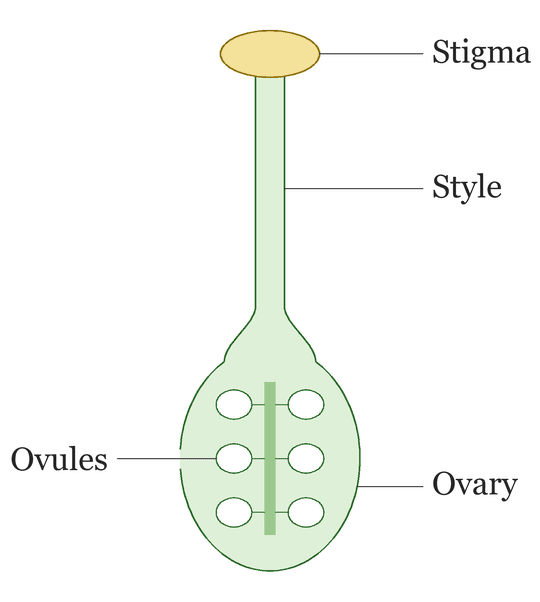
Therefore, a pistil is made of the stigma at the top, the style in the middle and the ovary at the bottom, and the ovary holds the ovules.
- 343 marks
Question 34
What is the difference between unisexual and bisexual flowers?
Solve with AIWritten solution
Solution:
Concept: Flowers can be sorted by the reproductive parts they carry. The stamen is the male part and the pistil is the female part.
Step 1 — Unisexual flowers.
A unisexual flower has only one reproductive part, either stamens or a pistil. A flower with only stamens is a male flower, and one with only a pistil is a female flower.
Step 2 — Bisexual flowers.
A bisexual flower has both stamens and a pistil in the same flower.
Step 3 — Put the differences side by side.
The table below shows the differences.
Unisexual flower Bisexual flower Has only one reproductive part Has both reproductive parts Has either stamens or a pistil Has stamens and a pistil Examples: cucumber, maize Examples: rose, mustard Therefore, a unisexual flower has either the male or the female part, while a bisexual flower has both the male and the female parts.
- 353 marks
Question 35
How does cross-pollination happen?
Solve with AIWritten solution
Solution:
Concept: In cross-pollination, pollen grains from a flower on one plant reach the stigma of a flower on another plant of the same kind.
Step 1 — Pollen is made.
The anthers of a flower on the first plant open and release pollen grains.
Step 2 — An agent carries the pollen.
Pollen cannot move on its own. An insect visiting for nectar gets pollen stuck on its body, or the wind or water carries the pollen away.
Step 3 — Pollen reaches another plant.
The insect then visits a flower of the same kind on a second plant, or the wind or water carries the pollen there. Some pollen rubs off or lands on the sticky stigma of that flower.
Therefore, cross-pollination happens when insects, wind or water carry pollen from a flower on one plant to the stigma of a flower on another plant of the same kind.
- 364 marks
Question 36
Classify various pollinating agents with the help of suitable examples.
Solve with AIWritten solution
Solution:
Concept: Agents of pollination are the carriers that take pollen from an anther to a stigma. The main agents are insects, wind and water.
Step 1 — Insects.
Bees and butterflies visit bright, scented flowers for nectar and carry the sticky pollen on their bodies. Examples: sunflower, marigold, jasmine.
Step 2 — Wind.
The wind blows small, light pollen from hanging anthers to feathery stigmas. Examples: grass, maize, rice, sugarcane.
Step 3 — Water.
In some water plants, flowers or pollen float and are carried by water to the female flowers. Examples: Vallisneria, Hydrilla.
Step 4 — Put them in a table.
The table below sorts the agents.
Agent How it helps Examples Insects Carry sticky pollen on their bodies Sunflower, marigold Wind Blows light pollen to feathery stigmas Grass, maize Water Carries floating flowers or pollen Vallisneria, Hydrilla Note: Some flowers are also pollinated by birds, such as sunbirds, and by animals such as bats.
Therefore, the pollinating agents are insects (sunflower, marigold), wind (grass, maize) and water (Vallisneria, Hydrilla).
- 374 marks
Question 37
Show the arrangement of whorls in a flower through a diagrammatic representation in your notebook. Label it correctly.
Solve with AIWritten solution
Solution:
Concept: The parts of a flower grow in four rings called whorls, one inside another, on the receptacle.
Step 1 — Draw the outer ring.
Draw a ring of green sepals on the outside. This is the 1st whorl, the calyx.
Step 2 — Draw the second ring.
Just inside it, draw a ring of petals. This is the 2nd whorl, the corolla.
Step 3 — Draw the third ring.
Inside the petals, draw the stamens (anthers seen from above). This is the 3rd whorl, the androecium.
Step 4 — Draw the centre.
In the very centre, draw the pistil cut across, with ovules inside. This is the 4th whorl, the gynoecium.
Step 5 — Label the diagram.
Label each ring with its part and its whorl, as in the diagram below.

Therefore, from outside to inside, the four whorls are the calyx (sepals), the corolla (petals), the androecium (stamens) and the gynoecium (pistil).
- 382 marks
Question 38
Why is it necessary that both anther and stigma mature at the same time in self-pollinating plants?
Solve with AIWritten solution
Solution:
Concept: In self-pollination, pollen from an anther must land on a stigma of the same flower or the same plant. A part is mature when it is ready to do its job.
Step 1 — Think about a mature anther.
A mature anther opens and releases its pollen. Pollen stays alive only for a short time.
Step 2 — Think about a mature stigma.
Only a mature stigma is sticky and ready to hold the pollen. If it is not ready, the pollen is not received.
Step 3 — Put the two together.
If the anther is ready first, its pollen is lost before the stigma is ready. If the stigma is ready first, there is no pollen to receive. Then self-pollination fails and no seeds form this way.
Therefore, the anther and the stigma must mature at the same time so that the plant's own pollen reaches a stigma that is ready to receive it.
- 392 marks
Question 39
Both wind-pollinating and water-pollinating plants produce pollen grains in large amount. Why?
Solve with AIWritten solution
Solution:
Concept: Wind and water do not aim for flowers. They carry pollen in every direction, by chance.
Step 1 — Think about where the pollen goes.
Most of the pollen carried by wind or water falls on the ground, on water, or on other plants. It never reaches a stigma of the right kind and is wasted.
Step 2 — Explain the large amount.
When a plant makes a very large amount of pollen, enough of it still reaches the right stigmas, even though most is lost.
Therefore, wind- and water-pollinated plants make pollen in large amounts because most of it is wasted on the way, and making more makes sure that some reaches the stigma.
What Class 5 Science Ch 4 covers
The sections of the chapter, in the order the book takes them. Every question above comes from one of these.
- 01Reproduction in plants
- 02Parts of a flower
- 03Unisexual and bisexual flowers
- 04Pollination
- 05Agents of pollination
More ways to study this chapter
The same chapter asked three other ways. Practise it, revise it, and see what the board has set on Ch 4 before.
Class 5 Science Ch 4 questions students ask
How many questions are there in Class 5 Science Ch 4?
39 questions. Every one is solved step by step on this page.
Are these Class 5 Science solutions free?
Yes. Every question and its full working is free to read, with no account needed.
Can I download the Class 5 Science Ch 4 solutions as a PDF?
There is no PDF to download. Every solution is on this page instead, which means it is searchable, always the current syllabus, and readable on a phone. Use your browser's print option if you want it on paper.