
Opening your dashboard
Class 5 Science Chapter 4 Plant Reproduction – Pollination: Competency-Based Questions (CBQ)
40 questions on Chapter 4, each worked through on its own page with the AI tutor. Class 5 Science, ICSE 2026-27.
40 questions
1–5 marks · Mixed difficulty
- 11 mark
Question 1
Cognitive domain: Application
Riya grows a bottle gourd creeper in a pot on the balcony of her tenth-floor flat. The creeper has many male flowers and female flowers, but very few bees reach that height, and almost no fruits form. What can Riya do to get more fruits?
- 21 mark
Question 2
Cognitive domain: Analysis
Kabir looked closely at four kinds of flowers, W, X, Y and Z, and noted their features in a table. (Hypothetical data.)
Flower Petals Scent Nectar Anthers and stigma W Small and green None None Hang outside the flower X Tiny and dull None None Feathery stigma outside Y Large and bright yellow Sweet Present Inside the flower Z Very small and pale None None Hang outside the flower Which flower is most likely pollinated by insects?
- 31 mark
Question 3
Cognitive domain: Analysis
A fruit farmer in Himachal Pradesh hires boxes of honeybees every spring, when his apple trees are in flower.
Assertion (A): Keeping beehives in an apple orchard during flowering helps the trees to give more apples.
Reason (R): Bees carry pollen from the flowers of one apple tree to the flowers of other apple trees.
- 41 mark
Question 4
Cognitive domain: Evaluation
Assertion (A): The flowers of grass have large, brightly coloured petals.
Reason (R): Grass flowers make a large amount of light pollen that the wind can carry.
- 51 mark
Question 5
Cognitive domain: Understanding
Vallisneria grows under water in ponds. Its male flowers break off, rise and float on the water. Its female flowers stay attached to the plant. Why does each female flower grow on a very long stalk?
- 61 mark
Question 6
Cognitive domain: Analysis & Evaluation
Assertion (A): Honeybees visit sunflowers again and again on a sunny morning.
Reason (R): Sunflowers make no nectar, so bees visit them only to rest.
- 71 mark
Question 7
Cognitive domain: Application
Tara gently takes apart a flower and counts its parts: 5 sepals, 5 petals, 10 stamens and 1 pistil. (Hypothetical data.) Is this flower unisexual or bisexual? Give a reason.
- 81 mark
Question 8
Cognitive domain: Application
A farmer grows tomatoes inside a closed greenhouse. No wind blows inside, and no insects can get in. Every morning she gently shakes the flowering plants. How does this help the plants to make fruits?
- 91 mark
Question 9
Cognitive domain: Analysis
Every spring, Mohit sneezes a lot when he plays near a large field of tall grass in flower. His doctor says he is allergic to pollen. Why is pollen from grass more likely to reach his nose than pollen from roses?
- 102 marks
Question 10
Cognitive domain: Analysis & Evaluation
One spring, a mango farmer sprayed a strong insect-killing chemical on his trees just when they were full of flowers. That summer, his trees gave far fewer mangoes than usual, even though the trees were healthy.
(a) Which living helpers did the spray most likely harm? (1 mark)
(b) Explain how this led to fewer mangoes. (1 mark)
- 112 marks
Question 11
Cognitive domain: Application & Creativity
Class 5 wants to start a butterfly garden in a corner of the school ground. They can choose from these plants: marigold, maize, jasmine and grass.
(a) Which two plants should they choose? (1 mark)
(b) Give a reason for your choice. (1 mark)
- 122 marks
Question 12
Cognitive domain: Analysis
A maize plant has a bunch of flowers called a tassel at its very top. The tassel has many anthers that hang out and shake in the breeze. Lower down, the young cob has long, silky threads that spread out in the air. Each silky thread ends in a stigma.
(a) Which part of the maize plant makes the pollen? (1 mark)
(b) Why is it useful for the silky threads to be long and spread out? (1 mark)
- 133 marks
Question 13
Cognitive domain: Analysis & Evaluation
Neha's class tried an experiment on cucumber plants, which have separate male flowers and female flowers. (Hypothetical data.)
- Set A: 10 female flower buds were covered with paper bags before they opened. The bags stayed on.
- Set B: 10 female flower buds were left open.
After two weeks, Set A had no young cucumbers, but Set B had 8 young cucumbers.
(a) Why did no cucumbers form in Set A? (1 mark)
(b) What does the experiment show about how fruits form? (1 mark)
(c) Suggest how Neha could get a cucumber from one of the bagged flowers. (1 mark)
- 144 marks
Question 14
Cognitive domain: Analysis & Evaluation
Aarav sat near a farm for one hour on a sunny morning. He counted how many times bees landed on the flowers of four crops. (Hypothetical data.)
Crop Flowers Bee visits in one hour Mustard Bright yellow, scented 48 Sunflower Large, bright yellow 36 Maize Small, dull, no nectar 2 Wheat Small, green, no nectar 0 (a) Which crop's flowers did the bees visit most? (1 mark)
(b) How many more visits did mustard get than sunflower? (1 mark)
(c) Why did maize and wheat get almost no visits? How are these crops pollinated instead? (2 marks)
- 155 marks
Question 15
Cognitive domain: Evaluation & Creativity
The eco-club of your school is making a "Save the Pollinators" display. Bees and butterflies are becoming fewer in many places.
(a) Why are bees called friends of the farmer? (1 mark)
(b) Give two features of flowers that attract bees. (2 marks)
(c) Suggest two things your school or family can do to help bees and butterflies. (2 marks)
- 161 mark
Question 16
Cognitive domain: Analysis
The diagram shows a flower that has been cut lengthwise. Four parts are marked P, Q, R and S.
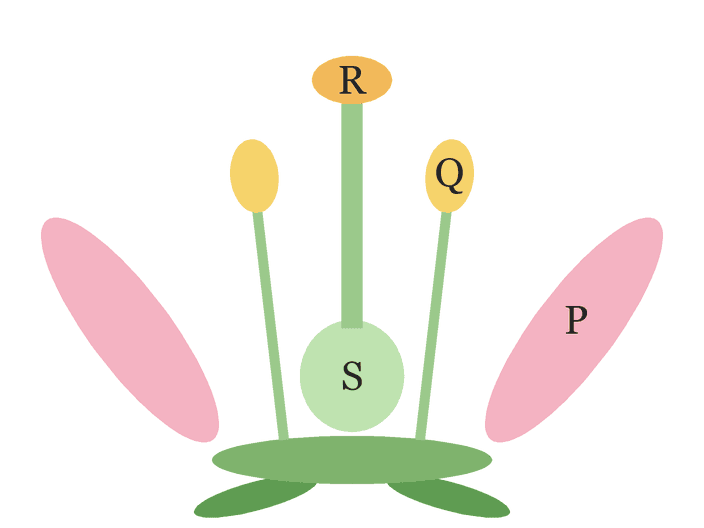
A bee's back is dusted with yellow pollen from another flower of the same kind. On which marked part must the bee leave the pollen for pollination to take place, and which marked part holds the ovules?
- 171 mark
Question 17
Cognitive domain: Analysis
A garden has four flowers, P, Q, R and S. A student counted their parts. (Hypothetical data.)
Flower Sepals Petals Stamens Pistils P 5 5 10 0 Q 5 5 0 1 R 4 4 6 1 S 3 3 0 1 The male flower and the female flower of one kind of plant have the same number of sepals and petals. Which two flowers most likely come from the same kind of plant, as its male flower and its female flower?
- 181 mark
Question 18
Cognitive domain: Evaluation
Assertion (A): Pollination alone does not make a seed.
Reason (R): After pollination, the male gamete from the pollen must still join the female gamete in the ovule.
- 191 mark
Question 19
Cognitive domain: Application
A farmer wants to grow a small patch of maize so that its flowers are pollinated well. Which place should he choose?
- 201 mark
Question 20
Cognitive domain: Analysis
The diagram shows three plants of the same kind. Their flowers a, b, c, d and e are bisexual. A bee made five journeys, numbered 1 to 5. In each journey, the bee carried pollen from the flower at the start of the arrow and left some of it on the stigma of the flower at the head of the arrow.

Which statement is correct?
- 211 mark
Question 21
Cognitive domain: Application & Analysis
A caterpillar eats all the sepals and all the petals of a rose flower. It does not touch the stamens or the pistil. A little later, a bee leaves pollen from another rose flower on the stigma of this flower. Which statement is correct?
- 221 mark
Question 22
Cognitive domain: Evaluation
Assertion (A): Insects are the only agents that carry pollen from one flower to another.
Reason (R): Wind and water can also carry pollen from one flower to another.
- 231 mark
Question 23
Cognitive domain: Understanding
Four events of insect pollination are listed below.
- The pollen sticks to the body of the bee.
- The bee drinks nectar from the flower.
- Some pollen rubs off on the stigma of another flower of the same kind.
- The bee is attracted by the bright petals and the sweet scent of a flower.
Which option puts the events in the correct order?
- 241 mark
Question 24
Cognitive domain: Analysis
Which of these plants has bisexual flowers and is pollinated by insects?
- 251 mark
Question 25
Cognitive domain: Understanding
Which of these new plants could form only because its parent plant first made a flower?
- 262 marks
Question 26
Cognitive domain: Evaluation
Meena says, "A bisexual flower always pollinates itself, because its stamens and its pistil are in the same flower." Is she right? Give a reason.
- 272 marks
Question 27
Cognitive domain: Analysis
Ravi finds a plant in a park. Its flowers are small and green and have no smell. Long anthers hang out of the flowers on thin stalks, and a cloud of yellow dust comes off them when he taps the stem. The stigmas look like tiny feathers.
(a) Which agent most likely pollinates this plant? Give two clues from Ravi's observations. (1 mark)
(b) Ravi's sister says, "This plant must be pollinated by water, because its pollen is so light." Is she right? Give a reason. (1 mark)
- 282 marks
Question 28
Cognitive domain: Application
Saffron (kesar) is grown in Kashmir. It is made of thin red threads that are picked by hand from the centre of the saffron flower. Each red thread is the top part of the female part of the flower, and each flower has 3 such threads.
(a) Name the female part of a flower, and name its top part from which a saffron thread comes. (1 mark)
(b) A farmer needs 600 threads. How many flowers must she pick? (1 mark)
- 292 marks
Question 29
Cognitive domain: Application
A honeybee visits 8 flowers in one minute. It collects nectar for 15 minutes before it flies back to its hive. (Hypothetical data.)
(a) How many flowers does the bee visit in this time? (1 mark)
(b) Why does every visit give a chance for pollination? (1 mark)
- 302 marks
Question 30
Cognitive domain: Evaluation
Tanya wrote three notes about flowers.
- Note 1: Pollination is the transfer of pollen from the stigma to the anther.
- Note 2: Self-pollination needs two plants.
- Note 3: Wind-pollinated flowers have large, bright petals and nectar.
Every note has a mistake. Correct any two of the notes.
- 312 marks
Question 31
Cognitive domain: Application & Analysis
Ravi and Seema both grow pumpkin plants. Ravi plants marigolds all around his pumpkin bed. Seema plants tall grass all around hers. Whose pumpkin plants are likely to give more fruits? Give a reason.
- 323 marks
Question 32
Cognitive domain: Creativity
Anu wants to find out whether bees like yellow flowers more than white flowers. She makes paper flowers of the two colours and puts a drop of sugar syrup in the middle of each one. She places them in a garden, 2 m apart. To make it a fair test:
(a) What should she change between the two kinds of flowers? (1 mark)
(b) Name two things she should keep the same. (1 mark)
(c) What should she count to find the answer? (1 mark)
- 333 marks
Question 33
Cognitive domain: Application & Analysis
In Kamal's papaya orchard, some plants have only male flowers, and the other plants have only female flowers. He wants fruits with seeds. A friend tells him to keep a few plants with male flowers among the plants with female flowers.
(a) Why can a plant with only female flowers not pollinate itself? (1 mark)
(b) How will the pollen reach the female flowers? (1 mark)
(c) What will happen if Kamal removes all the plants with male flowers? (1 mark)
- 343 marks
Question 34
Cognitive domain: Understanding & Application
The diagram shows a flower as seen from above. The four whorls of the flower are marked P, Q, R and S.
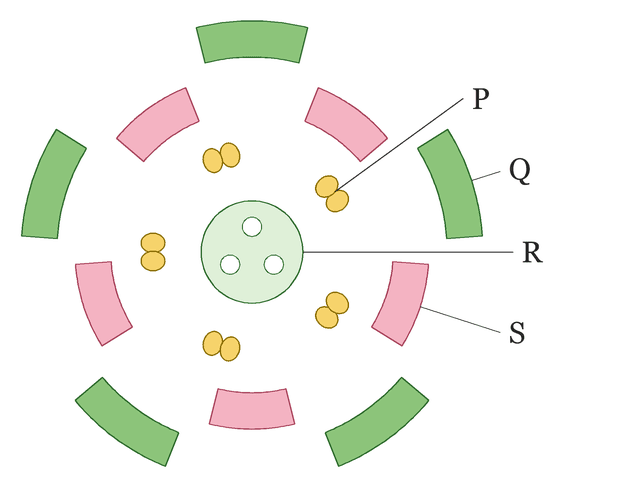
(a) Which letter marks the female part of the flower? (1 mark)
(b) Which letter marks the whorl that protects the flower when it is a bud? Name this whorl. (1 mark)
(c) Which two letters mark the reproductive whorls, the parts that hold the sex cells needed to form a seed? (1 mark)
- 353 marks
Question 35
Cognitive domain: Application & Analysis
A maize field and a mustard field were both in flower when it rained heavily for a whole week.
(a) How could the rain stop the pollination of maize? (1 mark)
(b) How could the rain stop the pollination of mustard? (1 mark)
(c) What is common to your answers in (a) and (b)? (1 mark)
- 363 marks
Question 36
Cognitive domain: Analysis & Application
Dhruv looks at the flowers of his cucumber plant. Flowers of kind X have a thin stalk and stamens covered with yellow pollen, and no swelling below the petals. Flowers of kind Y have a tiny green swelling like a baby cucumber just below the petals, and a sticky top in the centre.
(a) Which kind of flower is male, and which is female? (1 mark)
(b) Which kind can grow into a cucumber, and what must happen first? (1 mark)
(c) Many flowers of kind X dry up and fall off, and no cucumber grows from them. Is this a problem for the plant? Give a reason. (1 mark)
- 374 marks
Question 37
Cognitive domain: Analysis & Evaluation
Rina's class wanted to find out how far the pollen of maize travels. They placed sticky glass slides in a line away from the edge of a maize field and counted the pollen grains on each slide after one hour of gentle breeze. The graph shows their results. (Hypothetical data.)

(a) At which distance did the slide catch the most pollen grains? (1 mark)
(b) How many fewer pollen grains were on the slide at 30 m than on the slide at 10 m? (1 mark)
(c) What does the graph show about the amount of pollen as we move away from the field? Why is it better to grow maize plants close together in a block than a few plants far apart? (2 marks)
- 385 marks
Question 38
Cognitive domain: Application & Creativity
For Science Day, your class is making two cardboard models of flowers. Model X shows a flower that is pollinated by insects. Model Y shows a flower that is pollinated by wind.
(a) Give two features that Model X should have. (2 marks)
(b) Model Y has anthers that hang outside the flower and a feathery stigma. Give one reason for each of these two features. (2 marks)
(c) Suggest a simple way to show how Model Y works, using talcum powder and a small table fan. (1 mark)
- 394 marks
Question 39
Cognitive domain: Analysis & Evaluation
A farmer grew watermelons in three fields, A, B and C. Each field had 40 female flowers. He put different numbers of bee boxes in the fields. After a few weeks, he counted the fruits. (Hypothetical data.)
Field Bee boxes Female flowers Fruits formed A 4 40 34 B 2 40 22 C 0 40 6 (a) In Field B, how many female flowers did not form fruits? (1 mark)
(b) What percentage of the female flowers in Field A formed fruits? (1 mark)
(c) Field C had no bee boxes, but 6 fruits still formed. Explain how. What can the farmer do to get more fruits in Field C? (2 marks)
- 405 marks
Question 40
Cognitive domain: Analysis & Evaluation
Meera watched one rose flower on her bush and wrote down what she saw. (Hypothetical data.)
Day What Meera saw 1 A closed bud, covered by small green leaf-like parts 3 The bud opened. The petals were pink and sweet-smelling. There was yellow powder on the stamens. 4 A bee visited the flower at noon. Later, Meera saw yellow powder on the sticky top of the pistil. 7 The petals dried up and fell off. 15 A small green swelling was growing in the place of the flower. (a) What are the green leaf-like parts on Day 1 called, and what do they do? (1 mark)
(b) Name the yellow powder seen on the pistil on Day 4, and name the process that brought it there. (2 marks)
(c) Meera's friend says, "The swelling on Day 15 would have formed even if no pollen had ever reached the pistil." Do you agree? Give a reason. (2 marks)