
Opening your dashboard
Class 5 Science Chapter 2: Skeletal System Solutions
38 textbook questions with step-by-step answers, free to read, for ICSE 2026-27.
Get talked through Ch 2, not just shown the answer
Reading a finished solution is not the same as being able to do it. The AI tutor takes one question at a time and works it with you, in your own words, until you can.
- Ask it out loud, in your own words
- It gives you the next step, not the answer
- Stuck on part (ii)? Start there
38 questions with solutions
1–5 marks · Mixed difficulty
- 11 mark
Question 1
Name the following.
A cage of bones around the chest
Solve with AIWritten solution
Solution:
Concept: The chest has a cage of curved bones around it. This cage keeps the soft organs inside the chest safe.
Step 1 — Recall the bones of the chest.
There are 12 pairs of thin, curved bones called ribs. At the back they join the backbone, and most of them join a flat bone called the sternum (breastbone) in front.
Step 2 — Name the cage.
Together the ribs, the sternum and the backbone make a cage around the chest. It is called the ribcage. It protects the heart and the lungs.
Therefore, a cage of bones around the chest is called the ribcage.
- 21 mark
Question 2
Name the following.
A joint that allows back and forth movement
Solve with AIWritten solution
Solution:
Concept: A joint is a place where two or more bones meet. Different joints allow different movements.
Step 1 — Think about the movement.
Back and forth movement happens in one direction only, like a door that opens and shuts on its hinges.
Step 2 — Name the joint.
The joint that works like the hinge of a door is the hinge joint. It is found at the elbows, knees, fingers and toes.
Therefore, a joint that allows back and forth movement is the hinge joint.
- 31 mark
Question 3
Name the following.
Part of bone where blood cells are made
Solve with AIWritten solution
Solution:
Concept: Bones are hard on the outside. The inside of a bone is soft and spongy, and long bones have a central space.
Step 1 — Look inside a bone.
The soft, jelly-like material inside a bone is called bone marrow. It has living cells and blood vessels.
Step 2 — Recall its job.
The blood cells of our body are made in the bone marrow.
Therefore, the part of a bone where blood cells are made is the bone marrow.
- 41 mark
Question 4
Name the following.
The position in which you hold your body in while sitting or standing
Solve with AIWritten solution
Solution:
Concept: The way we hold our body has a name, and holding it well keeps our bones and muscles healthy.
Step 1 — Recall the word.
The position in which we hold our body while standing or sitting is called posture.
Step 2 — Link it to health.
A good posture keeps the backbone straight and avoids back pain and neck pain.
Therefore, the position in which we hold our body while sitting or standing is called posture.
- 51 mark
Question 5
Name the following.
The mineral required for strong bones
Solve with AIWritten solution
Solution:
Concept: Bones are hard because they contain minerals. Two important nutrients for strong bones are the mineral calcium and vitamin D.
Step 1 — Separate the mineral from the vitamin.
Vitamin D is a vitamin, not a mineral. It helps the body take in calcium from food.
Step 2 — Name the mineral.
The mineral our bones need most is calcium. Milk, curd and green leafy vegetables give us calcium.
Note: Bones also contain the mineral phosphorus, but calcium is the main mineral for strong bones.
Therefore, the mineral required for strong bones is calcium.
- 61 mark
Question 6
Choose the correct option.
A framework of bones that gives shape and support to our body.
Solve with AIAnswer
(A) Muscle
(B) Skin
(C) Heart
- Correct
(D) Skeleton
Answer: (D) Skeleton
Concept: All the bones of our body together form a framework. This framework is called the skeleton.
Step 1 — What is asked.
We need the name of the framework of bones that gives our body its shape and holds it up.
Step 2 — Choose the answer.
Without bones we could not stand, sit or walk. The framework of bones is the skeleton.
Step 3 — Check the other options.
Each of the other options is wrong for the reason given below.
- (A): Muscles are soft, stretchy bands of tissue. They pull on bones to move them, but they are not bones.
- (B): Skin is the outer covering of the body. It protects us, but it is not made of bones.
- (C): The heart is a muscular organ that pumps blood. It is protected by the ribcage and is not a framework.
Therefore, the framework of bones is the skeleton: option (D).
- 71 mark
Question 7
Choose the correct option.
An adult human body has ______ bones.
Solve with AIAnswer
(A) 304
- Correct
(B) 206
(C) 220
(D) 260
Answer: (B) 206
Concept: A baby is born with more bones than an adult. As the child grows, some small bones join (fuse) together. So an adult has fewer bones.
Step 1 — What is asked.
We need the number of bones in the skeleton of an adult (a grown-up).
Step 2 — Recall the number.
An adult human skeleton has 206 bones.
Step 3 — Check the other options.
Each of the other options is wrong for the reason given below.
- (A): An adult does not have 304 bones. A newborn baby has more bones than an adult, but some of them fuse as the child grows, leaving 206.
- (C): 220 is more than the real count. An adult skeleton has 206 bones.
- (D): 260 is far more than the real count. An adult skeleton has 206 bones.
Note: A newborn baby has about 270 to 300 bones, depending on how the small pieces are counted. That number goes down to 206 as bones fuse.
Therefore, an adult human body has 206 bones: option (B).
- 81 mark
Question 8
Choose the correct option.
The bone marrow does not contain ______.
Solve with AIAnswer
(A) living cells
(B) blood vessels
- Correct
(C) muscles
(D) none of these
Answer: (C) muscles
Concept: Bone marrow is the soft, jelly-like material inside bones. It contains living cells and blood vessels, and blood cells are made in it.
Step 1 — What is asked.
We must find the thing that is NOT found in bone marrow.
Step 2 — Check each item.
Living cells and blood vessels are both found in bone marrow. Muscles are not. Muscles lie outside the bones and are joined to them by tendons.
Step 3 — Choose the answer.
So bone marrow does not contain muscles.
Step 4 — Check the other options.
Each of the other options is wrong for the reason given below.
- (A): Bone marrow does contain living cells. Some of these cells make new blood cells.
- (B): Bone marrow does contain blood vessels. They bring food and oxygen to the marrow and carry new blood cells away.
- (D): This choice would mean the marrow has all three things. It does not have muscles, so one of the items is correct.
Therefore, bone marrow does not contain muscles: option (C).
- 91 mark
Question 9
Choose the correct option.
Which of the following is not true for cartilage?
Solve with AIAnswer
(A) Found between two bones
(B) Tough elastic material
- Correct
(C) Makes blood cells
(D) Found in ear lobes
Answer: (C) Makes blood cells
Concept: Cartilage is a tough but bendy (elastic) material. It covers the ends of bones at a joint, so the bones do not rub against each other. It also gives shape to the nose and the outer ear.
Step 1 — What is asked.
We must find the statement that is NOT true for cartilage.
Step 2 — Recall where blood cells are made.
Blood cells are made in the bone marrow inside bones. Cartilage does not make blood cells.
Step 3 — Choose the answer.
So 'makes blood cells' is not true for cartilage.
Step 4 — Check the other options.
Each of the other options is wrong for the reason given below.
- (A): This is true. Cartilage lies between the ends of two bones at a joint and cushions them.
- (B): This is true. Cartilage is tough and elastic, so it can bend and spring back.
- (D): This is meant as true: the bendy ear flap gets its shape from cartilage (see the note below about the hanging lobe).
Note: Strictly, the soft hanging tip of the ear (where earrings are worn) has no cartilage. The rest of the ear flap is shaped by cartilage, which is why it bends easily.
Therefore, the statement that is not true for cartilage is 'makes blood cells': option (C).
- 101 mark
Question 10
Choose the correct option.
Our body needs sunlight to make ______.
Solve with AIAnswer
- Correct
(A) Vitamin D
(B) Bone marrow
(C) Muscles
(D) Cartilage
Answer: (A) Vitamin D
Concept: When sunlight falls on our skin, the skin makes vitamin D. Vitamin D helps the body take in calcium from food, which keeps bones strong.
Step 1 — What is asked.
We need the thing that our body makes with the help of sunlight.
Step 2 — Recall the fact.
Our skin makes vitamin D when it gets direct sunlight. This is why we should spend some time in the sun every day.
Step 3 — Check the other options.
Each of the other options is wrong for the reason given below.
- (B): Bone marrow is already present inside our bones. It is not made by sunlight.
- (C): Muscles grow when we use them and eat enough protein. Sunlight does not make muscles.
- (D): Cartilage is a tough, bendy material at the joints. Our body does not need sunlight to make it.
Therefore, our body needs sunlight to make vitamin D: option (A).
- 111 mark
Question 11
Choose the correct option.
Our vertebral column is made of ______ bones.
Solve with AIAnswer
(A) 32
(B) 37
(C) 36
- Correct
(D) 33
Answer: (D) 33
Concept: The vertebral column (backbone or spine) is a column of small bones called vertebrae. The backbone has 33 of them.
Step 1 — What is asked.
We need the number of small bones (vertebrae) that make up the backbone.
Step 2 — Recall the number.
The backbone is made of 33 small bones called vertebrae. They are stacked one above the other, with the spinal cord running through their hollow centres.
Step 3 — Check the other options.
Each of the other options is wrong for the reason given below.
- (A): 32 is one less than the 33 vertebrae of the backbone.
- (B): 37 is more than the number of vertebrae in the backbone.
- (C): 36 is more than the number of vertebrae in the backbone.
Note: In a grown-up, the lowest 9 of these bones join together into 2 bones. So an adult's backbone is often counted as 26 bones.
Therefore, our vertebral column is made of 33 bones: option (D).
- 121 mark
Question 12
Fill in the blank using a word from the box: posture, involuntary, voluntary, muscles, smooth.
The soft and stretchy band of tissues are called ______.
Solve with AIWritten solution
Solution:
Concept: Bones cannot move by themselves. Soft, stretchy bands of tissue pull on them to move them.
Step 1 — Recall the name.
The soft and stretchy bands of tissue are called muscles. There are more than 600 muscles in our body.
Step 2 — Check with the word box.
The word 'muscles' is in the box and fits the sentence.
Therefore, the soft and stretchy band of tissues are called muscles.
- 131 mark
Question 13
Fill in the blank using a word from the box: posture, involuntary, voluntary, muscles, smooth.
______ muscles are under our control.
Solve with AIWritten solution
Solution:
Concept: Some muscles work only when we want them to. Others work on their own.
Step 1 — Recall the type.
Muscles that we can move when we want, such as those of the arms and legs, are voluntary muscles.
Step 2 — Check with the word box.
The word 'voluntary' is in the box and fits the sentence.
Therefore, voluntary muscles are under our control.
- 141 mark
Question 14
Fill in the blank using a word from the box: posture, involuntary, voluntary, muscles, smooth.
Cardiac muscles are ______ in nature.
Solve with AIWritten solution
Solution:
Concept: Cardiac muscles are the muscles of the heart. The heart keeps beating day and night, even when we sleep.
Step 1 — Ask whether we control them.
We cannot make our heart stop or start by wishing it. The heart muscle works on its own.
Step 2 — Choose the word.
Muscles that work on their own are called involuntary muscles. The word 'involuntary' is in the box.
Therefore, cardiac muscles are involuntary in nature.
- 151 mark
Question 15
Fill in the blank using a word from the box: posture, involuntary, voluntary, muscles, smooth.
Involuntary muscles are also known as ______ muscles.
Solve with AIWritten solution
Solution:
Concept: Involuntary muscles are found in the walls of internal organs such as the stomach and intestines.
Step 1 — Look at the muscle.
These muscles do not have stripes on them. They look smooth.
Step 2 — Choose the word.
So involuntary muscles are also called smooth muscles. The word 'smooth' is in the box.
Therefore, involuntary muscles are also known as smooth muscles.
- 161 mark
Question 16
Fill in the blank using a word from the box: posture, involuntary, voluntary, muscles, smooth.
Sleeping on very high pillow can affect our ______.
Solve with AIWritten solution
Solution:
Concept: Posture is the position in which we hold our body. It matters while sitting, standing and even while sleeping.
Step 1 — Think about a very high pillow.
A very high pillow bends the neck upwards all night. This bends the top of the backbone out of its natural shape.
Step 2 — Choose the word.
So a very high pillow spoils the way we hold our body, which is our posture. The word 'posture' is in the box.
Therefore, sleeping on a very high pillow can affect our posture.
- 171 mark
Question 17
Write T for True statements or F for False statements.
The number of bones in a human body increases as we grow up.
Solve with AIWritten solution
Solution:
Concept: A newborn baby has about 270 to 300 bones. An adult has 206 bones.
Step 1 — Compare the numbers.
A baby has more bones than an adult. As a child grows, some bones join (fuse) together, for example the bones of the skull and the lower backbone.
Step 2 — Decide.
So the number of bones goes down as we grow up. It does not increase. The statement is false.
Therefore, the statement is False (F): the number of bones decreases as we grow up, because some bones fuse together.
- 181 mark
Question 18
Write T for True statements or F for False statements.
Voluntary muscles have stripes on them.
Solve with AIWritten solution
Solution:
Concept: Voluntary muscles are joined to the bones, so they are also called skeletal muscles.
Step 1 — Recall how they look.
Under a microscope, voluntary (skeletal) muscles show stripes across them. Smooth muscles have no stripes.
Step 2 — Decide.
The statement matches this fact, so it is true.
Therefore, the statement is True (T).
- 191 mark
Question 19
Write T for True statements or F for False statements.
The vertebral column protects the delicate umbilical cord.
Solve with AIWritten solution
Solution:
Concept: The vertebral column (backbone) is hollow in the centre. It encloses and protects the delicate spinal cord, which comes down from the brain.
Step 1 — Find what the backbone protects.
The soft spinal cord runs through the hollow centres of the vertebrae. The backbone protects the spinal cord.
Step 2 — Check the word in the statement.
The statement says 'umbilical cord'. The umbilical cord is a different thing: it joins an unborn baby to its mother and is cut soon after birth. It has nothing to do with the backbone.
Step 3 — Decide.
So, as it is printed, the statement is false.
Note: The word 'umbilical' here is most likely a printing slip for 'spinal'. If the statement said 'spinal cord', it would be True.
Therefore, the statement is False (F): the vertebral column protects the spinal cord.
- 201 mark
Question 20
Write T for True statements or F for False statements.
The ligaments are the strong tissues that hold the bones together.
Solve with AIWritten solution
Solution:
Concept: At a joint, two bones must stay together while they move.
Step 1 — Recall the ligaments.
Ligaments are strong, stretchy straps of tissue. They join one bone to another bone at a joint and stop the joint from slipping out of place.
Step 2 — Decide.
The statement matches this fact, so it is true.
Watch out: Do not mix up ligaments and tendons. Ligaments join bone to bone, and tendons join muscle to bone.
Therefore, the statement is True (T).
- 211 mark
Question 21
Write T for True statements or F for False statements.
The ribcage protects our brain.
Solve with AIWritten solution
Solution:
Concept: Different parts of the skeleton protect different organs.
Step 1 — Recall what the ribcage protects.
The ribcage is around the chest. It protects the heart and the lungs.
Step 2 — Recall what protects the brain.
The brain is protected by the skull.
Step 3 — Decide.
So the statement is false.
Therefore, the statement is False (F): the skull protects the brain, and the ribcage protects the heart and lungs.
- 221 mark
Question 22
Write where do we find these joints in our body.
The hinge joint
Solve with AIWritten solution
Solution:
Concept: A hinge joint works like the hinge of a door. It lets bones move in one direction only, forward and backward.
Step 1 — Think of body parts that fold like a door.
We bend our elbow, our knee, and our fingers and toes in one direction only.
Step 2 — Write the places.
So hinge joints are found at the elbows, knees, fingers and toes.
Therefore, the hinge joint is found at the elbows, knees, fingers and toes.
- 231 mark
Question 23
Write where do we find these joints in our body.
The ball and socket joint
Solve with AIWritten solution
Solution:
Concept: In a ball and socket joint, the round end (ball) of one bone fits into a cup (socket) of another bone. It allows movement in all directions.
Step 1 — Think of parts that swing in a full circle.
We can swing our arm round in a circle at the shoulder, and move our leg in many directions at the hip.
Step 2 — Write the places.
So ball and socket joints are found at the shoulders and hips.
Therefore, the ball and socket joint is found at the shoulders and hips.
- 241 mark
Question 24
Write where do we find these joints in our body.
The pivot joint
Solve with AIWritten solution
Solution:
Concept: A pivot joint lets one bone turn around another, like a key turning in a lock.
Step 1 — Think of the head turning.
When we turn our head to look left and right, it turns on the top of the backbone.
Step 2 — Write the place.
So the pivot joint is found in the neck, where the head joins the backbone.
Note: More exactly, the pivot joint is between the first two bones at the top of the backbone. The top bone turns around a peg on the second bone, and the skull turns with it.
Therefore, the pivot joint is found in the neck, where the skull joins the backbone.
- 251 mark
Question 25
Write where do we find these joints in our body.
The gliding joint
Solve with AIWritten solution
Solution:
Concept: A gliding joint is found between the flat surfaces of small bones. The bones slide (glide) over each other.
Step 1 — Think of small bones that slide.
Our wrist and ankle are made of many small bones that slide over each other when we bend and twist our hands and feet.
Step 2 — Write the places.
So gliding joints are found in the wrists and ankles.
Therefore, the gliding joint is found in the wrists and ankles.
- 265 marks
Question 26
Match the columns.
Column A Column B 1. Jelly like substance a. Cartilage 2. Tough and elastic substance b. Lower leg 3. Made of two bones c. Muscles 4. Soft and stretchy d. Back pain 5. Bad posture e. Bone marrow Solve with AIWritten solution
Solution:
Concept: Each item in Column A describes one part of the body, one material or one effect. We match each description with the thing it describes.
Step 1 — Match item 1.
The jelly-like substance inside bones is the bone marrow. So 1 matches e.
Step 2 — Match item 2.
The tough and elastic substance at the ends of bones is cartilage. So 2 matches a.
Step 3 — Match item 3.
The lower leg is made of two bones, the tibia and the fibula. So 3 matches b.
Step 4 — Match item 4.
Muscles are soft and stretchy bands of tissue. So 4 matches c.
Step 5 — Match item 5.
Bad posture can lead to back pain. So 5 matches d.
Step 6 — Write the answer as a table.
The matched pairs are shown below.
Column A Column B 1. Jelly like substance e. Bone marrow 2. Tough and elastic substance a. Cartilage 3. Made of two bones b. Lower leg 4. Soft and stretchy c. Muscles 5. Bad posture d. Back pain Therefore, 1 matches e, 2 matches a, 3 matches b, 4 matches c and 5 matches d.
- 272 marks
Question 27
What are the four parts of the skeleton?
Solve with AIWritten solution
Solution:
Concept: The skeleton is the framework of all the bones in our body. It can be divided into four main parts.
Step 1 — List the parts of the head and trunk.
The skull is the bony case of the head. The ribcage is around the chest. The backbone (vertebral column) runs down the middle of the back.
Step 2 — List the arms and legs.
The limbs are the arms (forelimbs) and the legs (hindlimbs).
Therefore, the four parts of the skeleton are the skull, the ribcage, the backbone and the limbs.
- 282 marks
Question 28
Write the names of the bones found in hind limbs and forelimbs.
Solve with AIWritten solution
Solution:
Concept: Our forelimbs are the arms and our hindlimbs are the legs. Each limb has an upper part and a lower part.
Step 1 — Bones of the hindlimbs (legs).
The upper leg has the thigh bone, called the femur. It is the longest bone in the body. The lower leg has two bones, the tibia and the fibula.
Step 2 — Bones of the forelimbs (arms).
The upper arm has one long bone, the humerus. The lower arm has two bones, the radius and the ulna.
Step 3 — Show them in a table.
The bones are shown below.
Limb Upper part Lower part Hindlimb (leg) Femur Tibia and fibula Forelimb (arm) Humerus Radius and ulna Note: The hands and feet also have many small bones, and the knee has a kneecap. The arms are joined to the backbone through the collar bones and shoulder blades.
Therefore, the hindlimbs have the femur, tibia and fibula, and the forelimbs have the humerus, radius and ulna.
- 292 marks
Question 29
How many bones are there in our spine?
Solve with AIWritten solution
Solution:
Concept: The spine (backbone or vertebral column) is a strong column of small bones called vertebrae.
Step 1 — Count the vertebrae.
The spine is made of 33 small bones (vertebrae), stacked one above the other.
Step 2 — Say why it has so many bones.
Because it has many small bones instead of one long bone, the spine can bend and twist. It is hollow in the centre and protects the spinal cord.
Note: In a grown-up, the lowest 9 vertebrae join together into 2 bones, so an adult's spine is often counted as 26 bones.
Therefore, there are 33 bones (vertebrae) in our spine.
- 302 marks
Question 30
What are floating ribs?
Solve with AIWritten solution
Solution:
Concept: The ribcage has 12 pairs of ribs. At the back, all of them are joined to the backbone. In front, most of them are joined to a flat bone called the sternum.
Step 1 — Find the ribs that are different.
The last two pairs of ribs (the 11th and 12th pairs) are not joined to the sternum in front.
Step 2 — Explain the name.
Their front ends are free, so these ribs seem to 'float'. That is why they are called floating ribs.
Therefore, floating ribs are the last two pairs of ribs, which are joined to the backbone but not to the sternum in front.
- 312 marks
Question 31
How many types of movable joints are there in our body? Name them.
Solve with AIWritten solution
Solution:
Concept: Movable joints are joints that let our bones move. Each type allows a different kind of movement.
Step 1 — Count the types.
There are four types of movable joints in our body.
Step 2 — Name them with an example each.
The four types are listed below.
- Hinge joint, at the elbow and knee.
- Ball and socket joint, at the shoulder and hip.
- Pivot joint, in the neck.
- Gliding joint, in the wrist and ankle.
Therefore, there are four types of movable joints: hinge, ball and socket, pivot and gliding joints.
- 322 marks
Question 32
What are tendons?
Solve with AIWritten solution
Solution:
Concept: Muscles move bones by pulling on them. To pull a bone, a muscle must be firmly joined to it.
Step 1 — Say what tendons are.
Tendons are strong fibres (tissue) at the ends of muscles.
Step 2 — Say what they do.
They join muscles to bones. When a muscle becomes shorter, it pulls the tendon, and the tendon pulls the bone, so the bone moves.
Watch out: Tendons join muscle to bone, but ligaments join bone to bone.
Therefore, tendons are strong fibres that join muscles to bones.
- 335 marks
Question 33
What are the functions of the skeletal system?
Solve with AIWritten solution
Solution:
Concept: The skeletal system is made of all the bones of our body. It does several important jobs.
Step 1 — Support and shape.
It gives support to our body and holds it up, so we can stand and sit. It also gives shape to our body and face.
Step 2 — Movement.
Along with the muscles, it helps us move, for example in walking and running. Muscles pull on the bones at the joints.
Step 3 — Protection.
It protects soft internal organs. The skull protects the brain, the ribcage protects the heart and lungs, and the backbone protects the spinal cord.
Step 4 — Making blood cells.
The bone marrow inside bones makes blood cells.
Step 5 — Storing minerals.
Bones store calcium and phosphorus, which the body needs for many kinds of work.
Therefore, the skeletal system gives support and shape, helps in movement, protects internal organs, makes blood cells and stores calcium and phosphorus.
- 343 marks
Question 34
What is the difference between skeletal muscles and smooth muscles?
Solve with AIWritten solution
Solution:
Concept: Skeletal muscles are voluntary muscles that are joined to bones. Smooth muscles are involuntary muscles found in the walls of internal organs.
Step 1 — Compare where they are found.
Skeletal muscles are joined to the bones, for example in the arms, legs, neck and shoulders. Smooth muscles are found in internal organs such as the stomach and intestines.
Step 2 — Compare control.
We can control skeletal muscles; they work when we want them to. Smooth muscles work on their own, without our control.
Step 3 — Compare how they look.
Skeletal muscles have stripes on them. Smooth muscles have no stripes.
Step 4 — Show the differences in a table.
The three differences are shown below.
Skeletal muscles Smooth muscles Joined to bones (arms, legs, neck) In internal organs (stomach, intestines) Voluntary: under our control Involuntary: work on their own Have stripes Have no stripes Therefore, skeletal muscles are joined to bones, are under our control and have stripes, while smooth muscles are in internal organs, work on their own and have no stripes.
- 353 marks
Question 35
What is cartilage? How is it useful for our body?
Solve with AIWritten solution
Solution:
Concept: Cartilage is a tough, elastic (bendy) material. It is not hard like bone.
Step 1 — Say what cartilage is.
Cartilage is a tough elastic substance that covers the ends of bones where they meet at a joint.
Step 2 — First use: it cushions the joint.
It acts like a cushion between two bones. It stops the bones from rubbing directly against each other, which would cause pain and wear the bones down.
Step 3 — Second use: it gives bendy shape.
It gives shape to parts that need to bend, such as the tip of the nose and the outer ear. That is why we can bend these parts easily.
Therefore, cartilage is a tough elastic substance at the ends of bones; it cushions joints so the bones do not rub, and it gives a bendy shape to the nose and outer ear.
- 363 marks
Question 36
Why is it important to hold good posture?
Solve with AIWritten solution
Solution:
Concept: Posture is the position in which we hold our body while standing, sitting or even lying down.
Step 1 — Good posture keeps the skeleton healthy.
A good posture keeps the backbone in its natural shape, so the bones, joints and muscles are not strained.
Step 2 — Bad posture causes health problems.
Bad posture, such as slouching or sleeping on a very high pillow, can lead to back pain, neck pain and headache. It can even affect digestion.
Step 3 — Good posture helps us feel and look well.
Good posture helps us stay healthy and makes us look more confident.
Therefore, good posture is important because it keeps the backbone and muscles healthy, prevents back pain, neck pain and headache, and helps us look confident.
- 375 marks
Question 37
Label the following in the picture of the skeleton given below.
ribcage, femur, humerus, skull, vertebral column, pivot joint, hinge joint, gliding joint, ball and socket joint
 Solve with AI
Written solution
Solution:
Concept: The skeleton has four main parts: the skull, the ribcage, the backbone and the limbs. Movable joints are found where bones of the limbs, neck and wrist meet.
Step 1 — Label the main bones.
Each bone is found as described below.
- Skull: the bony case of the head.
- Vertebral column: the column of small bones down the middle of the back.
- Ribcage: the cage of curved bones around the chest.
- Humerus: the single long bone of the upper arm.
- Femur: the long thigh bone of the upper leg.
Step 2 — Label the joints.
Each joint is found as described below.
- Pivot joint: at the top of the neck, where the head turns on the backbone.
- Ball and socket joint: at the shoulder (the hip also has one).
- Hinge joint: at the elbow (the knee also has one).
- Gliding joint: at the wrist (the ankle also has gliding joints).
Step 3 — See the labelled picture.
The labelled skeleton is shown below.
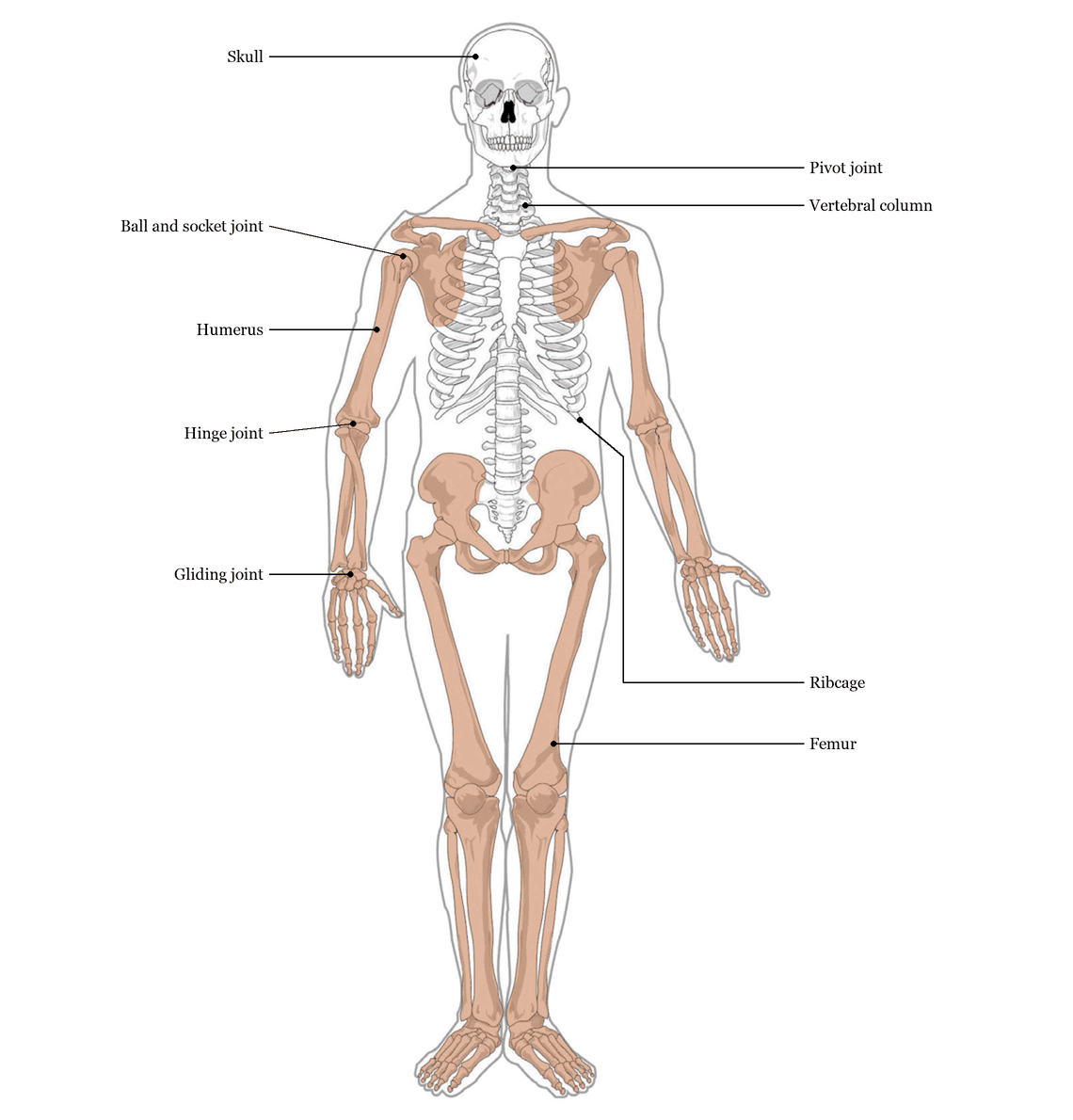
Therefore, the skull, vertebral column, ribcage, humerus, femur, pivot joint (neck), ball and socket joint (shoulder), hinge joint (elbow) and gliding joint (wrist) are labelled as shown in the picture.
- 383 marks
Question 38
Rohan is a very naughty boy. He fell down while running down the stairs and broke his bone which is above the wrist and below the elbow. Which bone/bones it could be? Name it. The doctor applied plaster on Rohan's hand and said that the bone will heal in two months. Find out how bones repair the fracture.
Solve with AIWritten solution
Solution:
Concept: The part of the arm between the elbow and the wrist is the lower arm. Bones are living parts of the body, so a broken bone (a fracture) can join again.
Step 1 — Find the broken bone.
The lower arm, between the elbow and the wrist, has two bones: the radius and the ulna. So Rohan broke his radius, his ulna, or both.
Step 2 — Say why the plaster is used.
The plaster holds the broken pieces still and in the right line. If the pieces moved, they could join in a wrong shape.
Step 3 — Say how the bone starts to heal.
Right after the break, blood collects at the broken ends and forms a clot. Within a few days, living bone cells start to make soft new tissue that bridges the gap between the two pieces.
Step 4 — Say how the bone becomes hard again.
Over the next weeks, calcium is laid down in this soft tissue, so it slowly turns into hard new bone. Later the new bone is smoothed and reshaped until it is strong again. This is why the doctor said it would take about two months.
Note: Food with calcium, vitamin D and protein, such as milk, curd, eggs and pulses, helps a broken bone heal.
Therefore, Rohan broke his radius or ulna (or both), and the bone repairs itself: a clot forms, living bone cells make soft new tissue that joins the pieces, and calcium slowly hardens it into new bone while the plaster keeps the pieces in place.
What Class 5 Science Ch 2 covers
The sections of the chapter, in the order the book takes them. Every question above comes from one of these.
- 01Functions
- 02Structure of bones
- 03Skull, ribcage, backbone, limbs
- 04Joints – movable and immovable
- 05Muscles and movement
- 06Healthy bones and muscles
More ways to study this chapter
The same chapter asked three other ways. Practise it, revise it, and see what the board has set on Ch 2 before.
Class 5 Science Ch 2 questions students ask
How many questions are there in Class 5 Science Ch 2?
38 questions. Every one is solved step by step on this page.
Are these Class 5 Science solutions free?
Yes. Every question and its full working is free to read, with no account needed.
Can I download the Class 5 Science Ch 2 solutions as a PDF?
There is no PDF to download. Every solution is on this page instead, which means it is searchable, always the current syllabus, and readable on a phone. Use your browser's print option if you want it on paper.