
Opening your dashboard
Class 5 Science Chapter 2 Skeletal System: Competency-Based Questions (CBQ)
40 questions on Chapter 2, each worked through on its own page with the AI tutor. Class 5 Science, ICSE 2026-27.
40 questions
1–5 marks · Mixed difficulty
- 11 mark
Question 1
Cognitive domain: Application
In a cricket match, Riya bowls the ball. She swings her straight arm in a big full circle before she lets the ball go. Which joint lets her arm move in a full circle?
- 21 mark
Question 2
Cognitive domain: Analysis
During a yoga class, the teacher asks the children to bend their knees. Sam notices that he can bend his knee backwards and straighten it, but he cannot bend it sideways.
Assertion (A): Our knee cannot bend sideways.
Reason (R): The knee has a hinge joint, which lets bones move in one direction only, forward and backward.
- 31 mark
Question 3
Cognitive domain: Application
Ayaan picks up his school bag. He bends his elbow to lift the bag up to his chest. Which muscle becomes shorter and pulls his lower arm up?
- 41 mark
Question 4
Cognitive domain: Analysis & Evaluation
The school doctor gives advice to Class 5 for strong bones.
Assertion (A): Children should drink milk and also play outdoors in the sunlight for some time every day.
Reason (R): Sunlight gives our bones the calcium that they need.
- 51 mark
Question 5
Cognitive domain: Understanding
A science teacher shows the class a cut piece of a long bone from a goat, bought at the butcher's shop. Inside the hard outer layer, the children see a soft, jelly-like material in the central space. Which statement about this soft material is correct?
- 61 mark
Question 6
Cognitive domain: Analysis & Evaluation
Assertion (A): We can make our heart stop beating for a minute whenever we wish.
Reason (R): The heart is made of cardiac muscle, which is involuntary in nature.
- 71 mark
Question 7
Cognitive domain: Application
Before crossing the road, Meena looks to her right, then to her left, then to her right again. She turns only her head and keeps her shoulders still. Name the type of joint that lets her turn her head like this.
- 81 mark
Question 8
Cognitive domain: Understanding
A newborn baby has about 270 to 300 bones. Her grandfather has 206 bones. Where did the baby's 'extra' bones go when the grandfather was growing up?
- 91 mark
Question 9
Cognitive domain: Analysis
Dadaji says that his knee hurts when he walks. The doctor says that the smooth, bendy layer at the ends of his knee bones has worn thin. Why does this make walking painful?
- 102 marks
Question 10
Cognitive domain: Evaluation
Sana does her homework lying on her stomach on her bed. She bends her neck down over her notebook, which is very close to her eyes.
(a) Give one problem this posture could cause her. (1 mark)
(b) Suggest one better way for Sana to sit while doing homework. (1 mark)
- 112 marks
Question 11
Cognitive domain: Analysis
Kiran wrote down what he ate in one day. (Hypothetical data.)
Meal Food eaten Breakfast A glass of milk and an egg Lunch Rice, spinach and a bowl of curd Evening A handful of nuts Dinner Roti and chickpea curry (a) Name two foods from his list that help to make his bones strong. (1 mark)
(b) Name two foods from his list that help to build strong muscles. (1 mark)
- 122 marks
Question 12
Cognitive domain: Analysis
Tanvi says, "One muscle is enough to move my arm. It pulls my lower arm up and then pushes it down again."
(a) What is wrong with Tanvi's idea? (1 mark)
(b) Which muscle straightens her arm again after the biceps has bent it? (1 mark)
- 133 marks
Question 13
Cognitive domain: Creating & Evaluation
For a science project, Arjun makes a model arm. He joins two cardboard strips with a paper fastener at one end, so that the lower strip can swing up and down. He ties one rubber band from the top strip to the front of the lower strip, and another rubber band from the top strip to the back of the lower strip.
(a) What do the cardboard strips and the paper fastener stand for? (1 mark)
(b) What do the two rubber bands stand for? (1 mark)
(c) Why did Arjun need two rubber bands and not one? (1 mark)
- 144 marks
Question 14
Cognitive domain: Application & Evaluation
While playing football, Nikhil lands badly on his foot. His ankle twists and starts to swell. The doctor says that the strong straps holding the ankle bones together have been stretched too much. This injury is called a sprain.
(a) What are the straps that hold bones together at a joint called? (1 mark)
(b) What are the strong fibres that join muscles to bones called? (1 mark)
(c) Nikhil's friends want to help him at once. Suggest two correct first-aid steps. (2 marks)
- 155 marks
Question 15
Cognitive domain: Analysis & Evaluation
Four friends of Class 5 noted their habits for one week. (Hypothetical data.)
Name Time outdoors in daylight each day Milk or curd each day Exercise or active play each day Asha 1 hour 2 glasses 1 hour Bunty 10 minutes none none (watches TV) Chitra 45 minutes 1 glass 1 hour Dev 1 hour none 30 minutes (a) Who has the habits that are least helpful for strong bones and muscles? Give one reason. (1 mark)
(b) Dev plays outdoors but does not take milk or curd. Which nutrient for his bones may he be getting too little of? (1 mark)
(c) Why is time outdoors in daylight good for the bones? (1 mark)
(d) Give Bunty two pieces of advice for healthy bones and muscles. (2 marks)
- 161 mark
Question 16
Cognitive domain: Understanding
Riya's class makes four simple models to show how different joints of the body work. The models are: a door hinge (P), a rod that turns inside a ring (Q), a ball that fits into a cup (R) and two flat plates that lie one over the other (S).
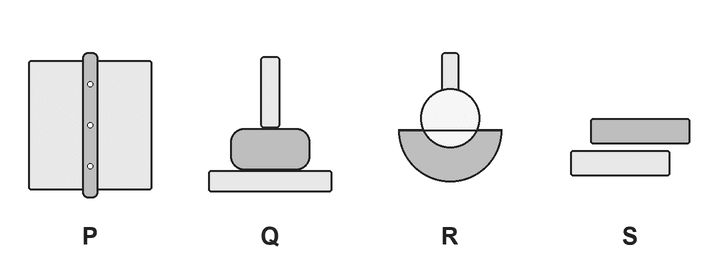
Which model best shows the joint at the hip, which lets the leg swing in all directions?
- 171 mark
Question 17
Cognitive domain: Analysis
A doctor explains the jobs of the skeleton to Class 5.
Assertion (A): Bones help the body to make red blood cells.
Reason (R): Bones act as a store for the minerals calcium and phosphorus.
- 181 mark
Question 18
Cognitive domain: Understanding
A teacher holds up a model of the skull in class. Aman notices that it has many holes and asks why a skull that guards the brain is not one closed ball of bone. Which answer is correct?
- 191 mark
Question 19
Cognitive domain: Application
After a heavy dinner, Anil falls fast asleep on the sofa. His arms and legs are relaxed and he is not thinking about anything. Which muscles of his body are still working?
- 201 mark
Question 20
Cognitive domain: Analysis
Neha gently folds the top of her outer ear (the ear flap) while combing her hair and finds that it bends easily.
Assertion (A): The outer ear can be bent easily without breaking.
Reason (R): The outer ear is shaped by bone, which is a hard substance.
- 211 mark
Question 21
Cognitive domain: Analysis
The diagram shows two bones that meet at a joint. P is a thin layer on the ends of the two bones. Q is a strong, stretchy strap that joins one bone to the other.
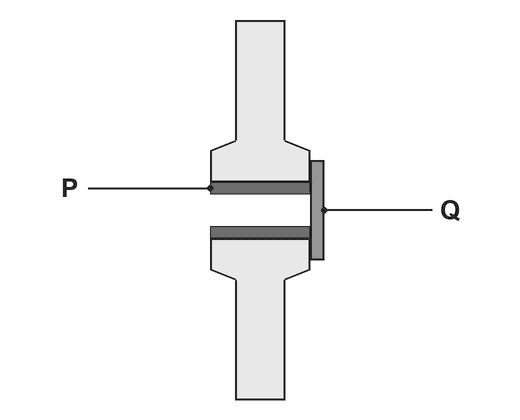
What could happen if the strap Q is badly torn?
- 221 mark
Question 22
Cognitive domain: Analysis
Neha does push-ups every day. Om does them only once a week. Their teacher counts how many push-ups each of them can do in a weekly test. The graph shows the results for 6 weeks. (Hypothetical data.)
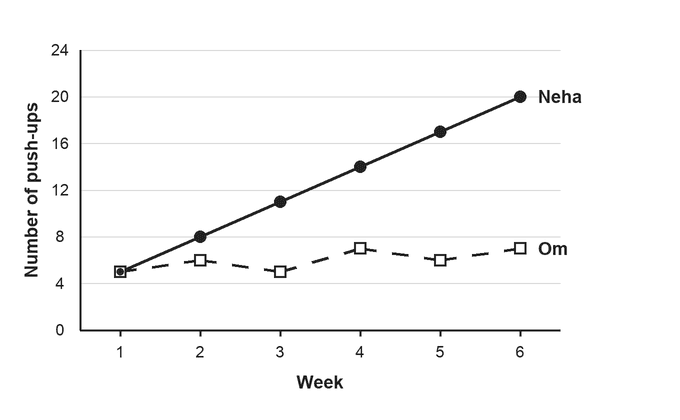
Which conclusion is supported by the graph?
- 231 mark
Question 23
Cognitive domain: Application
A craftsman makes a model of the human ribcage. He uses 12 pairs of curved canes for the ribs. He fixes every cane to the model breastbone (sternum) in front, except the floating ribs. How many canes does he fix to the breastbone?
- 241 mark
Question 24
Cognitive domain: Evaluation
Raju says, "The bones of our body have only one job: they help us to stand and walk." Which of the following is another job of the bones that shows Raju is wrong?
- 251 mark
Question 25
Cognitive domain: Application
A fact card in the school library says: "The two hands and the two feet of an adult together have 106 bones. Each hand has 27 bones." Both feet have the same number of bones. How many bones does each foot have?
- 262 marks
Question 26
Cognitive domain: Evaluation
Kabir rides a bicycle to school. His father makes him wear a helmet every day. Kabir says, "My skull is already hard, so I do not need a helmet."
(a) Which part of the skeleton protects the brain? (1 mark)
(b) Give one reason why Kabir should still wear the helmet. (1 mark)
- 272 marks
Question 27
Cognitive domain: Analysis
The bones of the skull are joined by immovable joints, but the bones of the leg meet at movable joints such as the knee.
(a) Name one place in the body, other than the skull, where there is an immovable joint. (1 mark)
(b) Explain why it is good for us that the bones of the skull do not move against each other. (1 mark)
- 282 marks
Question 28
Cognitive domain: Analysis
After Prisha's broken arm healed, the doctor removed the plaster. Prisha saw that her arm looked thinner than her other arm and felt weak.
(a) Why did the muscles of the arm become thinner and weaker? (1 mark)
(b) What can Prisha do to make the arm muscles strong again? (1 mark)
- 292 marks
Question 29
Cognitive domain: Creating
Class 5 is making a poster for the school notice board. The poster is called "Strong Bones, Strong Muscles".
(a) Write a short slogan (one line) for the poster. (1 mark)
(b) Write two facts from the lesson that the poster should show. (1 mark)
- 302 marks
Question 30
Cognitive domain: Understanding
Think about two situations.
Situation 1: A person has muscles but has no bones in the body.
Situation 2: A person has bones but the muscles do not work.
(a) What would be missing in Situation 1? (1 mark)
(b) What would be missing in Situation 2? (1 mark)
- 312 marks
Question 31
Cognitive domain: Application
A fact card says: "172 of the 206 bones in an adult's body are part of a pair, like the two thigh bones. The remaining bones are single bones."
(a) How many bones in the body are single bones? (1 mark)
(b) Name one part of the body where single (unpaired) bones are found. (1 mark)
- 323 marks
Question 32
Cognitive domain: Creating
Rhea wants to show her class how the ribcage protects the heart and the lungs. She has a soft sponge ball, some curved bamboo strips, a long cardboard strip, a short cardboard strip, thread and tape.
(a) What can she use to stand for the heart and lungs, and what for the ribs? (1 mark)
(b) How can she show the breastbone (sternum) and the backbone in her model? (1 mark)
(c) How can she test whether her model protects the "heart and lungs"? (1 mark)
- 333 marks
Question 33
Cognitive domain: Analysis
Mohan hurt his elbow while playing. The doctor wrapped his elbow in a stiff splint, so that he cannot bend it. His shoulder is free.
(a) Which type of joint is at the elbow? (1 mark)
(b) Can Mohan still swing his whole arm in a big circle? Give a reason. (1 mark)
(c) Name one thing that Mohan cannot do easily with that hand while the splint is on. (1 mark)
- 343 marks
Question 34
Cognitive domain: Evaluation
Three friends talk about muscles.
Mira says, "Muscles push the bones to make them move."
Hari says, "I can make the muscles of my stomach and intestines move whenever I wish."
Zoya says, "The muscles of my arms have stripes on them and I can control them."
For each friend, say whether the statement is right or wrong. If it is wrong, write the correct statement. (1 mark each)
- 353 marks
Question 35
Cognitive domain: Application
In yoga class, Pooja does the Cobra pose (Bhujangasana). She lies on her stomach and puts her hands beside her shoulders. She presses down on her hands and lifts her body from the waist up, arching her spine backwards. Her hips stay on the floor.
(a) Which part of the skeleton is arched backwards in this pose? (1 mark)
(b) Name one group of muscles that this pose makes stronger. (1 mark)
(c) Why is it better for Pooja to do such exercises regularly than only once? (1 mark)
- 363 marks
Question 36
Cognitive domain: Analysis
A bicycle maker tests two steel rods of the same length and the same outer width. Rod X is solid. Rod Y is a hollow tube. (Hypothetical data.)
Rod X (solid) Rod Y (hollow tube) Mass of the rod 500 g 300 g Load the rod can hold before it bends 20 kg 17 kg (a) How much lighter is Rod Y than Rod X? (1 mark)
(b) How much less load can Rod Y hold than Rod X? (1 mark)
(c) The long bones of our arms and legs are built like tubes. Use the table to give one reason why this is useful. (1 mark)
- 374 marks
Question 37
Cognitive domain: Analysis
Sunita does an experiment with a clean, dry chicken leg bone, under her teacher's guidance. She soaks it in vinegar, which slowly removes the calcium from the bone. Every two days she holds one end of the bone and presses the other end, and measures how far it bends. (Hypothetical data.)
Day 0 2 4 6 8 How far the bone bends (mm) 0 4 10 18 25 (a) How far could the bone bend on day 4? (1 mark)
(b) Did the bone become harder or softer as the days passed? (1 mark)
(c) What does this experiment tell us about the job of calcium in the bones? Use it to explain why children need calcium and vitamin D. (2 marks)
- 385 marks
Question 38
Cognitive domain: Evaluation
A doctor visits Class 5 and records the school bags of five children. The doctor says, "A school bag should weigh no more than one-tenth of the child's body weight." (Hypothetical data.)
Child Body weight (kg) Weight of school bag (kg) How the bag is carried Back pain? Aarav 30 5 on one shoulder Yes Bela 35 3 on both shoulders No Chetan 32 4 on one shoulder Yes Divya 28 2 on both shoulders No Esha 33 3 on one shoulder Yes (a) Whose school bags are heavier than the doctor's limit? (1 mark)
(b) What do all the children with back pain have in common? Name the part of the skeleton that is affected. (2 marks)
(c) Give Aarav two pieces of advice to protect his back. (2 marks)
- 394 marks
Question 39
Cognitive domain: Evaluation
Anil wrote a revision table for the lesson on the skeletal system. Two of his rows have a mistake.
Part Anil's fact Skull It has 22 bones and protects the brain. Ribcage It has 12 pairs of ribs and protects the spinal cord. Hinge joint It is found at the elbow and the knee, and allows movement in all directions. Cardiac muscle It is found in the heart and works on its own. (a) Which two rows have a mistake? (1 mark)
(b) Write the correct fact for each of those two rows. (2 marks)
(c) Name the part of the skeleton that protects the spinal cord. (1 mark)
- 404 marks
Question 40
Cognitive domain: Analysis
Dev reads about foods that help to make strong bones. His school diary gives the amount of calcium in 100 g of some foods. (Hypothetical data.)
Food (100 g) Calcium (mg) Milk 120 Curd 150 Spinach 75 Rice 10 Apple 6 (a) Which food in the table has the most calcium in 100 g? (1 mark)
(b) Name two foods in the table that the lesson names as good for bones. (1 mark)
(c) Dev eats 200 g of curd and 100 g of spinach in a day. How much calcium does he get from these two foods? (2 marks)