
Opening your dashboard
Class 5 Science Chapter 11: Simple Machines Solutions
35 textbook questions with step-by-step answers, free to read, for ICSE 2026-27.
Get talked through Ch 11, not just shown the answer
Reading a finished solution is not the same as being able to do it. The AI tutor takes one question at a time and works it with you, in your own words, until you can.
- Ask it out loud, in your own words
- It gives you the next step, not the answer
- Stuck on part (ii)? Start there
35 questions with solutions
1–5 marks · Mixed difficulty
- 11 mark
Question 1
Give two examples of the following.
Class 1 lever
Solve with AIWritten solution
Solution:
Concept: In a class 1 lever, the fulcrum is between the load and the effort.
Step 1 — What is asked.
We need two objects that work as class 1 levers.
Step 2 — Recall a see-saw.
In a see-saw, the support in the middle is the fulcrum. One child is the load and the other child gives the effort. The fulcrum is between them.
Step 3 — Recall a pair of scissors.
In a pair of scissors, the point where the two blades are joined is the fulcrum. The paper being cut is the load, and our fingers give the effort. The joint is between them.
Note: A beam balance and a pair of pliers are also class 1 levers.
Therefore, two examples of a class 1 lever are a see-saw and a pair of scissors.
- 21 mark
Question 2
Give two examples of the following.
Class 2 lever
Solve with AIWritten solution
Solution:
Concept: In a class 2 lever, the load is between the fulcrum and the effort.
Step 1 — What is asked.
We need two objects that work as class 2 levers.
Step 2 — Recall a wheelbarrow.
In a wheelbarrow, the wheel is the fulcrum. The things in the tub are the load, and we lift the handles (the effort). The load is between the wheel and the handles.
Step 3 — Recall a nutcracker.
In a nutcracker, the fulcrum is at the end where the two handles are joined. The nut is the load, and we press the handles (the effort). The nut is between the joint and our hand.
Note: A bottle opener is also a class 2 lever.
Therefore, two examples of a class 2 lever are a wheelbarrow and a nutcracker.
- 31 mark
Question 3
Give two examples of the following.
Class 3 lever
Solve with AIWritten solution
Solution:
Concept: In a class 3 lever, the effort is between the fulcrum and the load.
Step 1 — What is asked.
We need two objects that work as class 3 levers.
Step 2 — Recall a pair of tweezers.
The two arms of the tweezers are joined at one end. This end is the fulcrum. We press the middle (the effort), and the tips hold the object (the load). The effort is between them.
Step 3 — Recall a pair of ice tongs.
Ice tongs also have their arms joined at one end (the fulcrum). We press the middle (the effort), and the far ends hold the ice (the load).
Note: A broom, a fishing rod and our arm are also class 3 levers.
Therefore, two examples of a class 3 lever are a pair of tweezers and a pair of ice tongs.
- 41 mark
Question 4
Give two examples of the following.
Inclined plain
Solve with AIWritten solution
Solution:
Concept: An inclined plane is a flat slope with one end higher than the other. It helps us move things up or down with less force.
Step 1 — What is asked.
We need two objects or places that are inclined planes.
Step 2 — Recall a ramp.
A ramp for a wheelchair is a gentle slope. It is easier to push a wheelchair up the ramp than to lift it up the steps.
Step 3 — Recall a slide.
A slide in a park is a slope with one end higher than the other. So it is also an inclined plane.
Note: The correct spelling is inclined plane. A plane is a flat surface. A 'plain' is a wide area of flat land, so it is a different word. A staircase and a ladder are also kinds of inclined planes.
Therefore, two examples of an inclined plane are a ramp for a wheelchair and a slide in a park.
- 51 mark
Question 5
Give two examples of the following.
Screw
Solve with AIWritten solution
Solution:
Concept: A screw is an inclined plane wrapped around a cylinder. Its spiral ridges are called the thread.
Step 1 — What is asked.
We need two things that use a screw.
Step 2 — Recall a jar lid.
The lid of a jar has a spiral thread inside it. It turns onto a matching thread on the neck of the jar and holds tight.
Step 3 — Recall a bulb.
The metal base at the end of many light bulbs has a screw thread. The bulb is turned into its holder.
Note: A nut and bolt is another example of a screw. Some bulbs have a push-and-twist base instead of a screw base.
Therefore, two examples of a screw are the lid of a jar and the base of a light bulb.
- 61 mark
Question 6
Give two examples of the following.
Wedge
Solve with AIWritten solution
Solution:
Concept: A wedge is made of two inclined planes joined together. It is thick at one end and thin or sharp at the other, and it is used to cut or split things.
Step 1 — What is asked.
We need two tools that are wedges.
Step 2 — Recall a knife.
The blade of a knife is thin and sharp at its edge and thicker at the back. It pushes the food apart as it cuts. So a knife is a wedge.
Step 3 — Recall an axe.
An axe is a wedge with a handle. Its sharp head splits wood apart.
Note: A needle, a fork and our front teeth also work as wedges.
Therefore, two examples of a wedge are a knife and an axe.
- 71 mark
Question 7
Give two examples of the following.
Wheel and axle
Solve with AIWritten solution
Solution:
Concept: A wheel and axle is a wheel joined to a rod (the axle) through its centre. The wheel and the axle turn together.
Step 1 — What is asked.
We need two things that use a wheel and axle.
Step 2 — Recall a door knob.
The round knob is the wheel. It is joined to a thin rod inside the door, which is the axle. Turning the knob turns the rod and opens the latch.
Step 3 — Recall a screwdriver.
The thick handle of a screwdriver is the wheel and the thin metal shaft is the axle. Turning the handle turns the shaft.
Note: Bicycle wheels and the steering wheel of a car are also examples.
Therefore, two examples of a wheel and axle are a door knob and a screwdriver.
- 81 mark
Question 8
Give two examples of the following.
Pulley
Solve with AIWritten solution
Solution:
Concept: A pulley is a wheel with a groove in it. A rope or chain moves in the groove and is used to lift or lower things.
Step 1 — What is asked.
We need two places where a pulley is used.
Step 2 — Recall a well.
A pulley is fixed above a well. A rope runs over it, and a person pulls the rope to lift a bucket of water.
Step 3 — Recall a lift.
A lift (elevator) is moved up and down by strong cables that run over pulleys.
Note: Pulleys are also used in cranes, flagpoles, window blinds and theatre curtains.
Therefore, two examples of the use of a pulley are drawing water from a well and a lift (elevator).
- 91 mark
Question 9
Choose the correct option.
Which of these is true for class 1 lever?
Solve with AIAnswer
(A) Effort in the middle
- Correct
(B) Fulcrum in the middle
(C) Resistance in the middle
(D) None of the mentioned
Answer: (B) Fulcrum in the middle
Concept: A lever has three parts: the fulcrum, the load and the effort. The class of a lever depends on which part is in the middle.
Step 1 — What is asked.
We must find the arrangement of a class 1 lever.
Step 2 — Recall the rule.
In a class 1 lever, the fulcrum is between the load and the effort. A see-saw is an example: the support is in the middle.
Step 3 — Check the other options.
Each of the other options is wrong for the reason given below.
- (A): Effort in the middle is the arrangement of a class 3 lever, such as tweezers.
- (C): Resistance is another name for the load. The load in the middle makes a class 2 lever, such as a wheelbarrow.
- (D): Option (B) is true for a class 1 lever, so 'None of the mentioned' cannot be the answer.
Therefore, in a class 1 lever, the fulcrum is in the middle: option (B).
- 101 mark
Question 10
Choose the correct option.
Bending our arm is an example of
Solve with AIAnswer
(A) class 1 lever
(B) class 2 lever
- Correct
(C) class 3 lever
(D) class 4 lever
Answer: (C) class 3 lever
Concept: In a class 3 lever, the effort is between the fulcrum and the load. Our arms and legs work as class 3 levers.
Step 1 — What is asked.
We must find the class of lever at work when we bend our arm.
Step 2 — Find the three parts.
The elbow is the fulcrum. The muscle of the upper arm pulls on the forearm a little way from the elbow; this is the effort. The thing held in the hand is the load.
Step 3 — Find the middle part.
The muscle pulls between the elbow and the hand. So the effort is in the middle, and the arm is a class 3 lever.
Step 4 — Check the other options.
Each of the other options is wrong for the reason given below.
- (A): A class 1 lever has the fulcrum in the middle. In the arm, the elbow (fulcrum) is at one end.
- (B): A class 2 lever has the load in the middle. In the arm, the load is in the hand, at the far end.
- (D): There are only three classes of levers. There is no class 4 lever.
Therefore, bending our arm is an example of a class 3 lever: option (C).
- 111 mark
Question 11
Choose the correct option.
Which of the following simple machine has no moving part?
Solve with AIAnswer
(A) Lever
(B) Wheel and Axle
- Correct
(C) Inclined plain
(D) Pulley
Answer: (C) Inclined plain
Concept: An inclined plane is just a slope, such as a ramp. It stays still while things are pushed or pulled along it.
Step 1 — What is asked.
We need the simple machine that has no moving part.
Step 2 — Check the inclined plane.
A ramp or a slide does not move at all. Only the load moves along it. So the inclined plane has no moving parts.
Step 3 — Check the other options.
Each of the other options is wrong for the reason given below.
- (A): A lever has a moving part: the rod turns about the fulcrum.
- (B): In a wheel and axle, the wheel and the axle turn together.
- (D): In a pulley, the wheel turns and the rope moves in its groove.
Watch out: The correct spelling is inclined plane. A plane is a flat surface. A 'plain' is a wide area of flat land, so it is a different word.
Therefore, the inclined plane has no moving part: option (C).
- 121 mark
Question 12
Choose the correct option.
Which of the following is not associated with an inclined plain?
Solve with AIAnswer
(A) Stairs
(B) Ramp
(C) Axe
- Correct
(D) Car steering wheel
Answer: (D) Car steering wheel
Concept: An inclined plane is a slope. Stairs and ramps are inclined planes. A wedge, such as an axe, is made of two inclined planes joined together.
Step 1 — What is asked.
We must find the one object that has nothing to do with an inclined plane.
Step 2 — Check the steering wheel.
A car steering wheel is a wheel joined to a rod (the axle). It is a wheel and axle, not a slope.
Step 3 — Choose the answer.
So the steering wheel is the only option not linked to an inclined plane.
Step 4 — Check the other options.
Each of the other options is wrong for the reason given below.
- (A): Stairs rise from a lower level to a higher one like a slope, so they are a kind of inclined plane.
- (B): A ramp is a gentle slope used to move things up or down. It is an inclined plane.
- (C): An axe is a wedge, and a wedge is made of two inclined planes joined together. So it is linked to the inclined plane.
Watch out: The correct spelling is inclined plane. A plane is a flat surface. A 'plain' is a wide area of flat land, so it is a different word.
Therefore, the car steering wheel is not associated with an inclined plane: option (D).
- 131 mark
Question 13
Choose the correct option.
In which of the following the force is applied on axle?
(A) Door knob
(B) Wheels on a skateboard
(C) Car wheels
(D) Ferris wheel
Solve with AIWritten solution
Solution:
Concept: A wheel and axle can work in two ways. In one, we turn the wheel and it turns the axle (a door knob). In the other, the axle is turned and it turns the wheel (a Ferris wheel).
Step 1 — What is asked.
We must find where the force turns the axle, which then turns the wheel.
Step 2 — Check the Ferris wheel.
A motor turns the axle at the centre of a Ferris wheel. The axle then turns the giant wheel. So the force is applied on the axle.
Step 3 — Check the car wheels.
In a car, the engine turns the axle of the wheels it drives, and the axle turns those wheels. So here, too, the force is applied on the axle.
Step 4 — Check the other two options.
A door knob is the wheel: we turn the knob, and it turns the thin rod (axle) inside. On a skateboard, nobody turns the axle; the wheels just spin round it as the board rolls.
Note: Both (C) and (D) are correct here. The Ferris wheel is the example used in this chapter for a force applied on the axle.
Therefore, the force is applied on the axle in (D) Ferris wheel, and also in (C) car wheels.
- 141 mark
Question 14
Fill in the blanks.
Word box: Thread · Wedge · Fulcrum · Inclined plain · Pulley
The support at fixed point in a lever is called ________.
Solve with AIWritten solution
Solution:
Concept: Every lever has three parts: the fulcrum, the load and the effort. The fulcrum is the fixed point on which the rod turns.
Step 1 — What is asked.
We need the name of the fixed support of a lever.
Step 2 — Pick the word from the box.
The rod of a lever rests and turns on its fulcrum. So the word is 'Fulcrum'.
Therefore, the answer is: The support at fixed point in a lever is called fulcrum.
- 151 mark
Question 15
Fill in the blanks.
Word box: Thread · Wedge · Fulcrum · Inclined plain · Pulley
________ makes loading and unloading easier.
Solve with AIWritten solution
Solution:
Concept: An inclined plane is a slope. Pushing a load up a slope is easier than lifting it straight up.
Step 1 — What is asked.
We need the simple machine that makes loading and unloading easier.
Step 2 — Pick the word from the box.
A ramp is used to roll heavy things, such as a car, into a truck and out of it again. A ramp is an inclined plane.
Note: The correct spelling is inclined plane. A plane is a flat surface. A 'plain' is a wide area of flat land, so it is a different word.
Therefore, the answer is: Inclined plane makes loading and unloading easier.
- 161 mark
Question 16
Fill in the blanks.
Word box: Thread · Wedge · Fulcrum · Inclined plain · Pulley
The spiral grooves in a screw are called ________.
Solve with AIWritten solution
Solution:
Concept: A screw is an inclined plane wrapped around a cylinder. The spiral ridges and grooves on it are called the thread.
Step 1 — What is asked.
We need the name of the spiral grooves on a screw.
Step 2 — Pick the word from the box.
The spiral that runs round a screw is its thread. The thread grips the material so that the screw holds tight.
Therefore, the answer is: The spiral grooves in a screw are called thread.
- 171 mark
Question 17
Fill in the blanks.
Word box: Thread · Wedge · Fulcrum · Inclined plain · Pulley
________ is made of two inclined plains joined together.
Solve with AIWritten solution
Solution:
Concept: A wedge is thick at one end and thin or sharp at the other. Each sloping side of it is an inclined plane.
Step 1 — What is asked.
We need the simple machine made of two inclined planes joined together.
Step 2 — Pick the word from the box.
When two slopes are joined back to back, they make a wedge, like the head of an axe.
Note: The correct spelling is inclined plane. A plane is a flat surface. A 'plain' is a wide area of flat land, so it is a different word.
Therefore, the answer is: Wedge is made of two inclined planes joined together.
- 181 mark
Question 18
Fill in the blanks.
Word box: Thread · Wedge · Fulcrum · Inclined plain · Pulley
The ________ is used to pull water from a well.
Solve with AIWritten solution
Solution:
Concept: A pulley is a wheel with a groove. A rope moves in the groove and is used to lift things.
Step 1 — What is asked.
We need the simple machine used to pull water out of a well.
Step 2 — Pick the word from the box.
A pulley is fixed above the well. The bucket hangs on one end of the rope, and the person pulls the other end down to lift the bucket.
Therefore, the answer is: The pulley is used to pull water from a well.
- 191 mark
Question 19
Write T for True statements or F for False statements.
In lever, the object on which the work is done is called effort.
Solve with AIWritten solution
Solution:
Concept: In a lever, the load is the object on which the work is done. The effort is the force we apply.
Step 1 — Read the statement.
It says that the object on which work is done is called the effort.
Step 2 — Check it.
The object that is lifted or moved is the load, not the effort. The effort is the push or pull we give.
Step 3 — Correct it.
The correct statement is: In a lever, the object on which the work is done is called the load.
Therefore, the statement is False (F).
- 201 mark
Question 20
Write T for True statements or F for False statements.
Steep slope in an inclined plain takes more effort to do a work.
Solve with AIWritten solution
Solution:
Concept: On an inclined plane, a gentle slope needs less force, and a steep slope needs more force, to move the same load up to the same height.
Step 1 — Read the statement.
It says that a steep slope needs more effort.
Step 2 — Check it.
A steep slope reaches the top in a short distance, so we must push harder. A gentle slope is longer, but each push can be smaller. So the statement is correct.
Note: The correct spelling is inclined plane. A plane is a flat surface. A 'plain' is a wide area of flat land, so it is a different word.
Therefore, the statement is True (T).
- 211 mark
Question 21
Write T for True statements or F for False statements.
Fulcrum can be located at one end of the lever.
Solve with AIWritten solution
Solution:
Concept: The fulcrum, load and effort can be anywhere along the rod of a lever. The class of the lever depends on which one is in the middle.
Step 1 — Read the statement.
It says that the fulcrum can be at one end of the lever.
Step 2 — Check it.
In a class 2 lever (a wheelbarrow) and in a class 3 lever (tweezers), the fulcrum is at one end. So the statement is correct.
Therefore, the statement is True (T).
- 221 mark
Question 22
Write T for True statements or F for False statements.
Force is applied on axle in case of a door knob.
Solve with AIWritten solution
Solution:
Concept: A wheel and axle works in two ways: the force can be applied on the wheel or on the axle.
Step 1 — Read the statement.
It says that in a door knob the force is applied on the axle.
Step 2 — Check it.
We hold and turn the round knob, which is the wheel. The knob then turns the thin rod (axle) inside the door. So the force is applied on the wheel, not on the axle.
Step 3 — Correct it.
The correct statement is: Force is applied on the wheel in case of a door knob.
Therefore, the statement is False (F).
- 231 mark
Question 23
Write T for True statements or F for False statements.
The wheel is fixed in one spot in pulley.
Solve with AIWritten solution
Solution:
Concept: In a simple pulley, the wheel is fixed in one place, and the rope moves through the groove in the wheel.
Step 1 — Read the statement.
It says that the wheel of a pulley stays in one spot.
Step 2 — Check it.
In the simple pulley above a well, the wheel is fixed to a frame. It only turns; it does not move up or down. So the statement is correct for a simple pulley.
Note: Some machines, such as cranes, also use pulleys that move up and down with the load. In the simple pulley of this chapter, the wheel stays fixed.
Therefore, the statement is True (T).
- 245 marks
Question 24
Match the following.
Column A Column B 1. Fulcrum in the middle a. Ceiling fan 2. Load in the middle b. Class 3 lever 3. Effort in the middle c. Class 2 lever 4. Force on axle d. Class 1 lever 5. Gentle slope e. Ramp for wheel chair Solve with AIWritten solution
Solution:
Concept: The class of a lever depends on which part is in the middle. A wheel and axle can have the force on the wheel or on the axle. A gentle slope is a kind of inclined plane.
Step 1 — Match 1 (Fulcrum in the middle).
A lever with the fulcrum between the load and the effort is a class 1 lever. So 1 matches d.
Step 2 — Match 2 (Load in the middle).
A lever with the load between the fulcrum and the effort is a class 2 lever. So 2 matches c.
Step 3 — Match 3 (Effort in the middle).
A lever with the effort between the fulcrum and the load is a class 3 lever. So 3 matches b.
Step 4 — Match 4 (Force on axle).
In a ceiling fan, the motor turns the central rod (axle), and the axle turns the blades. So 4 matches a.
Step 5 — Match 5 (Gentle slope).
A ramp for a wheelchair is a long, gentle slope, so the wheelchair can be pushed up with little force. So 5 matches e.
Step 6 — Write the matched pairs.
The table below shows each item with its match.
Column A Column B 1. Fulcrum in the middle d. Class 1 lever 2. Load in the middle c. Class 2 lever 3. Effort in the middle b. Class 3 lever 4. Force on axle a. Ceiling fan 5. Gentle slope e. Ramp for wheel chair Therefore, 1 matches d, 2 matches c, 3 matches b, 4 matches a and 5 matches e.
- 252 marks
Question 25
What are the basic types of simple machines?
Solve with AIWritten solution
Solution:
Concept: A simple machine is a basic tool that makes our work easier. It helps us apply a force to do work.
Step 1 — Count the types.
There are six basic types of simple machines.
Step 2 — Name them.
The six types are the lever, the inclined plane, the screw, the wedge, the wheel and axle, and the pulley.
Therefore, the basic types of simple machines are the lever, inclined plane, screw, wedge, wheel and axle, and pulley.
- 262 marks
Question 26
Where is fulcrum located in a nut cracker?
Solve with AIWritten solution
Solution:
Concept: A nutcracker is a class 2 lever: the load (the nut) is between the fulcrum and the effort.
Step 1 — Find the three parts.
We press the two handles together; this is the effort. The nut placed between the arms is the load.
Step 2 — Locate the fulcrum.
The two arms are joined at one end by a hinge. The arms turn about this joint, so it is the fulcrum.
Therefore, in a nutcracker the fulcrum is at the end where the two handles are joined together.
- 272 marks
Question 27
What is a screw? What is its use?
Solve with AIWritten solution
Solution:
Concept: A screw is one of the six simple machines. It is made from an inclined plane.
Step 1 — Say what a screw is.
A screw is an inclined plane wrapped around a cylinder (a rod). The spiral ridges on it are called the thread.
Step 2 — Give its use.
Screws are used to hold objects together. For example, screws hold pieces of wood together, and the screw thread on a jar lid holds the lid tightly on the jar.
Therefore, a screw is an inclined plane wrapped around a cylinder, and it is used to hold objects together.
- 282 marks
Question 28
What are the things a wedge can be used for?
Solve with AIWritten solution
Solution:
Concept: A wedge is made of two inclined planes joined together. It is thick at one end and thin or sharp at the other, so it can push things apart.
Step 1 — Cutting and splitting.
A knife uses its thin edge to cut food. An axe splits a log of wood apart.
Step 2 — Tightening and holding.
A small wedge pushed under a door holds the door open and stops it from moving.
Step 3 — Scraping.
A scraper has a thin edge that pushes under paint or dirt and lifts it off a surface.
Therefore, a wedge can be used for cutting, splitting, tightening (holding things in place) and scraping.
- 292 marks
Question 29
What are the two ways in which wheel and axle work? Mention any one example for each.
Solve with AIWritten solution
Solution:
Concept: A wheel and axle has a wheel joined to a rod (the axle) through its centre, so the two turn together.
Step 1 — First way: force on the wheel.
We turn the wheel, and the wheel turns the axle. Example: a screwdriver. Its handle is the wheel, and turning it turns the shaft (axle), which turns the screw.
Step 2 — Second way: force on the axle.
The axle is turned, and the axle turns the wheel. Example: a Ferris wheel. Its central axle is turned, and the giant wheel turns with it.
Therefore, a wheel and axle works either with the force on the wheel (for example, a screwdriver) or with the force on the axle (for example, a Ferris wheel).
- 305 marks
Question 30
What are the different types of lever? Explain with diagrams and example.
Solve with AIWritten solution
Solution:
Concept: A lever is a rod or bar that turns on a fixed support called the fulcrum. The load is the object to be moved, and the effort is the force we apply. Levers are of three types (classes), depending on which of these three is in the middle.
Step 1 — Class 1 lever.
In a class 1 lever, the fulcrum is between the load and the effort. When we push one end down, the other end goes up. Examples: a see-saw and a pair of scissors.
Step 2 — Class 2 lever.
In a class 2 lever, the load is between the fulcrum and the effort. The fulcrum is at one end and we lift the other end. Examples: a wheelbarrow and a nutcracker.
Step 3 — Class 3 lever.
In a class 3 lever, the effort is between the fulcrum and the load. The fulcrum is at one end, and the load is at the other end. Examples: a pair of tweezers, ice tongs and our arm.
Step 4 — Look at the diagrams.
The diagrams below show the three classes. The blue arrow is the load, the red arrow is the effort, and the green mark is the fulcrum.

Note: Class 1 and class 2 levers can lift a heavy load with a small effort. A class 3 lever needs a bigger effort than the load, but it lets us move the load quickly and over a long distance, as when we sweep with a broom.
Therefore, the three types of lever are class 1 (fulcrum in the middle, for example a see-saw), class 2 (load in the middle, for example a wheelbarrow) and class 3 (effort in the middle, for example tweezers).
- 313 marks
Question 31
How does a pulley work?
Solve with AIWritten solution
Solution:
Concept: A pulley is a wheel with a groove around its rim. A rope or chain runs in the groove. It has two main parts: the wheel and the rope.
Step 1 — Fix the wheel.
In a simple pulley, the wheel is fixed in one spot, for example on a frame above a well. The wheel can turn but cannot move up or down.
Step 2 — Attach the load.
The rope runs over the wheel through its groove. The load, such as a bucket, is tied to one end of the rope.
Step 3 — Pull the other end.
A person pulls the other end of the rope downwards. The rope moves through the groove, the wheel turns, and the load goes up. To lower the load, the person lets the rope out slowly.
Step 4 — See why it helps.
It is easier to pull down than to lift up, because we can use the weight of our body. The groove keeps the rope in place so that it does not slip off the wheel.
Note: A single fixed pulley changes the direction of the force. The pull needed is about the same as the weight of the load. Machines such as cranes join several pulleys together so that a smaller pull can lift a heavy load.
Therefore, a pulley works by letting us pull a rope down over a fixed, grooved wheel so that the load tied to the other end is lifted up.
- 321 mark
Question 32
Ellie and Micky are having fun at the park. They decided to try the new see-saw. Look at the picture and answer the following questions:
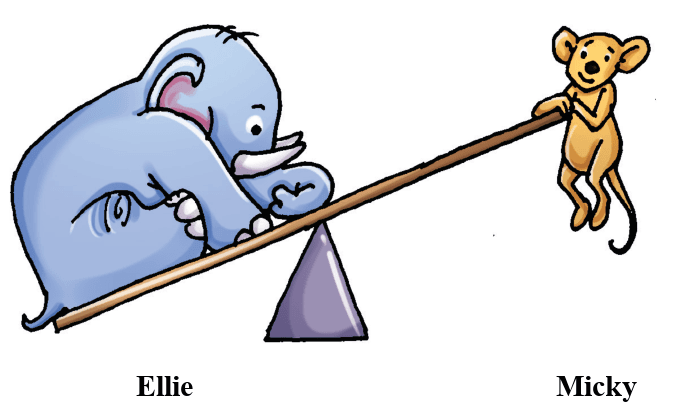
- What class of lever is this?
Solve with AIWritten solution
Solution:
Concept: The class of a lever depends on which part is in the middle. In a class 1 lever, the fulcrum is between the load and the effort.
Step 1 — Find the fulcrum.
The see-saw plank rests on the triangular support in the middle. This support is the fulcrum.
Step 2 — Find the load and the effort.
Ellie sits on one side of the support and Micky is on the other side. One of them is the load and the other gives the effort.
Step 3 — Find the middle part.
The fulcrum is between the load and the effort. So the see-saw is a class 1 lever.
Therefore, the see-saw is a class 1 lever.
- 333 marks
Question 33
Ellie and Micky are having fun at the park. They decided to try the new see-saw. Look at the picture and answer the following questions:
- In order to balance Ellie and Micky, how should you change the position of the fulcrum? Would you move it closer to Micky or move it closer to Ellie? Or, if moving the fulcrum is not an option, what more can be done so that Ellie can go up?
Solve with AIWritten solution
Solution:
Concept: On a see-saw, the heavier side goes down. A heavy person sitting close to the fulcrum can be balanced by a light person sitting far from it.
Step 1 — See why Ellie's side is down.
Ellie the elephant is much heavier than Micky the mouse. Micky is even a little farther from the fulcrum than Ellie, but Ellie's weight is so much bigger that her side goes down and Micky stays up in the air.
Step 2 — Move the fulcrum.
The fulcrum should be moved closer to Ellie. Then Ellie is near the fulcrum and Micky is far from it. If the fulcrum is moved close enough to Ellie, Micky's small weight, far from the fulcrum, can balance Ellie's big weight, near the fulcrum.
Step 3 — If the fulcrum cannot move: change where Ellie sits.
Ellie can move closer to the middle of the see-saw, towards the fulcrum. Her weight then has less turning effect, which helps her side to rise.
Step 4 — If the fulcrum cannot move: add weight on Micky's side.
More friends can sit on Micky's side, at the far end. Their extra weight helps push Micky's side down, so Ellie's side goes up.
Therefore, the fulcrum should be moved closer to Ellie; if it cannot be moved, Ellie should sit closer to the middle, or more weight (more friends) should be added on Micky's side, so that Ellie can go up.
- 342 marks
Question 34
When we use a screwdriver to loosen a screw, we actually use two simple machines. What are these machines?
Solve with AIWritten solution
Solution:
Concept: Many tools use two or more simple machines together. A screwdriver works as a wheel and axle, and the thing it turns is a screw.
Step 1 — First machine: wheel and axle.
The thick handle of the screwdriver is the wheel, and the thin metal shaft is the axle. When we turn the wide handle, the shaft turns with more force, which helps to turn a tight screw.
Step 2 — Second machine: screw.
The screw is an inclined plane wrapped around a rod. As the screwdriver turns it, its spiral thread moves it out of the wood, so the screw comes loose.
Therefore, the two simple machines are the wheel and axle (the screwdriver) and the screw.
- 352 marks
Question 35
When we use the same screwdriver to pry open a lid of a tight can, which simple machine we are using it as?
Solve with AIWritten solution
Solution:
Concept: To pry means to force something open by pushing a tool under its edge and pressing on the other end. A rod that turns on a support to lift something is a lever.
Step 1 — Find the three parts.
The tip of the screwdriver goes under the edge of the lid. The lid is the load. The rim of the can, on which the screwdriver rests, is the fulcrum. We push down on the handle; this is the effort.
Step 2 — Name the machine.
The screwdriver turns on the rim of the can, and pushing the handle down lifts the lid up. So it works as a lever. The fulcrum (the rim) is between the effort (the handle) and the load (the lid), so it is a class 1 lever.
Note: The thin, flat tip of the screwdriver first works like a wedge to slip under the edge of the lid.
Therefore, we are using the screwdriver as a lever (a class 1 lever).
What Class 5 Science Ch 11 covers
The sections of the chapter, in the order the book takes them. Every question above comes from one of these.
- 01Introduction to simple machines
- 02Lever
- 03Inclined plane
- 04Screw
- 05Wedge
- 06Wheel and axle
- 07Pulley
More ways to study this chapter
The same chapter asked three other ways. Practise it, revise it, and see what the board has set on Ch 11 before.
Class 5 Science Ch 11 questions students ask
How many questions are there in Class 5 Science Ch 11?
35 questions. Every one is solved step by step on this page.
Are these Class 5 Science solutions free?
Yes. Every question and its full working is free to read, with no account needed.
Can I download the Class 5 Science Ch 11 solutions as a PDF?
There is no PDF to download. Every solution is on this page instead, which means it is searchable, always the current syllabus, and readable on a phone. Use your browser's print option if you want it on paper.