
Opening your dashboard
Class 5 Science Chapter 11 Simple Machines: Competency-Based Questions (CBQ)
40 questions on Chapter 11, each worked through on its own page with the AI tutor. Class 5 Science, ICSE 2026-27.
40 questions
1–5 marks · Mixed difficulty
- 11 mark
Question 1
Cognitive domain: Application
Kavya wants to lift one edge of a heavy stone slab with a long iron rod. She puts a brick under the rod to act as the fulcrum, slides one end of the rod under the slab, and pushes down on the other end. Where should she place the brick so that she needs the least effort?
- 21 mark
Question 2
Cognitive domain: Application
A delivery worker has to push a heavy trolley into a van. The floor of the van is 80 cm above the road. He has three strong planks to make a slope from the road to the van floor: one is 1.5 m long, one is 2.5 m long and one is 4 m long. Which plank lets him push the trolley up with the least force?
- 31 mark
Question 3
Cognitive domain: Analysis
A new hospital is being built. The builder plans a ramp next to the front steps for wheelchairs and stretcher trolleys.
Assertion (A): The ramp is made long, with a gentle slope.
Reason (R): On a gentle slope, a smaller push is needed to move a wheelchair up, although it has to travel a longer distance.
- 41 mark
Question 4
Cognitive domain: Understanding
Neha's mother says, "Use the sharp knife to cut the vegetables, not the blunt one. It cuts much more easily." Why does the sharp knife cut more easily?
- 51 mark
Question 5
Cognitive domain: Understanding
On Independence Day, the school flag is tied to a rope that runs over a small grooved wheel at the top of the flagpole. Arjun pulls the rope down, and the flag goes up. How does the wheel at the top help Arjun?
- 61 mark
Question 6
Cognitive domain: Analysis
The knob of a door latch came off. Tara tried to turn the thin metal rod of the latch with her fingers, but it was very hard. When the knob was fixed back on, she turned it easily.
Assertion (A): It is easier to turn the latch with the knob on than by holding the thin rod alone.
Reason (R): In a wheel and axle, a small force applied on the large wheel turns the axle with a larger force.
- 73 marks
Question 7
Cognitive domain: Analysis
Rohan's toy cart weighs 10 N (newton is the unit of force). He wants to get it onto a table 24 cm high. Lifting it straight up needs a pull of 10 N. He then pulls it up planks of different lengths that reach the table top, and reads the pull on a spring balance. The cart runs on smooth wheels.
Length of plank Pull needed 40 cm 6 N 80 cm 3 N 120 cm 2 N (a) Which plank needed the least pull? (1 mark)
(b) What pattern do you see between the length of the plank and the pull needed? (1 mark)
(c) Which simple machine did the planks make, and how did it help Rohan? (1 mark)
- 83 marks
Question 8
Cognitive domain: Application
Dadi uses a nutcracker to crack walnuts. First she puts a walnut near the tips of the arms, far from the hinge, and finds it very hard to crack. Then she puts the walnut close to the hinge, and it cracks easily.
(a) Which class of lever is a nutcracker? (1 mark)
(b) Name the fulcrum, the load and the effort in the nutcracker. (1 mark)
(c) Why does the walnut crack more easily when it is close to the hinge? (1 mark)
- 93 marks
Question 9
Cognitive domain: Application
A bicycle is a machine made of several simple machines working together. Name three different simple machines that you can find in a bicycle. For each one, name the part of the bicycle where it is found.
- 102 marks
Question 10
Cognitive domain: Analysis
When Aman sweeps the floor, he holds the top of the broom still with one hand and pushes the middle of the handle with his other hand. The bristles at the bottom sweep the dust.
(a) Name the fulcrum, the effort and the load in the broom. (1 mark)
(b) Which class of lever is the broom? (1 mark)
- 113 marks
Question 11
Cognitive domain: Understanding
Ravi opens a jar of pickle. He has to turn the lid round about three times before it comes off.
(a) Which simple machine do the lid and the neck of the jar make? (1 mark)
(b) What are the spiral ridges on the neck of the jar called? (1 mark)
(c) Why does the lid not fall off when the closed jar is turned upside down? (1 mark)
- 123 marks
Question 12
Cognitive domain: Evaluation
Workers at a building site must lift bags of cement to the roof of a two-storey house. In plan 1, a worker stands at the edge of the roof and pulls each bag up with a rope. In plan 2, a pulley is fixed at the top of the house, and a worker on the ground pulls the rope.
(a) In plan 2, which way does the worker pull the rope, and which way does the bag move? (1 mark)
(b) Give one reason why plan 2 is easier and safer. (1 mark)
(c) What part of the pulley wheel stops the rope from slipping off it? (1 mark)
- 133 marks
Question 13
Cognitive domain: Application
A classroom door keeps banging shut in the wind. Anu pushes a small block of wood, thick at one end and thin at the other, into the gap under the door. The door now stays open.
(a) Name the simple machine that Anu used. (1 mark)
(b) How does it hold the door in place? (1 mark)
(c) Name two objects in a kitchen that also work as this simple machine. (1 mark)
- 144 marks
Question 14
Cognitive domain: Application
A village park has these four things:
- A see-saw
- A slide
- A merry-go-round that turns on a central pole
- An old well, where a bucket hangs on a rope that runs over a grooved wheel
Name the simple machine in each one, and give a short reason for each answer.
- 153 marks
Question 15
Cognitive domain: Evaluation
Ishaan says, "With a machine, we can do work without using any effort at all."
(a) Is Ishaan right? (1 mark)
(b) Use the example of a ramp to explain what a machine really does. (1 mark)
(c) Write two ways in which simple machines make our work easier. (1 mark)
- 161 mark
Question 16
Cognitive domain: Analysis
A long bar rests on a support at P. A heavy block rests on the bar at Q, and a hand pushes the bar up at R, as shown.
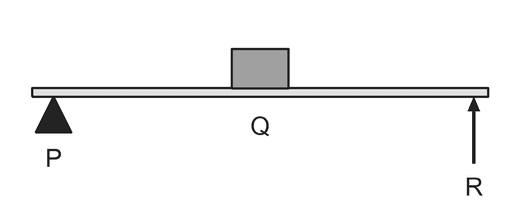
Which option names the fulcrum, the load and the effort, and the class of this lever, correctly?
- 171 mark
Question 17
Cognitive domain: Analysis
In the school hall, the stage curtain is raised by pulling a rope. The rope runs over a grooved wheel fixed to a beam above the stage, and the curtain is tied to the other end of the rope.
Assertion (A): In this simple pulley, the wheel stays fixed to the beam.
Reason (R): The wheel moves up along with the curtain when the rope is pulled.
- 181 mark
Question 18
Cognitive domain: Understanding
Rima cuts a right-angled triangle from a sheet of paper and colours its sloping edge red. She keeps the shorter straight edge along a pencil and rolls the paper tightly round the pencil.
What does the red edge look like on the pencil, and what part of a screw does it match?
- 191 mark
Question 19
Cognitive domain: Understanding
At a metro station, Aman steps on an escalator that carries him from the ground floor up to the platform. His friend says, "An escalator is a kind of inclined plane." Why is the friend right?
- 201 mark
Question 20
Cognitive domain: Analysis
Ravi has three screwdrivers with the same thin metal shaft. Their handles are 2 cm, 4 cm and 6 cm across. (Hypothetical data.) He has to turn a very tight screw. Which screwdriver should he use, and why?
- 211 mark
Question 21
Cognitive domain: Evaluation
Four friends talk about levers in the school lab. Only one of them is right. Who is right?
- 221 mark
Question 22
Cognitive domain: Application
A hand-turned pencil sharpener has a handle that is turned round to spin a rod. Inside it, a sharp blade shaves the wood off the pencil. A pencil sharpener is a machine made by joining simple machines. Which two simple machines work together in it?
- 231 mark
Question 23
Cognitive domain: Analysis
Mr. Das shows his class a screw, a wedge and a ramp, and tells them how these simple machines are made.
Assertion (A): A screw is made of a wedge wrapped round a rod.
Reason (R): A wedge is made of two inclined planes joined together.
- 241 mark
Question 24
Cognitive domain: Analysis
Rahul wrote a list in his notebook: a job, then the simple machine that helps in doing it. One pair in his list is wrong. Which pair is wrong?
- 251 mark
Question 25
Cognitive domain: Application
Imran makes a toy pulley for the science fair. He fixes a flat plastic disc to a nail on a board and puts a string over it. When he pulls the string to lift a toy bag, the string keeps slipping off the edge of the disc. What should he do?
- 262 marks
Question 26
Cognitive domain: Application
Dev opens a bottle of cold drink with a metal bottle opener. He hooks the thin lip of the opener under the edge of the cap, rests the front of the opener on top of the cap, and lifts the handle up. The cap pops off.
(a) Which part is the load? (1 mark)
(b) Name the class of this lever, and give a reason. (1 mark)
- 272 marks
Question 27
Cognitive domain: Understanding
A tailor's needle is thin and pointed at one end and gets thicker towards the other end. The tailor pushes the pointed end into a piece of cloth.
(a) Which simple machine does the needle work as? (1 mark)
(b) What does the pointed end do to the threads of the cloth as it is pushed in? (1 mark)
- 282 marks
Question 28
Cognitive domain: Application
The iron head of Grandpa's hammer has become loose on its wooden handle. He taps a thin wooden wedge into the top of the handle, and the head now sits firmly.
(a) How does the wedge make the hammer head firm? (1 mark)
(b) Name one other job that a wedge can do, with an example. (1 mark)
- 292 marks
Question 29
Cognitive domain: Understanding
Sumit has to move a heavy box across the school corridor. First he drags it along the floor, and it is hard work. Then he puts the box on a small cart with four wheels and pulls the cart.
(a) Which simple machine do the wheels of the cart form? (1 mark)
(b) Why is it easier to move the box on the cart? (1 mark)
- 302 marks
Question 30
Cognitive domain: Application
In a gym, Kavya sits on a bench and pulls a bar down. A rope joined to the bar runs over a grooved wheel fixed above her head, and the other end of the rope lifts a stack of weights.
(a) Which simple machine is used in this exercise machine? (1 mark)
(b) Why does pulling the bar down make the weights go up? (1 mark)
- 312 marks
Question 31
Cognitive domain: Evaluation
Rahul and his friends push a heavy box up a ramp into a hall. Rahul says, "On a ramp, the box becomes lighter, so we can push it easily."
(a) Is Rahul right about the box becoming lighter? (1 mark)
(b) What does the ramp really do? (1 mark)
- 323 marks
Question 32
Cognitive domain: Analysis
A science teacher shows three tools, X, Y and Z, which are all levers. She tells the class only where the three parts of each lever are.
Tool Fulcrum Load Effort X At the left end In the middle At the right end Y In the middle At the left end At the right end Z At the left end At the right end In the middle (a) Find the class of lever for X, Y and Z. (1 mark)
(b) Name one real tool for each of X, Y and Z. (1 mark)
(c) On tool Z, should the effort be applied nearer to the fulcrum or nearer to the load, so that the load is lifted more easily? (1 mark)
- 333 marks
Question 33
Cognitive domain: Evaluation
Farmer Ramesh has three jobs to do today. In his shed he has five tools: a knife, a pulley with a rope, a wheelbarrow, a pair of tweezers and a screwdriver.
(a) He must cut open the stitched mouths of some sacks of seeds. Which tool should he use, and which simple machine is it? (1 mark)
(b) He must carry six heavy bags of manure from the shed to the far end of his field. Which tool should he use, and why? (1 mark)
(c) He must pick out tiny stones from a plate of grain. Which tool should he use, and which class of lever is it? (1 mark)
- 343 marks
Question 34
Cognitive domain: Analysis
A ceiling fan has a thin rod, the axle, that is turned by a motor at its centre. Three large blades are joined to the rod, and they turn with it. Dolly looks at the fan while it makes one full turn.
(a) Which part moves along a longer path in one full turn: a point at the tip of a blade, or a point on the rod? (1 mark)
(b) In a ceiling fan, is the force applied on the wheel or on the axle? (1 mark)
(c) How does the long path of the blades help the fan? (1 mark)
- 353 marks
Question 35
Cognitive domain: Understanding
Sana says, "A wedge and a ramp are very much alike."
(a) What is a wedge made of? (1 mark)
(b) When a load is raised on a ramp, the ramp stays still and the load moves along it. How does a wedge work differently? (1 mark)
(c) Give one example of an object that works as a ramp and one that works as a wedge. (1 mark)
- 363 marks
Question 36
Cognitive domain: Analysis
Sort these four things into simple machines and complex machines: a see-saw, a ramp, a wheelbarrow and a car.
(a) Which two are simple machines? (1 mark)
(b) Which two are complex machines? (1 mark)
(c) For each complex machine, name one simple machine found in it, and the part where it is found. (1 mark)
- 374 marks
Question 37
Cognitive domain: Creativity
The science club wants to find out whether a simple pulley makes it easier to lift a load. They have a pulley, a string, a bag of sand, a spring balance that shows the pull in newtons (N), and a stand to fix the pulley on.
(a) Describe how the club can lift the bag in two ways and read the pull each time. (1 mark)
(b) Write two things that must be kept the same in both ways, so that the test is fair. (1 mark)
(c) What readings do you expect, and what do they show about a simple pulley? (2 marks)
- 384 marks
Question 38
Cognitive domain: Analysis
A village hand pump has a long handle that turns on a pin. The rod that goes down into the well is joined to the handle close to the pin, on one side of it. A person holds the handle on the other side of the pin and pushes it down. To lift the water, the pump rod needs a pull of 120 N. A student measured the effort needed when the hand is held at different distances from the pin. (Hypothetical data.)
Distance of the hand from the pin Effort needed 20 cm 66 N 40 cm 34 N 60 cm 23 N 80 cm 18 N (a) At which distance is the effort the smallest? (1 mark)
(b) What pattern do you see in the table? (1 mark)
(c) Name the fulcrum, the load and the effort of the pump handle, and say which class of lever it is. Then say why the handle is made long. (2 marks)
- 394 marks
Question 39
Cognitive domain: Application
Long ago, the Greek scientist Archimedes is said to have designed a machine to lift the water that leaked into the hold (the lowest part inside) of a ship. It had a water-tight cylinder with a spiral running from one end to the other. The lower end of the cylinder was dipped in the water. A sailor turned the machine by hand, and the water that collected in the spiral was lifted out of the hold.
(a) Which simple machine does the spiral inside the cylinder work like? (1 mark)
(b) Why did the sailor have to keep turning the machine? (1 mark)
(c) Explain why the spiral makes it easy to raise water from a low place to a high place. (2 marks)
- 405 marks
Question 40
Cognitive domain: Evaluation
At the school science fair, three students showed models that lift the same 20 N weight. (Hypothetical data.) The table shows what they measured.
Model Simple machine Effort needed Distance the hand moves Height the weight rises Asha Lever 11 N 20 cm 10 cm Bilal Simple pulley 21 N 30 cm 30 cm Chetan Ramp 12 N 75 cm 30 cm (a) Which model needs the least effort? (1 mark)
(b) For which model does the effort turn out to be more than the weight, and what is this model good for? (2 marks)
(c) A shopkeeper has to raise cartons to a loft 3 m high while standing on the ground. Which of the three machines would you advise, and why? (2 marks)