
Opening your dashboard
Class 5 Science Chapter 1: Circulatory System Solutions
33 textbook questions with step-by-step answers, free to read, for ICSE 2026-27.
Get talked through Ch 1, not just shown the answer
Reading a finished solution is not the same as being able to do it. The AI tutor takes one question at a time and works it with you, in your own words, until you can.
- Ask it out loud, in your own words
- It gives you the next step, not the answer
- Stuck on part (ii)? Start there
33 questions with solutions
1–5 marks · Mixed difficulty
- 11 mark
Question 1
Give one word for the following.
Several organs together do one major job. ________
Solve with AIWritten solution
Solution:
Concept: Our body has many organs. A group of organs that work together to do one main job is called an organ system.
Step 1 — What is asked.
We need one word (or term) for several organs that work together to do one major job.
Step 2 — Recall the term.
The heart, blood and blood vessels work together to carry materials round the body. Such a group is an organ system. Other examples are the digestive system and the respiratory system.
Therefore, the answer is organ system.
- 21 mark
Question 2
Give one word for the following.
Tubes in which blood flows across the body. ________
Solve with AIWritten solution
Solution:
Concept: Blood flows round the body inside tube-like structures called blood vessels.
Step 1 — What is asked.
We need the name of the tubes that carry blood through the body.
Step 2 — Recall the term.
These tubes are the blood vessels. There are three kinds: arteries, veins and capillaries.
Therefore, the answer is blood vessels.
- 31 mark
Question 3
Give one word for the following.
Thick-walled tubes that carry oxygen to all parts of the body. ________
Solve with AIWritten solution
Solution:
Concept: Arteries carry blood away from the heart to all parts of the body. They have thick, stretchy walls because blood flows through them at high pressure.
Step 1 — What is asked.
We need the thick-walled vessels that carry oxygen-rich blood to the body parts.
Step 2 — Recall the term.
Arteries have thick walls. Most of them carry pure, oxygen-rich blood from the heart to the body.
Note: One artery is different: the pulmonary artery carries impure blood from the heart to the lungs.
Therefore, the answer is arteries.
- 41 mark
Question 4
Give one word for the following.
Thin-walled tubes that carry blood back to the heart. ________
Solve with AIWritten solution
Solution:
Concept: Veins carry blood from all parts of the body back to the heart. Blood flows through them at low pressure, so their walls are thin.
Step 1 — What is asked.
We need the thin-walled vessels that bring blood back to the heart.
Step 2 — Recall the term.
Veins have thin walls and carry blood back to the heart. They also have valves that stop blood from flowing backwards.
Therefore, the answer is veins.
- 51 mark
Question 5
Give one word for the following.
The artery through which deoxygenated blood flows towards the lungs.
Solve with AIWritten solution
Solution:
Concept: Most arteries carry oxygen-rich blood. The pulmonary artery is the exception: it carries deoxygenated (impure) blood from the heart to the lungs.
Step 1 — What is asked.
We need the one artery that carries deoxygenated blood, rich in carbon dioxide, to the lungs.
Step 2 — Recall the term.
The right ventricle pumps impure blood into the pulmonary artery. This artery takes the blood to the lungs, where it gives out carbon dioxide and takes in oxygen.
Therefore, the answer is pulmonary artery.
- 61 mark
Question 6
Choose the correct option.
Which of the following is not a part of the circulatory system?
Solve with AIAnswer
(A) Blood vessels
(B) Heart
- Correct
(C) Intestine
(D) Blood
Answer: (C) Intestine
Concept: The circulatory system is made up of three parts: the heart, the blood and the blood vessels.
Step 1 — What is asked.
We must find the one option that is NOT a part of the circulatory system.
Step 2 — Check each option.
Blood vessels, the heart and blood are the three parts of the circulatory system. The intestine is not one of them.
Step 3 — Name the system of the intestine.
The intestine is a part of the digestive system. It digests food and passes it into the blood.
Step 4 — Check the other options.
Each of the other options is wrong for the reason given below.
- (A): Blood vessels are the tubes that carry blood, so they are a part of the circulatory system.
- (B): The heart pumps blood round the body, so it is a part of the circulatory system.
- (D): Blood is the liquid that carries materials round the body, so it is a part of the circulatory system.
Therefore, the intestine is not a part of the circulatory system: option (C).
- 71 mark
Question 7
Choose the correct option.
The blood vessel that allows passage of nutrients and other gases
Solve with AIAnswer
(A) Vein
(B) Artery
(C) Aorta
- Correct
(D) Capillary
Answer: (D) Capillary
Concept: Capillaries are the extremely thin blood vessels that link arteries to veins. Nutrients, oxygen, carbon dioxide and other wastes can pass through their very thin walls.
Step 1 — What is asked.
We must find the vessel through whose walls nutrients and gases pass between the blood and the body cells.
Step 2 — Think about the walls.
Only a very thin wall lets materials pass through it easily. Capillaries have the thinnest walls of all blood vessels.
Step 3 — Choose the answer.
So nutrients and gases pass through the walls of the capillaries.
Step 4 — Check the other options.
Each of the other options is wrong for the reason given below.
- (A): A vein carries blood back to the heart. Its wall is too thick for nutrients and gases to pass through easily.
- (B): An artery has a thick, stretchy wall that can bear high pressure. Materials do not pass out through it.
- (C): The aorta is the main artery. It has the thickest wall of all, so materials do not pass through it.
Therefore, nutrients and gases pass through the walls of the capillaries: option (D).
- 81 mark
Question 8
Choose the correct option.
________ are thick-walled blood vessels that carry blood away from the heart.
Solve with AIAnswer
- Correct
(A) Arteries
(B) Veins
(C) Capillaries
(D) Superior vena cava
Answer: (A) Arteries
Concept: Arteries carry blood away from the heart. Blood flows through them at high pressure, so they have thick, stretchy walls.
Step 1 — What is asked.
We need the thick-walled vessels that carry blood away from the heart.
Step 2 — Recall the facts.
Arteries carry blood from the heart to the body parts, and their walls are thick to bear the high pressure.
Step 3 — Choose the answer.
So the blank is filled by 'Arteries'.
Step 4 — Check the other options.
Each of the other options is wrong for the reason given below.
- (B): Veins have thin walls and carry blood back to the heart, not away from it.
- (C): Capillaries have extremely thin walls. They join arteries to veins.
- (D): The superior vena cava is a vein. It brings blood from the upper part of the body back to the heart.
Therefore, arteries are thick-walled vessels that carry blood away from the heart: option (A).
- 91 mark
Question 9
Choose the correct option.
The oxygenated blood reaches to the left auricle through ________
Solve with AIAnswer
- Correct
(A) pulmonary vein
(B) superior vena cava
(C) pulmonary artery
(D) inferior vena cava
Answer: (A) pulmonary vein
Concept: Blood takes in oxygen in the lungs. This oxygenated (pure) blood comes back to the heart through the pulmonary veins and enters the left auricle.
Step 1 — What is asked.
We need the vessel that brings oxygen-rich blood into the left auricle.
Step 2 — Follow the blood from the lungs.
Blood becomes oxygen-rich in the lungs. The pulmonary vein carries it from the lungs to the heart.
Step 3 — Choose the answer.
The pulmonary vein opens into the left auricle. It is the only vein that carries pure blood.
Step 4 — Check the other options.
Each of the other options is wrong for the reason given below.
- (B): The superior vena cava brings impure blood from the upper body into the right auricle.
- (C): The pulmonary artery carries impure blood from the right ventricle to the lungs, away from the heart.
- (D): The inferior vena cava brings impure blood from the lower body into the right auricle.
Therefore, oxygenated blood reaches the left auricle through the pulmonary vein: option (A).
- 101 mark
Question 10
Choose the correct option.
In an average adult, the heart pumps blood about ________ times a minute.
Solve with AIAnswer
(A) 50
- Correct
(B) 72
(C) 100
(D) 120
Answer: (B) 72
Concept: The heart beats again and again to pump blood. In an average adult at rest, it beats about 72 times a minute. The normal resting rate of adults is about 60 to 100 beats a minute.
Step 1 — What is asked.
We need the usual number of heartbeats in one minute for an average adult.
Step 2 — Recall the fact.
An average adult's heart beats about 72 times a minute at rest. We can feel each beat as a pulse at the wrist.
Step 3 — Choose the answer.
So the blank is filled by 72.
Step 4 — Check the other options.
Each of the other options is wrong for the reason given below.
- (A): 50 is lower than the usual resting rate of most adults.
- (C): 100 is the top of the normal resting range for adults, not the average.
- (D): 120 is much faster than an adult's resting heartbeat. The heart beats this fast during hard exercise.
Therefore, an average adult's heart pumps blood about 72 times a minute: option (B).
- 111 mark
Question 11
Fill in the blanks.
Word box: upper · lower · circulatory · capillaries · heart
________ system carries out transportation of materials.
Solve with AIWritten solution
Solution:
Concept: The circulatory system is the body's transport system. It carries food, water and oxygen to all parts of the body and carries wastes away.
Step 1 — What is asked.
We need the system that transports (carries) materials in the body.
Step 2 — Pick the word from the box.
The system that carries materials round the body is the circulatory system.
Therefore, the answer is: Circulatory system carries out transportation of materials.
- 121 mark
Question 12
Fill in the blanks.
Word box: upper · lower · circulatory · capillaries · heart
Superior vena cava brings blood from the ________ part of the body.
Solve with AIWritten solution
Solution:
Concept: The two main veins are the superior vena cava and the inferior vena cava. 'Superior' means upper and 'inferior' means lower.
Step 1 — What is asked.
We need the part of the body from which the superior vena cava brings blood.
Step 2 — Pick the word from the box.
The superior vena cava brings blood from the head, neck, arms and chest, that is, the upper part of the body, back to the heart.
Therefore, the answer is: Superior vena cava brings blood from the upper part of the body.
- 131 mark
Question 13
Fill in the blanks.
Word box: upper · lower · circulatory · capillaries · heart
Inferior vena cava brings blood from the ________ part of the body.
Solve with AIWritten solution
Solution:
Concept: The inferior vena cava is the large vein that brings blood from the lower part of the body back to the heart.
Step 1 — What is asked.
We need the part of the body from which the inferior vena cava brings blood.
Step 2 — Pick the word from the box.
The inferior vena cava brings blood from the belly and the legs, that is, the lower part of the body, back to the heart.
Therefore, the answer is: Inferior vena cava brings blood from the lower part of the body.
- 141 mark
Question 14
Fill in the blanks.
Word box: upper · lower · circulatory · capillaries · heart
________ works like a pump to send blood through arteries, veins and capillaries.
Solve with AIWritten solution
Solution:
Concept: The heart is a hollow, muscular organ. It beats all the time and pumps blood round the body.
Step 1 — What is asked.
We need the organ that works like a pump.
Step 2 — Pick the word from the box.
The heart squeezes again and again to push blood through all the blood vessels.
Therefore, the answer is: Heart works like a pump to send blood through arteries, veins and capillaries.
- 151 mark
Question 15
Fill in the blanks.
Word box: upper · lower · circulatory · capillaries · heart
The ________ are thin tubes that link arteries and veins.
Solve with AIWritten solution
Solution:
Concept: Capillaries are the extremely thin blood vessels that connect arteries to veins.
Step 1 — What is asked.
We need the thin tubes that join arteries to veins.
Step 2 — Pick the word from the box.
Capillaries always lie between the arteries and the veins.
Therefore, the answer is: The capillaries are thin tubes that link arteries and veins.
- 161 mark
Question 16
Write T for True statements or F for False statements.
Circulatory system is responsible for transportation of blood in the body.
Solve with AIWritten solution
Solution:
Concept: The circulatory system (heart, blood and blood vessels) moves blood round the body.
Step 1 — Read the statement.
It says that the circulatory system moves blood through the body.
Step 2 — Check it.
The heart pumps blood and the blood vessels carry it to every part of the body. So the statement is correct.
Therefore, the statement is True (T).
- 171 mark
Question 17
Write T for True statements or F for False statements.
Heart is fist-size organ found in our head.
Solve with AIWritten solution
Solution:
Concept: The heart is about the size of our fist. It lies in the chest, between the two lungs, a little towards the left side.
Step 1 — Read the statement.
It says that the heart is fist-sized and lies in the head.
Step 2 — Check it.
The heart is fist-sized, but it lies in the chest, not in the head. The ribcage protects it.
Step 3 — Correct it.
The correct statement is: The heart is a fist-sized organ found in our chest.
Therefore, the statement is False (F).
- 181 mark
Question 18
Write T for True statements or F for False statements.
Capillaries are thin-walled blood vessels that carry blood back to the heart.
Solve with AIWritten solution
Solution:
Concept: Capillaries are extremely thin vessels that link arteries to veins. Veins are the vessels that carry blood back to the heart.
Step 1 — Read the statement.
It says that capillaries carry blood back to the heart.
Step 2 — Check it.
Capillaries are thin-walled, but they only link the arteries to the veins. It is the veins that carry blood back to the heart.
Step 3 — Correct it.
The correct statement is: Veins are thin-walled blood vessels that carry blood back to the heart.
Therefore, the statement is False (F).
- 191 mark
Question 19
Write T for True statements or F for False statements.
The upper two chambers of the heart are called ventricles.
Solve with AIWritten solution
Solution:
Concept: The heart has four chambers. The upper two are the auricles (also called atria), and the lower two are the ventricles.
Step 1 — Read the statement.
It says that the upper chambers are the ventricles.
Step 2 — Check it.
The ventricles are the lower chambers. The upper chambers are the auricles (atria).
Step 3 — Correct it.
The correct statement is: The upper two chambers of the heart are called auricles (atria).
Therefore, the statement is False (F).
- 201 mark
Question 20
Write T for True statements or F for False statements.
Pulmonary artery is the main artery in the body.
Solve with AIWritten solution
Solution:
Concept: The aorta is the main artery. It comes out of the left ventricle and carries pure blood to the whole body. The pulmonary artery carries impure blood from the heart to the lungs only.
Step 1 — Read the statement.
It says that the pulmonary artery is the main artery.
Step 2 — Check it.
The main artery is the aorta, not the pulmonary artery. The pulmonary artery goes only to the lungs.
Step 3 — Correct it.
The correct statement is: Aorta is the main artery in the body.
Therefore, the statement is False (F).
- 215 marks
Question 21
Match the columns.
Column A Column B 1. Aorta a. Red colour of blood 2. Valve b. Main artery 3. Haemoglobin c. Pure blood 4. Pulmonary artery d. Vein 5. Pulmonary vein e. Impure blood Solve with AIWritten solution
Solution:
Concept: Each term in column A is linked to one fact about it in column B. Use each item of column B only once.
Step 1 — Match 1 (Aorta).
The aorta is the main artery coming out of the heart. So 1 matches b.
Step 2 — Match 2 (Valve).
Valves are found in veins. They stop blood from flowing backwards. So 2 matches d.
Step 3 — Match 3 (Haemoglobin).
Haemoglobin is the red pigment that gives blood its red colour. So 3 matches a.
Step 4 — Match 4 (Pulmonary artery).
The pulmonary artery carries impure blood from the heart to the lungs. So 4 matches e.
Step 5 — Match 5 (Pulmonary vein).
The pulmonary vein carries pure blood from the lungs to the heart. So 5 matches c.
Step 6 — Write the matched pairs.
The table below shows each term with its match.
Column A Column B 1. Aorta b. Main artery 2. Valve d. Vein 3. Haemoglobin a. Red colour of blood 4. Pulmonary artery e. Impure blood 5. Pulmonary vein c. Pure blood Therefore, 1 matches b, 2 matches d, 3 matches a, 4 matches e and 5 matches c.
- 222 marks
Question 22
What does circulatory system consist of? Write the function of this system.
Solve with AIWritten solution
Solution:
Concept: The circulatory system is the transport system of the body.
Step 1 — Name the parts.
The circulatory system consists of the heart, the blood and the blood vessels (arteries, veins and capillaries).
Step 2 — State the function.
It carries digested food, water and oxygen to all parts of the body. It also carries wastes, such as carbon dioxide, away from the body cells so that they can be removed from the body.
Therefore, the circulatory system consists of the heart, blood and blood vessels, and its function is to carry food, water and oxygen to all body parts and to carry wastes away from them.
- 232 marks
Question 23
How many chambers are there in human heart? Name them.
Solve with AIWritten solution
Solution:
Concept: The heart is hollow inside. Its hollow space is divided into compartments called chambers.
Step 1 — Count the chambers.
The human heart has four chambers: two upper chambers and two lower chambers.
Step 2 — Name the upper chambers.
The two upper chambers are the right auricle and the left auricle. Auricles are also called atria (singular: atrium).
Step 3 — Name the lower chambers.
The two lower chambers are the right ventricle and the left ventricle.
Therefore, the human heart has four chambers: the right auricle, the left auricle, the right ventricle and the left ventricle.
- 242 marks
Question 24
What are blood vessels? Mention the types.
Solve with AIWritten solution
Solution:
Concept: Blood does not flow loosely in the body. It always flows inside tubes.
Step 1 — Define blood vessels.
Blood vessels are tube-like structures through which blood flows to all parts of the body and back to the heart.
Step 2 — Mention the types.
There are three types of blood vessels: arteries, veins and capillaries.
Therefore, blood vessels are the tubes that carry blood round the body, and they are of three types: arteries, veins and capillaries.
- 252 marks
Question 25
Why is the colour of blood red?
Solve with AIWritten solution
Solution:
Concept: Blood contains red blood cells. These cells contain a red pigment (colouring substance) called haemoglobin.
Step 1 — Name the pigment.
Blood has a red pigment called haemoglobin. It is found inside the red blood cells.
Step 2 — Link the pigment to the colour.
There are a very large number of red blood cells in blood, so the haemoglobin in them makes the whole of the blood look red. Haemoglobin also carries oxygen.
Therefore, blood is red because it contains a red pigment called haemoglobin.
- 262 marks
Question 26
Why do arteries have thicker wall in comparison to veins?
Solve with AIWritten solution
Solution:
Concept: Arteries carry blood straight out of the heart. Veins bring blood back to the heart after it has passed through the body.
Step 1 — Look at the pressure in arteries.
Every heartbeat pushes blood into the arteries with great force. So blood flows through the arteries at high pressure.
Step 2 — Link the pressure to the wall.
The arteries have thick, stretchy (elastic) walls so that they can bear this high pressure without bursting.
Step 3 — Compare with veins.
Blood flows through the veins at low pressure, so the veins do not need thick walls. Their walls are thin.
Therefore, arteries have thicker walls than veins because blood flows through them at high pressure, and the thick, elastic walls can bear this pressure.
- 272 marks
Question 27
How is pulmonary vein different from rest of the veins?
Solve with AIWritten solution
Solution:
Concept: Veins carry blood back to the heart. Most veins carry impure (deoxygenated) blood from the body organs.
Step 1 — Recall what other veins carry.
All the other veins normally carry deoxygenated (impure) blood, rich in carbon dioxide, from the body organs to the heart.
Step 2 — Recall what the pulmonary vein carries.
The pulmonary vein carries oxygenated (pure) blood, rich in oxygen, from the lungs to the left auricle of the heart.
Therefore, the pulmonary vein is different because it carries oxygenated (pure) blood from the lungs to the heart, while the rest of the veins carry deoxygenated (impure) blood.
- 283 marks
Question 28
List the functions of blood.
Solve with AIWritten solution
Solution:
Concept: Blood is the liquid that flows round the body. Every part of the body needs it, because it carries materials to and from the body cells.
Step 1 — Carrying food and water.
Blood carries digested food and water to all the parts of the body.
Step 2 — Carrying oxygen.
Blood carries oxygen from the lungs to all the parts of the body.
Step 3 — Removing carbon dioxide.
Blood carries the waste gas carbon dioxide from the body cells to the lungs, where we breathe it out.
Step 4 — Removing other wastes.
Blood carries other wastes from all the body parts to the kidneys. The kidneys remove them from the body in urine.
Step 5 — Protecting the body.
The white blood cells in blood kill bacteria and other germs that cause diseases. So blood protects the body from diseases.
Therefore, blood carries food, water and oxygen to all parts of the body, carries carbon dioxide and other wastes away, and protects the body from diseases.
- 293 marks
Question 29
Write any three differences between arteries and veins.
Solve with AIWritten solution
Solution:
Concept: Arteries and veins are both blood vessels. They differ in the direction of blood flow, in their walls, and in whether they have valves.
Step 1 — Compare them in a table.
The table below compares arteries and veins point by point.
Arteries Veins Carry blood away from the heart to the body parts. Carry blood from the body parts back to the heart. Have thick, elastic walls. Have thin walls. Have no valves along their length. Have valves that stop blood flowing backwards. Lie deep under the skin. Lie less deep, so many can be seen under the skin. Usually carry oxygenated (pure) blood. Usually carry deoxygenated (impure) blood. Step 2 — Choose any three.
Any three rows of the table are enough. The first three are the most important differences.
Note: The pulmonary artery carries impure blood and the pulmonary vein carries pure blood, so the last row says 'usually'. The heart has valves where the aorta and the pulmonary artery leave it, but the arteries have none along their length.
Therefore, three differences are: arteries carry blood away from the heart but veins bring it back; arteries have thick walls but veins have thin walls; and arteries have no valves along their length but veins have valves.
- 304 marks
Question 30
Show the flow of circulation of blood with the help of a flowchart.
Solve with AIWritten solution
Solution:
Concept: Blood goes round the body in a closed loop. Impure blood from the body passes through the right side of the heart to the lungs. Pure blood from the lungs passes through the left side of the heart to the body.
Step 1 — Start in the body.
In the body parts, blood gives oxygen and food to the cells and picks up carbon dioxide. It becomes impure and flows into the veins.
Step 2 — Impure blood reaches the heart.
The veins join into the superior and inferior vena cava. These bring the impure blood into the right auricle, which passes it down into the right ventricle.
Step 3 — Impure blood goes to the lungs.
The right ventricle pumps the blood into the pulmonary artery, which takes it to the lungs. In the lungs the blood gives out carbon dioxide and takes in oxygen, so it becomes pure.
Step 4 — Pure blood comes back to the heart.
The pulmonary veins bring the pure blood to the left auricle, which passes it down into the left ventricle.
Step 5 — Pure blood goes to the body.
The thick-walled left ventricle pumps the pure blood into the aorta. The aorta branches into arteries that take it to all body parts, and the loop starts again.
Step 6 — Draw the flowchart.
The flowchart below shows the whole loop. Follow the arrows down the left column and up the right column.

Therefore, the flow is: body parts → veins → venae cavae → right auricle → right ventricle → pulmonary artery → lungs → pulmonary veins → left auricle → left ventricle → aorta → arteries → body parts.
- 315 marks
Question 31
Label the following diagram of the heart.
 Solve with AI
Written solution
Solution:
Concept: The heart is drawn as we see it from the front, so the heart's right side is on our left in the picture. The right side has the venae cavae; the left side has the pulmonary veins. The aorta arches over the top, and the pulmonary artery crosses in front of it.
Step 1 — Name the letters on the left of the picture.
A is the aorta, the large arch at the top. B is the superior vena cava, which comes down from above. C is the right auricle, the upper chamber. D is the right ventricle, the lower chamber. E is the inferior vena cava, which comes up from below.
Step 2 — Name the letters on the right of the picture.
F is the pulmonary artery, which goes out towards the lungs. G is the group of pulmonary veins, which bring blood from the lungs. H is the left auricle, the upper chamber. I is the left ventricle, the lower chamber with the thickest wall.
Step 3 — Check with the labelled diagram.
The labelled diagram of the heart is shown below.
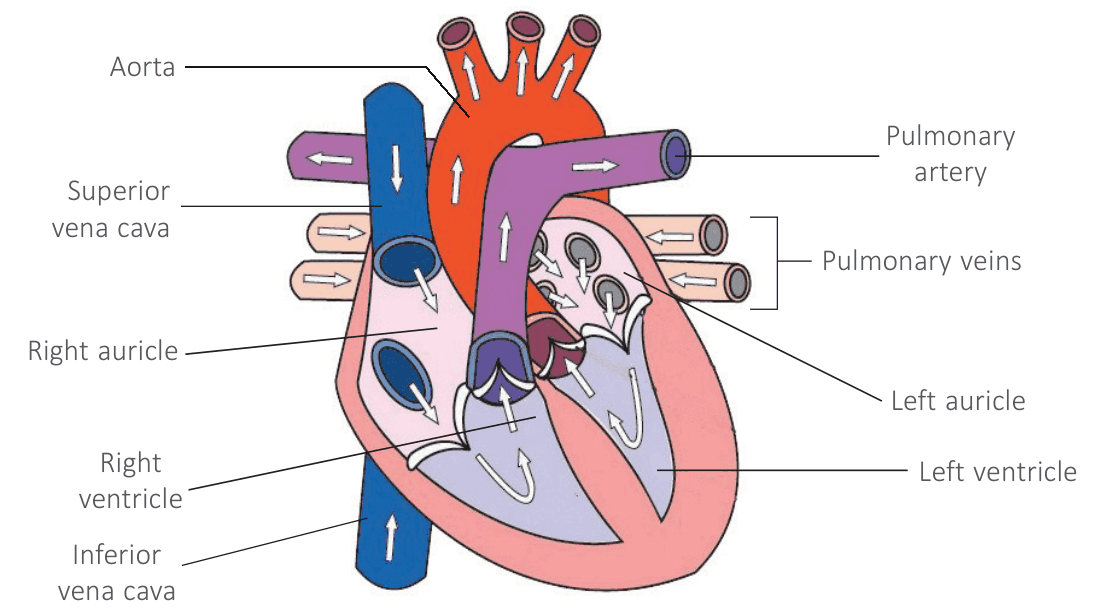
Therefore, A is the aorta, B the superior vena cava, C the right auricle, D the right ventricle, E the inferior vena cava, F the pulmonary artery, G the pulmonary veins, H the left auricle and I the left ventricle.
- 322 marks
Question 32
Why do arteries don't need valves?
Solve with AIWritten solution
Solution:
Concept: Valves are flaps that let blood flow in one direction only. Veins need them because blood in veins flows slowly, at low pressure.
Step 1 — Think about the pressure in arteries.
Every heartbeat pushes blood into the arteries with great force. So blood in the arteries flows at high pressure.
Step 2 — Explain why no valves are needed.
This strong push from the heart keeps the blood moving forward, away from the heart, all the time. The blood does not slip backwards, so the arteries need no valves along their length.
Note: The heart itself has valves where the aorta and the pulmonary artery leave it. These stop blood from flowing back into the heart between beats.
Therefore, arteries do not need valves because the strong pressure from the heart is enough to keep blood flowing in one direction only.
- 332 marks
Question 33
What will happen if valves are removed from the veins?
Solve with AIWritten solution
Solution:
Concept: Blood in the veins flows slowly, at low pressure. Valves in the veins let blood flow only towards the heart. They also help blood to travel back to the heart against the pull of gravity, for example up from the legs.
Step 1 — Think about what valves do.
Valves shut if the blood starts to flow backwards. Without them, nothing would stop the blood from slipping back.
Step 2 — Say what would happen.
Blood in the veins would flow backwards, mainly in the legs, where it has to go upwards. It would collect in the veins of the legs and feet, which could swell.
Step 3 — Say how the body is affected.
Less blood would get back to the heart, so the heart would have less blood to pump to the lungs and the rest of the body.
Therefore, without valves, blood in the veins would flow backwards and collect in the lower body, so less blood would return to the heart.
What Class 5 Science Ch 1 covers
The sections of the chapter, in the order the book takes them. Every question above comes from one of these.
- 01Parts of the circulatory system
- 02Heart – structure and function
- 03Process of circulation
- 04Arteries, veins, capillaries
More ways to study this chapter
The same chapter asked three other ways. Practise it, revise it, and see what the board has set on Ch 1 before.
Class 5 Science Ch 1 questions students ask
How many questions are there in Class 5 Science Ch 1?
33 questions. Every one is solved step by step on this page.
Are these Class 5 Science solutions free?
Yes. Every question and its full working is free to read, with no account needed.
Can I download the Class 5 Science Ch 1 solutions as a PDF?
There is no PDF to download. Every solution is on this page instead, which means it is searchable, always the current syllabus, and readable on a phone. Use your browser's print option if you want it on paper.