
Opening your dashboard
Class 5 Science Chapter 1 Circulatory System: Competency-Based Questions (CBQ)
40 questions on Chapter 1, each worked through on its own page with the AI tutor. Class 5 Science, ICSE 2026-27.
40 questions
1–5 marks · Mixed difficulty
- 11 mark
Question 1
Cognitive domain: Application
The school nurse lets Aarav use her stethoscope. He wants to hear his friend's heartbeat as clearly as possible. Where on his friend's body should he place the round end of the stethoscope?
- 21 mark
Question 2
Cognitive domain: Analysis
Meera sees thin greenish-blue lines under the skin on the back of her hand. Her brother says, "Those are arteries carrying blood to your fingers." Which statement correctly explains what Meera sees?
- 31 mark
Question 3
Cognitive domain: Analysis
A doctor tells Class 5 that a cut in an artery is more serious than a cut in a vein.
Assertion (A): When an artery is cut, blood comes out in strong spurts, one spurt with each heartbeat.
Reason (R): Blood in the arteries flows at high pressure, because the heart pushes it out with every beat.
- 41 mark
Question 4
Cognitive domain: Application
In a science quiz, Tara must follow one drop of blood on its journey. The drop has just been pumped out of the right ventricle. Where does it go next?
- 51 mark
Question 5
Cognitive domain: Understanding
At a health check-up, a doctor presses two fingers on the thumb side of Kabir's wrist. She counts the throbs she feels there. What causes each throb?
- 61 mark
Question 6
Cognitive domain: Analysis & Evaluation
Assertion (A): The walls of the ventricles are thicker than the walls of the auricles.
Reason (R): The ventricles receive the blood that comes into the heart from the veins.
- 71 mark
Question 7
Cognitive domain: Application
Kabir runs a 100 m race on Sports Day. Right after the race he feels his heart beating very fast. Why does his heart beat faster while he runs?
- 81 mark
Question 8
Cognitive domain: Application
When a nurse takes a blood sample for a test, she puts the needle into a vein on the inner side of the elbow, not into an artery. Give one reason why a vein is chosen.
- 91 mark
Question 9
Cognitive domain: Understanding
Rohan puts his ear gently on his father's chest. He hears a soft "lub-dub, lub-dub" sound again and again. What does each "lub-dub" tell Rohan about the heart?
- 102 marks
Question 10
Cognitive domain: Evaluation
Diya says, "The heart is on the left side of the chest." Her friend Sam says, "No, the heart is right in the middle of the chest." Who is correct? Explain your answer.
- 112 marks
Question 11
Cognitive domain: Analysis & Evaluation
Ishaan's chart for the science fair says, "The right side of the heart pumps blood to the whole body." His teacher says this sentence is wrong.
(a) Which side of the heart pumps blood to the whole body? (1 mark)
(b) To which organ does the right side of the heart pump blood, and why? (1 mark)
- 122 marks
Question 12
Cognitive domain: Analysis
In a town, a pump at the waterworks pushes water through pipes to every house. Ravi says, "Our circulatory system works like this."
(a) In Ravi's idea, what do the pump, the pipes and the water stand for? (1 mark)
(b) Give one way in which the circulatory system is different from the town's water supply. (1 mark)
- 133 marks
Question 13
Cognitive domain: Application
Anu takes a deep breath of fresh air in the park. Some oxygen from this breath reaches the muscles of her toes. Write, in the correct order, the chambers of the heart and the blood vessels that this oxygen passes through on its way from her lungs to her toes.
- 144 marks
Question 14
Cognitive domain: Analysis & Evaluation
Four friends of Class 5 counted their pulse for one minute while sitting quietly. Then they skipped for two minutes and counted their pulse again at once. (Hypothetical data.)
Name Pulse at rest (beats per minute) Pulse just after skipping (beats per minute) Ali 88 128 Neha 92 140 Sam 84 120 Priya 96 132 (a) Whose pulse was the highest just after skipping? (1 mark)
(b) By how many beats per minute did Neha's pulse go up? (1 mark)
(c) Explain why every child's pulse went up after skipping. Also explain why the pulse at the wrist tells us how fast the heart is beating. (2 marks)
- 155 marks
Question 15
Cognitive domain: Evaluation & Creativity
Your school is holding a blood donation camp for parents and teachers. A poster at the gate says, "Give blood, save a life!"
(a) Mihir of Class 5 wants to give blood too. Can he? Give a reason. (1 mark)
(b) The blood collected may be given to a patient who has lost a lot of blood in an accident. Give two jobs this blood will do in the patient's body. (2 marks)
(c) Write a short poster message for the camp that has two true facts about blood or the heart. (2 marks)
- 161 mark
Question 16
Cognitive domain: Understanding
A teacher shows Class 5 a model of the human heart that is cut open. Anika looks inside it. Which description of the inside of a real heart should she write in her notebook?
- 171 mark
Question 17
Cognitive domain: Analysis
The figure shows the round trip of blood in the body as four arrows. The heart is drawn as two parts, its right side and its left side.
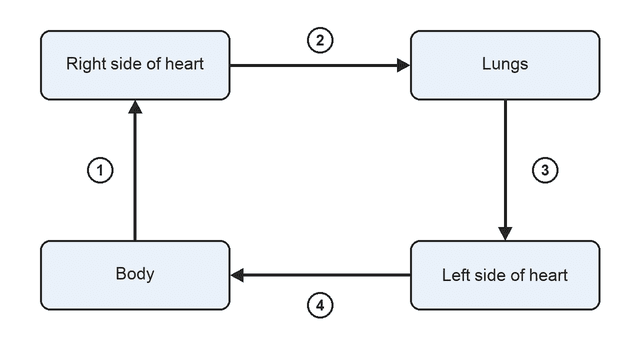
Which two arrows show blood that is rich in oxygen?
- 181 mark
Question 18
Cognitive domain: Application
A doctor examines Vihaan. His lungs take in plenty of air, and his stomach and intestines digest his food well. But the cells of his leg muscles are not getting enough oxygen and digested food. (Hypothetical case.)
Which system should the doctor check next, and why?
- 191 mark
Question 19
Cognitive domain: Recall
A blood test report of a child with a throat infection shows more white blood cells than usual. Which job of the blood is done by white blood cells?
- 201 mark
Question 20
Cognitive domain: Analysis
A teacher writes two statements about blood vessels on the board.
Assertion (A): The pulmonary vein carries blood that is rich in oxygen.
Reason (R): Veins carry blood towards the heart.
- 211 mark
Question 21
Cognitive domain: Evaluation
Read the two statements about capillaries.
Assertion (A): The walls of capillaries are thicker than the walls of arteries.
Reason (R): Oxygen and digested food pass through the walls of capillaries into the body cells.
- 221 mark
Question 22
Cognitive domain: Application
At rest, the heart of an average adult beats 72 times in one minute. About how much time passes between the start of one heartbeat and the start of the next?
- 231 mark
Question 23
Cognitive domain: Evaluation
Aryan is a healthy child. A nurse counts his pulse at the wrist for one full minute and gets 90. At the same time a doctor counts his heartbeats with a stethoscope for one minute and gets 72. (Hypothetical data.)
What is the best conclusion?
- 241 mark
Question 24
Cognitive domain: Evaluation
Four students each wrote one sentence to sum up how blood moves in the body. Which sentence is the best summary?
- 251 mark
Question 25
Cognitive domain: Analysis
Sana drew a simple picture of how blood flows through the heart. She numbered the six arrows. One of the arrows points the wrong way.

Which arrow is drawn the wrong way?
- 262 marks
Question 26
Cognitive domain: Analysis
The table gives the jobs of three organ systems of our body.
System Some of its organs Its job Respiratory Lungs, windpipe Takes in oxygen and removes carbon dioxide Excretory Kidneys, bladder Removes wastes, such as urine, from the body Circulatory Heart, blood vessels, blood Transports materials round the body Carbon dioxide and other wastes are made in the body cells, which are far from the lungs and the kidneys. Explain, using the table, why the respiratory system and the excretory system cannot do their jobs without the circulatory system.
- 272 marks
Question 27
Cognitive domain: Application
In the muscles of our arm, blood flows from an artery, through very thin vessels, into a vein.
Draw a simple line diagram to show how these three kinds of blood vessels are joined. Use arrows to show the direction of the blood flow, and label the three kinds of vessels. (2 marks)
- 282 marks
Question 28
Cognitive domain: Application
Raju is 6 years old. His father is 40 years old. Raju holds up his small fist next to his father's big fist.
Your book says that the size of the heart is roughly equal to the size of our fist. Whose heart is bigger, Raju's or his father's? Give a reason.
- 292 marks
Question 29
Cognitive domain: Analysis
At a science fair, a poster asks: "What if the capillaries had thick walls, like arteries?" Explain what would happen to the supply of oxygen and digested food to the body cells, and to the removal of carbon dioxide from them.
- 302 marks
Question 30
Cognitive domain: Application
Rhea's father does yogic deep breathing in which breathing out takes twice as long as breathing in. He breathes in through the nose for a count of 2 and breathes out for a count of 4. Each count takes 1 second. (Hypothetical timing.)
(a) How long does he take to complete 5 full breaths (one breath is one inhale and one exhale)? (1 mark)
(b) His heart beats 72 times in a minute. How many times does it beat while he does these 5 breaths? (1 mark)
- 312 marks
Question 31
Cognitive domain: Application
Dev falls on his chest from his bicycle. The doctor checks him and says that his heart is safe. Name the part of the skeleton that protects the heart. Why is it important that the heart is protected?
- 323 marks
Question 32
Cognitive domain: Application
While playing, Arjun winds a rubber band tightly round the tip of his finger. After a few minutes his fingertip looks pale and feels cold and tingly. His teacher asks him to take the band off at once.
(a) What is the tight band stopping from reaching the fingertip? (1 mark)
(b) Name two useful things that the cells of the fingertip are not getting while the band is on. (1 mark)
(c) The cells of the fingertip keep making carbon dioxide. Why is this also a problem while the band is on? (1 mark)
- 333 marks
Question 33
Cognitive domain: Evaluation
Riya lets her arm hang down for a minute, and a greenish-blue vein stands out on the inside of her forearm. Her teacher does a simple test on this vein.
- She presses one finger firmly on the vein at point H, near the wrist, and keeps it there.
- With a second finger she strokes the vein from H towards the elbow, pushing the blood out of it, and stops at point E.
- She lifts the second finger off at E. The part of the vein between H and E stays flat and empty.
- Then she lifts the first finger off at H. The empty part fills up with blood at once, starting from the wrist end.
(a) In which direction does blood flow in this vein: from the wrist towards the elbow, or from the elbow towards the wrist? Give a reason from the test. (1 mark)
(b) After the second finger is lifted at E, blood from the elbow side does not flow back into the empty part. Which parts of the vein stop it? (1 mark)
(c) Riya says, "In an artery of the forearm, the blood would flow the other way, from the elbow towards the wrist." Is she right? Give a reason. (1 mark)
- 343 marks
Question 34
Cognitive domain: Evaluation
Long ago, many people believed that blood was made in the liver and was used up in the body. William Harvey used numbers to show that this idea could not be right.
Here are rounded figures for an adult at rest. The body holds about 5 litres of blood. The heart pumps about 5 litres of blood every minute.
(a) About how many litres of blood does the heart pump in one hour? (1 mark)
(b) How many times the body's whole 5 litres of blood is this? (1 mark)
(c) Use your answers to explain why the blood cannot be made in the liver and used up, but must go round and round the body. (1 mark)
- 353 marks
Question 35
Cognitive domain: Analysis
Suppose the pulmonary veins get blocked, so that no blood can come from the lungs to the heart.
(a) Which chamber of the heart stops receiving blood from the lungs? (1 mark)
(b) What will happen to the blood that the heart sends into the aorta? (1 mark)
(c) Why will the body cells be harmed? (1 mark)
- 363 marks
Question 36
Cognitive domain: Analysis
Blood flows through every organ of the body. The table shows one change that each of three organs P, Q and R makes to the blood that flows through it.
Organ Blood flowing into the organ Blood flowing out of the organ P Little oxygen, much carbon dioxide Much oxygen, little carbon dioxide Q Much of the waste that leaves the body in urine Very little of this waste R (soon after a meal) Little digested food Much digested food (a) Name organ P. Is the blood that flows out of P pure blood or impure blood? (1 mark)
(b) Name organ Q and the organ system it belongs to. (1 mark)
(c) Name organ R and the organ system it belongs to. (1 mark)
- 374 marks
Question 37
Cognitive domain: Analysis
A class measured the pulse of five members of a family while each person was sitting quietly. The bar chart shows the results. (Hypothetical data.)
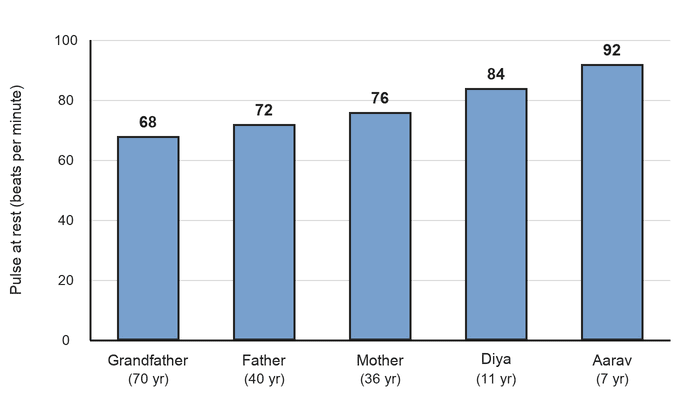
(a) The book says that the heart of an average adult beats about 72 times a minute at rest. Name the people in the chart whose pulse is higher than 72. (1 mark)
(b) How many more times does Aarav's heart beat than Grandfather's heart in 5 minutes? (1 mark)
(c) The two children have the fastest pulses in this chart. Can we say from this chart that every child has a faster pulse than every adult? Give a reason. (2 marks)
- 384 marks
Question 38
Cognitive domain: Evaluation
Mira says that skipping raises the pulse more than walking does. To test this, she makes a plan. Jay skips for 5 minutes, and Mira herself walks for 1 minute. Straight after, Jay counts his pulse for 15 seconds, and Mira counts her pulse for one full minute. Then they compare the two numbers they counted. (Hypothetical plan.)
Jay says that this is not a fair test.
(a) Write two things in Mira's plan that make the test unfair. (2 marks)
(b) Which one thing should be changed on purpose in a fair test of Mira's idea? (1 mark)
(c) Mira repeats the test fairly, with the same child doing both activities, with a rest in between. After which activity do you expect the pulse to be higher? Give a reason. (1 mark)
- 394 marks
Question 39
Cognitive domain: Creativity
Class 5 wants to act out how blood moves through the heart in the school playground. Four children stand for the four chambers of the heart. They stand in two rows of two, an upper row and a lower row, placed like the chambers of a real heart, two on top and two below. A ball stands for a drop of blood that is passed from child to child. A teacher shows the "lungs" and the "body" by two chairs placed outside the group.
(a) Name the two chambers that the two children in the upper row stand for. (1 mark)
(b) Write the order in which the ball is passed, starting at the right auricle, until it leaves the heart to the body. Include the chair for the lungs. (2 marks)
(c) Write one way in which this game is different from the real heart. (1 mark)
- 405 marks
Question 40
Cognitive domain: Analysis
Read this imaginary story.
Ruby is a drop of blood. She starts her journey in the left ventricle of Dev's heart and is pushed into the aorta. From the aorta she flows into smaller arteries that run down to Dev's leg. In the very thin capillaries of the leg muscles, Ruby gives out oxygen and takes in carbon dioxide. Next she enters the veins, where small flaps called valves stop her from slipping backwards. Through the inferior vena cava she reaches the right auricle and then the right ventricle. The right ventricle pumps her to the lungs through the pulmonary vein. In the lungs Ruby gives out carbon dioxide, takes in oxygen and is ready for another round.
(a) Name, in order, the three kinds of blood vessels that Ruby flows through between the aorta and the inferior vena cava. (1 mark)
(b) One sentence in the story is wrong. Copy the wrong part and correct it. (2 marks)
(c) Ruby is pure blood when she leaves the left ventricle. Why is she impure blood when she reaches the right auricle? (2 marks)