
Question 1113 marksEasy
In each of the figures below, determine if the dotted line is a line of symmetry.
(a)
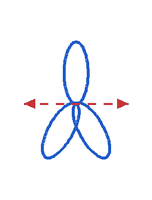
(b)
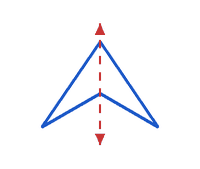
(c)
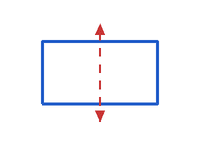
(d)
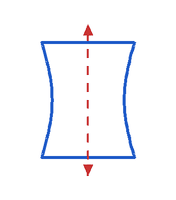
(e)
(f)

(g)
(h)
Confirming your payment
Sign up now and get 250 free tokens.
Self Assessment · Question 111 of 114
In each of the figures below, determine if the dotted line is a line of symmetry.
(a)
(b)
(c)
(d)
(e)
(f)
(g)
(h)
Solution:
Concept: A line is a line of symmetry if folding the figure along it makes the two parts cover each other exactly. Each part is then the mirror image of the other.
Step 1 — Part (a).
Above the dotted line there is one petal, and below it there are two. When we fold along the line, the parts do not cover each other, so it is not a line of symmetry.
Step 2 — Part (b).
The left half of the arrow shape is the mirror image of the right half, so the two halves match. It is a line of symmetry.
Step 3 — Part (c).
The dotted line goes down the middle of the rectangle, so the two halves are equal and match. It is a line of symmetry.
Step 4 — Part (d).
The left and right curved sides are mirror images of each other. It is a line of symmetry.
Step 5 — Part (e).
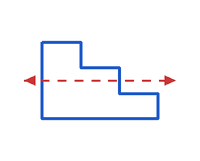
The steps above the line do not match the solid block below it, so the halves do not cover each other. It is not a line of symmetry.
Step 6 — Part (f).
The line joins two opposite corners of the hexagon; the top half is the mirror image of the bottom half. It is a line of symmetry.
Step 7 — Part (g).
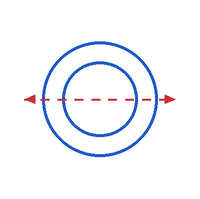
The line passes through the centre of both circles, so the top half matches the bottom half. It is a line of symmetry.
Step 8 — Part (h).
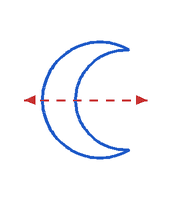
The top half of the crescent is the mirror image of the bottom half. It is a line of symmetry.
Watch out: Both parts must match exactly in shape and size; just cutting a figure into two pieces is not enough.
Therefore, the dotted line is a line of symmetry in (b), (c), (d), (f), (g) and (h), but not in (a) and (e).