
Opening your dashboard
Class 5 Maths Chapter 23: Self Assessment Solutions
114 textbook questions with step-by-step answers, free to read, for ICSE 2026-27.
Get talked through Ch 23, not just shown the answer
Reading a finished solution is not the same as being able to do it. The AI tutor takes one question at a time and works it with you, in your own words, until you can.
- Ask it out loud, in your own words
- It gives you the next step, not the answer
- Stuck on part (ii)? Start there
114 questions with solutions
1–3 marks · Mixed difficulty
- 11 mark
Question 1
The smallest 8-digit number is
Solve with AIAnswer
- Correct
(A) 1,00,00,000
(B) 1,00,00,001
(C) 1,00,00,002
(D) 99,99,999
Answer: (A) 1,00,00,000
Concept: The number of digits tells us how big a whole number is. The smallest number with a given number of digits is 1 followed by zeros, and the largest has 9 in every place.
Step 1 — Make the smallest 8-digit number.
The smallest number must start with the smallest digit allowed at the front, which is 1 (a number cannot start with 0). All the other seven places get the smallest digit, 0.
Step 2 — Write it with commas.
One followed by seven zeros is 1,00,00,000, which we read as one crore.
Why the other options are wrong:
- (B) 1,00,00,001: This is 1 more than 1,00,00,000, so it is not the smallest 8-digit number.
- (C) 1,00,00,002: This is 2 more than 1,00,00,000, so it is not the smallest 8-digit number.
- (D) 99,99,999: This has only 7 digits. It is the largest 7-digit number, just 1 less than one crore.
Therefore, the smallest 8-digit number is 1,00,00,000, option (A).
- 21 mark
Question 2
The largest 7-digit number is
Solve with AIAnswer
(A) 10,00,00,009
(B) 99,99,99,999
- Correct
(C) 99,99,999
(D) 1,99,999
Answer: (C) 99,99,999
Concept: The number of digits tells us how big a whole number is. The smallest number with a given number of digits is 1 followed by zeros, and the largest has 9 in every place.
Step 1 — Make the largest 7-digit number.
The largest number with 7 digits has the biggest digit, 9, in all seven places.
Step 2 — Write it with commas.
Seven nines written in the Indian System are 99,99,999 (ninety-nine lakh, ninety-nine thousand, nine hundred ninety-nine).
Watch out: Count the digits, not the commas.
Why the other options are wrong:
- (A) 10,00,00,009: This has 9 digits, not 7.
- (B) 99,99,99,999: This has 9 digits; it is the largest 9-digit number, not the largest 7-digit number.
- (D) 1,99,999: This has only 6 digits.
Therefore, the largest 7-digit number is 99,99,999, option (C).
- 31 mark
Question 3
The place value of 5 in 9,85,43,210 is
Solve with AIAnswer
(A) 1 crore
(B) 50 lakh
(C) 50 thousand
- Correct
(D) five lakh
Answer: (D) five lakh
Concept: In the Indian System the places, from the right, are ones, tens, hundreds, thousands, ten thousands, lakhs, ten lakhs, crores and ten crores. We put the first comma after three digits from the right, and then a comma after every two digits. The place value of a digit is the digit times the value of its place.
Step 1 — Find the place of 5.
We read the places of 9,85,43,210 from the left: 9 is in the crores place, 8 in the ten lakhs place and 5 in the lakhs place.
Step 2 — Find its place value.
The place value is the digit times the value of its place.
5,00,000 is read as five lakh.
Watch out: The place value depends on where the digit stands, so first find its place.
Why the other options are wrong:
- (A) 1 crore: The crores place holds 9, not 5, so no digit here has the place value 1 crore.
- (B) 50 lakh: 50 lakh would need 5 in the ten lakhs place, but that place holds 8.
- (C) 50 thousand: 50 thousand would need 5 in the ten thousands place, but that place holds 4.
Therefore, the place value of 5 is five lakh, option (D).
- 41 mark
Question 4
The face value of 9 in 38,95,008 is
Solve with AIAnswer
(A) Nine thousand
(B) Ninety thousand
- Correct
(C) 9
(D) Nine lakh
Answer: (C) 9
Concept: Every digit in a number has a face value (the digit itself) and a place value (the digit times the value of its place).
Step 1 — Recall what face value means.
The face value of a digit is the digit itself. It does not change with the place of the digit.
Step 2 — Read the face value of 9.
So the face value of 9 in 38,95,008 is simply 9.
Watch out: Do not mix face value with place value; only the place value depends on the place.
Why the other options are wrong:
- (A) Nine thousand: Nine thousand would need 9 in the thousands place, and it is not a face value anyway.
- (B) Ninety thousand: 9 stands in the ten thousands place, so ninety thousand is its place value, not its face value.
- (D) Nine lakh: Nine lakh would need 9 in the lakhs place, which holds 8; it is not a face value either.
Therefore, the face value of 9 is 9, option (C).
- 53 marks
Question 5
Arrange the following in ascending order
(a) 38,94,35,678; 98,76,54,321; 11,23,45,331; 4,32,15,673; 42,13,24,567
(b) 42,31,34,678; 75,32,14,571; 83,24,12,531; 17,32,14,541; 73,24,51,321
(c) 45,67,89,321; 73,21,45,678; 46,12,34,127; 53,26,78,931; 64,21,41,321
Solve with AIWritten solution
Solution:
Concept: Ascending order means from the smallest to the greatest. To compare two numbers, first count their digits: the number with more digits is greater. If they have the same number of digits, compare the digits one by one from the left; the first place where they differ decides.
Step 1 — Part (a).
The number 4,32,15,673 has only 8 digits, and all the others have 9 digits. So 4,32,15,673 is the smallest of them.
The 9-digit numbers have different crores (the first two digits): 11, 38, 42, 98. So these crores alone give the order.
Written from smallest to greatest: 4,32,15,673; 11,23,45,331; 38,94,35,678; 42,13,24,567; 98,76,54,321.
Step 2 — Part (b).
All five numbers have 9 digits, so we compare them from the left.
The 9-digit numbers have different crores (the first two digits): 17, 42, 73, 75, 83. So these crores alone give the order.
Written from smallest to greatest: 17,32,14,541; 42,31,34,678; 73,24,51,321; 75,32,14,571; 83,24,12,531.
Step 3 — Part (c).
All five numbers have 9 digits, so we compare them from the left.
The 9-digit numbers have different crores (the first two digits): 45, 46, 53, 64, 73. So these crores alone give the order.
Written from smallest to greatest: 45,67,89,321; 46,12,34,127; 53,26,78,931; 64,21,41,321; 73,21,45,678.
Watch out: A number with fewer digits is always smaller, even if its first digit is big.
Therefore, the numbers in ascending order are: (a) 4,32,15,673; 11,23,45,331; 38,94,35,678; 42,13,24,567; 98,76,54,321; (b) 17,32,14,541; 42,31,34,678; 73,24,51,321; 75,32,14,571; 83,24,12,531; (c) 45,67,89,321; 46,12,34,127; 53,26,78,931; 64,21,41,321; 73,21,45,678.
- 63 marks
Question 6
Arrange the following in descending order
(a) 15,63,21,456; 34,56,78,413; 93,21,32,141; 6,46,78,132; 20,13,24,412
(b) 8,41,23,456; 21,24,13,452; 73,24,56,123; 93,45,67,831; 13,24,12,313
(c) 13,57,89,032; 83,24,12,321; 43,41,24,217; 53,21,34,567; 73,23,15,678
Solve with AIWritten solution
Solution:
Concept: Descending order means from the greatest to the smallest. To compare two numbers, first count their digits: the number with more digits is greater. If they have the same number of digits, compare the digits one by one from the left; the first place where they differ decides.
Step 1 — Part (a).
The number 6,46,78,132 has only 8 digits, and all the others have 9 digits. So 6,46,78,132 is the smallest of them.
The 9-digit numbers have different crores (the first two digits): 93, 34, 20, 15. So these crores alone give the order.
Written from greatest to smallest: 93,21,32,141; 34,56,78,413; 20,13,24,412; 15,63,21,456; 6,46,78,132.
Step 2 — Part (b).
The number 8,41,23,456 has only 8 digits, and all the others have 9 digits. So 8,41,23,456 is the smallest of them.
The 9-digit numbers have different crores (the first two digits): 93, 73, 21, 13. So these crores alone give the order.
Written from greatest to smallest: 93,45,67,831; 73,24,56,123; 21,24,13,452; 13,24,12,313; 8,41,23,456.
Step 3 — Part (c).
All five numbers have 9 digits, so we compare them from the left.
The 9-digit numbers have different crores (the first two digits): 83, 73, 53, 43, 13. So these crores alone give the order.
Written from greatest to smallest: 83,24,12,321; 73,23,15,678; 53,21,34,567; 43,41,24,217; 13,57,89,032.
Watch out: In descending order the number with fewer digits comes last.
Therefore, the numbers in descending order are: (a) 93,21,32,141; 34,56,78,413; 20,13,24,412; 15,63,21,456; 6,46,78,132; (b) 93,45,67,831; 73,24,56,123; 21,24,13,452; 13,24,12,313; 8,41,23,456; (c) 83,24,12,321; 73,23,15,678; 53,21,34,567; 43,41,24,217; 13,57,89,032.
- 71 mark
Question 7
The greatest 9-digit number using the digits 0, 1, 2, 3, 4, 5, 6, 7, 8 only once is
Solve with AIAnswer
(A) 801234567
- Correct
(B) 876543210
(C) 801234876
(D) 876501234
Answer: (B) 876543210
Concept: To make the greatest number from given digits, write the digits from the biggest to the smallest. To make the smallest number, write them from the smallest to the biggest, but a number cannot start with 0, so we put the smallest non-zero digit first and the 0 next to it.
Step 1 — Order the digits.
To get the greatest number we put the biggest digit in the biggest place. So we write the nine digits from the biggest to the smallest: 8, 7, 6, 5, 4, 3, 2, 1, 0.
Step 2 — Write the number.
This gives 876543210, which uses every digit exactly once.
Why the other options are wrong:
- (A) 801234567: This puts 0 in the second place, so it is much smaller than 876543210.
- (C) 801234876: This uses 8 twice and leaves out 5, so it breaks the rule 'each digit only once'.
- (D) 876501234: This has 0 in the fifth place where 876543210 has 4, so it is smaller.
Therefore, the greatest number is 876543210, option (B).
- 81 mark
Question 8
The smallest 9-digit number formed by using the digits 0, 1, 2, 3, 4, 5, 6, 7, 8 only once is
Solve with AIAnswer
(A) 012345678
- Correct
(B) 102345678
(C) 108765432
(D) 1876543210
Answer: (B) 102345678
Concept: To make the greatest number from given digits, write the digits from the biggest to the smallest. To make the smallest number, write them from the smallest to the biggest, but a number cannot start with 0, so we put the smallest non-zero digit first and the 0 next to it.
Step 1 — Order the digits.
For the smallest number we write the digits from the smallest to the biggest: 0, 1, 2, 3, 4, 5, 6, 7, 8.
Step 2 — Move 0 away from the front.
A number cannot start with 0, so we put the smallest non-zero digit, 1, first and the 0 just after it. This gives 102345678.
Watch out: Never start a number with 0; 012345678 is really the 8-digit number 12345678.
Why the other options are wrong:
- (A) 012345678: A number cannot begin with 0; written this way it is only the 8-digit number 12,345,678.
- (C) 108765432: After 10 this has 8, where 102345678 has 2, so it is bigger than 102345678.
- (D) 1876543210: This has 10 digits and uses 1 twice, so it does not use the nine digits once each.
Therefore, the smallest number is 102345678, option (B).
- 91 mark
Question 9
The greatest 9-digit number using the digits 0, 1, 2, 3 and 4 with repetition is
Solve with AIAnswer
- Correct
(A) 444443210
(B) 404444232
(C) 440444231
(D) 410444432
Answer: (A) 444443210
Concept: To make the greatest number from given digits, write the digits from the biggest to the smallest. To make the smallest number, write them from the smallest to the biggest, but a number cannot start with 0, so we put the smallest non-zero digit first and the 0 next to it.
Step 1 — Understand the rule.
Each of the digits 0, 1, 2, 3 and 4 must appear at least once, and a digit may be repeated. The number has 9 places, so 5 places are used by the five different digits and 4 places are free.
Step 2 — Use the free places for the biggest digit.
To make the number as big as possible we fill the free places with the biggest digit, 4. So 4 appears 5 times in all.
Step 3 — Write the digits from the biggest.
We write the five 4s first and then 3, 2, 1, 0. This gives 444443210.
Watch out: Here every digit 0 to 4 must be used. If that were not needed, the greatest number would simply be 444444444, but it is not an option.
Why the other options are wrong:
- (B) 404444232: It does not use the digit 1 at all, and its second digit is 0, so it is also smaller than 444443210.
- (C) 440444231: Its third digit is 0, while 444443210 has 4 there, so it is smaller.
- (D) 410444432: Its second digit is 1, while 444443210 has 4 there, so it is smaller.
Therefore, the greatest number is 444443210, option (A).
- 101 mark
Question 10
The number 38,32,871 is read in International System as
Solve with AIAnswer
(A) Thirty eight lakh thirty two thousand eight hundred and seventy one
- Correct
(B) Three million eight hundred thirty two thousand eight hundred seventy one
(C) Thirty eight million thirty two thousand eight hundred seventy one
(D) Three lakh eight hundred thirty two thousand eight hundred seventy one
Answer: (B) Three million eight hundred thirty two thousand eight hundred seventy one
Concept: In the International System the places, from the right, are ones, tens, hundreds, thousands, ten thousands, hundred thousands, millions, ten millions and hundred millions. We put a comma after every three digits from the right. 10 lakh = 1 million and 1 crore = 10 million.
Step 1 — Put in the International commas.
We remove the Indian commas and put a comma after every three digits from the right: 38,32,871 becomes 3,832,871.
Step 2 — Read each period.
The periods are 3 millions, 832 thousands and 871 ones. So we read it as three million eight hundred thirty two thousand eight hundred seventy one.
Watch out: Lakh and crore belong to the Indian System only.
Why the other options are wrong:
- (A): This is the correct name in the Indian System, but the question asks for the International System.
- (C): Thirty eight million is 38,000,000, so this name is 38,032,871, a much bigger number.
- (D): This mixes the Indian word 'lakh' with International periods, so it is not a proper name in either system.
Therefore, 38,32,871 is read as three million eight hundred thirty two thousand eight hundred seventy one, option (B).
- 111 mark
Question 11
Five lakh seventy five thousand eight hundred is read in International System as
Solve with AIAnswer
(A) 5 million seventy five thousand eight hundred
(B) Fifty seven million five thousand eight hundred
- Correct
(C) Five hundred seventy five thousand eight hundred.
(D) Five crore seventy five thousand eight hundred.
Answer: (C) Five hundred seventy five thousand eight hundred.
Concept: In the International System the places, from the right, are ones, tens, hundreds, thousands, ten thousands, hundred thousands, millions, ten millions and hundred millions. We put a comma after every three digits from the right. 10 lakh = 1 million and 1 crore = 10 million.
Step 1 — Write the number in figures.
Five lakh seventy five thousand eight hundred is 5,75,800 in the Indian System.
Step 2 — Put in the International commas.
With a comma after every three digits from the right it becomes 575,800.
Step 3 — Read each period.
The periods are 575 thousands and 800 ones. So it is read as five hundred seventy five thousand eight hundred.
Watch out: 5 lakh is not 5 million: 5 lakh = 500 thousand, and 10 lakh make 1 million.
Why the other options are wrong:
- (A): 5 million seventy five thousand eight hundred is 5,075,800, which is about ten times too big.
- (B): Fifty seven million five thousand eight hundred is 57,005,800, a far bigger number.
- (D): Five crore is an Indian word and five crore seventy five thousand eight hundred is 5,00,75,800, a far bigger number.
Therefore, five lakh seventy five thousand eight hundred is read as five hundred seventy five thousand eight hundred, option (C).
- 121 mark
Question 12
When we add 83,24,56,789; 93,24,156; 34,56,789 we get
Solve with AIAnswer
(A) 85,42,37,734
- Correct
(B) 84,52,37,734
(C) 85,47,72,334
(D) 84,53,77,234
Answer: (B) 84,52,37,734
Concept: To add or subtract big numbers, we write them one under the other with ones under ones, tens under tens, and so on, and work from the ones place to the left, carrying or borrowing when needed.
Step 1 — Add the first two numbers.
We add 83,24,56,789 and 93,24,156 place by place, starting from the ones.
Step 2 — Add the third number.
Now we add 34,56,789 to this total.
Watch out: Line up the ones digits; the three numbers have different numbers of digits.
Why the other options are wrong:
- (A) 85,42,37,734: This has 85 crore 42 lakh, but the correct sum has 84 crore 52 lakh, so it is 90 lakh too big.
- (C) 85,47,72,334: This differs from the correct sum 84,52,37,734 already in the crores (85 instead of 84).
- (D) 84,53,77,234: This differs from the correct sum 84,52,37,734 in the ten thousands place and the places after it.
Therefore, the sum is 84,52,37,734, option (B).
- 131 mark
Question 13
When we subtract 82,34,518 from 39,45,67,812, we get
Solve with AIAnswer
(A) 368333294
(B) 368294333
- Correct
(C) 386333294
(D) 863833294
Answer: (C) 386333294
Concept: To add or subtract big numbers, we write them one under the other with ones under ones, tens under tens, and so on, and work from the ones place to the left, carrying or borrowing when needed.
Step 1 — Subtract.
We take the smaller number 82,34,518 away from the bigger number 39,45,67,812, place by place from the ones, borrowing where needed.
Step 2 — Check by adding.
Adding the answer to the number we took away must give back 39,45,67,812.
Watch out: The options are written without commas, so compare them digit by digit with 386333294.
Why the other options are wrong:
- (A) 368333294: 368333294 has 6 and 8 swapped in the second and third places of the correct answer 386333294.
- (B) 368294333: 368294333 does not match the correct answer 386333294; it is about 1.8 crore too small.
- (D) 863833294: 863833294 is far bigger than 39,45,67,812 itself, so it cannot be a difference taken from it.
Therefore, the answer is 386333294, option (C).
- 141 mark
Question 14
When we multiply 6,324 by 762, we get
Solve with AIAnswer
(A) 48,81,888
(B) 4,88,88,481
(C) 4,88,881
- Correct
(D) 48,18,888
Answer: (D) 48,18,888
Concept: To multiply by a 3-digit number, we multiply by its hundreds, tens and ones separately and add the three products.
Step 1 — Break 762 into parts.
We write 762 as 700 + 60 + 2 and multiply 6,324 by each part.
Step 2 — Add the three products.
Adding the three answers gives the full product.
Watch out: When you multiply by 60, put one zero at the end; when you multiply by 700, put two zeros.
Why the other options are wrong:
- (A) 48,81,888: 48,81,888 has the digits 1 and 8 swapped in the ten thousands and thousands places of 48,18,888.
- (B) 4,88,88,481: 4,88,88,481 is about 4.9 crore, ten times too big: 6,324 × 762 is less than 6,400 × 800 = 51,20,000.
- (C) 4,88,881: 4,88,881 is only about 4.9 lakh, ten times too small: 6,324 × 762 is more than 6,000 × 700 = 42,00,000.
Therefore, 6,324 × 762 = 48,18,888, option (D).
- 151 mark
Question 15
When we divide 83,45,678 by 83, the remainder is
Solve with AIAnswer
- Correct
(A) 28
(B) 38
(C) 48
(D) 58
Answer: (A) 28
Concept: In long division we divide one part of the dividend at a time and bring down the next digit each time. The remainder is what is left at the end, and it must be smaller than the divisor.
Step 1 — Do the long division.
We divide 83,45,678 by 83 from the left, one digit at a time.
- Take the first 2 digits, 83. Divide 83 by 83: 83 × 1 = 83, remainder 0.
- Bring down 4 to make 4. It is less than 83, so write 0 in the quotient; remainder 4.
- Bring down 5 to make 45. It is less than 83, so write 0 in the quotient; remainder 45.
- Bring down 6 to make 456. Divide 456 by 83: 83 × 5 = 415, remainder 41.
- Bring down 7 to make 417. Divide 417 by 83: 83 × 5 = 415, remainder 2.
- Bring down 8 to make 28. It is less than 83, so write 0 in the quotient; remainder 28.
Step 2 — Read the remainder.
The quotient is 1,00,550 and 28 is left at the end, so the remainder is 28.
Step 3 — Check the answer.
Dividend = divisor × quotient + remainder, so this must give back 83,45,678.
Watch out: When a part is smaller than 83, write 0 in the quotient before bringing down the next digit.
Why the other options are wrong:
- (B) 38: With remainder 38 we would need 83 × 1,00,550 + 38 = 83,45,688, not 83,45,678.
- (C) 48: With remainder 48 we would need 83 × 1,00,550 + 48 = 83,45,698, not 83,45,678.
- (D) 58: With remainder 58 we would need 83 × 1,00,550 + 58 = 83,45,708, not 83,45,678.
Therefore, the remainder is 28, option (A).
- 161 mark
Question 16
When we divide 3,24,558 by 19, the quotient is
Solve with AIAnswer
(A) 17,802
(B) 18,207
(C) 17,208
- Correct
(D) 17,082
Answer: (D) 17,082
Concept: In long division we divide one part of the dividend at a time and bring down the next digit each time. The digits we write on top form the quotient.
Step 1 — Do the long division.
We divide 3,24,558 by 19 from the left, one digit at a time.
- Take the first 2 digits, 32. Divide 32 by 19: 19 × 1 = 19, remainder 13.
- Bring down 4 to make 134. Divide 134 by 19: 19 × 7 = 133, remainder 1.
- Bring down 5 to make 15. It is less than 19, so write 0 in the quotient; remainder 15.
- Bring down 5 to make 155. Divide 155 by 19: 19 × 8 = 152, remainder 3.
- Bring down 8 to make 38. Divide 38 by 19: 19 × 2 = 38, remainder 0.
Step 2 — Read the quotient.
The digits written on top make the quotient 17,082, and nothing is left over.
Step 3 — Check the answer.
Divisor × quotient must give back 3,24,558.
Watch out: When 19 does not go into a part (here 15), write 0 in the quotient; forgetting it gives a wrong answer.
Why the other options are wrong:
- (A) 17,802: 19 × 17,802 = 3,38,238, not 3,24,558.
- (B) 18,207: 19 × 18,207 = 3,45,933, not 3,24,558.
- (C) 17,208: 19 × 17,208 = 3,26,952, not 3,24,558.
Therefore, the quotient is 17,082, option (D).
- 171 mark
Question 17
The Roman numeral for 500 is
Solve with AIAnswer
(A) V
(B) M
- Correct
(C) D
(D) L
Answer: (C) D
Concept: Roman numerals use seven letters: I = 1, V = 5, X = 10, L = 50, C = 100, D = 500 and M = 1000. A letter written after a bigger letter is added, so XI means 11. A smaller letter written before a bigger one is taken away, so IX means 9, XL means 40 and CM means 900. A letter is never written more than three times in a row.
Step 1 — Recall the letters.
Of the seven Roman letters, the one that stands for 500 is D.
Why the other options are wrong:
- (A) V: V stands for 5.
- (B) M: M stands for 1000.
- (D) L: L stands for 50.
Therefore, the Roman numeral for 500 is D, option (C).
- 181 mark
Question 18
The Roman numeral for 39 is
Solve with AIAnswer
(A) IXXL
(B) LI
(C) XL
- Correct
(D) XXXIX
Answer: (D) XXXIX
Concept: Roman numerals use seven letters: I = 1, V = 5, X = 10, L = 50, C = 100, D = 500 and M = 1000. A letter written after a bigger letter is added, so XI means 11. A smaller letter written before a bigger one is taken away, so IX means 9, XL means 40 and CM means 900. A letter is never written more than three times in a row.
Step 1 — Break 39 into tens and ones.
We write 39 as 30 + 9.
Step 2 — Write each part.
30 is three tens, so it is XXX. 9 is one less than 10, so it is IX.
Step 3 — Join the parts.
Writing the tens first and then the ones gives XXXIX.
Watch out: Write the tens and the ones separately; do not take 1 away from 40.
Why the other options are wrong:
- (A) IXXL: IXXL is not a proper Roman numeral: I may be written only before V or X, never before two letters.
- (B) LI: LI is 50 + 1 = 51.
- (C) XL: XL is 50 − 10 = 40.
Therefore, the Roman numeral for 39 is XXXIX, option (D).
- 191 mark
Question 19
The prime factors of 750 are
Solve with AIAnswer
(A) 6, 5 and 25
(B) 2, 15 and 25
- Correct
(C) 2, 3 and 5
(D) 30, 5 and 5
Answer: (C) 2, 3 and 5
Concept: A prime number has exactly two factors: 1 and itself (2, 3, 5, 7, 11, …). The prime factors of a number are the prime numbers that divide it exactly.
Step 1 — Divide by prime numbers.
We keep dividing 750 by the smallest prime number that divides it exactly.
- 750 ÷ 2 = 375
- 375 ÷ 3 = 125
- 125 ÷ 5 = 25
- 25 ÷ 5 = 5
- 5 ÷ 5 = 1
Step 2 — Write 750 as a product of primes.
The divisors we used multiply back to 750.
Step 3 — List the different prime factors.
The different prime numbers in this product are 2, 3 and 5.
Why the other options are wrong:
- (A) 6, 5 and 25: 6 = 2 × 3 and 25 = 5 × 5 are not prime numbers.
- (B) 2, 15 and 25: 15 = 3 × 5 and 25 = 5 × 5 are not prime numbers.
- (D) 30, 5 and 5: 30 = 2 × 3 × 5 is not a prime number.
Therefore, the prime factors of 750 are 2, 3 and 5, option (C).
- 201 mark
Question 20
Every number is a factor of
Solve with AIAnswer
(A) 1
- Correct
(B) 0
(C) 2
(D) 3
Answer: (B) 0
Concept: A factor of a number divides it exactly, with no remainder. If a × b = c, then a and b are factors of c.
Step 1 — Test the number 0.
Any number multiplied by 0 gives 0, for example 7 × 0 = 0. So 0 is a multiple of every number, which means every number divides 0 exactly.
Step 2 — Name the answer.
A number is a factor of another if it divides it exactly. So every number is a factor of 0.
Watch out: 1 is a factor of every number; that is the other way round from this question.
Why the other options are wrong:
- (A) 1: The only factor of 1 is 1 itself; for example, 2 is not a factor of 1.
- (C) 2: The only factors of 2 are 1 and 2; for example, 3 is not a factor of 2.
- (D) 3: The only factors of 3 are 1 and 3; for example, 2 is not a factor of 3.
Therefore, every number is a factor of 0, option (B).
- 211 mark
Question 21
A number is divisible by 9 if the sum of its digits is divisible by
Solve with AIAnswer
(A) 3
(B) 6
- Correct
(C) 9
(D) 5
Answer: (C) 9
Concept: A divisibility test tells us whether one number divides another exactly, without doing the full division.
Step 1 — Recall the rule.
A number is divisible by 9 when the sum of its digits is divisible by 9.
Step 2 — Try an example.
For 7,524 the digits add up to 7 + 5 + 2 + 4 = 18, and 18 is divisible by 9. Indeed, 7,524 ÷ 9 = 836 exactly.
Watch out: The test for 3 also uses the digit sum, but it needs the sum to be divisible by 3 only.
Why the other options are wrong:
- (A) 3: 12 has digit sum 3, which is divisible by 3, but 12 is not divisible by 9.
- (B) 6: 15 has digit sum 6, which is divisible by 6, but 15 is not divisible by 9.
- (D) 5: 14 has digit sum 5, which is divisible by 5, but 14 is not divisible by 9.
Therefore, a number is divisible by 9 if the sum of its digits is divisible by 9, option (C).
- 221 mark
Question 22
The only prime number that is even is
Solve with AIAnswer
(A) 1
- Correct
(B) 2
(C) 3
(D) 5
Answer: (B) 2
Concept: A prime number has exactly two factors: 1 and itself (2, 3, 5, 7, 11, …). The prime factors of a number are the prime numbers that divide it exactly.
Step 1 — Look at the even numbers.
Every even number can be divided by 2. So an even number bigger than 2 has at least three factors (1, 2 and itself) and is not prime.
Step 2 — Check the number 2.
The number 2 itself has only two factors, 1 and 2. So 2 is prime, and it is the only even prime number.
Watch out: 1 is not a prime number, because it has only one factor.
Why the other options are wrong:
- (A) 1: 1 has only one factor, so it is not a prime number; it is also odd.
- (C) 3: 3 is prime, but it is odd, not even.
- (D) 5: 5 is prime, but it is odd, not even.
Therefore, the only even prime number is 2, option (B).
- 231 mark
Question 23
The HCF of 30 and 50 is
Solve with AIAnswer
(A) 50
(B) 150
- Correct
(C) 10
(D) 1,500
Answer: (C) 10
Concept: The HCF (highest common factor) of some numbers is the biggest number that divides each of them exactly. The LCM (lowest common multiple) is the smallest number that each of them divides exactly.
Step 1 — List the factors.
We write all the factors of each number.
- Factors of 30: 1, 2, 3, 5, 6, 10, 15, 30
- Factors of 50: 1, 2, 5, 10, 25, 50
Step 2 — Pick the highest common factor.
The factors found in both lists are 1, 2, 5 and 10. The highest of them is 10.
Watch out: The HCF can never be bigger than the smallest of the numbers.
Why the other options are wrong:
- (A) 50: 50 does not divide 30 exactly, so it is not a common factor.
- (B) 150: 150 is the LCM of 30 and 50, not the HCF.
- (D) 1,500: 1,500 is the product 30 × 50, not the HCF.
Therefore, the HCF of 30 and 50 is 10, option (C).
- 241 mark
Question 24
The LCM of 12, 16 and 20 is
Solve with AIAnswer
(A) 1,000
(B) 192
(C) 320
- Correct
(D) 240
Answer: (D) 240
Concept: The HCF (highest common factor) of some numbers is the biggest number that divides each of them exactly. The LCM (lowest common multiple) is the smallest number that each of them divides exactly.
Step 1 — Write each number as a product of primes.
We break each number into prime factors.
Step 2 — Take each prime the greatest number of times it appears.
2 appears at most four times (in 16), 3 once and 5 once. We multiply these together.
Why the other options are wrong:
- (A) 1,000: 1,000 ÷ 12 is not a whole number, so 1,000 is not a multiple of 12.
- (B) 192: 192 = 12 × 16, but 192 ÷ 20 = 9.6 is not a whole number.
- (C) 320: 320 ÷ 12 is not a whole number, so 320 is not a multiple of 12.
Therefore, the LCM of 12, 16 and 20 is 240, option (D).
- 251 mark
Question 25
The sum of is :
Solve with AIAnswer
(A)
- Correct
(B)
(C)
(D)
Answer: (B)
Concept: To add fractions with different denominators (bottom numbers), we first change them into equivalent fractions with the same denominator, using the LCM of the denominators. Then we add the numerators.
Step 1 — Find a common denominator.
The LCM of 2, 3, 4 and 5 is 60, so we change every fraction into sixtieths.
Step 2 — Add the numerators.
Now all the fractions have the same denominator, so we add the numerators.
Watch out: Never add the denominators; only the numerators are added.
Why the other options are wrong:
- (A): 67/60 is 10/60 less than the true sum, 77/60.
- (C): 57/60 is 20/60 less than the true sum, 77/60.
- (D): 87/60 is 10/60 more than the true sum, 77/60.
Therefore, the sum is 77/60, option (B).
- 261 mark
Question 26
The decimal fraction 0.02 is equal to
Solve with AIAnswer
(A)
(B)
(C)
- Correct
(D)
Answer: (D)
Concept: A decimal with two decimal places is a number of hundredths. To reduce a fraction we divide its numerator and denominator by the same number.
Step 1 — Write the decimal as hundredths.
0.02 has two decimal places, so it means 2 hundredths.
Step 2 — Reduce to the lowest terms.
We divide the numerator and the denominator by 2.
Watch out: 0.02 is 2 hundredths, not 2 tenths.
Why the other options are wrong:
- (A): 1/80 = 0.0125, not 0.02.
- (B): 1/200 = 0.005, not 0.02.
- (C): 1/100 = 0.01, which is only half of 0.02.
Therefore, 0.02 = 1/50, option (D).
- 271 mark
Question 27
25 km 625 m in metres is
Solve with AIAnswer
(A) 25265 m
- Correct
(B) 25625 m
(C) 25256 m
(D) 25526
Answer: (B) 25625 m
Concept: In the metric system, kilo means 1000: 1 km = 1000 m, 1 kg = 1000 g and 1 kL = 1000 L. To change a big unit into a small one we multiply by 1000; to change a small unit into a big one we divide by 1000.
Step 1 — Change the kilometres into metres.
1 km = 1000 m, so we multiply 25 by 1000.
Step 2 — Add the metres.
Now we add the 625 m.
Why the other options are wrong:
- (A) 25265 m: The metres part is written 265 instead of 625.
- (C) 25256 m: The metres part is written 256 instead of 625.
- (D) 25526: The metres part is written 526 instead of 625, and the unit is missing.
Therefore, 25 km 625 m is 25625 m, option (B).
- 283 marks
Question 28
Estimate the sums to the nearest 100
(a) 3,84,781 + 2,37,324 + 8,34,567
(b) 8,32,145 + 3,21,983 + 4,56,789
(c) 4,56,781 + 2,98,749 + 3,45,678
Solve with AIWritten solution
Solution:
Concept: To round a number to the nearest 100, we look at its tens digit. If the tens digit is 5 or more, the hundreds digit goes up by 1; if it is less than 5, the hundreds digit stays the same. The tens and ones then become 0. To estimate a sum, we round every number first and then add the rounded numbers.
Step 1 — Part (a).
First we round each number to the nearest 100.
- 3,84,781 rounds up to 3,84,800, because its tens digit 8 is 5 or more.
- 2,37,324 rounds down to 2,37,300, because its tens digit 2 is less than 5.
- 8,34,567 rounds up to 8,34,600, because its tens digit 6 is 5 or more.
Then we add the rounded numbers.
Step 2 — Part (b).
First we round each number to the nearest 100.
- 8,32,145 rounds down to 8,32,100, because its tens digit 4 is less than 5.
- 3,21,983 rounds up to 3,22,000, because its tens digit 8 is 5 or more.
- 4,56,789 rounds up to 4,56,800, because its tens digit 8 is 5 or more.
Then we add the rounded numbers.
Step 3 — Part (c).
First we round each number to the nearest 100.
- 4,56,781 rounds up to 4,56,800, because its tens digit 8 is 5 or more.
- 2,98,749 rounds down to 2,98,700, because its tens digit 4 is less than 5.
- 3,45,678 rounds up to 3,45,700, because its tens digit 7 is 5 or more.
Then we add the rounded numbers.
Watch out: Round each number first and then add; do not add the exact numbers and round only the total.
Therefore, the estimated sums are (a) 14,56,700; (b) 16,10,900; (c) 11,01,200.
- 291 mark
Question 29
3,845 gm is equal to
Solve with AIAnswer
(A) 384.5 kg
(B) 38.45 kg
(C) 3.3845 kg
- Correct
(D) 3.845 kg
Answer: (D) 3.845 kg
Concept: In the metric system, kilo means 1000: 1 km = 1000 m, 1 kg = 1000 g and 1 kL = 1000 L. To change a big unit into a small one we multiply by 1000; to change a small unit into a big one we divide by 1000.
Step 1 — Divide by 1000.
1000 g make 1 kg, so to change grams into kilograms we divide by 1000. This moves the decimal point three places to the left.
Watch out: Grams to kilograms means dividing by 1000, not by 10 or 100.
Why the other options are wrong:
- (A) 384.5 kg: 384.5 kg is 3845 divided by 10 only; it would be 3,84,500 g.
- (B) 38.45 kg: 38.45 kg is 3845 divided by 100 only; it would be 38,450 g.
- (C) 3.3845 kg: 3.3845 kg has an extra digit 3; it would be 3,384.5 g.
Therefore, 3,845 g = 3.845 kg, option (D).
- 301 mark
Question 30
97.75 kL is equal to
Solve with AIAnswer
(A) 9,77,500 L
(B) 977.5 L
- Correct
(C) 97,750 L
(D) 97.75 L
Answer: (C) 97,750 L
Concept: In the metric system, kilo means 1000: 1 km = 1000 m, 1 kg = 1000 g and 1 kL = 1000 L. To change a big unit into a small one we multiply by 1000; to change a small unit into a big one we divide by 1000.
Step 1 — Multiply by 1000.
1 kL = 1000 L, so to change kilolitres into litres we multiply by 1000. This moves the decimal point three places to the right.
Watch out: When the number of places runs out, fill the empty place with 0: 97.75 becomes 97750.
Why the other options are wrong:
- (A) 9,77,500 L: 9,77,500 L is 97.75 multiplied by 10,000, not by 1000.
- (B) 977.5 L: 977.5 L is 97.75 multiplied by 10 only.
- (D) 97.75 L: 97.75 L has not been changed at all; it is 1000 times too small.
Therefore, 97.75 kL = 97,750 L, option (C).
- 311 mark
Question 31
The average marks obtained by Arvind in his annual examination in six subjects was 72.5. The total marks he scored was
Solve with AIAnswer
(A) 432
(B) 425
(C) 453
- Correct
(D) 435
Answer: (D) 435
Concept: The average of some numbers is their total divided by how many numbers there are. So total = average × number of items.
Step 1 — Use the average rule.
Average = total ÷ number of subjects, so the total is the average multiplied by the number of subjects.
Step 2 — Check the answer.
Dividing the total by 6 must give back the average.
Why the other options are wrong:
- (A) 432: 432 ÷ 6 = 72, not 72.5; it leaves out the half mark in each subject.
- (B) 425: 425 ÷ 6 is about 70.8, not 72.5.
- (C) 453: 453 ÷ 6 = 75.5, not 72.5.
Therefore, the total marks were 435, option (D).
- 321 mark
Question 32
A train covers a distance of 315 km in 9 hours. The distance covered by it in 12 hours is
Solve with AIAnswer
(A) 450 km
(B) 320 km
(C) 415 km
- Correct
(D) 420 km
Answer: (D) 420 km
Concept: In the unitary method we first find the value for one unit (here 1 hour) and then multiply to get the value for the number of units we want.
Step 1 — Find the distance in 1 hour.
The train goes 315 km in 9 hours, so in 1 hour it goes 315 ÷ 9 km.
Step 2 — Find the distance in 12 hours.
In 12 hours it goes 12 times as far.
Why the other options are wrong:
- (A) 450 km: 450 km in 12 hours would mean 37.5 km every hour, but the train goes 35 km every hour.
- (B) 320 km: 320 km is only 5 km more than the 315 km covered in 9 hours, yet the train runs 3 more hours.
- (C) 415 km: 415 km would need 415 ÷ 12 km every hour, which is not 35 km.
Therefore, the train covers 420 km in 12 hours, option (D).
- 331 mark
Question 33
Expressing 16 out of 40 as a percentage, we write
Solve with AIAnswer
(A) 10%
(B) 20%
- Correct
(C) 40%
(D) 30%
Answer: (C) 40%
Concept: Per cent (%) means 'out of 100'. So 40% means 40 out of every 100, or the fraction .
Step 1 — Write it as a fraction.
16 out of 40 is the fraction 16/40.
Step 2 — Multiply by 100.
To change a fraction into a percentage we multiply it by 100.
So 16 out of 40 is 40%.
Why the other options are wrong:
- (A) 10%: 10% of 40 is 4, not 16.
- (B) 20%: 20% of 40 is 8, not 16.
- (D) 30%: 30% of 40 is 12, not 16.
Therefore, 16 out of 40 is 40%, option (C).
- 341 mark
Question 34
When we convert 25% into a decimal fraction, we get
Solve with AIAnswer
(A) 0.255
(B) 0.15
- Correct
(C) 0.25
(D) 1.25
Answer: (C) 0.25
Concept: Per cent (%) means 'out of 100'. So 40% means 40 out of every 100, or the fraction . Dividing by 100 moves the decimal point two places to the left.
Step 1 — Write the percentage as a fraction.
25% means 25 out of 100.
Why the other options are wrong:
- (A) 0.255: 0.255 is 25.5%, not 25%.
- (B) 0.15: 0.15 is 15%, not 25%.
- (D) 1.25: 1.25 is 125%, not 25%.
Therefore, 25% = 0.25, option (C).
- 351 mark
Question 35
20% of 1,000 is
Solve with AIAnswer
(A) 300
- Correct
(B) 200
(C) 400
(D) 500
Answer: (B) 200
Concept: Per cent (%) means 'out of 100'. So 40% means 40 out of every 100, or the fraction .
Step 1 — Multiply by the fraction.
20% of 1,000 means 20/100 of 1,000.
Why the other options are wrong:
- (A) 300: 300 is 30% of 1,000.
- (C) 400: 400 is 40% of 1,000.
- (D) 500: 500 is 50% of 1,000, which is half of it.
Therefore, 20% of 1,000 is 200, option (B).
- 361 mark
Question 36
The sum of 180 + (–70) + (–40) + 50 is
Solve with AIAnswer
(A) 140
- Correct
(B) 120
(C) 320
(D) 240
Answer: (B) 120
Concept: When we add a negative integer, we move to the left on the number line, which is the same as subtracting its size.
Step 1 — Add the negative numbers.
Adding a negative number is the same as taking away. First we put the two negative numbers together.
Step 2 — Add the positive numbers.
Next we put the two positive numbers together.
Step 3 — Combine the two totals.
Now we take 110 away from 230.
Watch out: Adding −70 means taking away 70.
Why the other options are wrong:
- (A) 140: 140 is 20 more than the correct total 120.
- (C) 320: 320 is bigger than 180 + 50 = 230; the two negative numbers make the total smaller than 230, not bigger.
- (D) 240: 240 is bigger than 180 + 50 = 230; the two negative numbers make the total smaller than 230, not bigger.
Therefore, the sum is 120, option (B).
- 371 mark
Question 37
When we convert 39837850 paise into Rupees we get
Solve with AIAnswer
- Correct
(A) ₹ 398378.50
(B) ₹ 398.37850
(C) ₹ 3983.785
(D) ₹ 39837.850
Answer: (A) ₹ 398378.50
Concept: Money: 100 paise = ₹ 1. To change paise into rupees, we divide by 100.
Step 1 — Divide by 100.
100 paise make ₹ 1, so to change paise into rupees we divide by 100. This moves the decimal point two places to the left.
So 39837850 paise is ₹ 398378.50.
Watch out: Divide by 100, not by 1000.
Why the other options are wrong:
- (B) ₹ 398.37850: ₹ 398.37850 is 39837850 divided by 1,00,000.
- (C) ₹ 3983.785: ₹ 3983.785 is 39837850 divided by 10,000.
- (D) ₹ 39837.850: ₹ 39837.850 is 39837850 divided by 1,000.
Therefore, 39837850 paise = ₹ 398378.50, option (A).
- 381 mark
Question 38
2 years and 12 hours when converted into hours is
Solve with AIAnswer
(A) 15272 hrs
(B) 17252 hrs
- Correct
(C) 17532 hrs
(D) 12752 hrs
Answer: (C) 17532 hrs
Concept: 1 ordinary year = 365 days and 1 day = 24 hours. To change a bigger unit of time into a smaller one, we multiply.
Step 1 — Change the years into days.
We take an ordinary year of 365 days, as this question does.
Step 2 — Change the days into hours.
1 day = 24 hours, so we multiply by 24.
Step 3 — Add the 12 hours.
Finally we add the extra 12 hours.
Watch out: First change years into days, then days into hours.
Note: If one of the two years were a leap year (366 days), the answer would be 24 hours more, 17,556 hours; the options use ordinary years.
Why the other options are wrong:
- (A) 15272 hrs: 15,272 hours is 2,260 hours less than the correct 17,532.
- (B) 17252 hrs: 17,252 hours is 280 hours less than the correct 17,532.
- (D) 12752 hrs: 12,752 hours is 4,780 hours less than the correct 17,532.
Therefore, 2 years and 12 hours is 17,532 hours, option (C).
- 391 mark
Question 39
______ is the biggest eight digit number.
Solve with AIWritten solution
Solution:
Concept: The number of digits tells us how big a whole number is. The smallest number with a given number of digits is 1 followed by zeros, and the largest has 9 in every place.
Step 1 — Fill every place with 9.
The biggest digit is 9. So the biggest 8-digit number has 9 in all eight places.
Step 2 — Write it with commas.
Eight nines in the Indian System are written 9,99,99,999.
Watch out: 1 more than 9,99,99,999 is 10,00,00,000, which has 9 digits.
Therefore, 9,99,99,999 is the biggest eight digit number.
- 401 mark
Question 40
When we add 3456789 and 1248975, we get ______ .
Solve with AIWritten solution
Solution:
Concept: To add or subtract big numbers, we write them one under the other with ones under ones, tens under tens, and so on, and work from the ones place to the left, carrying or borrowing when needed.
Step 1 — Add place by place.
We write the numbers one under the other and add from the ones place, carrying when a column adds up to 10 or more.
Step 2 — Check by subtracting.
Taking one number away from the sum must give back the other number.
Watch out: Remember every carry; here every column from the ones to the lakhs carries 1.
Therefore, when we add 3456789 and 1248975, we get 47,05,764.
- 411 mark
Question 41
When we subtract 3987654 from 5312035, we get ______ .
Solve with AIWritten solution
Solution:
Concept: To add or subtract big numbers, we write them one under the other with ones under ones, tens under tens, and so on, and work from the ones place to the left, carrying or borrowing when needed.
Step 1 — Subtract place by place.
We take 39,87,654 away from 53,12,035, starting from the ones and borrowing where the top digit is smaller.
Step 2 — Check by adding.
Adding the answer to the number we took away must give back 53,12,035.
Watch out: The words 'subtract A from B' mean B − A, so here the bigger number 5312035 comes first.
Therefore, when we subtract 3987654 from 5312035, we get 13,24,381.
- 421 mark
Question 42
48345 × 125 gives ______ .
Solve with AIWritten solution
Solution:
Concept: To multiply by a bigger number, we can split it into easy parts, multiply by each part and add the answers.
Step 1 — Break 125 into parts.
We write 125 as 100 + 25 and multiply 48,345 by each part.
Step 2 — Add the two products.
Adding the two answers gives the full product.
Watch out: Multiplying by 100 just puts two zeros at the end.
Therefore, 48345 × 125 gives 60,43,125.
- 431 mark
Question 43
as a decimal fraction is ______ .
Solve with AIWritten solution
Solution:
Concept: A fraction with denominator 10, 100 or 1000 is easy to write as a decimal: the number of zeros tells us the number of decimal places.
Step 1 — Divide 1 by 1000.
Dividing by 1000 moves the decimal point three places to the left. We fill the empty places with zeros.
Watch out: 1000 has three zeros, so the answer has three decimal places: 0.001, not 0.01.
Therefore, 1/1000 as a decimal fraction is 0.001.
- 441 mark
Question 44
The common fraction for 8.32 is ______ .
Solve with AIWritten solution
Solution:
Concept: A decimal with two decimal places is a number of hundredths. We write it over 100 and then reduce the fraction.
Step 1 — Write the decimal as hundredths.
8.32 has two decimal places, so we write it over 100.
Step 2 — Reduce to the lowest terms.
The HCF of 832 and 100 is 4, so we divide the top and the bottom by 4.
As a mixed number, 208/25 is 8 and 8/25.
Watch out: Always reduce the fraction to its lowest terms.
Therefore, the common fraction for 8.32 is 208/25 (that is, 8 and 8/25).
- 451 mark
Question 45
0.725 × 0.25 is ______ .
Solve with AIWritten solution
Solution:
Concept: To multiply decimals, we multiply the numbers as whole numbers, then give the product as many decimal places as the two numbers have together.
Step 1 — Multiply without the decimal points.
First we multiply the numbers as if they were whole numbers.
Step 2 — Count the decimal places.
0.725 has 3 decimal places and 0.25 has 2, so the product has 3 + 2 = 5 decimal places.
Step 3 — Place the decimal point.
We count 5 places from the right of 18125.
Watch out: Count the decimal places of both numbers, not just one.
Therefore, 0.725 × 0.25 is 0.18125.
- 461 mark
Question 46
0.101 ÷ 0.3 is ______ .
Solve with AIWritten solution
Solution:
Concept: To divide by a decimal, we multiply both numbers by 10, 100 or 1000 to make the divisor a whole number, and then divide as usual.
Step 1 — Make the divisor a whole number.
We multiply both numbers by 10, so that we divide by 3 instead of 0.3. This does not change the answer.
Step 2 — Divide by 3.
Now we divide 1.01 by 3. It goes 0.3 times with 0.11 left, and then the digit 6 keeps repeating: 1.01 ÷ 3 = 0.33666…
Step 3 — Round the answer.
The division never ends, so we round to four decimal places. The fifth decimal digit is 6, which is 5 or more, so the fourth digit 6 goes up to 7.
Watch out: Multiply BOTH numbers by 10; if only the divisor is changed, the answer changes.
Therefore, 0.101 ÷ 0.3 is 0.33666…; correct to four decimal places it is 0.3367.
- 471 mark
Question 47
reduced to its lowest term is ______ .
Solve with AIWritten solution
Solution:
Concept: A fraction is in its lowest terms when its numerator and denominator have no common factor other than 1. We divide both by their HCF.
Step 1 — Find the HCF.
The biggest number that divides both 250 and 1000 is 250 (1000 = 4 × 250).
Step 2 — Divide the top and the bottom by the HCF.
Dividing both by 250 gives the lowest terms.
Therefore, 250/1000 reduced to its lowest terms is 1/4.
- 481 mark
Question 48
is ______ .
Solve with AIWritten solution
Solution:
Concept: To divide by a fraction, we multiply by its reciprocal.
Step 1 — Turn the division into a multiplication.
Dividing by a fraction is the same as multiplying by its reciprocal (the fraction turned upside down). The reciprocal of 1/3 is 3/1.
Step 2 — Multiply and reduce.
We multiply the tops and the bottoms, then reduce.
Watch out: Turn only the second fraction (the divisor) upside down.
Therefore, 1/12 ÷ 1/3 is 1/4.
- 491 mark
Question 49
= ______ .
Solve with AIWritten solution
Solution:
Concept: To divide by a fraction, we multiply by its reciprocal.
Step 1 — Read the fraction as a division.
A fraction line means 'divided by', so this is 20 divided by 7/3.
Step 2 — Multiply by the reciprocal.
The reciprocal of 7/3 is 3/7.
Step 3 — Write it as a mixed number.
60 ÷ 7 = 8 with 4 left over, so 60/7 is 8 and 4/7.
Watch out: 20 ÷ 7/3 is not 20 × 7/3; turn 7/3 upside down first.
Therefore, the answer is 60/7, or 8 and 4/7 as a mixed number.
- 501 mark
Question 50
Rounding off 7.567 kg to the nearest kg we get ______ .
Solve with AIWritten solution
Solution:
Concept: To round to the nearest whole number, we look at the tenths digit: 5 or more rounds up, less than 5 rounds down.
Step 1 — Look at the tenths digit.
To round to the nearest whole kg, we look at the first digit after the decimal point. In 7.567 it is 5.
Step 2 — Round up or down.
5 is 5 or more, so we round up: 7 becomes 8.
Therefore, rounding off 7.567 kg to the nearest kg we get 8 kg.
- 511 mark
Question 51
A number is divisible by 4 if ______ .
Solve with AIWritten solution
Solution:
Concept: A divisibility test tells us whether a number divides another exactly, without doing the full division.
Step 1 — See why only the last two digits matter.
100 = 4 × 25, so every whole number of hundreds is divisible by 4. So only the number made by the tens and ones digits decides.
Step 2 — Try an example.
In 5,316 the last two digits make 16, and 16 ÷ 4 = 4. So 5,316 is divisible by 4 (5,316 ÷ 4 = 1,329).
Watch out: It is not enough for the last digit to be even: 14 ends in 4 but is not divisible by 4.
Therefore, a number is divisible by 4 if the number formed by its last two digits is divisible by 4, or its last two digits are both zeros.
- 521 mark
Question 52
A prime factor is ______ .
Solve with AIWritten solution
Solution:
Concept: A prime number has exactly two factors: 1 and itself (2, 3, 5, 7, 11, …). The prime factors of a number are the prime numbers that divide it exactly.
Step 1 — Look at an example.
The factors of 12 are 1, 2, 3, 4, 6 and 12. Of these, only 2 and 3 are prime numbers.
Step 2 — Say what a prime factor is.
So 2 and 3 are the prime factors of 12. A prime factor is a factor that is also a prime number.
Watch out: 4 and 6 are factors of 12, but they are not prime, so they are not prime factors.
Therefore, a prime factor is a factor of a number that is itself a prime number (divisible only by 1 and itself).
- 531 mark
Question 53
Every number is a multiple of ______ .
Solve with AIWritten solution
Solution:
Concept: A multiple of a number is what we get when we multiply it by 1, 2, 3, … (its times table).
Step 1 — Write the number as a product.
Any number can be written as 1 times itself, for example 23 = 1 × 23.
Step 2 — Name the answer.
So every number is in the table of 1, which means every number is a multiple of 1.
Watch out: Every number is also a multiple of itself, but 1 is the number that works for all numbers.
Therefore, every number is a multiple of 1.
- 541 mark
Question 54
HCF of 8, 16 and 24 is ______ .
Solve with AIWritten solution
Solution:
Concept: The HCF (highest common factor) of some numbers is the biggest number that divides each of them exactly. The LCM (lowest common multiple) is the smallest number that each of them divides exactly.
Step 1 — Check whether 8 divides all three.
8 ÷ 8 = 1, 16 ÷ 8 = 2 and 24 ÷ 8 = 3, so 8 divides all three numbers.
Step 2 — Check that nothing bigger works.
No number bigger than 8 can divide 8 itself, so 8 is the highest common factor.
Watch out: When the smallest number divides all the others, it is the HCF.
Therefore, the HCF of 8, 16 and 24 is 8.
- 551 mark
Question 55
LCM of 10, 15, 20 and 25 is ______ .
Solve with AIWritten solution
Solution:
Concept: The HCF (highest common factor) of some numbers is the biggest number that divides each of them exactly. The LCM (lowest common multiple) is the smallest number that each of them divides exactly.
Step 1 — Write each number as a product of primes.
We break each number into prime factors.
Step 2 — Take each prime the greatest number of times it appears.
2 appears at most twice (in 20), 3 once (in 15) and 5 at most twice (in 25). We multiply these together.
Step 3 — Check.
300 ÷ 10 = 30, 300 ÷ 15 = 20, 300 ÷ 20 = 15 and 300 ÷ 25 = 12, all whole numbers.
Watch out: Take each prime factor only as many times as it appears in ONE number, the one where it appears most.
Therefore, the LCM of 10, 15, 20 and 25 is 300.
- 561 mark
Question 56
LCM × HCF = ______ .
Solve with AIWritten solution
Solution:
Concept: The HCF (highest common factor) of some numbers is the biggest number that divides each of them exactly. The LCM (lowest common multiple) is the smallest number that each of them divides exactly.
Step 1 — Try two numbers.
Take 4 and 6. Their HCF is 2 and their LCM is 12.
Step 2 — Multiply the LCM and the HCF.
We compare LCM × HCF with the product of the two numbers.
Both give 24, and this is true for any two numbers.
Watch out: This rule is for TWO numbers only; for three numbers it does not always work.
Therefore, LCM × HCF = the product of the two numbers.
- 571 mark
Question 57
Roman numeral for 924 is ______ .
Solve with AIWritten solution
Solution:
Concept: Roman numerals use seven letters: I = 1, V = 5, X = 10, L = 50, C = 100, D = 500 and M = 1000. A letter written after a bigger letter is added, so XI means 11. A smaller letter written before a bigger one is taken away, so IX means 9, XL means 40 and CM means 900. A letter is never written more than three times in a row.
Step 1 — Break 924 into places.
We write 924 as hundreds, tens and ones.
Step 2 — Write each part.
Each part has its own letters.
- 900 is 100 less than 1000, so it is CM.
- 20 is two tens, so it is XX.
- 4 is 1 less than 5, so it is IV.
Step 3 — Join the parts.
We write the parts from the biggest to the smallest: CM, XX, IV.
Watch out: 900 is CM, not DCCCC; a letter is never written four times.
Therefore, the Roman numeral for 924 is CMXXIV.
- 581 mark
Question 58
Roman numeral for 2,520 is ______ .
Solve with AIWritten solution
Solution:
Concept: Roman numerals use seven letters: I = 1, V = 5, X = 10, L = 50, C = 100, D = 500 and M = 1000. A letter written after a bigger letter is added, so MC means 1000 + 100. A smaller letter written before a bigger one is taken away, so CM stands for 900 (1000 take away 100). We write the thousands first, then the hundreds, tens and ones.
Step 1 — Break the number into places.
We split 2,520 into thousands, hundreds, tens and ones.
Step 2 — Write each part in Roman numerals.
Each part has its own letters.
- 2000 is two thousands, so it is MM.
- 500 is D.
- 20 is two tens, so it is XX.
- There are no ones.
Step 3 — Join the parts.
We write the letters from the biggest part to the smallest: MM, then D, then XX.
Watch out: A letter is never written more than three times in a row, so 2,000 is MM (two Ms), not a new letter.
Therefore, the Roman numeral for 2,520 is MMDXX.
- 591 mark
Question 59
Dividend = divisor × quotient + ______ .
Solve with AIWritten solution
Solution:
Concept: When we divide, the number being divided is the dividend, the number we divide by is the divisor, the answer is the quotient, and what is left over is the remainder.
Step 1 — Divide a small example.
Let us divide 17 by 5. Five fives are 25, which is too big, so 5 goes into 17 three times (5 × 3 = 15), and 2 is left over. So the quotient is 3 and the remainder is 2.
Step 2 — Put the parts back together.
Multiplying the divisor by the quotient gives back the part that was shared out. Adding what was left over gives the whole number we started with.
Step 3 — Name the missing part.
The part that is added after divisor × quotient is the number left over, which is called the remainder.
Watch out: The remainder is always smaller than the divisor.
Therefore, Dividend = divisor × quotient + remainder.
- 601 mark
Question 60
If the sum of two numbers is 83,48,32,413 and one of them is 25,67,89,123, the other number is ______ .
Solve with AIWritten solution
Solution:
Concept: If the sum of two numbers is known and one number is known, the other number = sum − known number.
Step 1 — Decide what to do.
The two numbers add up to the sum. So the other number is the sum take away the number we know.
Step 2 — Subtract.
We subtract place by place from the ones, borrowing where needed.
Step 3 — Check the answer.
Adding the two numbers should give back the sum.
Watch out: Subtract the known number from the sum; do not add them.
Therefore, the other number is 57,80,43,290.
- 611 mark
Question 61
11,723 × 723 = ______ .
Solve with AIWritten solution
Solution:
Concept: To multiply by a 3-digit number, we multiply by its hundreds, tens and ones separately and then add the three products.
Step 1 — Break the multiplier into parts.
We write 723 as 700 + 20 + 3 and multiply 11,723 by each part.
Step 2 — Multiply by each part.
Each part is easy to multiply: multiply by 7, 2 or 3 and then put zeros at the end.
Step 3 — Add the three products.
Adding the three answers gives the full product.
Watch out: When you multiply by 20, put one zero at the end; when you multiply by 700, put two zeros.
Therefore, 11,723 × 723 = 84,75,729.
- 621 mark
Question 62
53,46,785 ÷ 35 = ______ + remainder ______ .
Solve with AIWritten solution
Solution:
Concept: In long division we divide one part of the dividend at a time and bring down the next digit each time. The remainder must be smaller than the divisor.
Step 1 — Do the long division.
We divide 53,46,785 by 35, one digit at a time, from the left.
- Take the first 2 digits, 53. Divide 53 by 35: 35 × 1 = 35, remainder 18.
- Bring down 4 to make 184. Divide 184 by 35: 35 × 5 = 175, remainder 9.
- Bring down 6 to make 96. Divide 96 by 35: 35 × 2 = 70, remainder 26.
- Bring down 7 to make 267. Divide 267 by 35: 35 × 7 = 245, remainder 22.
- Bring down 8 to make 228. Divide 228 by 35: 35 × 6 = 210, remainder 18.
- Bring down 5 to make 185. Divide 185 by 35: 35 × 5 = 175, remainder 10.
Step 2 — Read the quotient and remainder.
The digits we wrote on top make the quotient 1,52,765, and 10 is left at the end, so the remainder is 10.
Step 3 — Check the answer.
Dividend = divisor × quotient + remainder, so this must give back 53,46,785.
Watch out: The remainder (10) must be less than the divisor (35); if it is not, the quotient digit is too small.
Therefore, 53,46,785 ÷ 35 gives quotient 1,52,765 and remainder 10, so the blanks are 1,52,765 and 10.
- 631 mark
Question 63
The additive inverse of –27 is ______ .
Solve with AIWritten solution
Solution:
Concept: A number and its additive inverse are the same distance from 0 on the number line, on opposite sides. They add up to 0.
Step 1 — Recall what an additive inverse is.
The additive inverse of a number is the number that we add to it to get 0.
Step 2 — Find the number.
The number −27 is 27 steps to the left of 0 on the number line. To come back to 0 we must move 27 steps to the right, which means adding +27.
Watch out: The additive inverse of a negative number is positive.
Therefore, the additive inverse of −27 is +27 (that is, 27).
- 641 mark
Question 64
The four types of angles are ______ .
Solve with AIWritten solution
Solution:
Concept: Angles are named by their size in degrees (°).
Step 1 — Compare each angle with a right angle.
We sort angles by their size, using the right angle (90°, the corner of a book) and the straight angle (180°, a straight line) as guides.
- An acute angle is less than 90°.
- A right angle is exactly 90°.
- An obtuse angle is more than 90° but less than 180°.
- A straight angle is exactly 180°.
Step 2 — Name the four types.
So the four types studied here are acute, right, obtuse and straight angles.
Watch out: An obtuse angle is bigger than a right angle but smaller than a straight angle.
Note: Angles bigger than 180° (reflex angles) also exist; you will study them in a higher class.
Therefore, the four types of angles are acute, right, obtuse and straight angles.
- 651 mark
Question 65
Perimeter of a square is ______ .
Solve with AIWritten solution
Solution:
Concept: The perimeter of a shape is the total length of its boundary. A square has 4 equal sides.
Step 1 — Add all the sides.
The perimeter is the distance all the way round, so we add the four sides. All four sides of a square are equal.
Step 2 — Write it as a multiplication.
Adding the same side four times is the same as 4 × side. For example, a square of side 5 cm has perimeter 4 × 5 cm = 20 cm.
Watch out: Perimeter is a length (cm, m), not an area (sq cm).
Therefore, the perimeter of a square is 4 × side.
- 661 mark
Question 66
Area of a triangle is ______ .
Solve with AIWritten solution
Solution:
Concept: The area of a rectangle is length × breadth. A triangle is half of a rectangle that has the same base and height.
Step 1 — Draw a rectangle round the triangle.
Draw a rectangle with the same base and the same height as the triangle.
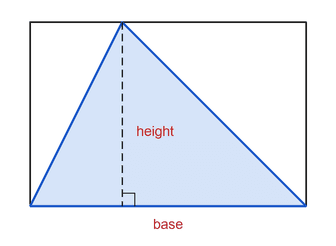
Step 2 — Compare the two areas.
The triangle covers exactly half of this rectangle, and the rectangle's area is base × height. So the triangle's area is half of base × height.
Watch out: The height is measured straight up from the base, at a right angle to it, not along a slanting side.
Therefore, the area of a triangle is .
- 671 mark
Question 67
2 km 320 m is = ______ m.
Solve with AIWritten solution
Solution:
Concept: 1 kilometre (km) = 1000 metres (m).
Step 1 — Change the kilometres into metres.
1 km = 1000 m, so we multiply 2 by 1000.
Step 2 — Add the metres.
Now we add the 320 m.
Watch out: 320 m is less than 1 km, so it is simply added to 2000 m; do not write 2000320.
Therefore, 2 km 320 m = 2,320 m.
- 681 mark
Question 68
300 gm = ______ kg.
Solve with AIWritten solution
Solution:
Concept: 1 kilogram (kg) = 1000 grams (g).
Step 1 — Divide by 1000.
Grams are smaller than kilograms, so we divide by 1000 to change grams into kilograms.
Watch out: To go from a small unit (g) to a big unit (kg) we divide, so the number gets smaller.
Therefore, 300 g = 0.3 kg.
- 691 mark
Question 69
15 kL = ______ L.
Solve with AIWritten solution
Solution:
Concept: 1 kilolitre (kL) = 1000 litres (L).
Step 1 — Multiply by 1000.
Kilolitres are bigger than litres, so we multiply by 1000.
Watch out: To go from a big unit (kL) to a small unit (L) we multiply.
Therefore, 15 kL = 15,000 L.
- 701 mark
Question 70
₹ 2 as a percentage of ₹ 50 is ______ .
Solve with AIWritten solution
Solution:
Concept: A percentage tells us how many out of 100. To write one quantity as a percentage of another, both must be in the same unit; then we divide the first by the second and multiply by 100.
Step 1 — Write the fraction.
We want ₹ 2 out of ₹ 50, so the fraction is 2 over 50.
Step 2 — Multiply by 100.
Multiplying the fraction by 100 gives the percentage.
Watch out: The 'out of' amount (₹ 50) goes at the bottom of the fraction.
Therefore, ₹ 2 as a percentage of ₹ 50 is 4%.
- 711 mark
Question 71
₹ 5,678 is = ______ paise.
Solve with AIWritten solution
Solution:
Concept: ₹ 1 = 100 paise.
Step 1 — Multiply by 100.
Each rupee is 100 paise, so we multiply the number of rupees by 100.
Watch out: Multiplying by 100 puts two zeros at the end.
Therefore, ₹ 5,678 = 5,67,800 paise.
- 721 mark
Question 72
₹ 42,565 ÷ 5 = ______ .
Solve with AIWritten solution
Solution:
Concept: Dividing an amount of money by a number shares it into that many equal parts.
Step 1 — Do the long division.
We divide 42,565 by 5, one digit at a time, from the left.
- Take the first 2 digits, 42. Divide 42 by 5: 5 × 8 = 40, remainder 2.
- Bring down 5 to make 25. Divide 25 by 5: 5 × 5 = 25, remainder 0.
- Bring down 6 to make 6. Divide 6 by 5: 5 × 1 = 5, remainder 1.
- Bring down 5 to make 15. Divide 15 by 5: 5 × 3 = 15, remainder 0.
Step 2 — Check the answer.
Multiplying the quotient by 5 should give back 42,565.
Watch out: The answer is also money, so write ₹ before it.
Therefore, ₹ 42,565 ÷ 5 = ₹ 8,513.
- 731 mark
Question 73
15 weeks and 5 days is ______ days.
Solve with AIWritten solution
Solution:
Concept: 1 week = 7 days, 1 day = 24 hours, 1 hour = 60 minutes and 1 minute = 60 seconds.
Step 1 — Change the weeks into days.
Each week has 7 days, so we multiply 15 by 7.
Step 2 — Add the extra days.
Now we add the 5 days.
Watch out: Multiply the weeks by 7, not by 30.
Therefore, 15 weeks and 5 days is 110 days.
- 741 mark
Question 74
45 minutes 45 seconds = ______ seconds.
Solve with AIWritten solution
Solution:
Concept: 1 week = 7 days, 1 day = 24 hours, 1 hour = 60 minutes and 1 minute = 60 seconds.
Step 1 — Change the minutes into seconds.
Each minute has 60 seconds, so we multiply 45 by 60.
Step 2 — Add the extra seconds.
Now we add the 45 seconds.
Watch out: Multiply only the minutes by 60; the 45 seconds are already seconds.
Therefore, 45 minutes 45 seconds = 2,745 seconds.
- 751 mark
Question 75
Observe the pattern and write the next number : 1, 8, 15, 22 ______ .
Solve with AIWritten solution
Solution:
Concept: In a number pattern, we look for the rule that takes us from one number to the next.
Step 1 — Find the rule.
We find how much each number goes up by.
- 8 − 1 = 7
- 15 − 8 = 7
- 22 − 15 = 7
Each number is 7 more than the one before it.
Step 2 — Find the next number.
We add 7 to the last number, 22.
Watch out: Check the rule on every pair of numbers, not just the first two.
Therefore, the next number is 29.
- 761 mark
Question 76
The word BODMAS stands for ______ .
Solve with AIWritten solution
Solution:
Concept: BODMAS is a rule that tells us the order of working when a sum has more than one operation.
Step 1 — Read the letters one by one.
Each letter of BODMAS stands for one step.
- B — Brackets
- O — Of (which means multiply)
- D — Division
- M — Multiplication
- A — Addition
- S — Subtraction
Step 2 — Use the order.
When we simplify, we work in this order: brackets first, then 'of', then divide and multiply, then add and subtract.
Watch out: 'Of' means multiplication, for example of 10 means .
Therefore, BODMAS stands for Brackets, Of, Division, Multiplication, Addition and Subtraction.
- 771 mark
Question 77
Average = .
Solve with AIWritten solution
Solution:
Concept: The average shares the total equally among all the quantities.
Step 1 — Try an example.
Take the three numbers 4, 6 and 8. Their sum is 18, and there are 3 numbers.
Step 2 — Name the bottom of the fraction.
We divided the sum by how many numbers there were, so the bottom of the fraction is the number of quantities.
Watch out: Divide by how many quantities there are, not by the biggest quantity.
Therefore, Average = .
- 781 mark
Question 78
250 m as a percentage of 4 km is ______ .
Solve with AIWritten solution
Solution:
Concept: A percentage tells us how many out of 100. To write one quantity as a percentage of another, both must be in the same unit; then we divide the first by the second and multiply by 100.
Step 1 — Use the same unit.
The two lengths are in different units, so we change 4 km into metres.
Step 2 — Write the fraction and multiply by 100.
Now we find 250 m out of 4000 m as a percentage.
Watch out: Change km into m first; 250 out of 4 is not the right fraction.
Therefore, 250 m as a percentage of 4 km is 6.25%.
- 793 marks
Question 79
Write the following numbers in the International System and write their names
5436787; 38456753; 123456789
Solve with AIWritten solution
Solution:
Concept: In the International System, 1 million = 1,000,000 (ten lakh) and the places are grouped in threes: ones, thousands, millions.
Step 1 — Put the commas.
In the International System we put a comma after every three digits, counting from the right. The groups are ones, thousands and millions.
- 5436787 is written 5,436,787.
- 38456753 is written 38,456,753.
- 123456789 is written 123,456,789.
Step 2 — Read each number.
We read each group with its name: millions, then thousands, then the rest.
- 5,436,787: Five million four hundred thirty six thousand seven hundred eighty seven.
- 38,456,753: Thirty eight million four hundred fifty six thousand seven hundred fifty three.
- 123,456,789: One hundred twenty three million four hundred fifty six thousand seven hundred eighty nine.
Watch out: In the International System the commas come after every three digits; do not use the Indian 2-2-3 grouping.
Therefore, 5,436,787 is five million four hundred thirty six thousand seven hundred eighty seven; 38,456,753 is thirty eight million four hundred fifty six thousand seven hundred fifty three; 123,456,789 is one hundred twenty three million four hundred fifty six thousand seven hundred eighty nine.
- 803 marks
Question 80
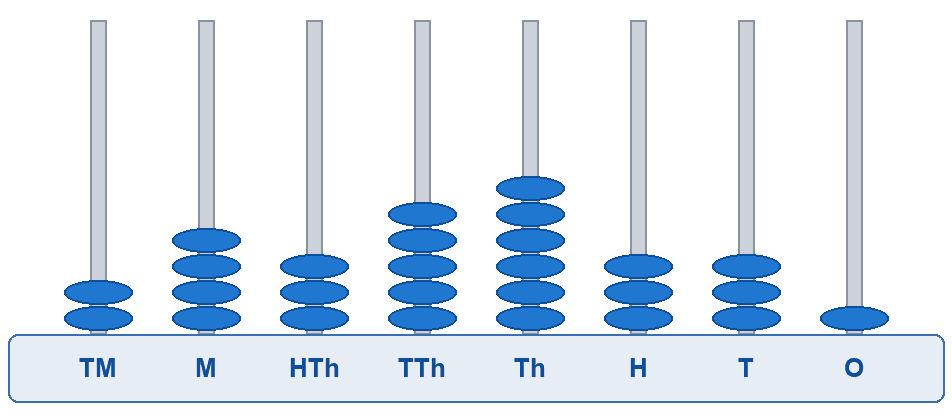
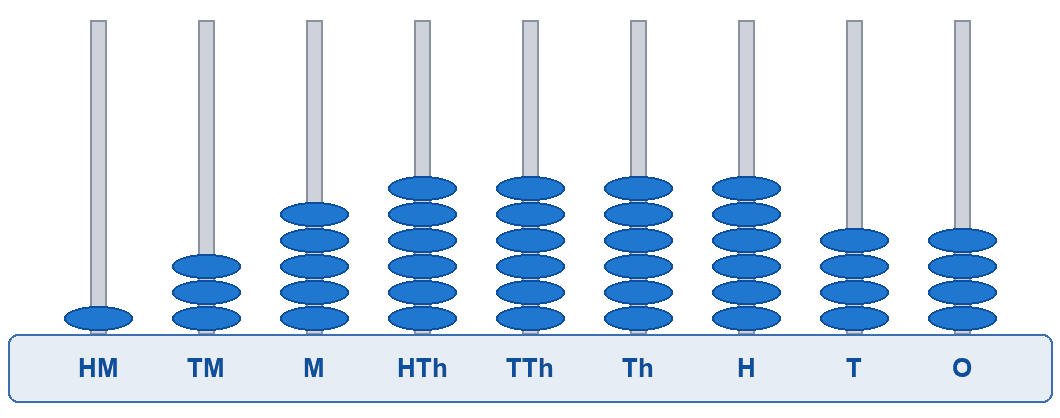
Write the numeral and number each abacus represents.
 Solve with AI
Written solution
Solution:
Concept: On an abacus, the number of beads on a rod is the digit in that place. A rod with no beads stands for 0. The rods are labelled with their places in the International System (TM = ten millions, HTh = hundred thousands, and so on).
Step 1 — Count the beads on the first abacus.
We count the beads on each rod from left to right.
- TM 2, M 4, HTh 3, TTh 5, Th 6, H 3, T 3, O 1
Step 2 — Write the first numeral and its name.
The counts are the digits in order, so the number is 24,356,331. Its name is: Twenty four million three hundred fifty six thousand three hundred thirty one.
Step 3 — Count the beads on the second abacus.
This abacus has nine rods, starting with HM (hundred millions).
- HM 1, TM 3, M 5, HTh 6, TTh 6, Th 6, H 6, T 4, O 4
Step 4 — Write the second numeral and its name.
The number is 135,666,644. Its name is: One hundred thirty five million six hundred sixty six thousand six hundred forty four.
Watch out: Count every rod, including the last one; nine rods give a 9-digit number.
Note: The answer printed in the book shows the second number as 135,6644, with two 6s missing; nine rods give the 9-digit number 135,666,644.
Therefore, the first abacus shows 24,356,331 and the second shows 135,666,644.
- 813 marks
Question 81
Express the following in an abacus in International System
(a) 83245629
(b) 34567823
(c) 53456728
Solve with AIWritten solution
Solution:
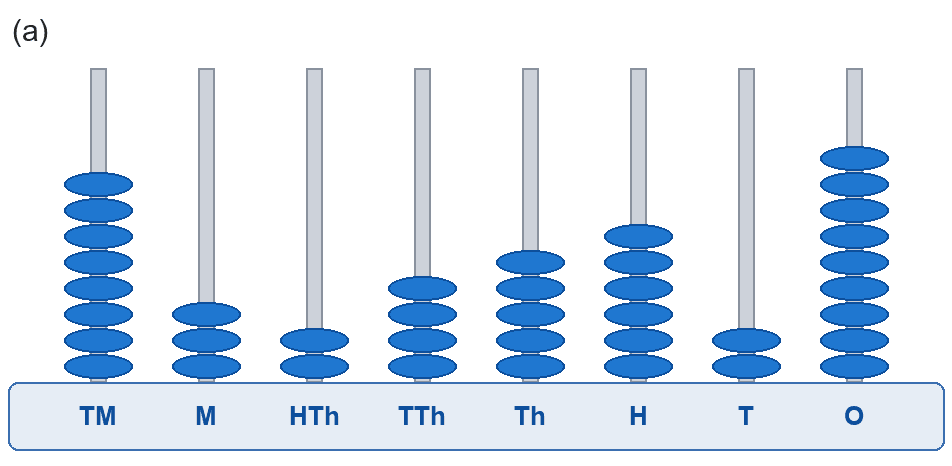
Concept: On an abacus, the number of beads on each rod is the digit in that place. In the International System the eight places are TM (ten millions), M (millions), HTh (hundred thousands), TTh (ten thousands), Th, H, T and O.
Step 1 — Choose the rods.
Each number has 8 digits, so we need eight rods: TM, M, HTh, TTh, Th, H, T and O.
Step 2 — Part (a).
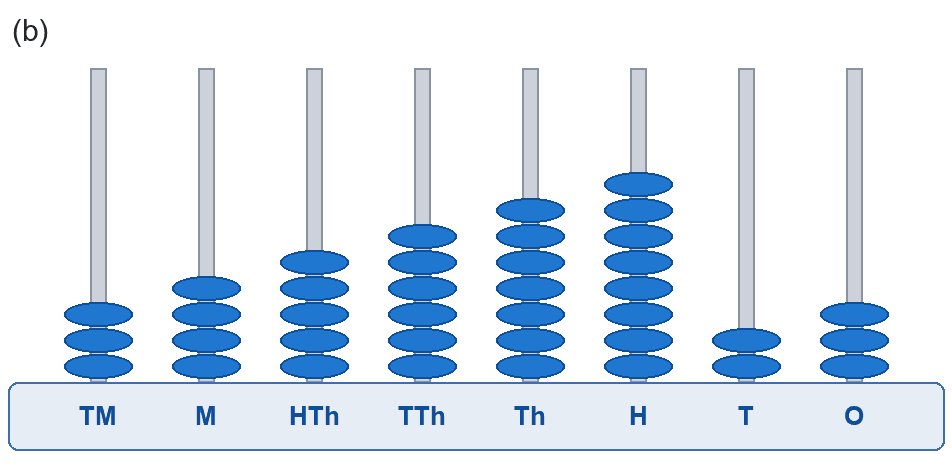
We write 83,245,629 and put 8, 3, 2, 4, 5, 6, 2, 9 beads on the rods from TM to O.
Step 3 — Part (b).
We write 34,567,823 and put 3, 4, 5, 6, 7, 8, 2, 3 beads on the rods from TM to O.
Step 4 — Part (c).
We write 53,456,728 and put 5, 3, 4, 5, 6, 7, 2, 8 beads on the rods from TM to O.
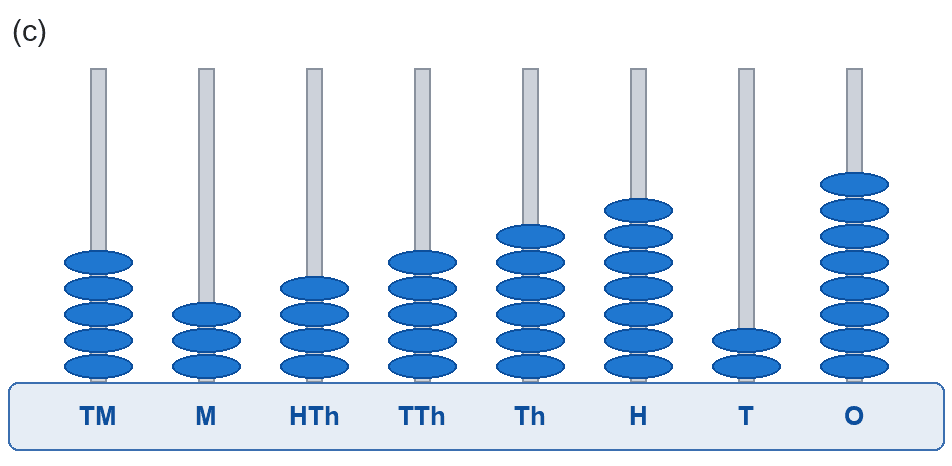
Watch out: Start from the left rod (TM) with the first digit; a 0 digit means an empty rod.
Therefore, the three numbers are shown on the abacuses above, with beads equal to each digit from TM to O.
- 823 marks
Question 82
Express the following in an abacus in Indian System of numeration.
(a) 32456789
(b) 34567892
(c) 12356789
Solve with AIWritten solution
Solution:
Concept: On an abacus, the number of beads on each rod is the digit in that place. In the Indian System the eight places are C (crores), TL (ten lakhs), L (lakhs), TTh (ten thousands), Th, H, T and O.
Step 1 — Choose the rods.
Each number has 8 digits, so we need eight rods: C (crores), TL (ten lakhs), L (lakhs), TTh, Th, H, T and O.
Step 2 — Part (a).
We write 3,24,56,789 and put 3, 2, 4, 5, 6, 7, 8, 9 beads on the rods from C to O.

Step 3 — Part (b).
We write 3,45,67,892 and put 3, 4, 5, 6, 7, 8, 9, 2 beads on the rods from C to O.
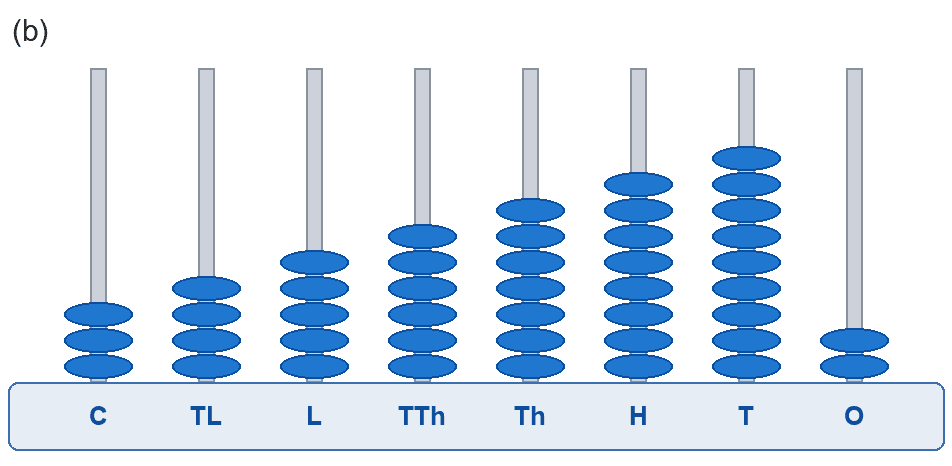
Step 4 — Part (c).
We write 1,23,56,789 and put 1, 2, 3, 5, 6, 7, 8, 9 beads on the rods from C to O.
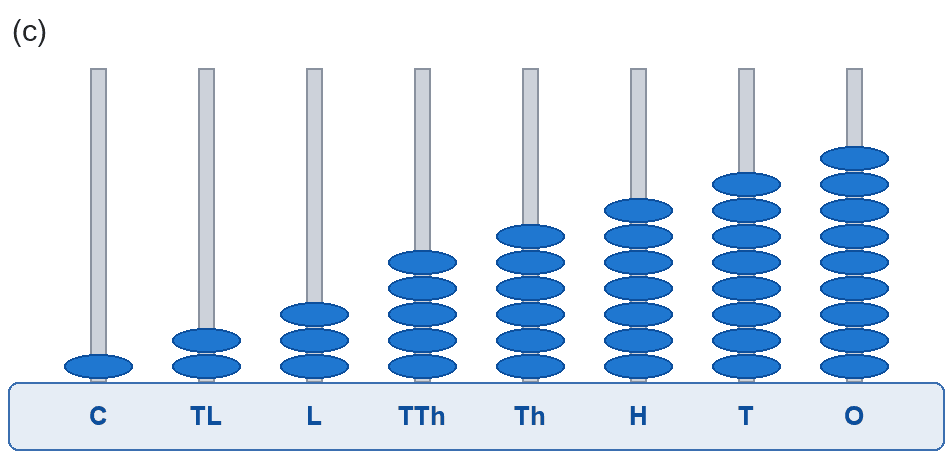
Watch out: In the Indian System the rods are crores and lakhs, not millions.
Therefore, the three numbers are shown on the abacuses above, with beads equal to each digit from C to O.
- 833 marks
Question 83
Find the sum of 3245678, 12345678 and 2983217.
Solve with AIWritten solution
Solution:
Concept: To add big numbers, we write them in columns, place under place, and add from the ones, carrying to the next place when a column adds up to 10 or more.
Step 1 — Add the first two numbers.
We write the numbers one under the other, ones under ones, and add from the ones.
Step 2 — Add the third number.
Now we add 29,83,217 to this answer.
Watch out: Line up the ones digits; 1,23,45,678 has one more digit than the others.
Therefore, the sum is 1,85,74,573.
- 843 marks
Question 84
Find the difference of 53212345 and 23567891.
Solve with AIWritten solution
Solution:
Concept: The difference of two numbers is the bigger number minus the smaller number.
Step 1 — Subtract the smaller from the bigger.
5,32,12,345 is bigger, so we take 2,35,67,891 away from it, borrowing where a top digit is smaller.
Step 2 — Check the answer.
Adding the answer to the smaller number should give the bigger number.
Watch out: When you borrow from a place, remember to make that digit 1 less.
Therefore, the difference is 2,96,44,454.
- 853 marks
Question 85
Multiply 37125 by 215.
Solve with AIWritten solution
Solution:
Concept: To multiply by a 3-digit number, we multiply by its hundreds, tens and ones separately and add the products.
Step 1 — Break 215 into parts.
We write 215 as 200 + 10 + 5 and multiply 37,125 by each part.
Step 2 — Multiply by each part.
Multiplying by 200 and by 10 is easy: multiply by 2 or 1 and put zeros at the end.
Step 3 — Add the three products.
Adding the three answers gives the full product.
Watch out: Write the zeros when multiplying by 200 and by 10.
Therefore, 37,125 × 215 = 79,81,875.
- 863 marks
Question 86
Divide 645675 by 15.
Solve with AIWritten solution
Solution:
Concept: In long division we divide part of the dividend, write the quotient digit, and bring down the next digit each time.
Step 1 — Do the long division.
We divide 6,45,675 by 15, one digit at a time, from the left.
- Take the first 2 digits, 64. Divide 64 by 15: 15 × 4 = 60, remainder 4.
- Bring down 5 to make 45. Divide 45 by 15: 15 × 3 = 45, remainder 0.
- Bring down 6 to make 6. It is less than 15, so write 0 in the quotient; remainder 6.
- Bring down 7 to make 67. Divide 67 by 15: 15 × 4 = 60, remainder 7.
- Bring down 5 to make 75. Divide 75 by 15: 15 × 5 = 75, remainder 0.
Step 2 — Read the answer.
The quotient is 43,045 and nothing is left over, so the remainder is 0.
Step 3 — Check the answer.
Multiplying the quotient by 15 should give back 6,45,675.
Watch out: When the number after bringing down is smaller than 15, write 0 in the quotient before bringing down the next digit.
Therefore, 6,45,675 ÷ 15 = 43,045, with remainder 0.
- 873 marks
Question 87
Divide 4832015 by 150 and find the quotient and remainder.
Solve with AIWritten solution
Solution:
Concept: In long division we divide part of the dividend, write the quotient digit, and bring down the next digit each time. Dividend = divisor × quotient + remainder.
Step 1 — Do the long division.
We divide 48,32,015 by 150, one digit at a time, from the left.
- Take the first 3 digits, 483. Divide 483 by 150: 150 × 3 = 450, remainder 33.
- Bring down 2 to make 332. Divide 332 by 150: 150 × 2 = 300, remainder 32.
- Bring down 0 to make 320. Divide 320 by 150: 150 × 2 = 300, remainder 20.
- Bring down 1 to make 201. Divide 201 by 150: 150 × 1 = 150, remainder 51.
- Bring down 5 to make 515. Divide 515 by 150: 150 × 3 = 450, remainder 65.
Step 2 — Read the quotient and remainder.
The quotient is 32,213 and 65 is left over, so the remainder is 65.
Step 3 — Check the answer.
Divisor × quotient + remainder should give back the dividend.
Watch out: The remainder (65) must be less than the divisor (150).
Therefore, the quotient is 32,213 and the remainder is 65.
- 883 marks
Question 88
Find all the prime factors of 1500.
Solve with AIWritten solution
Solution:
Concept: A prime number has exactly two factors, 1 and itself. Prime factorisation writes a number as a product of prime numbers only.
Step 1 — Divide by the smallest primes.
We keep dividing by the smallest prime number that divides exactly, until we reach 1.
- 1500 ÷ 2 = 750
- 750 ÷ 2 = 375
- 375 ÷ 3 = 125
- 125 ÷ 5 = 25
- 25 ÷ 5 = 5
- 5 ÷ 5 = 1
Step 2 — Write 1500 as a product of primes.
The divisors we used are the prime factors.
Step 3 — List the different primes.
The different prime numbers in this product are 2, 3 and 5.
Watch out: 375 is not divisible by 2 (it is odd), so try 3 next.
Therefore, 1500 = 2 × 2 × 3 × 5 × 5 × 5, so the prime factors of 1500 are 2, 3 and 5.
- 893 marks
Question 89
Find the HCF of 30, 40 and 50.
Solve with AIWritten solution
Solution:
Concept: The HCF (highest common factor) is the biggest number that divides all the given numbers exactly. It is the product of the prime factors common to all of them.
Step 1 — Write each number as a product of primes.
We break each number into prime factors.
- 30 = 2 × 3 × 5
- 40 = 2 × 2 × 2 × 5
- 50 = 2 × 5 × 5
Step 2 — Pick the common factors.
The primes found in all three numbers are one 2 and one 5.
Step 3 — Multiply the common factors.
Their product is the HCF.
Watch out: Take a common prime only as many times as it appears in every number.
Therefore, the HCF of 30, 40 and 50 is 10.
- 903 marks
Question 90
Find the LCM of 28, 36 and 45.
Solve with AIWritten solution
Solution:
Concept: The LCM (lowest common multiple) is the smallest number that all the given numbers divide exactly. Take every prime factor the greatest number of times it appears in any one number.
Step 1 — Write each number as a product of primes.
We break each number into prime factors.
- 28 = 2 × 2 × 7
- 36 = 2 × 2 × 3 × 3
- 45 = 3 × 3 × 5
Step 2 — Take each prime the greatest number of times.
2 appears at most twice, 3 at most twice, 5 once and 7 once.
Step 3 — Multiply.
Their product is the LCM.
Watch out: Do not multiply all the numbers together; that gives a common multiple, but not the lowest one.
Therefore, the LCM of 28, 36 and 45 is 1,260.
- 913 marks
Question 91
Arrange the following fractions in ascending order .
Solve with AIWritten solution
Solution:
Concept: To compare fractions, we make them like fractions (same denominator); then the one with the bigger numerator is bigger. Ascending order means from smallest to biggest.
Step 1 — Find a common denominator.
The LCM of the denominators 5, 4 and 3 is 60.
Step 2 — Change each fraction.
We multiply the top and bottom of each fraction by the same number to make 60 at the bottom.
Step 3 — Compare the numerators.
Now all the bottoms are the same, so the fraction with the smaller top is smaller. Since 20 < 24 < 45, the order from smallest to biggest is one third, two fifths, three quarters.
Watch out: A bigger denominator does not mean a bigger fraction: is less than .
Therefore, the ascending order is .
- 923 marks
Question 92
Add : .
Solve with AIWritten solution
Solution:
Concept: A mixed number such as means 5 wholes and one third. To add or subtract fractions, we first make the denominators (bottom numbers) the same, using their LCM. With mixed numbers, we can add the whole numbers and the fractions separately.
Step 1 — Add the whole numbers.
We add the whole-number parts first.
Step 2 — Add the fractions.
The LCM of 3, 4 and 4 is 12, so we change each fraction to twelfths and add.
Step 3 — Put the two parts together.
The sum is 8 wholes and five sixths.
Watch out: Reduce to its lowest terms by dividing top and bottom by 2.
Therefore, .
- 933 marks
Question 93
Subtract : .
Solve with AIWritten solution
Solution:
Concept: A mixed number such as means 5 wholes and one third. To add or subtract fractions, we first make the denominators (bottom numbers) the same, using their LCM.
Step 1 — Change to improper fractions.
We change each mixed number into an improper fraction.
Step 2 — Make the denominators the same.
The LCM of 2 and 5 is 10, so we change both fractions to tenths and subtract.
Step 3 — Change back to a mixed number.
19 tenths is 1 whole (10 tenths) and 9 tenths left.
Watch out: is smaller than , so change to improper fractions first instead of taking the fractions away directly.
Therefore, .
- 943 marks
Question 94
Multiply : .
Solve with AIWritten solution
Solution:
Concept: To multiply fractions, change mixed numbers into improper fractions, then multiply the numerators together and the denominators together.
Step 1 — Change to improper fractions.
We change each mixed number into an improper fraction.
Step 2 — Multiply tops and bottoms.
We multiply the numerators together and the denominators together.
Step 3 — Change back to a mixed number.
18 goes into 91 five times (5 × 18 = 90) with 1 left over.
Watch out: Do not multiply the whole numbers and fractions separately; that gives a wrong answer.
Therefore, .
- 953 marks
Question 95
.
Solve with AIWritten solution
Solution:
Concept: To divide by a fraction, multiply by its reciprocal.
Step 1 — Turn the division into a multiplication.
Dividing by a fraction is the same as multiplying by its reciprocal (the fraction turned upside down).
Step 2 — Cancel common factors.
22 and 11 can both be divided by 11, and 15 and 25 can both be divided by 5.
Step 3 — Change to a mixed number.
6 fifths is 1 whole and 1 fifth.
Watch out: Turn over only the second fraction (the divisor), not the first.
Therefore, .
- 963 marks
Question 96
.
Solve with AIWritten solution
Solution:
Concept: A mixed number such as means 5 wholes and one third. To add or subtract fractions, we first make the denominators (bottom numbers) the same, using their LCM.
Step 1 — Change to improper fractions.
We change each mixed number into an improper fraction.
Step 2 — Make the denominators the same.
15 is a multiple of 5, so we change fifths into fifteenths and subtract.
Step 3 — Change back to a mixed number.
15 goes into 44 twice (2 × 15 = 30) with 14 left over.
Watch out: When you change to fifteenths, multiply both top and bottom by 3.
Therefore, .
- 973 marks
Question 97
Multiply : 0.24 × 0.45 × 0.15.
Solve with AIWritten solution
Solution:
Concept: To multiply decimals, multiply the numbers as if there were no decimal points, then give the product as many decimal places as all the numbers have together.
Step 1 — Multiply without the decimal points.
We first multiply 24, 45 and 15 as whole numbers.
Step 2 — Count the decimal places.
Each number has 2 decimal places, so the product has 2 + 2 + 2 = 6 decimal places.
Step 3 — Put in the decimal point.
We count 6 places from the right of 16200, filling in a zero in front.
Watch out: Zeros at the end after the decimal point can be dropped (0.016200 = 0.0162), but not the zero after the point.
Therefore, 0.24 × 0.45 × 0.15 = 0.0162.
- 983 marks
Question 98
Divide : 9.45 ÷ 3.15.
Solve with AIWritten solution
Solution:
Concept: When we multiply both the dividend and the divisor by the same number, the quotient does not change.
Step 1 — Make the divisor a whole number.
We multiply both numbers by 100, which does not change the answer.
Step 2 — Divide.
We check how many times 315 goes into 945.
So 945 ÷ 315 = 3.
Watch out: Move the decimal point the same number of places in both numbers.
Therefore, 9.45 ÷ 3.15 = 3.
- 993 marks
Question 99
Estimate the following sums to the nearest 100 and then to the nearest 1000.
(a) 345678 + 567892 + 783245
(b) 456789 + 6789542 + 842345
Solve with AIWritten solution
Solution:
Concept: To estimate a sum, round every number to the place asked and add the rounded numbers. To round to the nearest 100, look at the tens digit: 5 or more rounds up, less than 5 rounds down. To round to the nearest 1000, look at the hundreds digit in the same way.
Step 1 — Part (a), nearest 100.
We round each number to the nearest 100, then add.
- 3,45,678 rounds up to 3,45,700, because the tens digit 7 is 5 or more.
- 5,67,892 rounds up to 5,67,900, because the tens digit 9 is 5 or more.
- 7,83,245 rounds down to 7,83,200, because the tens digit 4 is less than 5.
Step 2 — Part (a), nearest 1000.
We round each number to the nearest 1000, then add.
- 3,45,678 rounds up to 3,46,000, because the hundreds digit 6 is 5 or more.
- 5,67,892 rounds up to 5,68,000, because the hundreds digit 8 is 5 or more.
- 7,83,245 rounds down to 7,83,000, because the hundreds digit 2 is less than 5.
Step 3 — Part (b), nearest 100.
We round each number to the nearest 100, then add.
- 4,56,789 rounds up to 4,56,800, because the tens digit 8 is 5 or more.
- 67,89,542 rounds down to 67,89,500, because the tens digit 4 is less than 5.
- 8,42,345 rounds down to 8,42,300, because the tens digit 4 is less than 5.
Step 4 — Part (b), nearest 1000.
We round each number to the nearest 1000, then add.
- 4,56,789 rounds up to 4,57,000, because the hundreds digit 7 is 5 or more.
- 67,89,542 rounds up to 67,90,000, because the hundreds digit 5 is 5 or more.
- 8,42,345 rounds down to 8,42,000, because the hundreds digit 3 is less than 5.
Watch out: Round each number first and then add; do not add first.
Therefore, (a) 16,96,800 to the nearest 100 and 16,97,000 to the nearest 1000; (b) 80,88,600 to the nearest 100 and 80,89,000 to the nearest 1000.
- 1003 marks
Question 100
Simplify, using BODMAS rule : .
Solve with AIWritten solution
Solution:
Concept: In BODMAS, brackets are done first, from the innermost outwards: the bar (vinculum) first, then ( ), then { }, then [ ].
Step 1 — Work out the bar.
The bar (vinculum) is the innermost bracket, so we do it first.
Step 2 — Work out the small bracket.
Now the ( ) bracket becomes 7 − 3.
Step 3 — Work out the curly bracket.
Now the { } bracket becomes 8 − 4.
Step 4 — Add.
Last, we add 15 and 4.
Watch out: Work from the inside out; do not start with the outer bracket.
Therefore, .
- 1013 marks
Question 101
Simplify : .
Solve with AIWritten solution
Solution:
Concept: In BODMAS we work out the bar (vinculum) first, then the bracket, then the rest.
Step 1 — Work out the bar.
The part under the bar is done first. Both mixed numbers have the same fraction, so we subtract the whole numbers.
Step 2 — Work out the bracket.
Now the bracket becomes three and a half minus 1.
Step 3 — Do the last subtraction.
Last, we take the bracket's value away from two and a half.
Watch out: A number take away itself is always 0.
Therefore, .
- 1023 marks
Question 102
Simplify : .
Solve with AIWritten solution
Solution:
Concept: In BODMAS we work out the bar (vinculum) first, then ( ), then the outer bracket, and divide last.
Step 1 — Work out the bar.
The part under the bar is done first.
Step 2 — Work out the small bracket.
Now the ( ) bracket becomes 2.30 − 1.75.
Step 3 — Work out the outer bracket.
Now the outer bracket becomes 8.35 − 0.55.
Step 4 — Divide.
Last, we divide 7.8 by the outer bracket's value. A number divided by itself is 1.
Watch out: 7.80 and 7.8 are the same number; a zero at the end after the decimal point changes nothing.
Note: As printed, the outer bracket opens with '[' and closes with '}'; both are read as the same outer bracket.
Therefore, .
- 1033 marks
Question 103
Find the average of 30.5, 31.7, 30.8, 35.2, 32.8, 30.45, 32.6, 30.8, 32.9, 30.1.
Solve with AIWritten solution
Solution:
Concept: Average = sum of the quantities ÷ number of quantities.
Step 1 — Add the first five numbers.
There are ten numbers, so we add them in two groups of five.
Step 2 — Add the last five numbers.
Now we add the other five.
Step 3 — Find the total.
We add the two group totals.
Step 4 — Divide by the number of quantities.
There are 10 numbers, so we divide the sum by 10.
Watch out: To divide by 10, move the decimal point one place to the left.
Therefore, the average is 31.785.
- 1043 marks
Question 104
A healthy human heart beats 51840 times in 12 hours. How many times will it beat in 5 hours ?
Solve with AIWritten solution
Solution:
Concept: In the unitary method we first find the value for 1 unit, then multiply to find the value for the number of units asked.
Step 1 — Find the beats in 1 hour.
The heart beats 51,840 times in 12 hours, so in 1 hour it beats 51,840 ÷ 12 times.
Step 2 — Find the beats in 5 hours.
In 5 hours it beats 5 times as many.
Watch out: First divide to get 1 hour, then multiply by 5.
Note: 4,320 beats in an hour is 72 beats in a minute, which is a normal resting heart rate.
Therefore, the heart will beat 21,600 times in 5 hours.
- 1053 marks
Question 105
In a class of 60 students, 5% failed in the final examination. Find the number of students who have passed.
Solve with AIWritten solution
Solution:
Concept: To find a percentage of a number, write the percentage as a fraction out of 100 and multiply.
Step 1 — Find how many failed.
5% means 5 out of every 100, so we find 5% of 60.
Step 2 — Find how many passed.
Everyone who did not fail passed, so we subtract from 60.
Watch out: The question asks for the students who passed, not those who failed.
Therefore, 57 students passed.
- 1063 marks
Question 106
Convert 1 month (30 days) 5 days and 10 hours into hours.
Solve with AIWritten solution
Solution:
Concept: 1 week = 7 days, 1 day = 24 hours, 1 hour = 60 minutes and 1 minute = 60 seconds. The question tells us to take 1 month as 30 days.
Step 1 — Change everything into days.
One month is taken as 30 days, so 1 month and 5 days is 35 days.
Step 2 — Change the days into hours.
Each day has 24 hours.
Step 3 — Add the extra hours.
Now we add the 10 hours.
Watch out: Add the 10 hours only after changing the days into hours.
Therefore, 1 month 5 days and 10 hours = 850 hours.
- 1073 marks
Question 107
Write the Roman numeral for 1100.
Solve with AIWritten solution
Solution:
Concept: Roman numerals use seven letters: I = 1, V = 5, X = 10, L = 50, C = 100, D = 500 and M = 1000. A letter written after a bigger letter is added, so MC means 1000 + 100. A smaller letter written before a bigger one is taken away, so CM stands for 900 (1000 take away 100). We write the thousands first, then the hundreds, tens and ones.
Step 1 — Break the number into parts.
We split 1100 into 1000 and 100.
Step 2 — Write each part.
1000 is M and 100 is C. The smaller letter C comes after the bigger M, so it is added.
Watch out: CM would mean 1000 − 100 = 900, so the order of the letters matters.
Therefore, the Roman numeral for 1100 is MC.
- 1083 marks
Question 108
Draw a line graph to represent the following data
Day Number of ice-cream cups sold by a vendor Monday 150 Tuesday 200 Wednesday 250 Thursday 300 Friday 150 Solve with AIWritten solution
Solution:
Concept: A line graph shows how a quantity changes. We plot one point for each item and join the points in order with straight lines.
Step 1 — Draw and label the axes.
We draw a horizontal axis for the days and a vertical axis for the number of ice-cream cups. We label them 'Day' and 'No. of ice-cream cups sold'.
Step 2 — Choose a scale.
The biggest number is 300, so we mark the vertical axis 0, 100, 200, 300, 400, 500 with 1 big square (1 cm) for 100 cups. Then 50 cups is half a square.
Step 3 — Plot the points.
For each day we go up to its number and mark a dot: Mon 150, Tue 200, Wed 250, Thurs 300 and Fri 150.
Step 4 — Join the points.
We join the dots in order with straight lines.
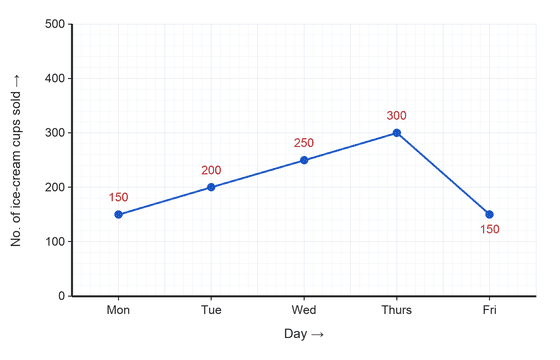
Step 5 — Read the graph.
The line goes up from Monday to Thursday and then comes down on Friday.
Watch out: Use equal gaps for equal amounts on the vertical axis, and start it at 0.
Therefore, the line graph is drawn above: the sale rises steadily from Monday to Thursday and then falls on Friday.
- 1093 marks
Question 109
The bar graph given below shows the favourite fruits of students of a class of 50 students. Observe the bar graph and answer the questions that follow.
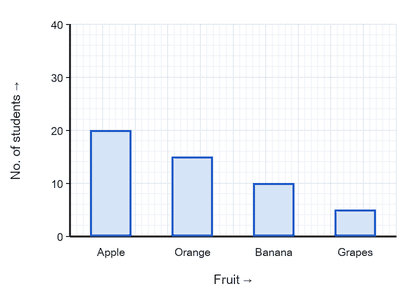
(a) Which is the most popular fruit ?
(b) How many students do not take grapes ?
(c) Which are the two most popular fruits ?
(d) What is the percentage of students who like banana ?
(e) What is the percentage of students who take apple and orange ?
Solve with AIWritten solution
Solution:
Concept: In a bar graph, the height of each bar on the scale gives the number for that item. A percentage is the number out of the total, multiplied by 100.
Step 1 — Read the bars.
We read the top of each bar against the scale on the left.
Fruit Apple Orange Banana Grapes Number of students 20 15 10 5 The total is 20 + 15 + 10 + 5 = 50, which matches the class of 50 students.
Step 2 — Part (a).
The tallest bar is Apple (20 students), so apple is the most popular fruit.
Step 3 — Part (b).
5 students take grapes, so the rest of the class does not.
Step 4 — Part (c).
The two tallest bars are Apple (20) and Orange (15).
Step 5 — Part (d).
10 out of 50 students like banana.
Step 6 — Part (e).
Apple and orange together have 20 + 15 = 35 students out of 50.
Watch out: For the percentages, divide by the whole class (50), not by 100.
Therefore, (a) apple; (b) 45 students; (c) apple and orange; (d) 20%; (e) 70%.
- 1103 marks
Question 110
Look at the given pie chart and answer the following questions.
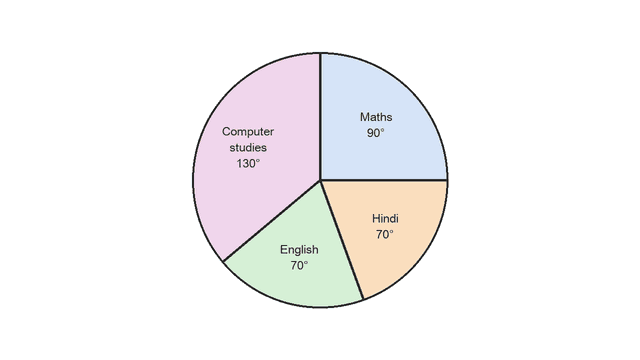
(a) Which is the most popular subject ?
(b) Which two subjects have equal number of participants ?
(c) What is the percentage of students preferring Mathematics ?
(d) What percent of the students preferred English and Hindi ?
Solve with AIWritten solution
Solution:
Concept: A pie chart shows a whole as a circle of 360°. A bigger angle means a bigger share, and the percentage of a part = (its angle ÷ 360°) × 100%.
Step 1 — Read the angles.
The pie chart gives each subject's angle: Computer studies 130°, Mathematics 90°, English 70° and Hindi 70°. They add up to 360°, the whole circle.
Step 2 — Part (a).
The biggest angle, 130°, belongs to Computer studies, so it is the most popular subject.
Step 3 — Part (b).
English and Hindi both have 70°, so they have the same number of students.
Step 4 — Part (c).
Mathematics has 90° out of 360°.
Step 5 — Part (d).
English and Hindi together have 70° + 70° = 140° out of 360°.
Watch out: Divide by 360°, not by 100, to change an angle into a fraction of the whole.
Therefore, (a) Computer studies; (b) English and Hindi; (c) 25%; (d) , about 38.9%.
- 1113 marks
Question 111
In each of the figures below, determine if the dotted line is a line of symmetry.
(a)
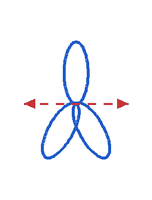
(b)
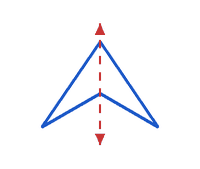
(c)
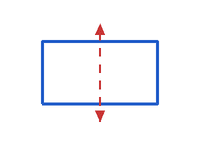
(d)
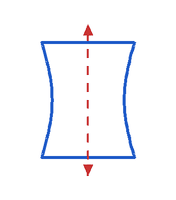
(e)
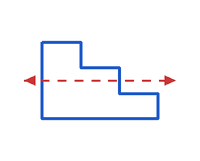
(f)

(g)
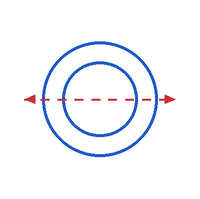
(h)
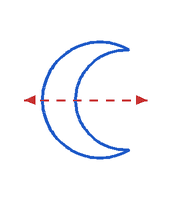 Solve with AI
Written solution
Solution:
Concept: A line is a line of symmetry if folding the figure along it makes the two parts cover each other exactly. Each part is then the mirror image of the other.
Step 1 — Part (a).
Above the dotted line there is one petal, and below it there are two. When we fold along the line, the parts do not cover each other, so it is not a line of symmetry.
Step 2 — Part (b).
The left half of the arrow shape is the mirror image of the right half, so the two halves match. It is a line of symmetry.
Step 3 — Part (c).
The dotted line goes down the middle of the rectangle, so the two halves are equal and match. It is a line of symmetry.
Step 4 — Part (d).
The left and right curved sides are mirror images of each other. It is a line of symmetry.
Step 5 — Part (e).
The steps above the line do not match the solid block below it, so the halves do not cover each other. It is not a line of symmetry.
Step 6 — Part (f).
The line joins two opposite corners of the hexagon; the top half is the mirror image of the bottom half. It is a line of symmetry.
Step 7 — Part (g).
The line passes through the centre of both circles, so the top half matches the bottom half. It is a line of symmetry.
Step 8 — Part (h).
The top half of the crescent is the mirror image of the bottom half. It is a line of symmetry.
Watch out: Both parts must match exactly in shape and size; just cutting a figure into two pieces is not enough.
Therefore, the dotted line is a line of symmetry in (b), (c), (d), (f), (g) and (h), but not in (a) and (e).
- 1123 marks
Question 112
Complete the following using a square grid paper.
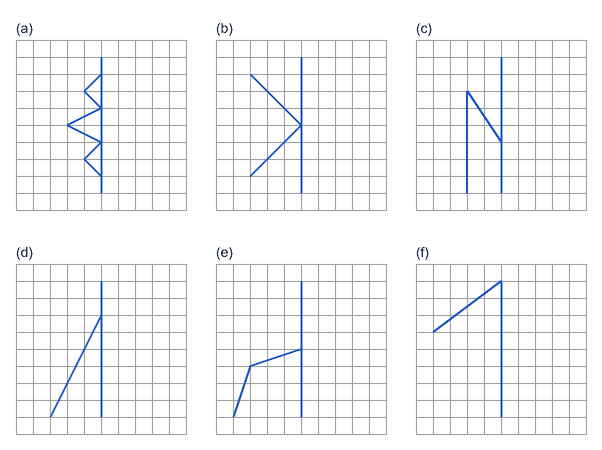 Solve with AI
Written solution
Solution:
Concept: In a symmetric figure, each point on one side of the mirror line has a matching point at the same distance on the other side, in the same row.
Step 1 — Find the mirror line.
In each grid, the long straight vertical line is the line of symmetry (the mirror line).
Step 2 — Reflect each corner.
For every corner of the drawn half, count the squares to the mirror line. Mark a new point the same number of squares on the other side, in the same row.
Step 3 — Join the new points.
Join the new points in the same order as the drawn half. The completed figures are shown below, with the new half in red.

Step 4 — Name the shapes.
The completed figures are:
- (a) three diamonds on the line: small, large, small;
- (b) a cross (X);
- (c) the letter M;
- (d) an upside-down V, like a tent, with the line through its top;
- (e) a roof shape with two sloping legs;
- (f) an arrow-head pointing up.
Watch out: Count the squares from the mirror line, not from the edge of the grid.
Therefore, each figure is completed by reflecting the drawn half in the mirror line, as shown above.
- 1133 marks
Question 113
Fill in the missing blanks in the following patterns.
(a)
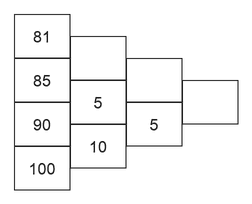
(b)
 Solve with AI
Written solution
Solution:
Concept: In a number pattern, we first find the rule from the numbers that are given, check it, and then use it to fill the blanks.
Step 1 — Part (a): find the rule.
Each box in the next column is the difference of the two boxes next to it on the left. We can see this from the boxes already filled: 90 − 85 = 5 and 100 − 90 = 10.
Step 2 — Part (a): fill the second column.
The top box of the second column is next to 81 and 85.
Step 3 — Part (a): fill the third column.
The third column has the given 5 (from 10 − 5). Its top box is next to 4 and 5.
Step 4 — Part (a): fill the last box.
The last box is next to 1 and 5.

Step 5 — Part (b): find the rule.
The two numbers at the ends of each straight line through the centre multiply to give the centre number, 64: for example, 2 × 32 = 64.
Step 6 — Part (b): fill the blanks.
The blank opposite 4 is 64 ÷ 4, and the blank opposite 8 is 64 ÷ 8.
Watch out: Check your rule on every filled box before using it.
Therefore, (a) the missing numbers are 4 (second column), 1 (third column) and 4 (last box); (b) the missing numbers are 16 (opposite 4) and 8 (opposite 8).
- 1143 marks
Question 114
Verify if 3,025 will be the 55th unit of the square number pattern.
Solve with AIWritten solution
Solution:
Concept: A square number is a number multiplied by itself. The nth square number is n × n.
Step 1 — Find the rule.
The square number pattern is 1, 4, 9, 16, 25, … The 1st number is 1 × 1, the 2nd is 2 × 2, the 3rd is 3 × 3, so the 55th number is 55 × 55.
Step 2 — Multiply.
We break 55 into 50 + 5 to multiply easily.
Step 3 — Compare.
The 55th square number is 3,025, which is the number given.
Watch out: The 55th square number is 55 × 55, not 55 × 2.
Therefore, yes, 3,025 is the 55th number of the square number pattern, because 55 × 55 = 3,025.
Class 5 Maths Ch 23 questions students ask
How many questions are there in Class 5 Maths Ch 23?
114 questions. Every one is solved step by step on this page.
Are these Class 5 Maths solutions free?
Yes. Every question and its full working is free to read, with no account needed.
Can I download the Class 5 Maths Ch 23 solutions as a PDF?
There is no PDF to download. Every solution is on this page instead, which means it is searchable, always the current syllabus, and readable on a phone. Use your browser's print option if you want it on paper.