Torque on a Current-Carrying Loop - Moving Coil Galvanometer · Question 57 of 68
(a) Explain the principle and construction of a moving coil galvanometer.
Question 575 marksMedium
(a) Explain the principle and construction of a moving coil galvanometer.
(b) Show that unless the magnetic field is radial, the current is not proportional to the deflection of the coil.
(c) Explain the working of a moving coil galvanometer with a neat sketch.
Solution:
Key idea: A current-carrying coil in a magnetic field feels a torque. In a moving coil galvanometer this torque is balanced by the twist of a suspension, and a radial field makes the twist proportional to the current.
Step 1 — State the principle, part (a).
When a current passes through a coil placed in a magnetic field, the coil experiences a torque and turns. The turning is opposed by the restoring torque of the twisted suspension, and the coil comes to rest at a deflection that measures the current.
Step 2 — Describe the construction, part (a).
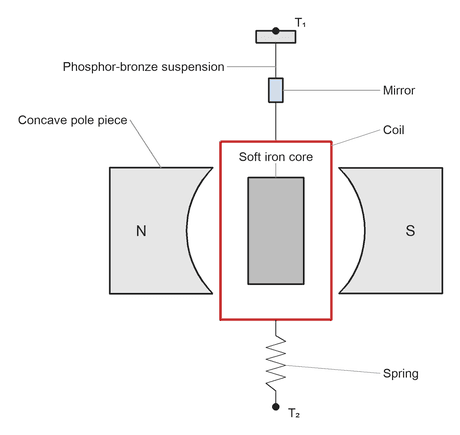
The main parts are shown in the figure and described below.
Coil: Many turns of fine insulated copper wire wound on a light, non-magnetic aluminium frame.
Suspension: The coil hangs between the poles of a strong horseshoe magnet from a thin phosphor-bronze strip, which also carries the current into the coil. A small mirror fixed to the strip is used with a lamp and scale to read the deflection.
Spring: The lower end of the coil is joined to a light phosphor-bronze spring, through which the current leaves.
Pole pieces and core: The pole pieces are concave, and a soft-iron cylinder is fixed inside the coil, coaxial with it, without touching it. Together they make the field in the gap strong and radial.
Step 3 — Write the torque balance in a uniform field, part (b).
Suppose the field is uniform instead of radial. When the coil has turned through ϕ, let the normal to the coil make an angle θ with B. The deflecting torque is then NIABsinθ, and at rest it balances the restoring torque Cϕ:
NIABsinθ=Cϕ
I=NABC⋅sinθϕ
Step 4 — Show that the current is not proportional to the deflection, part (b).
As the coil turns, θ changes along with ϕ, so sinθ has a different value at each deflection. The ratio ϕI is therefore not constant: I is not proportional to ϕ, and the scale would not be evenly divided.
Step 5 — Show what the radial field changes, part (b).
In a radial field the plane of the coil lies along the field lines in every position, so the normal is always at 90∘ to B and sinθ is always 1:
I=NABCϕ
Now NABC is a constant, so I∝ϕ. This holds only because the field is radial.
Step 6 — Explain the working, part (c).
The sketch shows the radial field in the gap between the concave pole pieces and the soft-iron core, with the two vertical sides of the coil in the gap.
When a current I flows, the two vertical sides of the coil carry current in opposite directions, so they feel equal and opposite forces that form a couple. Because the field is radial, the deflecting torque is NIAB in every position of the coil.
Step 7 — Explain how the reading is obtained, part (c).
The coil turns and twists the suspension, which sets up a restoring torque Cϕ. The coil stops turning when the two torques balance:
NIAB=Cϕ
I=Kϕ
Here K=NABC is the galvanometer constant. The deflection, read with the lamp and scale (or a pointer), is proportional to the current, so the current is read on a linear scale. Eddy currents in the aluminium frame damp the motion, so the coil settles quickly.
Therefore, a moving coil galvanometer works because a current-carrying coil in a magnetic field feels a torque; only in a radial field is this torque NIAB in every position, so only then is the current proportional to the deflection (I=Kϕ).