Torque on a Current-Carrying Loop - Moving Coil Galvanometer · Question 56 of 68
(a) Derive an expression for the torque acting on a current-carrying coil suspended in a uniform magnetic field when…
Question 565 marksMedium
(a) Derive an expression for the torque acting on a current-carrying coil suspended in a uniform magnetic field when the plane of the coil is (i) parallel to the magnetic field and (ii) oriented in any direction.
(b) Prove that the torque acting on a coil suspended in a uniform magnetic field is independent of the shape of the coil.
Solution:
Key idea: In a uniform field the net force on a closed current loop is zero, but the forces on two opposite sides can form a couple. The torque of that couple is NIABsinθ, where θ is the angle between the normal to the coil and B.
Step 1 — Set up the coil for part (a).
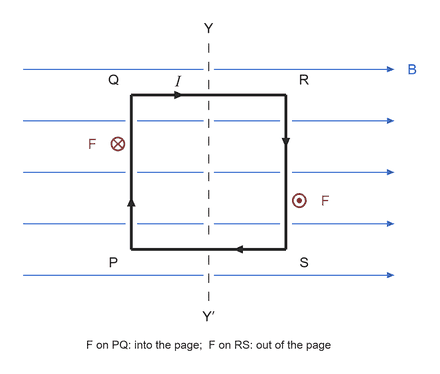
Consider a rectangular coil PQRS of N turns carrying a current I in a uniform field B, free to turn about the vertical axis YY′. The sides PQ and RS have length l, and the sides QR and SP have length b. The area of each turn is A=lb.
Step 2 — Find the torque with the plane of the coil parallel to the field, part (a)(i).
In the front view the sides QR and SP lie along B, so no force acts on them.
The sides PQ and RS are perpendicular to B. Each feels a force of the same size, in opposite directions (into and out of the page):
F=NIlB
These two forces form a couple whose arm is the full width b of the coil:
τ=NIlB×b
τ=NIAB
This is the greatest torque the coil can feel.
Step 3 — Find the torque with the coil in any position, part (a)(ii).
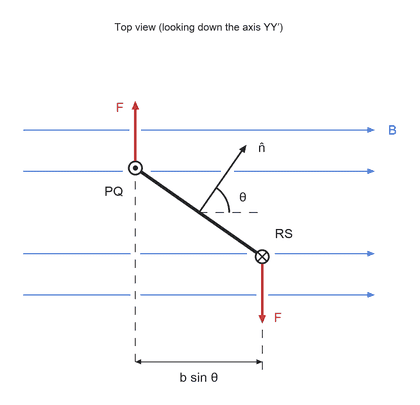
Now let the normal to the coil make an angle θ with B, as in the top view.
The forces on QR and SP are equal and opposite and act along the same line (the axis YY′), so they cancel and give no torque.
The sides PQ and RS are still perpendicular to B, so each still feels a force NIlB. The perpendicular distance between these two forces is now bsinθ:
τ=NIlB×bsinθ
τ=NIABsinθ
In vector form, with the moment m=NIA along the normal:
τ=m×B
The torque is greatest at θ=90∘ (part (a)(i)) and zero at θ=0∘ or 180∘.
Step 4 — Divide a coil of any shape into small rectangles, part (b).
Take a plane loop of any shape carrying a current I. Divide its area into a very large number of small rectangular loops of areas ΔA1, ΔA2, ΔA3, …, each carrying the same current I in the same sense.
On every side shared by two neighbouring rectangles the two currents are equal and opposite, so they cancel. Only the outer boundary, which is the original loop, is left with a net current. So the set of small loops is equivalent to the original loop.
Step 5 — Add the torques on the small loops.
All the small loops lie in the same plane, so they make the same angle θ with the field. By Step 3 the torque on the kth small loop is IΔAkBsinθ, and all these torques point the same way, so they add:
τ=IBsinθ(ΔA1+ΔA2+ΔA3+⋯)
τ=IABsinθ
Here A is the total area of the loop. For N turns the torque is NIABsinθ.
Step 6 — Draw the conclusion.
The result contains only the area A of the loop, not its shape. Loops of different shapes with the same area, current, number of turns and orientation feel the same torque.
Therefore, the torque on the coil is NIAB when its plane is parallel to the field and NIABsinθ in any position, and because it depends only on the area A, the torque is independent of the shape of the coil.