
Question 523 marksMedium
What is magnetic dipole moment? Derive an expression for the orbital magnetic moment of an electron in Bohr model of hydrogen atom.
Confirming your payment
Sign up now and get 250 free tokens.
Torque on a Current-Carrying Loop - Moving Coil Galvanometer · Question 52 of 68
What is magnetic dipole moment? Derive an expression for the orbital magnetic moment of an electron in Bohr model of hydrogen atom.
Solution:
Key idea: A current loop of area carrying a current has a magnetic dipole moment . An electron going round its orbit is such a loop, with a current equal to the charge passing a point each second.
Step 1 — Define the magnetic dipole moment.
For a current loop, the magnetic dipole moment is the product of the current and the area of the loop:
It is directed along the normal to the loop (right-hand thumb rule), and it fixes the torque that the loop feels in a uniform field. Its unit is A m.
Step 2 — Set up the orbiting electron.
In the Bohr model an electron of charge and mass moves with speed in a circular orbit of radius round the nucleus.
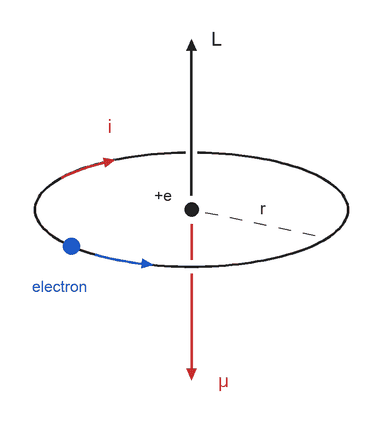
Step 3 — Find the equivalent current.
The electron goes round once in a time , the length of the orbit divided by the speed:
A charge passes any point of the orbit once in each period, so the size of the current is
Step 4 — Find the orbital magnetic moment.
The moment is the current times the area of the orbit:
Step 5 — Write it in terms of the angular momentum.
The orbital angular momentum is , so we replace by :
The electron is negative, so the current flows opposite to its motion and points opposite to :
Step 6 — Use Bohr's quantum condition.
In the Bohr model the angular momentum in the th orbit is . Substituting this:
Step 7 — Evaluate the Bohr magneton.
For the moment is the Bohr magneton :
Note: This is the result of the Bohr model. In quantum mechanics the real ground state of hydrogen has zero orbital angular momentum (), so it has no orbital magnetic moment; its magnetic moment, about one Bohr magneton, comes from the electron's spin.
Therefore, the orbital magnetic moment of the electron is ; in the th Bohr orbit its size is , with A m.