
Question 513 marksMedium
Derive an expression for the torque acting on a current-carrying loop placed in a uniform magnetic field. Hence obtain an equation for dipole moment.
Confirming your payment
Sign up now and get 250 free tokens.
Torque on a Current-Carrying Loop - Moving Coil Galvanometer · Question 51 of 68
Derive an expression for the torque acting on a current-carrying loop placed in a uniform magnetic field. Hence obtain an equation for dipole moment.
Solution:
Key idea: In a uniform field the forces on a closed current loop add up to zero, but the forces on two opposite sides can form a couple. The torque of this couple turns the loop, and comparing it with gives the loop's dipole moment.
Step 1 — Set up the coil.
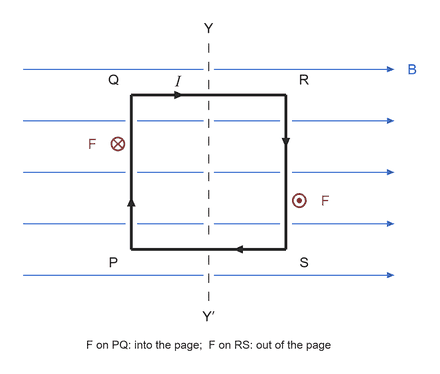
Consider a rectangular coil PQRS of turns carrying a current in a uniform field . The sides and have length , and the sides and have length . The coil can turn about the vertical axis YY′, and is the angle between the normal to the coil and . The front view shows the coil with its plane along .
Step 2 — Find the forces on the horizontal sides.
The sides QR and SP stay horizontal as the coil turns. The forces on them are equal and opposite and act along the same vertical line (the axis YY′), so they cancel and give no torque.
Step 3 — Find the forces on the vertical sides.
The sides PQ and RS are vertical, so they are always perpendicular to the horizontal field. The force on each of them has the same size:
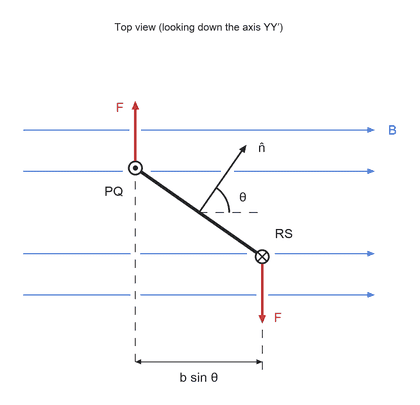
These two forces are equal and opposite but do not act along the same line, so they form a couple.
Step 4 — Find the arm of the couple.
The top view, looking down the axis, shows that the perpendicular distance between the two forces is .
Step 5 — Write the torque.
The torque of a couple is one of the forces times the arm:
The area of the coil is , so the torque becomes
In vector form, with the area vector along the normal to the coil:
Step 6 — Compare with a magnetic dipole.
A magnetic dipole of moment in a uniform field feels a torque . Comparing this with the torque on the coil, the coil behaves as a dipole of moment
For a single loop the moment is . It is directed along the normal to the coil by the right-hand thumb rule, and its unit is A m.
Therefore, the torque on the coil is , and the coil's magnetic dipole moment is .