
Question 615 marksMedium
(a) Distinguish between intrinsic and extrinsic semiconductors.
(b) What are ‘donors’ and ‘acceptors’?
(c) Explain how -type and -type semiconductors are made.
Confirming your payment
Sign up now and get 250 free tokens.
Semiconductor Electronics · Question 61 of 66
(a) Distinguish between intrinsic and extrinsic semiconductors.
(b) What are ‘donors’ and ‘acceptors’?
(c) Explain how -type and -type semiconductors are made.
Solution:
Concept: A pure semiconductor is intrinsic; a doped one is extrinsic. Doping with a pentavalent or a trivalent impurity changes the number and kind of the majority carriers.
Step 1 — Distinguish intrinsic from extrinsic semiconductors, part (a). We compare the two kinds point by point.
Step 2 — Define donors, part (b). Donors are pentavalent (group 15) impurity atoms, such as arsenic, antimony and phosphorus. Each donates one free electron to the semiconductor.
Step 3 — Define acceptors, part (b). Acceptors are trivalent (group 13) impurity atoms, such as boron, indium, gallium and aluminium. Each creates a hole that accepts an electron from a neighbouring bond.
Step 4 — Explain how an -type semiconductor is made, part (c). A pentavalent impurity is added to pure Si or Ge in a ratio of about 1 in to . Four of its five valence electrons form covalent bonds with the neighbouring atoms, and the fifth is loosely held and becomes free:

The free electrons are the majority carriers. Their energy level (the donor level) lies just below the conduction band.
Step 5 — Explain how a -type semiconductor is made, part (c). A trivalent impurity is added in the same small ratio. Its three valence electrons complete only three bonds, and the fourth bond is left with a hole:
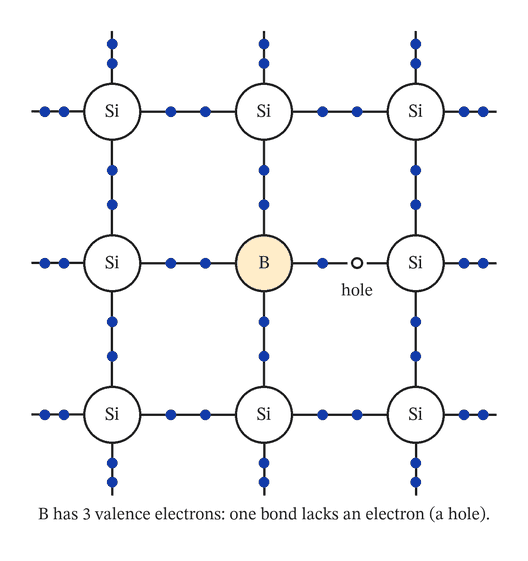
The holes are the majority carriers. The acceptor level lies just above the valence band. The two band diagrams are:
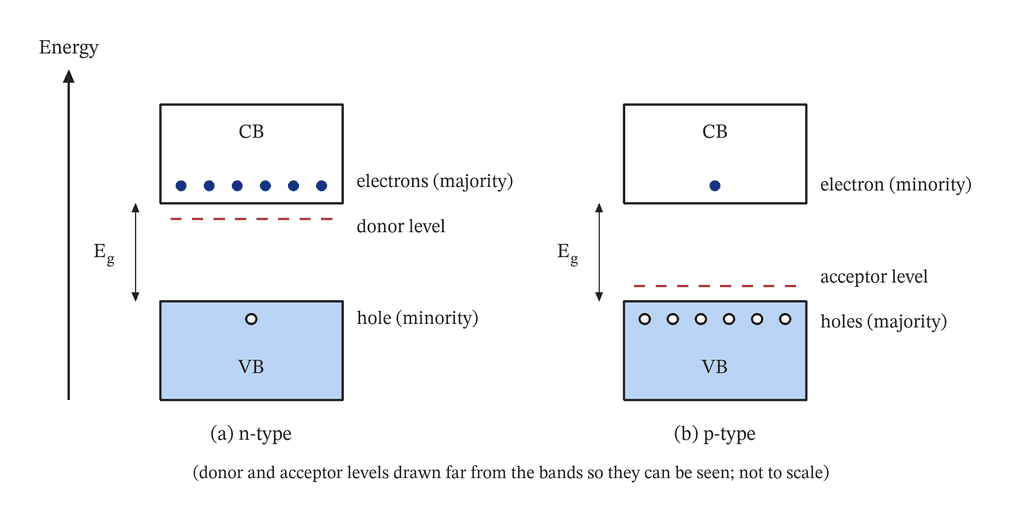
Therefore, (a) an intrinsic semiconductor is pure with equal electrons and holes, while an extrinsic one is doped and has more of one kind; (b) donors are pentavalent impurities that give free electrons and acceptors are trivalent impurities that create holes; (c) n-type material is made by doping Si or Ge with a pentavalent impurity and p-type material by doping with a trivalent impurity.