
Question 605 marksMedium
Using band theory, explain the difference between conductors, insulators and semiconductors with appropriate diagrams.
Confirming your payment
Sign up now and get 250 free tokens.
Semiconductor Electronics · Question 60 of 66
Using band theory, explain the difference between conductors, insulators and semiconductors with appropriate diagrams.
Solution:
Concept: In a solid the energies of the valence electrons form the valence band (VB); above it is the conduction band (CB), whose electrons are free to carry current. How these two bands are placed decides whether the solid is a conductor, an insulator or a semiconductor.
Step 1 — Draw the three band diagrams. The figure shows the three cases:
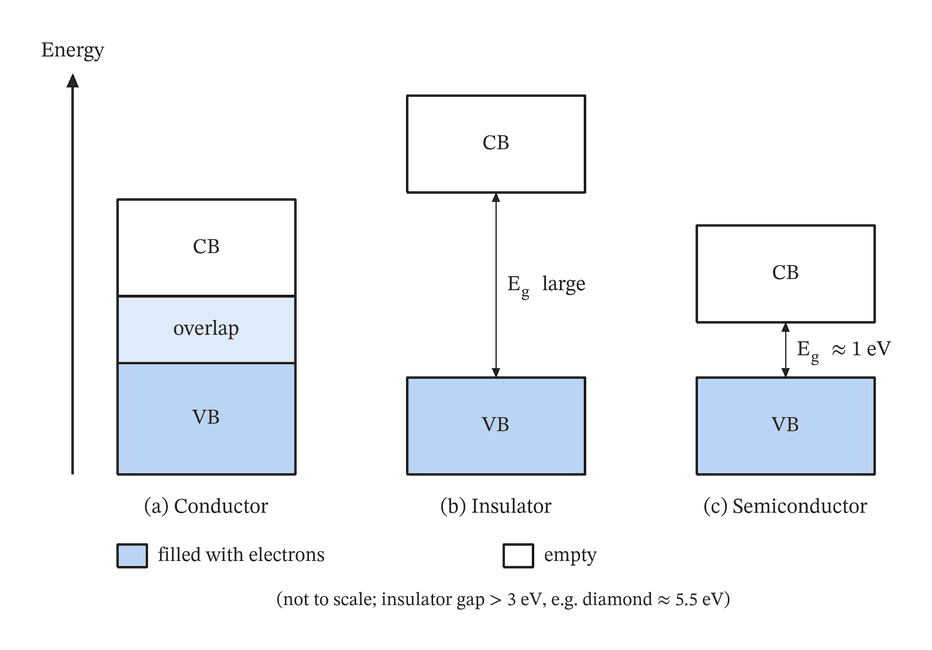
Step 2 — Explain conductors. In a conductor (copper, silver, aluminium) either the VB and the CB overlap or the highest occupied band is only partly filled, so there is no forbidden gap. Electrons need no extra energy to move into empty states, so a large number of free electrons are always available. A small potential difference produces a large current.
Step 3 — Explain insulators. In an insulator (glass, diamond, dry wood) the VB is completely filled and the CB is empty, separated by a large forbidden gap of more than about 3 eV (about 5.5 eV for diamond). The valence electrons are rigidly held in bonds, and at ordinary temperatures practically none of them gains enough energy to cross the gap, so practically no current flows.
Step 4 — Explain semiconductors. In a pure semiconductor (silicon, germanium) the forbidden gap is small: about 1.1 eV for Si and about 0.7 eV for Ge at room temperature. At 0 K the VB is full and the CB empty, so a semiconductor is then an insulator. As the temperature rises, some electrons gain enough thermal energy to jump into the CB, each leaving a hole in the VB, so both carry current. The conductivity therefore lies between that of a conductor and an insulator and rises with temperature.
Step 5 — Summarise the difference. The difference lies in the forbidden gap: zero (bands overlap, or the highest band is partly filled) for conductors, large (more than about 3 eV) for insulators, and small (about 1 eV) for semiconductors.
Therefore, conductors have overlapping bands (or a partly filled highest band), insulators have a wide forbidden gap (more than about 3 eV) that electrons practically cannot cross at ordinary temperatures, and semiconductors have a narrow gap (about 1 eV) that some electrons cross at room temperature.