(a) Explain the difference between reactance and impedance.
Question 1045 marksMedium
(a) Explain the difference between reactance and impedance.
(b) Derive an expression for the impedance of an LR circuit connected to an AC power supply. Obtain an expression for the phase relationship between the current and the voltage.
Solution:
Key idea: Reactance is the opposition of a pure inductor or capacitor, and impedance is the total opposition of a circuit with resistance and reactance. In a series LR circuit the voltages across R and L are at right angles in phase, so they add like perpendicular vectors.
Step 1 — Explain reactance (part a).
Reactance is the opposition offered to AC by a pure inductor, XL=ωL, or by a pure capacitor, XC=1/(ωC). It depends on the frequency, uses up no average power, and makes the current and voltage differ in phase by π/2.
Step 2 — Explain impedance (part a).
Impedance is the total opposition of a circuit containing both resistance and reactance, Z=R2+X2, where X is the net reactance. Power is used up in its resistive part, and the phase difference lies between 0 and π/2. Both reactance and impedance are ratios of voltage to current, measured in ohm.
Step 3 — Write the voltages in the LR circuit (part b).
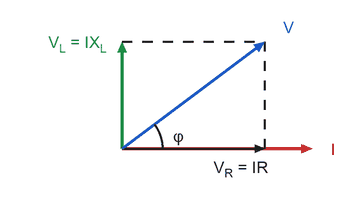
Let the current I=I0sinωt flow through R and L in series. The voltage across the resistor, VR=I0R, is in phase with the current. The voltage across the inductor, VL=I0XL, leads the current by π/2.
Step 4 — Add the two voltages.
The two voltage phasors are at right angles, so the applied voltage is found by Pythagoras' theorem.
V0=VR2+VL2
V0=I0R2+XL2
Step 5 — Find the impedance.
The impedance is the ratio of the peak voltage to the peak current.
Z=I0V0
Z=R2+ω2L2
Step 6 — Find the phase relation.
From the right-angled triangle of voltages, the angle ϕ between the applied voltage and the current satisfies
tanϕ=VRVL
tanϕ=RωL
The voltage leads the current by ϕ, so if I=I0sinωt, then V=V0sin(ωt+ϕ), with ϕ between 0 and π/2.
Therefore, (a) reactance is the frequency-dependent opposition of a pure inductor or capacitor and impedance is the total opposition of resistance and reactance together; (b) for an LR circuit Z=R2+ω2L2, and the voltage leads the current by ϕ=tan−1(ωL/R).