
Question 1035 marksMedium
(a) Explain the terms 'phase lead' and 'phase lag'.
(b) Obtain the phase relationship between current and voltage when AC supply is connected to (i) an inductor and (ii) a capacitor.
Confirming your payment
Sign up now and get 250 free tokens.
Alternating Current · Question 103 of 134
(a) Explain the terms 'phase lead' and 'phase lag'.
(b) Obtain the phase relationship between current and voltage when AC supply is connected to (i) an inductor and (ii) a capacitor.
Solution:
Key idea: For two sinusoidal quantities of the same frequency, the phase difference tells us which one reaches its maximum first. The one that gets there first leads, and the other lags.
Step 1 — Set up two quantities (part a).
Consider two quantities of the same frequency, and , with positive.
Step 2 — Explain phase lead.
The quantity reaches each maximum (and each zero) earlier than , by a time . We say that leads by the phase angle . For example, the current in a pure capacitor leads the voltage by .
Step 3 — Explain phase lag.
The quantity reaches each maximum later than , by the same time . We say that lags by . Lead and lag are two ways of describing the same phase difference.
Step 4 — Write the loop equation for a pure inductor (part b i).
Let be applied across a pure inductance . The inductor has no resistance, so the applied emf is balanced at every instant by the back emf.
Step 5 — Integrate to find the current in the inductor.
We divide by and integrate. The constant of integration is zero, because a purely alternating source drives no steady part of the current.
Here the peak current is . So in a pure inductor the current lags the voltage by (the voltage leads).
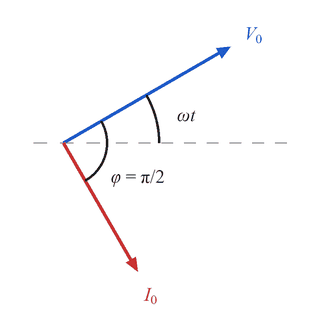
Step 6 — Write the charge on a pure capacitor (part b ii).
Let the same voltage be applied across a pure capacitance . The charge on the capacitor follows the voltage at every instant.
Step 7 — Differentiate to find the current in the capacitor.
The current is the rate of change of the charge.
Here the peak current is , where . So in a pure capacitor the current leads the voltage by .
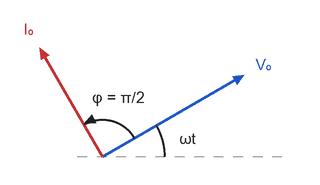
Therefore, a quantity that reaches its maximum earlier leads and one that reaches it later lags; in a pure inductor the current lags the voltage by , and in a pure capacitor the current leads the voltage by .