
Confirming your payment

Skip to content

Sign up now and get .

Opening your dashboard

Class 12 Maths Chapter 7: Continuity and Differentiability of Functions Solutions

32 textbook questions with step-by-step answers, free to read, for ISC 2026-27.

AI Tutor

Get talked through Ch 7, not just shown the answer

Reading a finished solution is not the same as being able to do it. The AI tutor takes one question at a time and works it with you, in your own words, until you can.

  • Ask it out loud, in your own words
  • It gives you the next step, not the answer
  • Stuck on part (ii)? Start there
Ch 7 solutions

32 questions with solutions

3 marks · Mixed difficulty

The first 12 solutions are on this page. This chapter is a long one, so the rest open on their own page to keep this one quick to load.

  1. 1

    Question 1

    Examine the continuity of the function f(x)=2x2−1f(x) = 2x^2 - 1 at x=3x = 3.

    Easy
    3 marks
    Solve with AI
    Written solution

    Solution:

    Key idea: A function ff is continuous at x=ax = a when the left-hand limit (LHL), the right-hand limit (RHL) and the value f(a)f(a) all exist and are equal. We find the one-sided limits by putting x=a−hx = a - h (left) and x=a+hx = a + h (right), where h>0h > 0 and h→0h \to 0.

    Step 1 — Find the value at the point.

    We substitute x=3x = 3 in the rule for ff.

    f(3)=2(3)2−1=18−1=17\begin{aligned} f(3) &= 2(3)^2 - 1 \\ &= 18 - 1 \\ &= 17 \end{aligned}

    Step 2 — Find the left-hand limit.

    We put x=3−hx = 3 - h and expand the square before letting h→0h \to 0.

    LHL=lim⁡h→0[2(3−h)2−1]=lim⁡h→0(17−12h+2h2)=17\begin{aligned} \text{LHL} &= \lim_{h \to 0} \left[2(3 - h)^2 - 1\right] \\ &= \lim_{h \to 0} \left(17 - 12h + 2h^2\right) \\ &= 17 \end{aligned}

    Step 3 — Find the right-hand limit.

    We put x=3+hx = 3 + h and expand in the same way.

    RHL=lim⁡h→0[2(3+h)2−1]=lim⁡h→0(17+12h+2h2)=17\begin{aligned} \text{RHL} &= \lim_{h \to 0} \left[2(3 + h)^2 - 1\right] \\ &= \lim_{h \to 0} \left(17 + 12h + 2h^2\right) \\ &= 17 \end{aligned}

    Step 4 — Compare the three values.

    The left-hand limit, the right-hand limit and f(3)f(3) are all equal to 1717, which is exactly the condition for continuity.

    Therefore, ff is continuous at x=3x = 3.

  2. 2

    Question 2

    Examine the following functions for continuity:

    (a) f(x)=x−5f(x) = x - 5

    (b) f(x)=1x−5, x≠5f(x) = \dfrac{1}{x - 5},\ x \ne 5

    (c) f(x)=x2−25x+5, x≠−5f(x) = \dfrac{x^2 - 25}{x + 5},\ x \ne -5

    (d) f(x)=∣x−5∣f(x) = |x - 5|

    Easy
    3 marks
    Solve with AI
    Written solution

    Solution:

    Key idea: A function is continuous when it is continuous at every point of its domain. At a general point x=cx = c we check that LHL, RHL and f(c)f(c) are equal. Points that are not in the domain are not tested.

    Step 1 — Part (a): test a general point.

    Here f(x)=x−5f(x) = x - 5 is defined for every real xx, so we take any real number cc and find the three values.

    LHL=lim⁡h→0(c−h−5)=c−5\begin{aligned} \text{LHL} &= \lim_{h \to 0} (c - h - 5) \\ &= c - 5 \end{aligned} RHL=lim⁡h→0(c+h−5)=c−5\begin{aligned} \text{RHL} &= \lim_{h \to 0} (c + h - 5) \\ &= c - 5 \end{aligned}

    Also f(c)=c−5f(c) = c - 5. All three are equal, so ff is continuous at every real cc.

    Step 2 — Part (b): test a general point of the domain.

    The rule 1x−5\dfrac{1}{x - 5} is defined for every real xx except 55, so we take any c≠5c \ne 5.

    LHL=lim⁡h→01c−h−5=1c−5\begin{aligned} \text{LHL} &= \lim_{h \to 0} \frac{1}{c - h - 5} \\ &= \frac{1}{c - 5} \end{aligned} RHL=lim⁡h→01c+h−5=1c−5\begin{aligned} \text{RHL} &= \lim_{h \to 0} \frac{1}{c + h - 5} \\ &= \frac{1}{c - 5} \end{aligned}

    Also f(c)=1c−5f(c) = \dfrac{1}{c - 5}. All three are equal, so ff is continuous at every point of its domain. The point x=5x = 5 is not in the domain, so continuity there is not tested.

    Step 3 — Part (c): simplify, then test a general point.

    For x≠−5x \ne -5 we factorise the numerator and cancel the factor x+5x + 5, which is not zero.

    f(x)=(x−5)(x+5)x+5=x−5\begin{aligned} f(x) &= \frac{(x - 5)(x + 5)}{x + 5} \\ &= x - 5 \end{aligned}

    Now we take any c≠−5c \ne -5.

    LHL=lim⁡h→0(c−h−5)=c−5\begin{aligned} \text{LHL} &= \lim_{h \to 0} (c - h - 5) \\ &= c - 5 \end{aligned} RHL=lim⁡h→0(c+h−5)=c−5\begin{aligned} \text{RHL} &= \lim_{h \to 0} (c + h - 5) \\ &= c - 5 \end{aligned}

    Also f(c)=c−5f(c) = c - 5. All three are equal, so ff is continuous at every point of its domain (all real xx except −5-5).

    Step 4 — Part (d): remove the modulus.

    We write ∣x−5∣|x - 5| without the modulus sign on each side of x=5x = 5.

    f(x)={5−x,x<5x−5,x≥5f(x) = \begin{cases} 5 - x, & x < 5 \\ x - 5, & x \ge 5 \end{cases}

    For x<5x < 5 and for x>5x > 5, ff is a linear polynomial, so it is continuous there. The only point left to check is x=5x = 5.

    Step 5 — Part (d): test the point x = 5.

    We find the value and the two one-sided limits at x=5x = 5.

    f(5)=∣5−5∣=0\begin{aligned} f(5) &= |5 - 5| \\ &= 0 \end{aligned} LHL=lim⁡x→5−(5−x)=0\begin{aligned} \text{LHL} &= \lim_{x \to 5^-} (5 - x) \\ &= 0 \end{aligned} RHL=lim⁡x→5+(x−5)=0\begin{aligned} \text{RHL} &= \lim_{x \to 5^+} (x - 5) \\ &= 0 \end{aligned}

    All three are 00, so ff is continuous at x=5x = 5 as well.

    Therefore, all four functions are continuous at every point of their domains: (a) and (d) for all real xx, (b) for all x≠5x \ne 5, (c) for all x≠−5x \ne -5.

  3. 3

    Question 3

    A function ff is defined by

    f(x)={x2−4x+3x2−1,for x≠12,for x=1f(x) = \begin{cases} \dfrac{x^2 - 4x + 3}{x^2 - 1}, & \text{for } x \ne 1 \\ 2, & \text{for } x = 1 \end{cases}

    Test the continuity of the function at x=1x = 1.

    Easy
    3 marks
    Solve with AI
    Written solution

    Solution:

    Key idea: For continuity at x=1x = 1 we need LHL, RHL and f(1)f(1) to be equal. Near x=1x = 1 we may cancel the common factor (x−1)(x - 1), because it is not zero while x≠1x \ne 1.

    Step 1 — Simplify the rule for x not equal to 1.

    We factorise the numerator and the denominator, then cancel (x−1)(x - 1).

    x2−4x+3x2−1=(x−1)(x−3)(x−1)(x+1)=x−3x+1\begin{aligned} \frac{x^2 - 4x + 3}{x^2 - 1} &= \frac{(x - 1)(x - 3)}{(x - 1)(x + 1)} \\ &= \frac{x - 3}{x + 1} \end{aligned}

    Step 2 — Find the left-hand limit.

    We put x=1−hx = 1 - h in the simplified rule.

    LHL=lim⁡h→0(1−h)−3(1−h)+1=lim⁡h→0−2−h2−h=−22=−1\begin{aligned} \text{LHL} &= \lim_{h \to 0} \frac{(1 - h) - 3}{(1 - h) + 1} \\ &= \lim_{h \to 0} \frac{-2 - h}{2 - h} \\ &= \frac{-2}{2} \\ &= -1 \end{aligned}

    Step 3 — Find the right-hand limit.

    We put x=1+hx = 1 + h in the simplified rule.

    RHL=lim⁡h→0(1+h)−3(1+h)+1=lim⁡h→0−2+h2+h=−22=−1\begin{aligned} \text{RHL} &= \lim_{h \to 0} \frac{(1 + h) - 3}{(1 + h) + 1} \\ &= \lim_{h \to 0} \frac{-2 + h}{2 + h} \\ &= \frac{-2}{2} \\ &= -1 \end{aligned}

    Step 4 — Compare with the value at the point.

    The two one-sided limits are both −1-1, but the function is given the value f(1)=2f(1) = 2, which is different.

    −1≠2-1 \ne 2

    Therefore, ff is discontinuous at x=1x = 1.

  4. 4

    Question 4

    Prove that the function f(x)=xnf(x) = x^n is continuous at x=nx = n, where nn is a positive integer.

    Medium
    3 marks
    Solve with AI
    Written solution

    Solution:

    Key idea: The limit of a product is the product of the limits. Since (n−h)n(n - h)^n is (n−h)(n - h) multiplied by itself nn times, its limit is nn multiplied by itself nn times.

    Step 1 — Find the value at the point.

    We substitute x=nx = n in the rule xnx^n.

    f(n)=nnf(n) = n^n

    Step 2 — Find the left-hand limit.

    We put x=n−hx = n - h and use the product rule for limits.

    LHL=lim⁡h→0(n−h)n=[lim⁡h→0(n−h)]n=nn\begin{aligned} \text{LHL} &= \lim_{h \to 0} (n - h)^n \\ &= \left[\lim_{h \to 0} (n - h)\right]^n \\ &= n^n \end{aligned}

    Step 3 — Find the right-hand limit.

    We put x=n+hx = n + h and use the same rule.

    RHL=lim⁡h→0(n+h)n=[lim⁡h→0(n+h)]n=nn\begin{aligned} \text{RHL} &= \lim_{h \to 0} (n + h)^n \\ &= \left[\lim_{h \to 0} (n + h)\right]^n \\ &= n^n \end{aligned}

    Step 4 — Compare the three values.

    The left-hand limit, the right-hand limit and f(n)f(n) are all equal to nnn^n, so the condition for continuity holds.

    Therefore, the function xnx^n is continuous at x=nx = n (proved).

  5. 5

    Question 5

    Show that the function

    f(x)={x2,for 1≤x<23x−4,for 2≤x<4f(x) = \begin{cases} x^2, & \text{for } 1 \le x < 2 \\ 3x - 4, & \text{for } 2 \le x < 4 \end{cases}

    is discontinuous at x=2x = 2 and continuous at x=3x = 3.

    Easy
    3 marks
    Solve with AI
    Written solution

    Solution:

    Key idea: A function ff is continuous at x=ax = a when the left-hand limit (LHL), the right-hand limit (RHL) and the value f(a)f(a) all exist and are equal. We find the one-sided limits by putting x=a−hx = a - h (left) and x=a+hx = a + h (right), where h>0h > 0 and h→0h \to 0.

    Step 1 — Find the value at x = 2.

    At x=2x = 2 the second rule 3x−43x - 4 applies, because 2≤x<42 \le x < 4 includes x=2x = 2.

    f(2)=3(2)−4=2\begin{aligned} f(2) &= 3(2) - 4 \\ &= 2 \end{aligned}

    Step 2 — Find the one-sided limits at x = 2.

    To the left of 22 the rule is x2x^2; to the right it is 3x−43x - 4.

    LHL=lim⁡h→0(2−h)2=4\begin{aligned} \text{LHL} &= \lim_{h \to 0} (2 - h)^2 \\ &= 4 \end{aligned} RHL=lim⁡h→0[3(2+h)−4]=2\begin{aligned} \text{RHL} &= \lim_{h \to 0} \left[3(2 + h) - 4\right] \\ &= 2 \end{aligned}

    Step 3 — Decide at x = 2.

    The left-hand limit 44 is not equal to the right-hand limit 22, so lim⁡x→2f(x)\lim_{x \to 2} f(x) does not exist and ff is discontinuous at x=2x = 2.

    Step 4 — Find the value and the limits at x = 3.

    Near x=3x = 3, on both sides, 2≤x<42 \le x < 4, so the rule is 3x−43x - 4.

    f(3)=3(3)−4=5\begin{aligned} f(3) &= 3(3) - 4 \\ &= 5 \end{aligned} LHL=lim⁡h→0[3(3−h)−4]=lim⁡h→0(5−3h)=5\begin{aligned} \text{LHL} &= \lim_{h \to 0} \left[3(3 - h) - 4\right] \\ &= \lim_{h \to 0} (5 - 3h) \\ &= 5 \end{aligned} RHL=lim⁡h→0[3(3+h)−4]=lim⁡h→0(5+3h)=5\begin{aligned} \text{RHL} &= \lim_{h \to 0} \left[3(3 + h) - 4\right] \\ &= \lim_{h \to 0} (5 + 3h) \\ &= 5 \end{aligned}

    Step 5 — Decide at x = 3.

    All three values are 55, so ff is continuous at x=3x = 3.

    Therefore, ff is discontinuous at x=2x = 2 and continuous at x=3x = 3 (proved).

  6. 6

    Question 6

    (a) Find all points of discontinuity of ff, where ff is defined by f(x)={2x+3,if x≤22x−3,if x>2f(x) = \begin{cases} 2x + 3, & \text{if } x \le 2 \\ 2x - 3, & \text{if } x > 2 \end{cases}

    (b) Discuss the discontinuity of the function f(x)f(x) at x=0x = 0, if f(x)={2x−1,if x<02x+1,if x≥0f(x) = \begin{cases} 2x - 1, & \text{if } x < 0 \\ 2x + 1, & \text{if } x \ge 0 \end{cases}

    (c) Is the function defined by f(x)={x+5,if x≤1x−5,if x>1f(x) = \begin{cases} x + 5, & \text{if } x \le 1 \\ x - 5, & \text{if } x > 1 \end{cases} a continuous function?

    (d) Show that f(x)={5x−4,when 0<x≤14x3−3x,when 1<x<2f(x) = \begin{cases} 5x - 4, & \text{when } 0 < x \le 1 \\ 4x^3 - 3x, & \text{when } 1 < x < 2 \end{cases} is continuous at x=1x = 1.

    Medium
    3 marks
    Solve with AI
    Written solution

    Solution:

    Key idea: Each piece is a polynomial, so ff is continuous inside each piece. Only the joining point needs a check: LHL, RHL and the value there must all be equal.

    Step 1 — Part (a): test the joining point x = 2.

    For x<2x < 2 and for x>2x > 2, ff is a polynomial, so it is continuous there. At x=2x = 2 the first rule applies.

    f(2)=2(2)+3=7\begin{aligned} f(2) &= 2(2) + 3 \\ &= 7 \end{aligned} LHL=lim⁡x→2−(2x+3)=7\begin{aligned} \text{LHL} &= \lim_{x \to 2^-} (2x + 3) \\ &= 7 \end{aligned} RHL=lim⁡x→2+(2x−3)=1\begin{aligned} \text{RHL} &= \lim_{x \to 2^+} (2x - 3) \\ &= 1 \end{aligned}

    Since 7≠17 \ne 1, the limit does not exist, so ff is discontinuous at x=2x = 2 only.

    Step 2 — Part (b): test the point x = 0.

    At x=0x = 0 the second rule 2x+12x + 1 applies.

    f(0)=2(0)+1=1\begin{aligned} f(0) &= 2(0) + 1 \\ &= 1 \end{aligned} LHL=lim⁡x→0−(2x−1)=−1\begin{aligned} \text{LHL} &= \lim_{x \to 0^-} (2x - 1) \\ &= -1 \end{aligned} RHL=lim⁡x→0+(2x+1)=1\begin{aligned} \text{RHL} &= \lim_{x \to 0^+} (2x + 1) \\ &= 1 \end{aligned}

    Since −1≠1-1 \ne 1, ff is discontinuous at x=0x = 0. The graph jumps by 22 there. Elsewhere ff is a polynomial, so it is continuous.

    Step 3 — Part (c): test the joining point x = 1.

    For x<1x < 1 and x>1x > 1, ff is a polynomial. At x=1x = 1 the first rule applies.

    f(1)=1+5=6\begin{aligned} f(1) &= 1 + 5 \\ &= 6 \end{aligned} LHL=lim⁡x→1−(x+5)=6\begin{aligned} \text{LHL} &= \lim_{x \to 1^-} (x + 5) \\ &= 6 \end{aligned} RHL=lim⁡x→1+(x−5)=−4\begin{aligned} \text{RHL} &= \lim_{x \to 1^+} (x - 5) \\ &= -4 \end{aligned}

    Since 6≠−46 \ne -4, ff is discontinuous at x=1x = 1, so it is not a continuous function.

    Step 4 — Part (d): test the joining point x = 1.

    At x=1x = 1 the first rule 5x−45x - 4 applies.

    f(1)=5(1)−4=1\begin{aligned} f(1) &= 5(1) - 4 \\ &= 1 \end{aligned} LHL=lim⁡x→1−(5x−4)=1\begin{aligned} \text{LHL} &= \lim_{x \to 1^-} (5x - 4) \\ &= 1 \end{aligned} RHL=lim⁡x→1+(4x3−3x)=4−3=1\begin{aligned} \text{RHL} &= \lim_{x \to 1^+} (4x^3 - 3x) \\ &= 4 - 3 \\ &= 1 \end{aligned}

    All three values are 11, so ff is continuous at x=1x = 1.

    Therefore, (a) ff is discontinuous only at x=2x = 2; (b) ff is discontinuous at x=0x = 0 and continuous elsewhere; (c) no, ff is not continuous (it breaks at x=1x = 1); (d) ff is continuous at x=1x = 1 (proved).

  7. 7

    Question 7

    Examine the continuity for the following functions:

    (a) f(x)={x+1,if x≥1x2+1,if x<1f(x) = \begin{cases} x + 1, & \text{if } x \ge 1 \\ x^2 + 1, & \text{if } x < 1 \end{cases}

    (b) f(x)={x10−1,if x≤1x2,if x>1f(x) = \begin{cases} x^{10} - 1, & \text{if } x \le 1 \\ x^2, & \text{if } x > 1 \end{cases}

    Easy
    3 marks
    Solve with AI
    Written solution

    Solution:

    Key idea: Both pieces are polynomials, so ff is continuous at every x≠1x \ne 1. Only the joining point x=1x = 1 needs LHL, RHL and f(1)f(1).

    Step 1 — Part (a): test x = 1.

    At x=1x = 1 the rule x+1x + 1 applies, because it holds for x≥1x \ge 1.

    f(1)=1+1=2\begin{aligned} f(1) &= 1 + 1 \\ &= 2 \end{aligned} LHL=lim⁡x→1−(x2+1)=2\begin{aligned} \text{LHL} &= \lim_{x \to 1^-} (x^2 + 1) \\ &= 2 \end{aligned} RHL=lim⁡x→1+(x+1)=2\begin{aligned} \text{RHL} &= \lim_{x \to 1^+} (x + 1) \\ &= 2 \end{aligned}

    All three are 22, so ff is continuous at x=1x = 1, and hence at every point.

    Step 2 — Part (b): test x = 1.

    At x=1x = 1 the rule x10−1x^{10} - 1 applies, because it holds for x≤1x \le 1.

    f(1)=110−1=0\begin{aligned} f(1) &= 1^{10} - 1 \\ &= 0 \end{aligned} LHL=lim⁡x→1−(x10−1)=0\begin{aligned} \text{LHL} &= \lim_{x \to 1^-} (x^{10} - 1) \\ &= 0 \end{aligned} RHL=lim⁡x→1+x2=1\begin{aligned} \text{RHL} &= \lim_{x \to 1^+} x^2 \\ &= 1 \end{aligned}

    Since 0≠10 \ne 1, ff is discontinuous at x=1x = 1; it is continuous at every other point.

    Therefore, (a) ff is continuous at all points; (b) ff is discontinuous at x=1x = 1 and continuous everywhere else.

  8. 8

    Question 8

    Discuss the continuity of the function f(x)f(x) at x=1/2x = 1/2, when f(x)f(x) is defined as follows:

    f(x)={12+x,0≤x<1/21,x=1/232+x,1/2<x≤1f(x) = \begin{cases} \dfrac{1}{2} + x, & 0 \le x < 1/2 \\ 1, & x = 1/2 \\ \dfrac{3}{2} + x, & 1/2 < x \le 1 \end{cases}

    Easy
    3 marks
    Solve with AI
    Written solution

    Solution:

    Key idea: A function ff is continuous at x=ax = a when the left-hand limit (LHL), the right-hand limit (RHL) and the value f(a)f(a) all exist and are equal. We find the one-sided limits by putting x=a−hx = a - h (left) and x=a+hx = a + h (right), where h>0h > 0 and h→0h \to 0.

    Step 1 — Write the value at the point.

    The rule gives the value directly at x=12x = \dfrac{1}{2}.

    f(12)=1f\left(\frac{1}{2}\right) = 1

    Step 2 — Find the left-hand limit.

    To the left of 12\dfrac{1}{2} the rule is 12+x\dfrac{1}{2} + x.

    LHL=lim⁡x→12−(12+x)=12+12=1\begin{aligned} \text{LHL} &= \lim_{x \to \frac{1}{2}^-} \left(\frac{1}{2} + x\right) \\ &= \frac{1}{2} + \frac{1}{2} \\ &= 1 \end{aligned}

    Step 3 — Find the right-hand limit.

    To the right of 12\dfrac{1}{2} the rule is 32+x\dfrac{3}{2} + x.

    RHL=lim⁡x→12+(32+x)=32+12=2\begin{aligned} \text{RHL} &= \lim_{x \to \frac{1}{2}^+} \left(\frac{3}{2} + x\right) \\ &= \frac{3}{2} + \frac{1}{2} \\ &= 2 \end{aligned}

    Step 4 — Compare the limits.

    The left-hand limit 11 is not equal to the right-hand limit 22, so lim⁡x→1/2f(x)\lim_{x \to 1/2} f(x) does not exist, even though LHL happens to equal f(12)f\left(\frac{1}{2}\right).

    Therefore, ff is discontinuous at x=12x = \dfrac{1}{2}.

  9. 9

    Question 9

    Examine the continuity of the function

    f(x)={−2,if x≤−12x,if −1<x≤12,if x>1f(x) = \begin{cases} -2, & \text{if } x \le -1 \\ 2x, & \text{if } -1 < x \le 1 \\ 2, & \text{if } x > 1 \end{cases}

    Easy
    3 marks
    Solve with AI
    Written solution

    Solution:

    Key idea: Inside each piece ff is a constant or a linear polynomial, so it is continuous there. Only the joining points x=−1x = -1 and x=1x = 1 need LHL, RHL and the value.

    Step 1 — Test the point x = -1.

    At x=−1x = -1 the first rule applies, so f(−1)=−2f(-1) = -2. We find the two one-sided limits.

    LHL=lim⁡x→−1−(−2)=−2\begin{aligned} \text{LHL} &= \lim_{x \to -1^-} (-2) \\ &= -2 \end{aligned} RHL=lim⁡x→−1+2x=2(−1)=−2\begin{aligned} \text{RHL} &= \lim_{x \to -1^+} 2x \\ &= 2(-1) \\ &= -2 \end{aligned}

    All three are −2-2, so ff is continuous at x=−1x = -1.

    Step 2 — Test the point x = 1.

    At x=1x = 1 the middle rule applies.

    f(1)=2(1)=2\begin{aligned} f(1) &= 2(1) \\ &= 2 \end{aligned} LHL=lim⁡x→1−2x=2\begin{aligned} \text{LHL} &= \lim_{x \to 1^-} 2x \\ &= 2 \end{aligned} RHL=lim⁡x→1+2=2\begin{aligned} \text{RHL} &= \lim_{x \to 1^+} 2 \\ &= 2 \end{aligned}

    All three are 22, so ff is continuous at x=1x = 1.

    Step 3 — Put the results together.

    The function is continuous inside every piece and at both joining points, so it is continuous at every real xx.

    Therefore, ff is continuous for all values of xx.

  10. 10

    Question 10

    A function f(x)f(x) is defined as follows:

    f(x)=xcos⁡1x, when x≠0,f(0)=0f(x) = x\cos\frac{1}{x}, \text{ when } x \ne 0, \quad f(0) = 0

    Examine the continuity at x=0x = 0.

    Medium
    3 marks
    Solve with AI
    Written solution

    Solution:

    Key idea: The factor cos⁡1h\cos\dfrac{1}{h} has no limit as h→0h \to 0, but it always lies between −1-1 and 11. Multiplied by a factor that tends to 00, the product is squeezed to 00.

    Step 1 — Find the left-hand limit.

    We put x=−hx = -h. Since cosine is an even function, cos⁡(−1h)=cos⁡1h\cos\left(-\dfrac{1}{h}\right) = \cos\dfrac{1}{h}.

    LHL=lim⁡h→0(−h)cos⁡(−1h)=lim⁡h→0(−hcos⁡1h)\begin{aligned} \text{LHL} &= \lim_{h \to 0} (-h)\cos\left(-\frac{1}{h}\right) \\ &= \lim_{h \to 0} \left(-h\cos\frac{1}{h}\right) \end{aligned}

    Because ∣cos⁡1h∣≤1\left|\cos\dfrac{1}{h}\right| \le 1, we have ∣−hcos⁡1h∣≤h\left|-h\cos\dfrac{1}{h}\right| \le h, and h→0h \to 0. So the left-hand limit is 00.

    Step 2 — Find the right-hand limit.

    We put x=hx = h and use the same bound.

    RHL=lim⁡h→0hcos⁡1h\text{RHL} = \lim_{h \to 0} h\cos\frac{1}{h}

    Since ∣hcos⁡1h∣≤h\left|h\cos\dfrac{1}{h}\right| \le h and h→0h \to 0, the right-hand limit is also 00.

    Step 3 — Compare with the value at the point.

    The left-hand limit, the right-hand limit and f(0)f(0) are all 00, so the condition for continuity holds.

    Therefore, ff is continuous at x=0x = 0.

  11. 11

    Question 11

    The function f(x)f(x) is defined as follows:

    f(x)={(x−a)cos⁡1x−a,when x≠a0,when x=af(x) = \begin{cases} (x - a)\cos\dfrac{1}{x - a}, & \text{when } x \ne a \\ 0, & \text{when } x = a \end{cases}

    Examine the continuity, when x=ax = a.

    Medium
    3 marks
    Solve with AI
    Written solution

    Solution:

    Key idea: The factor cos⁡1x−a\cos\dfrac{1}{x - a} has no limit as x→ax \to a, but it always lies between −1-1 and 11, while (x−a)→0(x - a) \to 0. So the product is squeezed to 00.

    Step 1 — Find the left-hand limit.

    We put x=a−hx = a - h, so x−a=−hx - a = -h. Cosine is even, so cos⁡(−1h)=cos⁡1h\cos\left(-\dfrac{1}{h}\right) = \cos\dfrac{1}{h}.

    LHL=lim⁡h→0(−h)cos⁡(−1h)=lim⁡h→0(−hcos⁡1h)\begin{aligned} \text{LHL} &= \lim_{h \to 0} (-h)\cos\left(-\frac{1}{h}\right) \\ &= \lim_{h \to 0} \left(-h\cos\frac{1}{h}\right) \end{aligned}

    Because ∣−hcos⁡1h∣≤h\left|-h\cos\dfrac{1}{h}\right| \le h and h→0h \to 0, the left-hand limit is 00.

    Step 2 — Find the right-hand limit.

    We put x=a+hx = a + h, so x−a=hx - a = h.

    RHL=lim⁡h→0hcos⁡1h\text{RHL} = \lim_{h \to 0} h\cos\frac{1}{h}

    Because ∣hcos⁡1h∣≤h\left|h\cos\dfrac{1}{h}\right| \le h and h→0h \to 0, the right-hand limit is also 00.

    Step 3 — Compare with the value at the point.

    The left-hand limit, the right-hand limit and f(a)f(a) are all 00, so the condition for continuity holds.

    Therefore, ff is continuous at x=ax = a.

  12. 12

    Question 12

    Examine the continuity of the following functions.

    (a) f(x)={∣x∣x,if x≠00,if x=0f(x) = \begin{cases} \dfrac{|x|}{x}, & \text{if } x \ne 0 \\ 0, & \text{if } x = 0 \end{cases}

    (b) f(x)={x∣x∣,if x<0−1,if x≥0f(x) = \begin{cases} \dfrac{x}{|x|}, & \text{if } x < 0 \\ -1, & \text{if } x \ge 0 \end{cases}

    Easy
    3 marks
    Solve with AI
    Written solution

    Solution:

    Key idea: The modulus is ∣x∣=−x|x| = -x for x<0x < 0 and ∣x∣=x|x| = x for x>0x > 0. Removing the modulus shows each function is a constant on each side of 00, so only x=0x = 0 needs testing.

    Step 1 — Part (a): simplify on each side of 0.

    We replace ∣x∣|x| by −x-x on the left of 00 and by xx on the right.

    For x<0x < 0:

    f(x)=−xx=−1\begin{aligned} f(x) &= \frac{-x}{x} \\ &= -1 \end{aligned}

    For x>0x > 0:

    f(x)=xx=1\begin{aligned} f(x) &= \frac{x}{x} \\ &= 1 \end{aligned}

    These are constants, so ff is continuous at every x≠0x \ne 0, and the given value at 00 is f(0)=0f(0) = 0.

    Step 2 — Part (a): find the one-sided limits at 0.

    We put x=−hx = -h for the left and x=hx = h for the right.

    LHL=lim⁡h→0∣−h∣−h=lim⁡h→0h−h=−1\begin{aligned} \text{LHL} &= \lim_{h \to 0} \frac{|-h|}{-h} \\ &= \lim_{h \to 0} \frac{h}{-h} \\ &= -1 \end{aligned} RHL=lim⁡h→0∣h∣h=1\begin{aligned} \text{RHL} &= \lim_{h \to 0} \frac{|h|}{h} \\ &= 1 \end{aligned}

    Since −1≠1-1 \ne 1, the limit does not exist, so ff is discontinuous at x=0x = 0.

    Step 3 — Part (b): simplify on each side of 0.

    We replace ∣x∣|x| by −x-x for x<0x < 0; for x≥0x \ge 0 the rule already gives −1-1.

    For x<0x < 0:

    f(x)=x−x=−1\begin{aligned} f(x) &= \frac{x}{-x} \\ &= -1 \end{aligned}

    So ff is the constant −1-1 on each side of 00, it is continuous at every x≠0x \ne 0, and f(0)=−1f(0) = -1.

    Step 4 — Part (b): find the one-sided limits at 0.

    We again put x=−hx = -h for the left and x=hx = h for the right.

    LHL=lim⁡h→0−h∣−h∣=lim⁡h→0−hh=−1\begin{aligned} \text{LHL} &= \lim_{h \to 0} \frac{-h}{|-h|} \\ &= \lim_{h \to 0} \frac{-h}{h} \\ &= -1 \end{aligned} RHL=lim⁡h→0(−1)=−1\begin{aligned} \text{RHL} &= \lim_{h \to 0} (-1) \\ &= -1 \end{aligned}

    All three values are −1-1, so ff is continuous at x=0x = 0 as well. In fact, ff is the constant −1-1 everywhere.

    Therefore, (a) ff is discontinuous at x=0x = 0 (continuous elsewhere); (b) ff is continuous at all points.

  13. 13

    Question 13

    Examine for continuity at x=0x = 0.

    (a) f(x)={tan⁡2x3x,when x≠023,when x=0f(x) = \begin{cases} \dfrac{\tan 2x}{3x}, & \text{when } x \ne 0 \\ \dfrac{2}{3}, & \text{when } x = 0 \end{cases}

    (b) f(x)=1+∣x∣xf(x) = 1 + \dfrac{|x|}{x} for x≠0x \ne 0 and f(0)=1f(0) = 1.

    Medium
    3 marks
  14. 14

    Question 14

    Find the value of aa, if the function f(x)f(x) defined by

    f(x)={2x−1,x<2a,x=2x+1,x>2f(x) = \begin{cases} 2x - 1, & x < 2 \\ a, & x = 2 \\ x + 1, & x > 2 \end{cases}

    is continuous at x=2x = 2.

    Easy
    3 marks
  15. 15

    Question 15

    For what value of λ\lambda is the function f(x)={λ(x2−2x),if x≤04x+1,if x>0f(x) = \begin{cases} \lambda(x^2 - 2x), & \text{if } x \le 0 \\ 4x + 1, & \text{if } x > 0 \end{cases} continuous at x=0x = 0? What about continuity at x=1x = 1?

    Easy
    3 marks
  16. 16

    Question 16

    Find the value of kk, so that the function ff defined by f(x)={kx+1,if x≤πcos⁡x,if x>πf(x) = \begin{cases} kx + 1, & \text{if } x \le \pi \\ \cos x, & \text{if } x > \pi \end{cases} is continuous at x=πx = \pi.

    Easy
    3 marks
  17. 17

    Question 17

    Find the value of kk, for which

    f(x)={1+kx−1−kxx,if −1≤x<02x+1x−1,if 0≤x<1f(x) = \begin{cases} \dfrac{\sqrt{1 + kx} - \sqrt{1 - kx}}{x}, & \text{if } -1 \le x < 0 \\ \dfrac{2x + 1}{x - 1}, & \text{if } 0 \le x < 1 \end{cases}

    is continuous at x=0x = 0.

    Medium
    3 marks
  18. 18

    Question 18

    Prove that the function f(x)={x∣x∣+2x2,x≠0k,x=0f(x) = \begin{cases} \dfrac{x}{|x| + 2x^2}, & x \ne 0 \\ k, & x = 0 \end{cases} remains discontinuous at x=0x = 0, regardless of the choice of kk.

    Medium
    3 marks
  19. 19

    Question 19

    Find the value of constant kk so that the function ff defined as

    f(x)={x2−2x−3x+1,if x≠−1k,if x=−1f(x) = \begin{cases} \dfrac{x^2 - 2x - 3}{x + 1}, & \text{if } x \ne -1 \\ k, & \text{if } x = -1 \end{cases}

    is continuous at x=−1x = -1.

    Easy
    3 marks
  20. 20

    Question 20

    Find the values of pp and qq, for which

    f(x)={1−sin⁡3x3cos⁡2x,if x<π2p,if x=π2q(1−sin⁡x)(π−2x)2,if x>π2f(x) = \begin{cases} \dfrac{1 - \sin^3 x}{3\cos^2 x}, & \text{if } x < \dfrac{\pi}{2} \\ p, & \text{if } x = \dfrac{\pi}{2} \\ \dfrac{q(1 - \sin x)}{(\pi - 2x)^2}, & \text{if } x > \dfrac{\pi}{2} \end{cases}

    is continuous at x=π2x = \dfrac{\pi}{2}.

    Medium
    3 marks
  21. 21

    Question 21

    The function f(x)=2x2−8x−2f(x) = \dfrac{2x^2 - 8}{x - 2} is undefined at x=2x = 2. What value should be assigned to f(2)f(2) so that f(x)f(x) is continuous at x=2x = 2?

    Easy
    3 marks
  22. 22

    Question 22

    The function f(x)=x2−1x3−1f(x) = \dfrac{x^2 - 1}{x^3 - 1} is undefined at the point x=1x = 1. What should be the value of f(1)f(1) such that f(x)f(x) may be continuous at x=1x = 1?

    Easy
    3 marks
  23. 23

    Question 23

    Is the function f(x)=3x+2sin⁡xxf(x) = \dfrac{3x + 2\sin x}{x} continuous at x=0x = 0? If not, how may the function be defined at x=0x = 0 to make it continuous at that point?

    Easy
    3 marks
  24. 24

    Question 24

    Show that the function f(x)=∣x−4∣f(x) = |x - 4|, x∈Rx \in R, is continuous but not differentiable at x=4x = 4.

    Medium
    3 marks
  25. 25

    Question 25

    Show that f(x)=∣x−5∣f(x) = |x - 5| is continuous at x=5x = 5 but f′(x)f'(x) does not exist at x=5x = 5.

    Medium
    3 marks
  26. 26

    Question 26

    Show that the function f(x)=∣x−1∣+∣x+1∣f(x) = |x - 1| + |x + 1| for all x∈Rx \in R, is not differentiable at the points x=−1x = -1 and x=1x = 1.

    Medium
    3 marks
  27. 27

    Question 27

    Show that the function

    f(x)={x2,x≤11x,x>1f(x) = \begin{cases} x^2, & x \le 1 \\ \dfrac{1}{x}, & x > 1 \end{cases}

    is continuous at x=1x = 1 but not differentiable.

    Medium
    3 marks
  28. 28

    Question 28

    Show that the function

    f(x)={x−1,if x<22x−3,if x≥2f(x) = \begin{cases} x - 1, & \text{if } x < 2 \\ 2x - 3, & \text{if } x \ge 2 \end{cases}

    is not differentiable at x=2x = 2.

    Medium
    3 marks
  29. 29

    Question 29

    A function f:R→Rf : R \to R satisfies the equation f(x+y)=f(x)⋅f(y)f(x + y) = f(x) \cdot f(y) for all x,y∈Rx, y \in R, f(x)≠0f(x) \ne 0. Suppose that the function is differentiable at x=0x = 0 and f′(0)=2f'(0) = 2, then prove that f′(x)=2f(x)f'(x) = 2f(x).

    Medium
    3 marks
  30. 30

    Question 30

    Examine the differentiability at x=2x = 2, when ff is defined by

    f(x)={1+x,if x≤25−x,if x>2f(x) = \begin{cases} 1 + x, & \text{if } x \le 2 \\ 5 - x, & \text{if } x > 2 \end{cases}

    Easy
    3 marks
  31. 31

    Question 31

    Find aa and bb if the function given by

    f(x)={ax2+b,if x<12x+1,if x≥1f(x) = \begin{cases} ax^2 + b, & \text{if } x < 1 \\ 2x + 1, & \text{if } x \ge 1 \end{cases}

    is differentiable at x=1x = 1.

    Medium
    3 marks
  32. 32

    Question 32

    If ff is differentiable at x=ax = a, then find the value of lim⁡x→a[xf(a)−af(x)x−a]\lim\limits_{x \to a} \left[\dfrac{xf(a) - af(x)}{x - a}\right].

    Medium
    3 marks
Inside Ch 7

What Class 12 Maths Ch 7 covers

The sections of the chapter, in the order the book takes them. Every question above comes from one of these.

  1. 01Continuity at a Point
  2. 02Continuity on an Interval and Algebra of Continuous Functions
  3. 03Differentiability
  4. 04Relation between Continuity and Differentiability
From the board papers

Ch 7 in past ISC papers

The same chapter as the board has actually asked it. These are worded differently from the textbook exercise, which is the point of reading them.

  1. 1

    Board paper question 1

    Find the value of constant 'kk' so that the function f(x)f(x) defined as:

    f(x)={x2−2x−3x+1,x≠−1k,x=−1f(x) = \begin{cases} \dfrac{x^2 - 2x - 3}{x + 1}, & x \neq -1 \\ k, & x = -1 \end{cases}

    is continuous at x=−1x = -1.

    EasyAsked 2018
    2 marks
    Solve with AI
    Written solution

    Solution:

    Concept: A function ff is continuous at x=ax = a when lim⁡x→af(x)\lim_{x \to a} f(x) exists and equals f(a)f(a).

    Step 1 — Write the condition for continuity.

    Here f(−1)=kf(-1) = k, so the function is continuous at x=−1x = -1 exactly when the limit equals kk:

    lim⁡x→−1f(x)=k\lim_{x \to -1} f(x) = k

    Step 2 — Factorise the numerator.

    We look for two numbers whose product is −3-3 and whose sum is −2-2; they are −3-3 and 11, so

    x2−2x−3=(x−3)(x+1)x^2 - 2x - 3 = (x - 3)(x + 1)

    Step 3 — Simplify the fraction for x≠−1x \neq -1.

    While xx approaches −1-1 it is never equal to −1-1, so the common factor (x+1)(x + 1) is not zero and can be cancelled:

    f(x)=(x−3)(x+1)x+1f(x) = \dfrac{(x - 3)(x + 1)}{x + 1} f(x)=x−3(x≠−1)f(x) = x - 3 \quad (x \neq -1)

    Step 4 — Find the limit.

    Now we let x→−1x \to -1 in the simplified form:

    lim⁡x→−1f(x)=lim⁡x→−1(x−3)\lim_{x \to -1} f(x) = \lim_{x \to -1} (x - 3) lim⁡x→−1f(x)=−4\lim_{x \to -1} f(x) = -4

    Step 5 — Equate the limit with f(−1)f(-1).

    Continuity needs the value kk to match this limit:

    k=−4k = -4

    Watch out: Putting x=−1x = -1 straight into the fraction gives 00\dfrac{0}{0}, which tells us nothing; always simplify first.

    Therefore, k=−4k = -4.

  2. 2

    Board paper question 2

    Show that the function

    f(x)={x2,x≤112,x>1f(x) = \begin{cases} x^2, & x \leq 1 \\ \dfrac{1}{2}, & x > 1 \end{cases}

    is continuous at x=1x = 1 but not differentiable.

    MediumAsked 2018
    4 marks
    Solve with AI
    Written solution

    Solution:

    Concept: A function ff is continuous at x=ax = a when the left-hand limit, the right-hand limit and f(a)f(a) are all equal. ff is differentiable at x=ax = a when the left-hand derivative Lf′(a)Lf'(a) and the right-hand derivative Rf′(a)Rf'(a) exist and are equal.

    Step 1 — Settle how to read the second piece.

    The paper prints the second piece as 12\dfrac{1}{2}. With that value, the right-hand limit at x=1x = 1 would be 12\dfrac{1}{2}, while f(1)=1f(1) = 1, so ff would not even be continuous there and the statement could not be shown. We therefore read the second piece as 1x\dfrac{1}{x}; this piece takes the value 11 at x=1x = 1, so it is the reading for which the statement holds:

    f(x)={x2,x≤11x,x>1f(x) = \begin{cases} x^2, & x \leq 1 \\ \dfrac{1}{x}, & x > 1 \end{cases}

    Step 2 — Find f(1)f(1).

    The point x=1x = 1 belongs to the first piece because x≤1x \leq 1 there:

    f(1)=12f(1) = 1^2 f(1)=1f(1) = 1

    Step 3 — Find the left-hand limit.

    To the left of 11 the function is x2x^2, so

    lim⁡x→1−f(x)=lim⁡x→1−x2\lim_{x \to 1^-} f(x) = \lim_{x \to 1^-} x^2 lim⁡x→1−f(x)=1\lim_{x \to 1^-} f(x) = 1

    Step 4 — Find the right-hand limit.

    To the right of 11 the function is 1x\dfrac{1}{x}, so

    lim⁡x→1+f(x)=lim⁡x→1+1x\lim_{x \to 1^+} f(x) = \lim_{x \to 1^+} \dfrac{1}{x} lim⁡x→1+f(x)=1\lim_{x \to 1^+} f(x) = 1

    Step 5 — Conclude continuity.

    Both one-sided limits equal 11, and f(1)=1f(1) = 1 as well, so ff is continuous at x=1x = 1.

    Step 6 — Find the left-hand derivative.

    We take a small h>0h > 0 and move to the left point 1−h1 - h, which uses the piece x2x^2:

    Lf′(1)=lim⁡h→0+f(1−h)−f(1)−h=lim⁡h→0+(1−h)2−1−h=lim⁡h→0+−2h+h2−h=lim⁡h→0+(2−h)=2\begin{aligned} Lf'(1) &= \lim_{h \to 0^+} \dfrac{f(1 - h) - f(1)}{-h} \\ &= \lim_{h \to 0^+} \dfrac{(1 - h)^2 - 1}{-h} \\ &= \lim_{h \to 0^+} \dfrac{-2h + h^2}{-h} \\ &= \lim_{h \to 0^+} (2 - h) \\ &= 2 \end{aligned}

    Step 7 — Find the right-hand derivative.

    The right point 1+h1 + h uses the piece 1x\dfrac{1}{x}:

    Rf′(1)=lim⁡h→0+f(1+h)−f(1)h=lim⁡h→0+11+h−1h=lim⁡h→0+−hh(1+h)=lim⁡h→0+−11+h=−1\begin{aligned} Rf'(1) &= \lim_{h \to 0^+} \dfrac{f(1 + h) - f(1)}{h} \\ &= \lim_{h \to 0^+} \dfrac{\frac{1}{1 + h} - 1}{h} \\ &= \lim_{h \to 0^+} \dfrac{-h}{h(1 + h)} \\ &= \lim_{h \to 0^+} \dfrac{-1}{1 + h} \\ &= -1 \end{aligned}

    Step 8 — Conclude about differentiability.

    The two one-sided derivatives are 22 and −1-1. They are not equal, so ff has a sharp corner at x=1x = 1 and is not differentiable there.

    Therefore, ff is continuous at x=1x = 1, but it is not differentiable there (left derivative 22, right derivative −1-1).

  3. 3

    Board paper question 3

    f(x)=x2−9x−3f(x) = \dfrac{x^2 - 9}{x - 3} is not defined at x=3. What value should be assigned to f(3) for continuity of f(x) at x= 3?

    EasyAsked 2019
    2 marks
    Solve with AI
    Written solution

    Solution:

    Concept: To make ff continuous at x=3x = 3, we must assign f(3)=lim⁡x→3f(x)f(3) = \lim_{x \to 3} f(x).

    Step 1 — Factorise the numerator.

    The numerator is a difference of two squares, a2−b2=(a−b)(a+b)a^2 - b^2 = (a - b)(a + b):

    x2−9=(x−3)(x+3)x^2 - 9 = (x - 3)(x + 3)

    Step 2 — Simplify for x≠3x \neq 3.

    Near x=3x = 3 (but not at it) the factor x−3x - 3 is not zero, so it cancels:

    f(x)=(x−3)(x+3)x−3f(x) = \dfrac{(x - 3)(x + 3)}{x - 3} f(x)=x+3(x≠3)f(x) = x + 3 \quad (x \neq 3)

    Step 3 — Find the limit at x=3x = 3.

    We now let x→3x \to 3 in the simplified form:

    lim⁡x→3f(x)=3+3\lim_{x \to 3} f(x) = 3 + 3 lim⁡x→3f(x)=6\lim_{x \to 3} f(x) = 6

    Step 4 — Assign the value.

    For continuity, f(3)f(3) must equal this limit, so we set f(3)=6f(3) = 6.

    Therefore, f(3)f(3) should be assigned the value 66.

  4. 4

    Board paper question 4

    Show that the function f(x)=∣x−4∣f(x) = |x - 4|, x∈Rx \in R is continuous, but not differentiable at x=4x = 4.

    MediumAsked 2019
    4 marks
    Solve with AI
    Written solution

    Solution:

    Concept: For any number tt, ∣t∣=t|t| = t when t≥0t \geq 0 and ∣t∣=−t|t| = -t when t<0t < 0. A function is continuous at aa when both one-sided limits equal f(a)f(a), and differentiable at aa when both one-sided derivatives are equal.

    Step 1 — Write ff without the modulus sign.

    The expression x−4x - 4 changes sign at x=4x = 4, so

    f(x)={−(x−4),x<4x−4,x≥4f(x) = \begin{cases} -(x - 4), & x < 4 \\ x - 4, & x \geq 4 \end{cases}

    Step 2 — Show continuity at every x≠4x \neq 4.

    On each side of 44, ff is a polynomial (4−x4 - x or x−4x - 4), and polynomials are continuous, so ff is continuous at every point other than 44.

    Step 3 — Show continuity at x=4x = 4.

    We compare the value with both one-sided limits:

    f(4)=∣4−4∣f(4) = |4 - 4| f(4)=0f(4) = 0 lim⁡x→4−f(x)=lim⁡x→4−(4−x)\lim_{x \to 4^-} f(x) = \lim_{x \to 4^-} (4 - x) lim⁡x→4−f(x)=0\lim_{x \to 4^-} f(x) = 0 lim⁡x→4+f(x)=lim⁡x→4+(x−4)\lim_{x \to 4^+} f(x) = \lim_{x \to 4^+} (x - 4) lim⁡x→4+f(x)=0\lim_{x \to 4^+} f(x) = 0

    All three are 00, so ff is continuous at x=4x = 4. Together with Step 2, ff is continuous on the whole of RR.

    Step 4 — Find the left-hand derivative at x=4x = 4.

    We take h>0h > 0, so the point 4−h4 - h lies to the left of 44, where f(4−h)=hf(4 - h) = h:

    Lf′(4)=lim⁡h→0+f(4−h)−f(4)−h=lim⁡h→0+h−0−h=−1\begin{aligned} Lf'(4) &= \lim_{h \to 0^+} \dfrac{f(4 - h) - f(4)}{-h} \\ &= \lim_{h \to 0^+} \dfrac{h - 0}{-h} \\ &= -1 \end{aligned}

    Step 5 — Find the right-hand derivative at x=4x = 4.

    Now 4+h>44 + h > 4, so f(4+h)=hf(4 + h) = h:

    Rf′(4)=lim⁡h→0+f(4+h)−f(4)h=lim⁡h→0+h−0h=1\begin{aligned} Rf'(4) &= \lim_{h \to 0^+} \dfrac{f(4 + h) - f(4)}{h} \\ &= \lim_{h \to 0^+} \dfrac{h - 0}{h} \\ &= 1 \end{aligned}

    Step 6 — Conclude.

    The left-hand derivative is −1-1 and the right-hand derivative is 11. They differ, so the graph has a sharp corner (a V shape) at x=4x = 4 and ff is not differentiable there.

    Therefore, the function ∣x−4∣|x - 4| is continuous on RR, but it is not differentiable at x=4x = 4.

  5. 5

    Board paper question 5

    If the following function is continuous at x=2x = 2 then the value of k will be:

    f(x)={2x+1,if x<2k,if x=23x−1,if x>2f(x) = \begin{cases} 2x + 1, & \text{if } x < 2 \\ k, & \text{if } x = 2 \\ 3x - 1, & \text{if } x > 2 \end{cases}

    MCQEasyAsked 2023
    1 mark
    Solve with AI
    Answer
    • (A) 22

    • (B) 33

    • (C) 55

      Correct
    • (D) −1-1

    Answer: (C) 55

    Concept: A function ff is continuous at x=2x = 2 when the left-hand limit, the right-hand limit and f(2)f(2) are all equal.

    Step 1 — Find the left-hand limit.

    For x<2x < 2 the function is 2x+12x + 1, so we put x=2x = 2 in it:

    lim⁡x→2−f(x)=2(2)+1\lim_{x \to 2^-} f(x) = 2(2) + 1 lim⁡x→2−f(x)=5\lim_{x \to 2^-} f(x) = 5

    Step 2 — Find the right-hand limit.

    For x>2x > 2 the function is 3x−13x - 1:

    lim⁡x→2+f(x)=3(2)−1\lim_{x \to 2^+} f(x) = 3(2) - 1 lim⁡x→2+f(x)=5\lim_{x \to 2^+} f(x) = 5

    Step 3 — Match f(2)f(2) with the limits.

    Both one-sided limits are 55, and f(2)=kf(2) = k, so continuity needs k=5k = 5.

    Why the others are wrong:

    • (A) This is the point x=2x = 2 itself, not the value of ff there; the limits are 55, not 22.
    • (B) This comes from using x+1x + 1 in place of 2x+12x + 1 at x=2x = 2; the correct left-hand limit is 55.
    • (D) This is the value of 3x−13x - 1 at x=0x = 0, not at x=2x = 2.

    Therefore, k=5k = 5, option (C).

  6. 6

    Board paper question 6

    The graph of the function f is shown below.
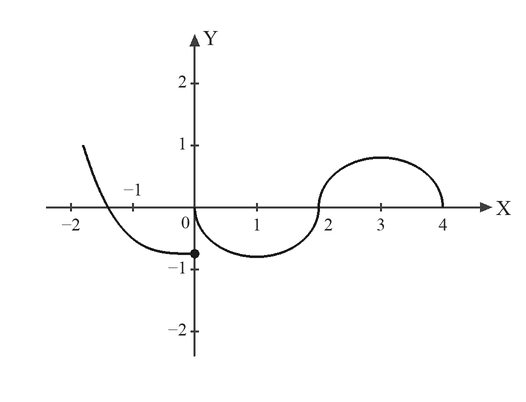
    Class 12 Maths Continuity and Differentiability of Functions

    Of the following options, at what values of x is the function f NOT differentiable?

    MCQMediumAsked 2024
    1 mark
    Solve with AI
    Answer
    • (A) At x=0x = 0 and x=2x = 2

      Correct
    • (B) At x=1x = 1 and x=3x = 3

    • (C) At x=−1x = -1 and x=1x = 1

    • (D) At x=−1.5x = -1.5 and x=1.5x = 1.5

    Answer: (A) At x=0x = 0 and x=2x = 2

    Concept: A function is not differentiable at a point where its graph has a break, a sharp corner (cusp), or a vertical tangent. Where the graph is a smooth unbroken curve with a non-vertical tangent, it is differentiable.

    Step 1 — Look at x=0x = 0.

    The left piece of the graph ends at the dot below the origin, while the right piece starts at the origin and leaves it heading straight down. The graph is broken there and the right piece starts with a vertical tangent, so ff is not differentiable at x=0x = 0.

    Step 2 — Look at x=2x = 2.

    The lower arc rises to meet the axis at x=2x = 2 and the upper arc starts there, and both are vertical at that point. A vertical tangent means the slope is not a finite number, so ff is not differentiable at x=2x = 2.

    Step 3 — Check the other points named in the options.

    At x=1x = 1 the lower arc has its lowest point, and at x=3x = 3 the upper arc has its highest point; there the tangent is horizontal (slope 00), so ff is differentiable. The left piece is also a smooth curve at x=−1x = -1 and at x=−1.5x = -1.5, and the lower arc is smooth at x=1.5x = 1.5.

    Why the others are wrong:

    • (B) At x=1x = 1 and x=3x = 3 the graph turns smoothly with a horizontal tangent, so ff is differentiable there.
    • (C) At x=−1x = -1 the left piece is smooth, and at x=1x = 1 the tangent is horizontal; ff is differentiable at both.
    • (D) Both points lie on smooth parts of the curve with finite slopes, so ff is differentiable there.

    Therefore, ff is not differentiable at x=0x = 0 and x=2x = 2, option (A).

All 10 board paper questions for this chapter, solved the same way.

Common questions

Class 12 Maths Ch 7 questions students ask

How many questions are there in Class 12 Maths Ch 7?

32 questions. Every one is solved step by step on this page.

Are these Class 12 Maths solutions free?

Yes. Every question and its full working is free to read, with no account needed.

Can I download the Class 12 Maths Ch 7 solutions as a PDF?

There is no PDF to download. Every solution is on this page instead, which means it is searchable, always the current syllabus, and readable on a phone. Use your browser's print option if you want it on paper.