
Opening your dashboard
Class 12 Maths Chapter 7 Continuity and Differentiability of Functions: Previous Year Questions
10 questions on Chapter 7, each solved step by step. Class 12 Maths, ICSE 2026-27.
10 questions with solutions
1–4 marks · Mixed difficulty
- 12 marks
Question 1
Find the value of constant '' so that the function defined as:
is continuous at .
Solve with AIWritten solution
Solution:
Concept: A function is continuous at when exists and equals .
Step 1 — Write the condition for continuity.
Here , so the function is continuous at exactly when the limit equals :
Step 2 — Factorise the numerator.
We look for two numbers whose product is and whose sum is ; they are and , so
Step 3 — Simplify the fraction for .
While approaches it is never equal to , so the common factor is not zero and can be cancelled:
Step 4 — Find the limit.
Now we let in the simplified form:
Step 5 — Equate the limit with .
Continuity needs the value to match this limit:
Watch out: Putting straight into the fraction gives , which tells us nothing; always simplify first.
Therefore, .
- 24 marks
Question 2
Show that the function
is continuous at but not differentiable.
Solve with AIWritten solution
Solution:
Concept: A function is continuous at when the left-hand limit, the right-hand limit and are all equal. is differentiable at when the left-hand derivative and the right-hand derivative exist and are equal.
Step 1 — Settle how to read the second piece.
The paper prints the second piece as . With that value, the right-hand limit at would be , while , so would not even be continuous there and the statement could not be shown. We therefore read the second piece as ; this piece takes the value at , so it is the reading for which the statement holds:
Step 2 — Find .
The point belongs to the first piece because there:
Step 3 — Find the left-hand limit.
To the left of the function is , so
Step 4 — Find the right-hand limit.
To the right of the function is , so
Step 5 — Conclude continuity.
Both one-sided limits equal , and as well, so is continuous at .
Step 6 — Find the left-hand derivative.
We take a small and move to the left point , which uses the piece :
Step 7 — Find the right-hand derivative.
The right point uses the piece :
Step 8 — Conclude about differentiability.
The two one-sided derivatives are and . They are not equal, so has a sharp corner at and is not differentiable there.
Therefore, is continuous at , but it is not differentiable there (left derivative , right derivative ).
- 32 marks
Question 3
is not defined at x=3. What value should be assigned to f(3) for continuity of f(x) at x= 3?
Solve with AIWritten solution
Solution:
Concept: To make continuous at , we must assign .
Step 1 — Factorise the numerator.
The numerator is a difference of two squares, :
Step 2 — Simplify for .
Near (but not at it) the factor is not zero, so it cancels:
Step 3 — Find the limit at .
We now let in the simplified form:
Step 4 — Assign the value.
For continuity, must equal this limit, so we set .
Therefore, should be assigned the value .
- 44 marks
Question 4
Show that the function , is continuous, but not differentiable at .
Solve with AIWritten solution
Solution:
Concept: For any number , when and when . A function is continuous at when both one-sided limits equal , and differentiable at when both one-sided derivatives are equal.
Step 1 — Write without the modulus sign.
The expression changes sign at , so
Step 2 — Show continuity at every .
On each side of , is a polynomial ( or ), and polynomials are continuous, so is continuous at every point other than .
Step 3 — Show continuity at .
We compare the value with both one-sided limits:
All three are , so is continuous at . Together with Step 2, is continuous on the whole of .
Step 4 — Find the left-hand derivative at .
We take , so the point lies to the left of , where :
Step 5 — Find the right-hand derivative at .
Now , so :
Step 6 — Conclude.
The left-hand derivative is and the right-hand derivative is . They differ, so the graph has a sharp corner (a V shape) at and is not differentiable there.
Therefore, the function is continuous on , but it is not differentiable at .
- 51 mark
Question 5
If the following function is continuous at then the value of k will be:
Solve with AIAnswer
(A)
(B)
- Correct
(C)
(D)
Answer: (C)
Concept: A function is continuous at when the left-hand limit, the right-hand limit and are all equal.
Step 1 — Find the left-hand limit.
For the function is , so we put in it:
Step 2 — Find the right-hand limit.
For the function is :
Step 3 — Match with the limits.
Both one-sided limits are , and , so continuity needs .
Why the others are wrong:
- (A) This is the point itself, not the value of there; the limits are , not .
- (B) This comes from using in place of at ; the correct left-hand limit is .
- (D) This is the value of at , not at .
Therefore, , option (C).
- 61 mark
Question 6
The graph of the function f is shown below.
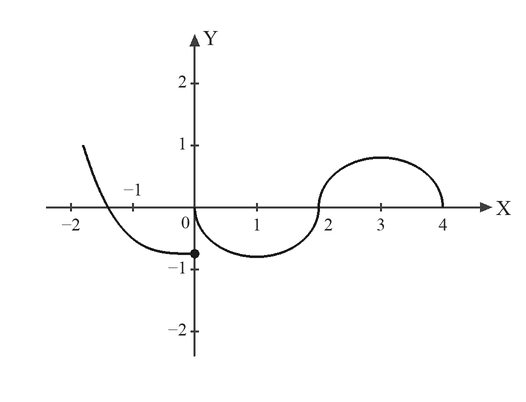
Of the following options, at what values of x is the function f NOT differentiable?
Solve with AIAnswer
- Correct
(A) At and
(B) At and
(C) At and
(D) At and
Answer: (A) At and
Concept: A function is not differentiable at a point where its graph has a break, a sharp corner (cusp), or a vertical tangent. Where the graph is a smooth unbroken curve with a non-vertical tangent, it is differentiable.
Step 1 — Look at .
The left piece of the graph ends at the dot below the origin, while the right piece starts at the origin and leaves it heading straight down. The graph is broken there and the right piece starts with a vertical tangent, so is not differentiable at .
Step 2 — Look at .
The lower arc rises to meet the axis at and the upper arc starts there, and both are vertical at that point. A vertical tangent means the slope is not a finite number, so is not differentiable at .
Step 3 — Check the other points named in the options.
At the lower arc has its lowest point, and at the upper arc has its highest point; there the tangent is horizontal (slope ), so is differentiable. The left piece is also a smooth curve at and at , and the lower arc is smooth at .
Why the others are wrong:
- (B) At and the graph turns smoothly with a horizontal tangent, so is differentiable there.
- (C) At the left piece is smooth, and at the tangent is horizontal; is differentiable at both.
- (D) Both points lie on smooth parts of the curve with finite slopes, so is differentiable there.
Therefore, is not differentiable at and , option (A).
- 72 marks
Question 7
Determine the value of 'k' for which the following function is continuous at
Solve with AIWritten solution
Solution:
Concept: For continuity at , we need ; here .
Step 1 — Factorise the numerator.
The numerator is a difference of two squares, , with and :
Step 2 — Simplify for .
Near (but not at it) the factor is not zero, so it cancels:
Step 3 — Find the limit.
We let in the simplified form:
Step 4 — Equate with .
Continuity needs to equal the limit, so .
Therefore, .
- 81 mark
Question 8
If
then the number of point(s) of discontinuity of , is / are:
Solve with AIAnswer
(A)
(B)
- Correct
(C)
(D)
Answer: (C)
Concept: Each piece here is a polynomial, and polynomials are continuous, so a break can happen only where the pieces join. At a joining point , is continuous only if the left-hand limit, the right-hand limit and are equal.
Step 1 — Check the joining point .
From the left, , and comes from the middle piece :
The left-hand limit is not equal to , so is discontinuous at .
Step 2 — Check the joining point .
From the left, , and comes from the last piece :
The left-hand limit is not equal to , so is discontinuous at .
Step 3 — Count the points.
There are no other joining points, so has exactly two points of discontinuity, and .
Why the others are wrong:
- (A) This counts only one of the two breaks; jumps at both and .
- (B) There are only two joining points, so there cannot be three breaks.
- (D) The pieces are continuous on their own, but the jumps at the joins make discontinuous at two points.
Therefore, has points of discontinuity, option (C).
- 91 mark
Question 9
Consider the function '' given by , then the function '' is:
Solve with AIAnswer
- Correct
(A) differentiable and continuous at .
(B) differentiable but not continuous at .
(C) continuous but not differentiable at .
(D) neither differentiable nor continuous at .
Answer: (A) differentiable and continuous at .
Concept: The derivative of is for . Every function that is differentiable at a point is also continuous at that point.
Step 1 — Check differentiability at .
The derivative of is , which is a finite number at :
So is differentiable at .
Step 2 — Deduce continuity.
Differentiability at a point always gives continuity there, so is also continuous at . We can also see this directly from the limit:
This limit is the value itself, so the graph has no break at .
Why the others are wrong:
- (B) This can never happen: a function differentiable at a point must be continuous there.
- (C) This fails because has the finite derivative at , so it is differentiable there.
- (D) This fails because is both continuous and differentiable at .
Therefore, is differentiable and continuous at , option (A).
- 101 mark
Question 10
Assertion: at is not differentiable.
Reason: A function is said to be differentiable at if Left hand derivative is equal to Right hand derivative i.e., .
Solve with AIAnswer
- Correct
(A) Both Assertion and Reason are true and Reason is the correct explanation for Assertion.
(B) Both Assertion and Reason are true but Reason is not the correct explanation for Assertion.
(C) Assertion is true and Reason is false.
(D) Assertion is false and Reason is true.
Answer: (A) Both Assertion and Reason are true and Reason is the correct explanation for Assertion.
Concept: A function is differentiable at when the left-hand derivative and the right-hand derivative exist and are equal.
Step 1 — Check that is continuous at .
We first make sure the graph is unbroken at :
The left piece also gives at , so is continuous at .
Step 2 — Find the two one-sided derivatives.
Each piece is a straight line, so its derivative is its slope. To the left the slope of is ; to the right the slope of is :
Step 3 — Judge the Assertion.
The one-sided derivatives and are unequal, so is not differentiable at . The Assertion is true.
Step 4 — Judge the Reason and whether it explains the Assertion.
The Reason states the test for differentiability: the left-hand and right-hand derivatives must be equal. This is true, and it is exactly the test that fails in Step 3, so the Reason correctly explains the Assertion.
Why the others are wrong:
- (B) The Reason is the very test used to show the Assertion, so it does explain it.
- (C) The Reason is the standard definition of differentiability, so it is true.
- (D) The Assertion is true, since the one-sided derivatives at are and .
Therefore, both statements are true and the Reason explains the Assertion, option (A).