
Question 1855 marksMedium
(a) What do you understand by the term adsorption? What are the factors which affect adsorption?
(b) Discuss the effect of temperature and pressure on the adsorption of a gas on a solid surface.
Confirming your payment
Sign up now and get 250 free tokens.
Surface Chemistry · Question 185 of 225
(a) What do you understand by the term adsorption? What are the factors which affect adsorption?
(b) Discuss the effect of temperature and pressure on the adsorption of a gas on a solid surface.
Solution:
Key idea: Adsorption is a surface effect, so it depends on the surface offered by the adsorbent, on how strongly the gas is attracted, and on the temperature and pressure that shift the adsorption equilibrium.
Step 1 — Define adsorption (part a).
Adsorption is the holding of molecules of a substance on the surface of a solid or liquid, so that their concentration at the surface is higher than in the bulk; for example, gases are adsorbed on charcoal.
Step 2 — State the factors that affect adsorption of gases on solids (part a).
The main factors are listed below.
Step 3 — Explain the effect of temperature (part b).
Adsorption is exothermic, so by Le Chatelier's principle physical adsorption decreases as the temperature rises. Chemisorption first increases, because it needs activation energy, and then decreases.
Step 4 — Explain the effect of pressure (part b).
At constant temperature, physical adsorption increases with pressure: steeply at low pressure, where is proportional to , then more slowly. At high pressure it reaches a limiting value when the surface is saturated. Over the middle range of pressure the change follows Freundlich's relation.
Step 5 — Show both effects on the isotherms.
The graph shows against at three temperatures, with . At every pressure the lowest temperature, , gives the most adsorption.
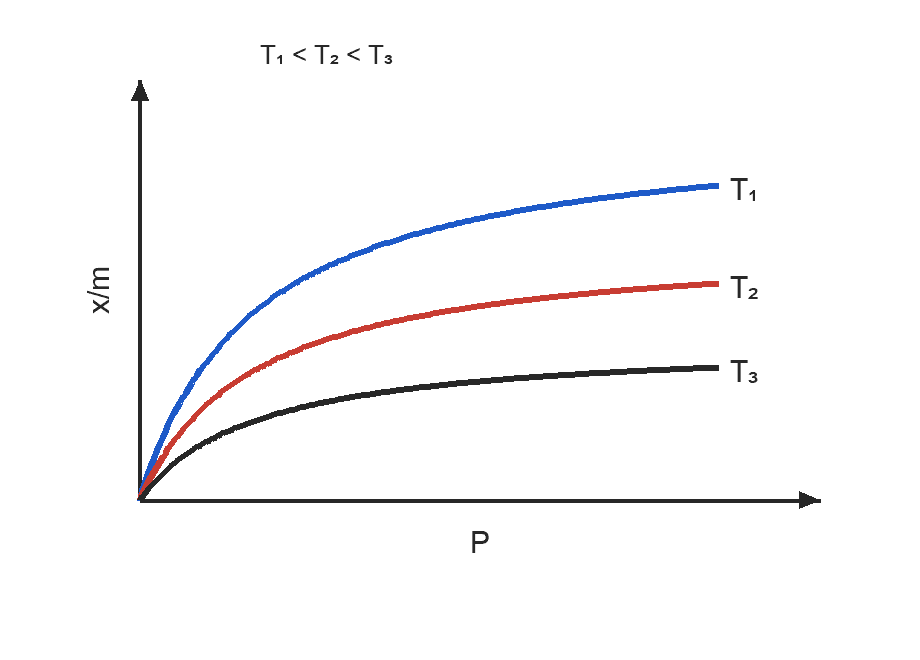
Therefore, adsorption is the holding of molecules on a surface and depends on the adsorbent's surface area and activation, the nature of the gas, temperature and pressure; it decreases with rise in temperature (physisorption) and increases with pressure until the surface is saturated.