
Question 1865 marksMedium
(a) Distinguish between physiosorption and chemisorption.
(b) How is Langmuir adsorption isotherm related to Freundlich's isotherm? How are shapes of adsorption isotherms modified when multilayer adsorption takes place.
Confirming your payment
Sign up now and get 250 free tokens.
Surface Chemistry · Question 186 of 225
(a) Distinguish between physiosorption and chemisorption.
(b) How is Langmuir adsorption isotherm related to Freundlich's isotherm? How are shapes of adsorption isotherms modified when multilayer adsorption takes place.
Solution:
Key idea: Physisorption and chemisorption differ in the forces that hold the adsorbed molecules. Langmuir's isotherm, , describes a single layer; when more layers form, the isotherm changes shape.
Step 1 — Distinguish physisorption from chemisorption (part a).
The table below compares the two kinds of adsorption.
| Physical adsorption | Chemical adsorption |
|---|---|
| Held by weak van der Waals forces | Held by chemical bonds (a surface compound forms) |
| Low enthalpy of adsorption, about 20–40 kJ mol⁻¹ | High enthalpy of adsorption, about 80–240 kJ mol⁻¹ |
| Reversible | Usually irreversible |
| Not specific: every gas is adsorbed to some extent on every solid | Highly specific: only when gas and surface can bond |
| Forms multimolecular layers | Forms a unimolecular (single) layer |
| Decreases as temperature rises | First increases, then decreases as temperature rises |
| Needs no activation energy | Needs activation energy |
| Greater for easily liquefied gases (high critical temperature) | Depends on the chemical affinity of gas and surface |
Step 2 — Find the low-pressure form of Langmuir's isotherm (part b).
At low pressure is much smaller than 1, so the denominator is close to 1 and the amount adsorbed is proportional to the pressure.
This is Freundlich's form with .
Step 3 — Find the high-pressure form.
At high pressure is much larger than 1, so the 1 in the denominator can be neglected and the amount adsorbed becomes constant.
This is Freundlich's form with .
Step 4 — Relate the two isotherms.
At intermediate pressures, varies roughly as with , which is Freundlich's isotherm. So Freundlich's equation is a special case of Langmuir's, valid over a limited middle range of pressure.
Step 5 — Describe the effect of multilayer adsorption.
Langmuir's isotherm levels off once the single layer is complete (Type I). When multilayers form, the curve does not level off: after the first layer is complete it rises again, and it climbs steeply near the saturation vapour pressure , where the gas condenses on the surface (Types II and III). When capillary condensation fills the pores, the curve levels off again near (Types IV and V).
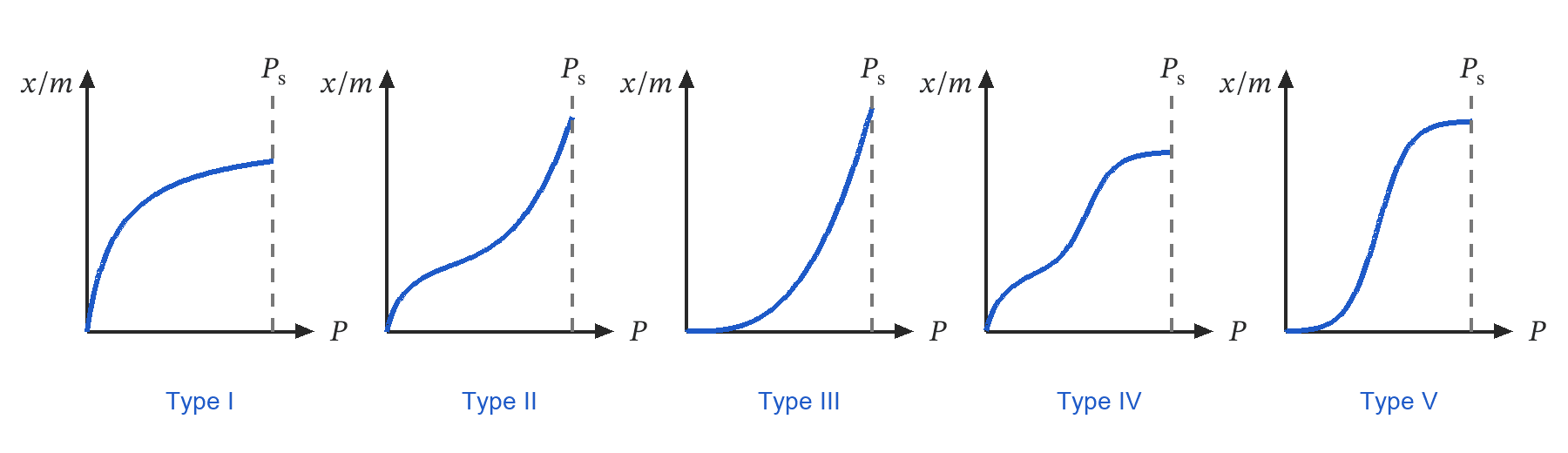
Therefore, physisorption is weak, reversible multilayer adsorption by van der Waals forces and chemisorption is strong, specific unimolecular adsorption by chemical bonds; Freundlich's isotherm is the middle-pressure special case of Langmuir's, and with multilayer adsorption the isotherm no longer levels off but rises steeply near the saturation vapour pressure.