Solution:
Key idea: How much gas a solid adsorbs depends on the adsorbent, the gas, the temperature and the pressure. An adsorption isotherm (x/m against P at a fixed temperature) shows the effect of pressure, and a set of isotherms at several temperatures shows the effect of temperature.
Step 1 — Explain the effect of the adsorbent and its surface area.
Good adsorbents such as charcoal and silica gel adsorb strongly. A finely divided, porous adsorbent has a large surface area per gram, so it adsorbs more.
Step 2 — Explain the effect of the nature of the gas.
Gases that are easily liquefied (high critical temperature) have stronger van der Waals forces and are adsorbed more. On charcoal the order is H2 < N2 < CO < CH4 < CO2 < HCl < NH3 < SO2, the same order as their critical temperatures (about 33 K for hydrogen up to about 431 K for sulphur dioxide).
Step 3 — Explain the effect of temperature.
Adsorption is exothermic, so by Le Chatelier's principle physical adsorption decreases as the temperature rises. Chemisorption needs some activation energy, so it may first increase with temperature and then decrease.
Step 4 — Explain the effect of pressure.
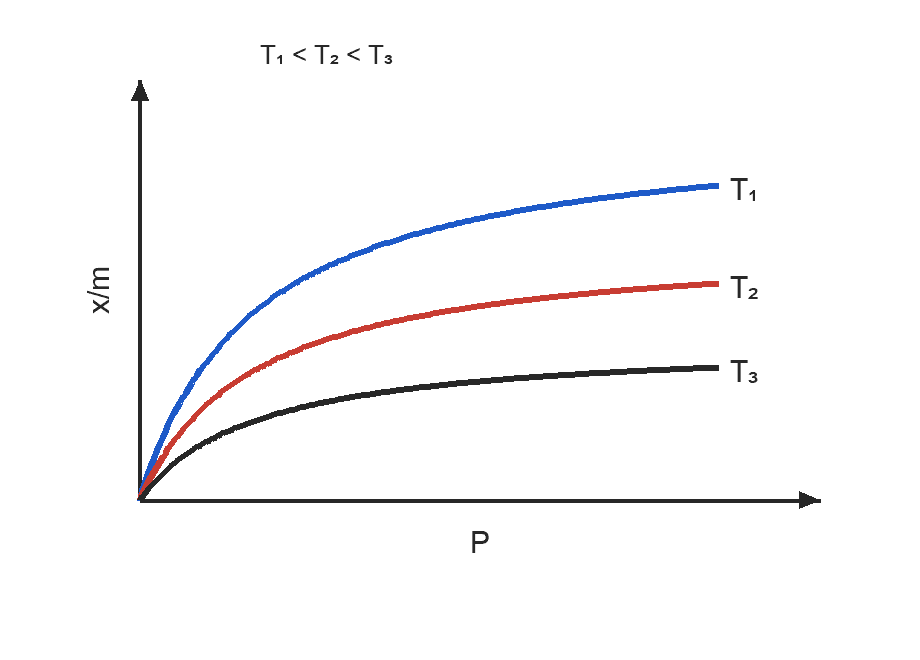
At constant temperature, adsorption of a gas increases with its pressure, steeply at first and then more slowly. The increase is larger at low temperature.
Step 5 — Explain the effect of activating the adsorbent.
Activation increases the free surface. Charcoal, for example, is activated by heating it in steam or in a vacuum at about 623–1273 K, which drives out gases already held in its pores and opens up more surface.
Step 6 — Describe the isotherms at different temperatures.
For a given gas and adsorbent, x/m rises with pressure, steeply at first and then more slowly towards a limit. At a higher temperature the whole curve lies lower (less gas is adsorbed at the same pressure), as the sketch shows for T1<T2<T3.
Step 7 — Link the curves to the isotherm equations.
At moderate pressures such curves follow Freundlich's equation x/m=kP1/n (with n>1); at high pressures they level off as Langmuir's monolayer picture predicts (Type I). Near the condensation temperature of the gas, many gases give the multilayer isotherms of Types II to V.
Therefore, adsorption of a gas increases with the surface area and activation of the adsorbent, with the ease of liquefaction of the gas and with pressure, and decreases with rise of temperature; the isotherms rise and then level off, and lie lower at higher temperatures.
